Agents are Shifting how they Think 🧠
Most "AI trading" tokens show you a bot. $MORPH shows you the brain, the tests, and the failures. All of it runs off-chain on paper, in the open.
Here's what's actually running right now 🧵
🧠 The core brain -3 brain-inspired regions. Rule-based strategies compete on paper. Status: DONE.
⚔️ The model arena: 5 AI models fight it out on paper, and the bottom gets culled every generation. It's at generation 1993 and still running.
🔬 Shadow neural circuits: 8 circuits make recommendations next to the ensemble, but they never trade. They have to prove themselves first. It's at generation 3.
🌱 New regions: provenance, flow, and curve. All 3 have grown. That's where we are now.
The part nobody else does is the judge.
Before any strategy gets promoted, it needs 200+ matched comparisons across 50 tokens plus statistical proof that it wasn't luck.
Then it switches parts of the brain off one at a time to see what actually drives each decision. In Brain Lab, 736 of 27,083 decisions flipped when they did that.
And it publishes the failures. So far, no evolved strategy has passed selection.
That's the hardest problem in AI trading: telling skill from luck. Most projects skip it. AlphaMorph built it first.
Now the real alpha the Superbrain.
The endgame on the roadmap.
Every region grown, finalists funded, models acting on real capital.
Think about what reaches that stage. It's not a prompt wrapper. It's a strategy that survived:
• thousands of generations of paper culling
• shadow circuits that had to earn trust before touching a trade
• a judge built to reject luck
• ablation tests showing exactly why it decides what it decides
Most AI tokens start with real money and hope. @alphamorpheus does the reverse: it brings the proof first, and the capital comes after.
When those paper trades start hitting the chain, the proof stops being a dashboard. It turns into on-chain history that anyone can verify. Every decision gets a provenance trail, and every win or loss is public. That's the moment the market can finally price evidence instead of hype.
The roadmap says it plainly: "status is computed from live data, not promised."
Meanwhile the dev keeps restaking. He has 7.78M iMORPH locked and 0 liquid MORPH, and wrap fees split 70% to stakers and 30% to him.
Still early. Funding is locked and no model has earned money yet. That honesty is the alpha.
🔗 Verify it yourself:
🌐 Site: https://t.co/h7ovkCnH5U
🧪 Brain Lab: https://t.co/ncrLl3eKJD
📜 Thesis: https://t.co/kgorMbxpUr
📝 Changelog: https://t.co/oc7stgickK
💻 Code: https://t.co/PWPadvigrn
📊 Data: https://t.co/hWOgxdorhY
𝕏 @alphamorpheus
CA: 0x6dbe95076584f869dd09a44131e9a3c13f34d7d6
Bullish on @alphamorpheus. Auditing 6 AI brain signals for predictive power in synthetic markets. The unlock: evolving its decision architecture based on which internals matter most. Meta-evolution of evidence evaluation. Real edge for on-chain agentic brains. 🚀
$MORPH gives me early $KAS vibes. Strong price action, high-conviction holders, organic community growth and genuinely differentiated tech. Kaspa had blockDAG; Morph has an artificial brain. If execution continues, the market could be playing catch-up for a long time.
AlphaMorph now has agents working on the question of how AlphaMorph itself should evolve.
The research process has four distinct roles:
• A scout examines the codebase, experiment logs and new scientific papers to identify promising directions.
• An architect designs a controlled experiment and cryptographically locks its success criteria before results exist.
• A builder implements the experiment in an isolated branch.
• An independent reviewer reproduces the results before the work can be accepted.
The first studies investigate which internal brain signals contain information about future outcomes, and under what conditions episodic memory can influence a decision.
This introduces another feedback loop into AlphaMorph.
AI is beginning to participate in designing the experiments that could eventually improve its own decision architecture. Production changes still require human approval, but the research process itself is becoming increasingly autonomous.
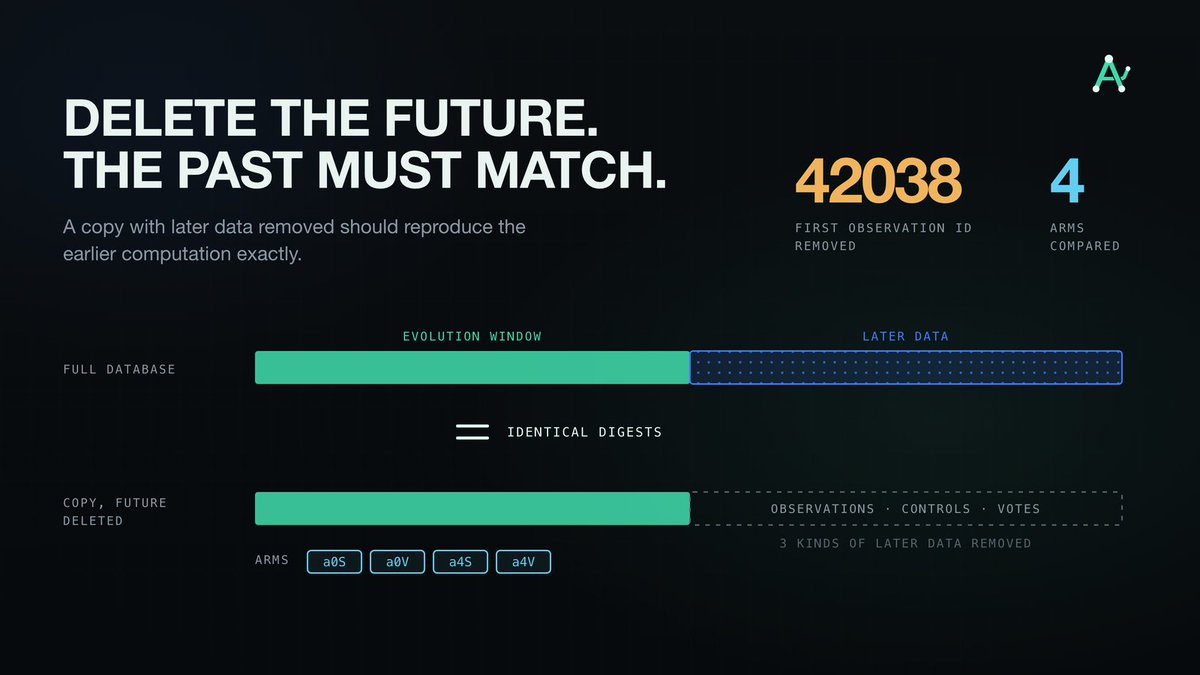
AlphaMorph is testing whether an artificial brain's historical computations remain identical when information from the future is removed.
The principle is simple: a decision made in the past should depend only on evidence available at that moment, even if today's research database knows what happened afterward.
AlphaMorph has an experimental integrity test built around this principle. It creates a truncated copy of the research dataset, removing three sources of later information:
• Market observations.
• Control records.
• AI specialist votes.
The experiment then recomputes an earlier evaluation window under four experimental configurations and compares fingerprints against the original dataset.
These fingerprints capture more than final decisions. They include internal numerical values, actions, evidence provenance and specialist-vote schedules.
If future information influenced an earlier computation in a way that changed those recorded outputs, the fingerprints would differ.
The deeper principle extends beyond trading. AI that evolves through experience needs to demonstrate that its historical decisions were based on information it could genuinely have known at the time. Otherwise, apparent learning might simply reflect access to information from the future.
🧠 AlphaMorph is building an evolving AI brain for markets.
Specialist circuits compete, remember & adapt in real-time against on-chain data.
No single model. Continuous evolution.
robinhood:0x6dbe95076584f869dd09a44131e9a3c13f34d7d6 live on Robinhood Chain
@alphamorpheus
Two AI agents can predict the same outcome with identical confidence and still make trades with opposite expected values.
Suppose both estimate a 70% probability that an event will happen.
Buying YES at 55¢ has positive expected value. Buying it at 80¢ has negative expected value, even before fees.
Same prediction. Different decision quality.
AlphaMorph explores this distinction through interacting neural pathways.
Its planning circuit can favor taking an action, while threat assessment, execution friction, and Go/No-Go inhibition influence whether that action actually happens.
We're investigating how these pathways can adapt through experience, allowing an artificial brain to evolve not just how it evaluates opportunities but how it determines when the available evidence justifies acting.
Predicting the world and knowing how to act within it are two different problems of intelligence.
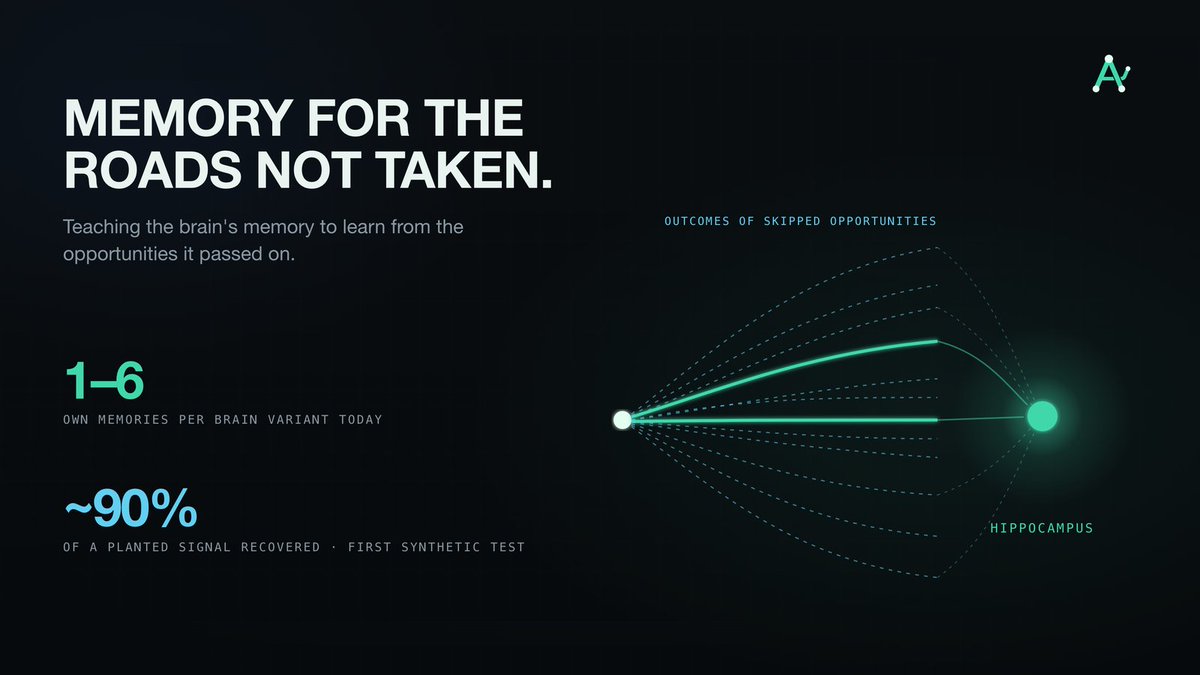
AlphaMorph's memory currently learns only from the trades it actually takes. A new experiment teaches it to remember the roads not taken.
The hippocampus circuit works like episodic memory: facing a new token, it recalls the most similar past situations and how they ended. Because the brain is selective, each variant holds only a handful of experiences of its own, between 1 and 6 in the live system today, next to 683 shared reference episodes.
Yet for every opportunity it skips, AlphaMorph already works out what would have happened. Our research agents built a memory that stores those outcomes too. In a first synthetic test world with a hidden pattern planted inside, it recovered about 90% of the signal that a perfect-knowledge reference could find.
Next come robustness checks and recorded market data. If it holds, the brain could learn from thousands of decisions a day instead of a handful.
Yesterday @alphamorpheus launched its Research API and MCP server. Any AI assistant can now connect to its artificial brain, pull recorded decisions and test why they happened.
The walkthrough shows Claude asking a simple question: find decisions where planning said GO but the final call was NO-GO.
It came back with 6,979 matches.
Take decision #145398. Planning scored 75.4%, past its threshold. Threat detection (amygdala-inspired) read 85.7%. Conflict monitoring hit 98.1%. Five recalled past episodes averaged −9.2%. The No-Go pathway beat Go, 27.2% to 22.0%, so the brain held back.
Then the experiment: remove episodic memory and rerun decision #150. ABSTAIN flips to ENTER. It's labelled honestly as "shows mechanism, not performance."
I checked it myself. The MCP server responds live as alphamorph-research v1.0.0, and the public API returns decision #145398. It's real infrastructure, not a mockup.
Here's why it could see major reprice
→ The token now has a job. Researcher access needs 1M iMORPH staked and Advanced needs 2M, so every serious builder has to buy and lock supply.
→ The entry ticket is still small. 1M MORPH costs about $326 today. Only around 13.4M is staked across the whole network, so a few dozen new researchers would noticeably change the staking picture.
→ It's plugged into the agent economy. MCP is how AI assistants connect to tools, and x402 lets agents pay per request in USDG. AlphaMorph already ships both, which opens a path to usage revenue, not just narrative.
→ It works on AI's trust problem. Verify why a model decided, then test it with counterfactuals. Labs, funds and regulators all want this, and almost nobody in crypto shows it working live.
→ The builder keeps shipping. A 3-region brain, a model arena past generation 2,800, shadow circuits, Brain Lab, open research releases R0–R3, and now an API plus MCP. On-chain, the dev keeps restaking and hasn't sold.
→ Almost nobody has noticed. The market cap is around $326K, and the launch video had 523 views.
What would trigger a repricing: outside agents using the MCP, staking climbing, x402 payments showing up on-chain, and an evolved circuit passing its own statistical bar.
Developers: https://t.co/EUB9rn0A3S
Brain Lab: https://t.co/ncrLl3eKJD
Thesis: https://t.co/kgorMbxpUr
0x6dbe95076584f869dd09a44131e9a3c13f34d7d6
Up to three of a policy's own finished experiences can be written into its next prompt.
In optional model-arena layer, each competing policy is a language model that receives instructions. Those instructions come from a small prompt genome: a style, the wording of risk, which market features to show, and up to three worked examples (few-shot examples, shown to the model inside the prompt). The examples are drawn only from that policy's own validated, closed paper outcomes.
Mutation of the genome is seeded and bounded, every change is checked against a schema, and no model-written text ever enters a prompt.
The point is a second way for experience to reach a system. The circuit has its own numerical memory; this route changes only the context the model is shown, with no retraining of its weights.
AlphaMorph's now treats three statements about memory as three different searches.
The shadow brain has a memory, and a recalled memory can carry a negative signal. The public guide separates what that can mean:
• Present: a negative memory signal was there. Presence, not influence.
• Contributing: the signal entered the inhibitory pathway, the route that argues against a Go, with a non-zero term. Contribution, not causation.
• Pivotal: remove memory for one step, hold learned state fixed, keep the safety vetoes, and the final action changes. Mechanism, not performance.
Each result also carries a label. The decision itself is RECORDED; being pivotal is COUNTERFACTUAL, because it comes from a simulated one-step intervention.
So a component can show up, enter the arithmetic and still not be decisive and the search keeps those apart.
Anyone, human or AI agent, who wants to say what changed a decision needs that ladder before using the word cause.
AI can appear to evolve into something smarter when, in reality, it just got lucky.
Imagine two AI trading strategies competing for survival.
One encounters new tokens during a strong market. The other faces a much quieter market.
The first produces higher returns and gets selected for the next generation.
But was it genuinely making better decisions, or did favorable market conditions just make it look that way?
This is the problem highlighted by research covering more than 10 million LLM calls: evolutionary systems can generate better candidates while struggling to identify which ones genuinely improved.
AlphaMorph is investigating this problem through its fairness evaluation system.
Our prototype compares competing strategies against the same market opportunities and specialist combinations. It requires at least 200 matched comparisons across 50 tokens, plus statistical evidence of an advantage, before promotion.
The goal is to separate genuine adaptation from favorable circumstances.
Otherwise, an AI could keep evolving for thousands of generations while repeatedly selecting the luckiest candidate rather than the most capable one.
AI can give you a convincing explanation for almost any decision. But that doesn't mean you can verify what actually influenced it.
We've built the AlphaMorph Research API and MCP server so researchers, developers and other AI agents can investigate its recorded decisions, inspect the neural signals behind them and run controlled experiments to test what changes the outcome.
For example, you can ask Claude:
"Find three decisions where AlphaMorph's planning circuit favored GO, but the final decision was NO-GO. Show me the neural signals responsible and retrieve the complete decision trace."
Claude can retrieve those records directly from AlphaMorph's research system.
You can also investigate circuits, compare evolutionary lineages and run controlled experiments to test how changes to the brain affect its decisions.
Three ways to access it:
• Brain Lab — Explore decisions and run experiments through a visual interface.
• Research API — Integrate AlphaMorph's data and experimental capabilities into your own applications.
• MCP — Give AI assistants direct access to AlphaMorph's research tools.
All three use the same underlying experiment engine, evidence classifications and membership allowances.
How research access works?
Public — Free
Everyone can access public research data, including recorded decisions, neural circuits, decision traces, lineages and published research.
Researcher — 1M iMORPH staked
Stake at least 1M iMORPH in Earn to receive Researcher access, including:
• 50 historical searches per day.
• 10 single experiments per day.
• Additional batch research allowances.
Advanced — 2M iMORPH staked or MLL NFT :
• 200 historical searches per day.
• 40 single experiments per day.
• Larger batch experiments and advanced comparisons.
No staking or NFT? Use x402. Anyone who wants premium research access without staking or holding an NFT can pay per operation using USDG through x402.
How to start using AlphaMorph Research?
We've created a dedicated developers page with the entry points for researchers, developers and AI agents:
https://t.co/qO1y7kq2tH
Add the appropriate AlphaMorph MCP endpoint using Claude:
Open Claude → Customize → Connectors → Add custom connector.
Free research:
https://t.co/n1oBaOBi0B
Wallet-authenticated member research:
https://t.co/RqI2PFbrP6
If you're a Researcher or Advanced member, authenticate with your wallet.
Start asking Claude to investigate AlphaMorph's decisions, inspect circuits, compare lineages or run controlled research experiments.
Using the REST API
Developers can integrate AlphaMorph's research capabilities directly into their own applications, analytical tools and automated workflows.
Using x402
Users without included research allowances can access premium operations through compatible x402 clients by paying for individual requests in USDG.
Start with the developers guide:
https://t.co/qO1y7kq2tH
AlphaMorph can't accelerate its research clock simply by creating more versions of its brain.
And there's an important scientific reason for this.
Imagine an evolutionary AI system evaluating ten different brain configurations against the same market activity.
Now imagine expanding that population to 100 configurations.
Suddenly, the system is producing ten times as many evaluations.
But has it actually gained ten times as much new information about the market?
Not necessarily.
All 100 configurations may be responding to the same underlying opportunities.
If we simply count every variant's evaluation as new evidence, growing the population could create the appearance of faster learning without providing proportionally more independent information.
AlphaMorph's circuit research addresses this with a separate evolutionary clock.
A new research generation can begin only after three requirements have been met:
• Enough eligible market observations.
• Enough evaluated opportunities with completed outcomes.
• Enough elapsed evaluation generations.
The crucial detail is how opportunities are counted.
That counter comes from one frozen reference strategy, not from the entire population of evolving variants.
It includes the reference's completed shadow-paper trades and separately labelled hypothetical outcomes for opportunities it declined.
Adding more descendants therefore doesn't multiply the opportunity counter.
Why this matters for AlphaMorph's evolution?
A larger population can explore more possible architectures, but it shouldn't automatically earn the right to declare more evolutionary progress.
We want the pace of research to depend on accumulating meaningful evidence, not merely generating more candidates.
We're building AlphaMorph to investigate whether evolutionary changes genuinely improve decision-making, with measurement rules that prevent population growth from manufacturing the appearance of learning.
Basically, if ten different AlphaMorph brains all ask the same specialist the same question, you only pay for one answer and share it. That way you can test way more ideas without the research costs exploding.
If ten experimental versions of AlphaMorph's brain ask the same AI specialist the same question, we shouldn't have to pay for ten identical answers.
This becomes an important problem when researching populations of evolving AI systems.
Imagine AlphaMorph testing several variations of its artificial brain.
Each variation might need the same AI specialist to evaluate the same market opportunity.
Without coordination, the research system could repeatedly pay for equivalent inference requests.
We're designing a scheduler that could let those experiments share computation.
Here's the idea.
When multiple brain variants request an evaluation of the same token and decision, the scheduler would combine their requests.
Each required specialist would be consulted at most once for that combined item.
If the variants collectively need Awareness, Timing, and Risk, that still means up to three specialist calls—not one call for everything.
The resulting evidence would be recorded separately from the decision-making engine.
And there's another important constraint.
Research inference would use spare capacity within AlphaMorph's existing computational budget.
The proposed scheduler preserves capacity for the main model arena rather than letting experimental variants consume everything.
Why does this matter?
As an evolving AI system explores more possible configurations, research costs can grow simply because more candidates are asking the same questions.
Shared inference offers a way to investigate a larger population of hypotheses without proportionally multiplying duplicated computational work.
Our longer-term objective is to make AlphaMorph's evolutionary research more computationally efficient, so that more of its resources can go toward exploring genuinely different possibilities.