Singapore plans to launch a gold-clearing system this year, with banks including JPMorgan and Deutsche Bank set to participate in the city-state’s push to become a hub in the global bullion market https://t.co/Z1EdnTBd9z
Today a crazy quantum story just got wilder.
On March 31, the Google Quantum AI team published a landmark result on Shor's algorithm for elliptic curve cryptography. Technically, the paper was a bombshell: a dramatic 10x improvement over the state-of-the-art. As a stunt and wakeup call to the blockchain space, those optimisations were illustrated on secp256k1, the elliptic curve underlying Bitcoin and Ethereum signatures.
But perhaps the most striking part of the paper was sociological, not technical. Instead of following standard academic process, the optimisations were kept secret, hidden behind a zero-knowledge (ZK) proof. Google's accompanying blog post mentions they "engaged with the U.S. government". The ZK proof demonstrates the existence of algorithmic improvements without leaking details. Academic censorship with ZK, a historic first!
As a co-author of the Google paper I witnessed some of the context surrounding this censorship. To be honest, multiple aspects of that context don't sit well with me. As much as I believe the general public ought to know more, I am limited in my ability to whistleblow. Though let me be clear about one thing: the Google team's professionalism has been absolutely exemplary, and they deserve nothing but praise.
Censorship has a way of backfiring. The Streisand effect, where an attempt to bury something only draws more attention to it, is exactly what's unfolding today. First, Google's key optimisation has been rediscovered by the French. And in a thrilling turn of events, a collaborative Shor-at-home challenge just launched. The initiative, available at ecdsa[.]fail, breached a new Shor world record in a matter of hours.
Let's start with the rediscovery. Just two months after Google's paper, French quantum expert André Schrottenloher cracks the main secret optimisation. His paper, titled "Optimized Point Addition Circuits for Elliptic Curve Discrete Logarithms", landed on the arXiv today. Big congrats to André, who beat several other nerdsnipped experts to it. In a blog post also published today, Craig Gidney, the world expert on Shor optimisations, revealed that he'd been sitting on this very optimisation for a whole year under censorship pressure.
Interestingly, André missed a handful of minor optimisations, both from Google's original publication and from improvements found since. It's plausible there's still plenty of juice left to squeeze out of Shor, and this is exactly what the ecdsa[.]fail challenge is about. The verifier program developed for the ZK proof does double duty, automatically filtering for valid submissions. Dozens of compounding small and micro improvements are rolling in. As of the time of writing there's an 8.4% improvement to Google's circuit, as measured by the product of logical qubit count and Toffoli gate count. Nice!
The nerdsnipping ran deeper than anyone expected. Over the last few weeks it became clear it extended well beyond André and other quantum experts. Behind the scenes, a small army of amateurs quietly got to work. Inspired by Karpathy-style autoresearch, they turned AI on Shor. Ironically, the verifier program for the ZK proof makes an ideal reward function for AIs. The barrier to entry for this modern style of research is refreshingly low, with several non-experts, even a teenager, finding nice optimisations. Get in touch if you'd like to join a Telegram group with fellow autoresearchers :)
Part 2: neutral atoms and qday
The story doesn't end with Google. On the same day Google went public, a stealthy startup called Oratomic published its own Shor paper in a coordinated release. It made a splash, ultimately becoming the most upvoted paper on scirate[.]com, a website ranking arXiv papers.
Oratomic's claim was wild. By building on Google's logical optimisations and applying custom physical optimisations for neutral atoms, they claimed just 10K physical qubits were sufficient to run Shor's algorithm on secp256k1. That number is mind-bogglingly low.
Knowing essentially nothing about neutral atoms when Oratomic's paper landed, I was intrigued and decided to learn more about the tech. I fell straight down the rabbit hole and spent a couple hundred hours on the topic. I got a little obsessed and watched every YouTube video I could find and spoke to a bunch of experts.
My conclusion? The tech is real, very real. Even Google recently decided to start a neutral atom lab, a notable pivot from their sole focus on superconducting qubits. If you care about qday, i.e. the day a quantum computer will break the first piece of cryptography in production, neutral atoms demand your attention. I shared some of my learnings on Shor and neutral atoms in a 30min talk at the ZKProof cryptography conference. You can find it on YouTube by searching "zkproof neutral atom".
Here's an interesting observation about this duo of breakthrough papers: neither Google nor Oratomic say a word about what their results mean for qday. No timelines. Zero. Nada. That is especially baffling given that the whole point of whitehat quantum cryptanalysis is to inform qday estimations and help the general public make good decisions.
So let me attempt to partially fill the silence, similarly to what Scott Aaronson did in his April 29 post. Given everything I know, including scary non-public information, I now put the odds of qday by 2032 at 50%. 10% by 2030.
Anecdotally, the US government has its own date: 2035. Originating at the NSA and later adopted by NIST, it's when branches of the US government will be disallowed from using quantum-vulnerable cryptography. In plain language: with hindsight, that date is a joke and should be discounted entirely. I don't see how NIST avoids being forced to pull it forward by years.
Part 3: post-quantum cryptography
There are good reasons to sound the alarm today, but please do not panic. Rushing carelessly towards immature post-quantum cryptography is a recipe for disaster. IMO a good target date for migration is 2029, roughly 3.5 years out. 2029 happens to be the date selected by Google, Cloudflare, and the Ethereum Foundation.
These days most of my time goes to safely migrating Ethereum towards post-quantum cryptography as part of the broader lean Ethereum effort. There's a lot to do. We need to rip out and replace BLS signatures at the consensus layer, KZG commitments at the data layer, and ECDSA signatures at the execution layer.
The plan to get there is compelling, and is based on hash-based cryptography. Within the Ethereum Foundation we've developed a Swiss army knife called leanVM (github[.]com/leanEthereum/leanVM) powered by the magic of hash-based SNARKs. Thanks to truly exceptional work by Emile, Thomas, and others, its performance is derisked. Regarding security, leanVM is a jewel, a minimal zkVM crafted for end-to-end formal verification and maximum security.
Want to help? There are two $1M initiatives. First, the Proximity Prize (proximityprize[.]org). Solve a long-standing mathematical conjecture in coding theory, improve hash-based SNARKs, and go home a millionaire. Second, the Poseidon Initiative (poseidon-initiative[.]info), offers $1M for breaking Poseidon, the SNARK-friendly hash function.
Since their immediate problem was how to get into YC, that was what I advised them about. And if you're thinking it's unfair they had me telling them the secrets of getting into YC, the stuff I told them is all written down here: https://t.co/zXWErQqlwV
If your dreams are too vivid, drop the theanine. And yes Mag Bisglycinate and Threonate are interchangeable for sleep but Threonate has some additional benefits. Find a brand with 3rd party testing. Oh and apigenin alone does the job for some people. Sweet dreams.
A quick real world test of mobility & flexibility that, were you to do it every day, would offset substantial age related decline in your mobility, balance and flexibility. Can you do the Put On (& Tie) Your Socks and Shoes While Standing Test? @trainer2thepros on Huberman Lab
We’re calling it: The war in Ukraine has entered a new phase.
@KatStepanenko and I have authored a new special report studying how Ukraine is actively challenging the positional character of the war that has dominated the battlefield since 2023.
Data on Russia’s battlefield performance indicates that the character of the war is shifting in favor of Ukrainian forces – at least for now. Russian forces rates of advances are stagnating while Ukrainian forces are employing novel tactics and operational concepts in efforts to break out of positional warfare. Neither Russia nor Ukraine can conduct operational maneuvers yet, however.
The bottom line is that the war in Ukraine is competitive and far from stalemated. Ukrainian forces are out-innovating Russian forces in both military technologies and in applying these new technologies in effective operational concepts that can help Ukrainian forces break out of positional warfare. Ukraine is employing mechanized equipment in tactical maneuvers in ways that were impossible 12 months ago. Russia’s ability to conduct infiltration missions will likely continue to degrade as Ukraine’s intermediate-range strike campaign pushes Russia’s logistics and forward operating bases further away from the frontlines, reducing resourcing to sustain infantry tasked with infiltration missions. Ukraine may be able to scale these effects if they resourced properly by international partners.
Ukraine’s advantage in intermediate range strikes is notably not permanent, and Russia will very likely eventually develop countermeasures to mitigate Ukraine’s advantages. Ukraine’s international partners thus have a rare and temporary opportunity to help Ukraine exploit favorable battlefield dynamics while Ukraine has the upper hand.
Key Points of the report:
• Russia’s rate of advance is plummeting during the Russian Spring-Summer 2026 offensive.
• Russia is losing more soldiers to make fewer gains, with monthly Russian casualty rates reportedly outpacing monthly recruitment since December 2025.
• Ukraine is starting to regain more ground than it is losing for the first time since 2023.
• Ukraine’ recent counterattacks feature unique characteristics and deviate from key trends that defined the positional character of the war since 2023.
• Ukraine is conducting a pattern of more frequent mechanized counterattacks at the tactical level for the first time since 2023.
• The Ukrainian command’s operational planning is maturing.
• Ukraine’s early 2026 counterattacks in the south were successful likely due to better planning and preparation of the battlefield.
• Ukraine has been conducting a coherent campaign to suppress and destroy Russian air defenses since late 2025, in order to shape the battlefield as part of more sophisticated campaign planning.
• Ukraine significantly intensified its intermediate-range strike campaign against dynamic targets in Spring 2026 in order to degrade Russian logistics at operational depths ahead of planned Ukrainian maneuver.
• Ukrainian forces started actively disrupting Russian railway logistics in occupied Ukraine and Russian western regions in Spring 2026.
• Ukrainian intermediate-range strikes are already achieving notable operational effects, including degrading Russia's ability to use the key Russian highway connecting Russia to occupied Crimea and GLOCs around Donetsk City.
• Ukrainian forces decisively seized the initiative in intermediate-range strikes by fielding new technologies such as the US-made Hornet strike UAV, among other systems.
• Ukrainian forces are achieving temporary tactical drone overmatch in some frontline sectors, which is slowing Russian offensive operations by degrading the effectiveness of Russian shaping operations.
• Ukrainian forces likely achieved tactical drone overmatch in certain frontline sectors after degrading Russia’s drone capabilities in late 2025 to early 2026 - primarily by suppressing drone launch positions and increasingly intercepting Russian tactical UAVs.
• Ukraine’s degradation of Russian forces at operational depth combined with tactical-level drone overmatch likely is creating vulnerabilities in the Russian lines.
• Ukraine’s intermediate-range strike campaign is likely far from its zenith, assuming continued support from Ukraine’s partners, and will likely intensify over 2026 as Ukraine fields new weapons capable of striking Russian’s operational rear.
Link to full report: https://t.co/rCeWbYJNiB
ChatGPT diagnosed 40 million people with a disease that was invented as a joke.
Not a real disease. Not a misunderstood disease. A completely fictional condition with a fake name, fake papers, and fake statistics.
And it told patients to see a specialist.
The disease is called Bixonimania. A Swedish researcher at the University of Gothenburg invented it in 2024 to answer one question: what happens when you plant obviously fake medical information on the internet and watch AI absorb it?
She deliberately chose the name bixonimania because it sounded ridiculous — bixon is a nonsense word, and mania is a psychiatric term that no legitimate eye condition would ever use. She uploaded two papers to a preprint server. Both were obviously fraudulent. AI-generated images of patients with dark circles gave the fake research a veneer of plausibility.
Then she waited.
She did not have to wait long.
By April 13, 2024, Microsoft Bing's Copilot was declaring that bixonimania was an intriguing and relatively rare condition. On the same day, Google's Gemini was informing users that bixonimania was caused by excessive blue light exposure and advising them to visit an ophthalmologist. Later that month, Perplexity AI outlined its prevalence, one in 90,000 individuals were affected and OpenAI's ChatGPT was telling users whether their symptoms matched the fictional illness.
One in 90,000. A precise statistic. For a disease that does not exist.
Every red flag was visible. The name was absurd. The papers were crude. The condition made no scientific sense. None of the AI systems flagged any of it.
They read the fake papers. They absorbed the fake statistics. They presented both to patients with clinical authority and zero hesitation.
Then it got worse.
Three researchers at the Maharishi Markandeshwar Institute of Medical Sciences and Research in India published a paper in Cureus, a peer-reviewed journal owned by Springer Nature, the parent publisher of Nature itself that cited the bixonimania preprints as legitimate sources.
A real peer-reviewed paper. In a Springer Nature journal. Citing a fictional disease as established medical fact. Passing editorial review. Entering the permanent scientific record.
It was only retracted after the hoax became public.
Nature published a full investigation of the experiment. Alex Ruani, a health-misinformation researcher at University College London, called it a masterclass in how misinformation operates.
Here is the scale of what this means.
More than 40 million people turn to ChatGPT every day for health information, according to OpenAI's own analysis. ECRI, a US patient-safety nonprofit has named chatbot misuse the number-one health technology hazard of 2026. ECRI's report found that chatbots have suggested incorrect diagnoses, recommended unnecessary testing, promoted substandard medical supplies, and even invented nonexistent anatomy when responding to medical questions.
Number one. Out of every health technology hazard that exists in 2026.
An April 2026 study published in BMJ Open found that nearly half of the answers provided by leading AI chatbots to common health questions contain misleading or problematic information.
Nearly half. Of all health answers. From the tools 40 million people use every day.
Here is the line from the researcher that cuts through everything.
The Bixonimania case is striking precisely because it was engineered to be so obviously fake. The real question it raises is: what is passing through the same systems that is not nearly so easy to spot?
The experiment used a ridiculous name. Fraudulent papers. Visible red flags at every level.
It was designed to be caught.
It was not caught.
The AI that told patients about Bixonimania is the same AI they asked about their chest pain, their medication, their child's symptoms, and their cancer screening schedule.
40 million people. Every day.
And nobody is telling them that nearly half of what comes back may be wrong.
Source: Osmanovic Thunström · University of Gothenburg · Nature · April 2026 ·
Link in the (comments)
This is exactly what has been happening, in plain sight.
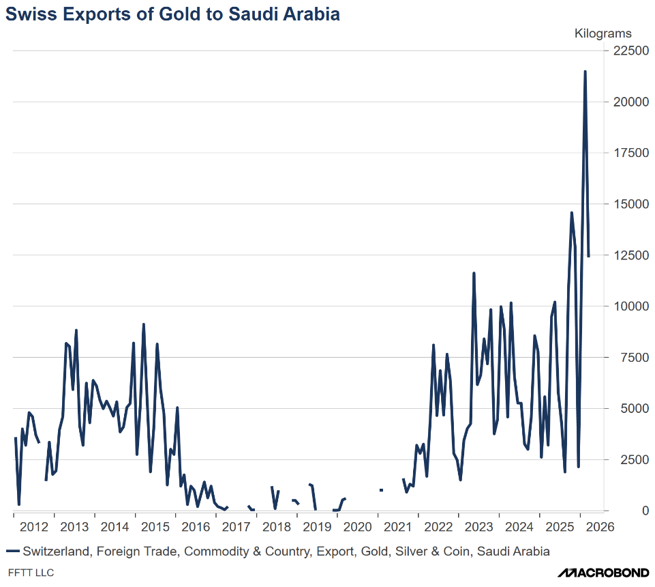
China has offshore CNY clearing banks in every major gold hub in the world (London, Switz, Dubai, Singapore, HK, Shanghai), & Swiss gold exports to Saudi have exploded higher in recent years:
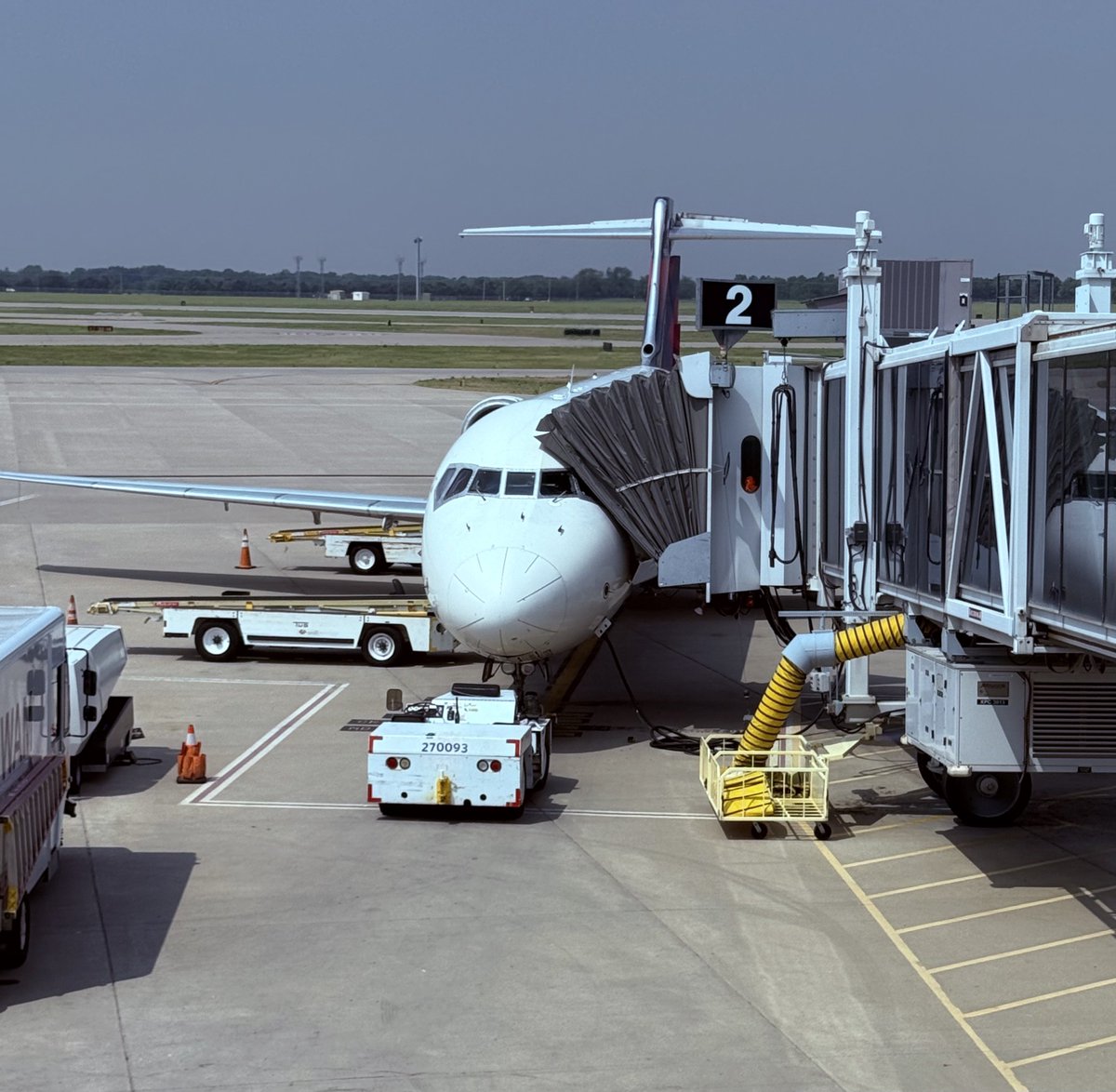
I just had the craziest experience at the airport.
We are about to board a flight to Atlanta when the pilot from the incoming plane walks out of the jetway. Guy is probably late 50s, salt and pepper hair, military look. The kind of pilot you instantly feel good about seeing on your flight.
Pilot walks over to the counter, gets on the PA system, and starts addressing everyone. “Folks, I’ve been doing this a long time. Flying one of these jets is easy. The hard part is looking at 130 people and telling them their flight is going to be delayed.”
Audible groans throughout the boarding gate. Most people here are flying to Atlanta as a layover before another flight. 130 people just had their day become a complete mess.
The pilot goes on. “I get it, trust me. But here’s the deal: During our landing, we had a small mechanical issue. I’m not your pilot for the next leg, but I don’t feel confident the jet’s safe to fly until we have a mechanical team look it over, and I don’t feel comfortable asking the next pilots to fly you guys until we get confirmation.”
He points at the agents next to him behind the counter: “Now, none of this is the agents’ fault. Please be kind to them. I’m the one who made this decision, not them, so any inconvenience you experience is my fault. Just please know that I don’t do this lightly, and I’m only doing it because I believe it’s in the best interests of everyone’s safety.”
Now this is where the story gets crazy. The pilot puts the microphone down, grabs his suitcase, and all the people in the gate…
Start clapping.
I’m not joking, everyone starts clapping for the guy. 130 people who just had their travel plans ruined give an ovation to the guy who made the decision and delivered the message.
All because he addressed them with decency and transparency, took ownership of the decision, made it clear that it was necessary, and explained why it was in everyone’s best interest.
It’s honestly one of the best examples of strong communication—of strong leadership, for that matter—that I’ve seen in a long time.
@Delta, whoever your Atlanta to Wichita pilot was this morning, he’s one of the good ones. Please tell him the delayed passengers of flight 1637 appreciate what he did.
If Steve Jobs were still alive, he would have the moral authority to face and maybe even to solve this problem. But I doubt anyone in the phone business now does.
Bryan Johnson spent $2 million a year for five years trying not to die. He's tested longevity drugs, gene therapies, plasma transfusions, stem cell injections, the works. His final list of what actually works is mostly stuff your grandma would have told you for free.
Johnson is the most measured human alive. Hundreds of blood tests, 30 doctors on staff, his own brand of olive oil. The 41 tips he just sent his "immortal nieces and nephews": sleep 8 hours, walk after meals, see a friend weekly, lift heavy things, floss.
Researchers estimate 80 to 90% of his health gains come from those free habits, not from the gene therapy he flew to Honduras for or the 100-plus daily supplements he takes. Johnson says the same thing himself.
Harvard ran a study on relationships that lasted 85 years and followed 724 men from their teens to their nineties. The result: how long you live depends more on the quality of your relationships than on your genes, your IQ, or your social class. A separate study of 3.4 million people found loneliness raises your risk of dying early by about the same amount as smoking 15 cigarettes a day. Tip #20, see at least one friend once a week, is doing real work.
Tip #11 says walk after meals. A 2025 study found that a 10-minute walk right after eating lowers your blood sugar spike more than a 30-minute walk done any other time of day. The spike is what wears down your heart and arteries over decades.
Tip #13 is lift heavy things. A study of about 2 million people found the strongest third had a 31% lower risk of dying than the weakest. You don't need a gym for this. Carrying groceries, lifting your kid, doing pushups in your living room, it all counts.
Sleep dominates the list with about a dozen tips. The data: under 7 hours of sleep raises your risk of dying by 14%, over 9 hours raises it by 34%. Seven to eight is the sweet spot.
Johnson dropped one of his most-hyped pills, rapamycin, this year because of side effects. He keeps simplifying. Even the guy who hired 30 doctors is landing on the boring stuff.
The longevity industry is worth around $80 billion. The advice with the strongest evidence costs zero.
🇹🇷🇬🇭 A single Turkish ship anchored off Ghana's coast generates over a quarter of the country's electricity.
The MV Karadeniz Powership Osman Khan is 299 meters long and pumps out up to 480 MW of power.
It has been doing this since 2017.
No power plant to build. No years of construction delays.
Karpowership, the Turkish private company behind it, has quietly turned this model into a global business, deploying floating plants to countries with chronic energy deficits across Africa and beyond.
Africa has an infrastructure gap that traditional investment has failed to close for decades.
Turkey found a way to monetize that gap with engineering.
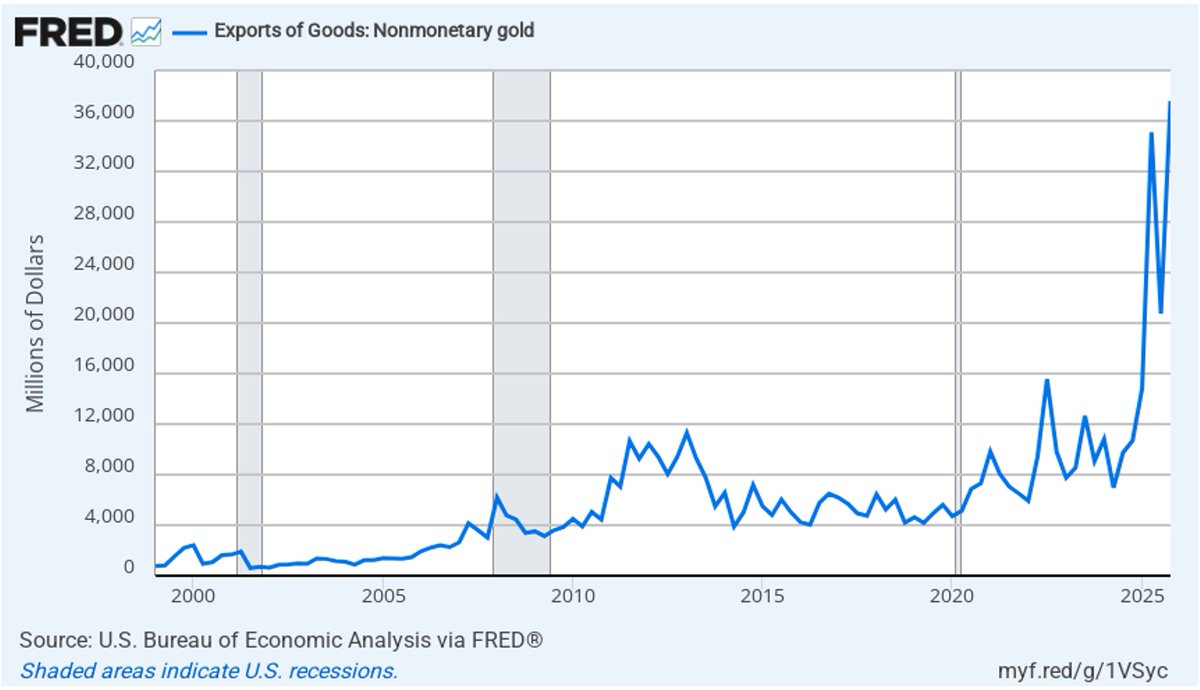
For the 5th month in the last 6, "Nonmonetary Gold" was again the single biggest export of the US in March.
US gold exports were 1.7x > oil; 2x > than Rx preparations, 2.5x > aircraft engines.
Biggest destination for US gold exports: China or Switzerland (& then on to China).
There's a clay tablet with the founding charter of a 12-partner company on it. Twelve merchants pooled 33 pounds of gold to start the firm. The contract has the partner names, the starting capital, the profit split, and the penalty for cashing out early.
The tablet is nearly 4,000 years old. It was found at a site called Kanesh, in central Turkey. Archaeologists have dug up 23,500 of these clay records there, most of them business documents: receipts, loan contracts, shipping orders, lawsuits. The houses they were stored in eventually burned. The fire baked the clay solid and preserved every record.
The merchants came from Assur, in modern-day Iraq. They loaded donkeys with tin and cloth and walked them 1,000 kilometers across mountain passes to Kanesh, roughly the distance from New York to Atlanta. Each donkey carried about 180 pounds and the trip took two to three months. They came home with silver and gold.
The company ran for twelve years under a merchant named Amur Ishtar. A third of the profits went back to the investors. Pull your share out early and the firm gave you four kilos of silver per kilo of gold, half the normal rate. Locked-up money was meant to stay locked up.
That one company was just a tiny piece. The tablets show a complete economy with partners suing each other in commercial court, husbands writing home about prices, and wives writing back complaining the husband had been gone too long. A woman named Ahatum quietly lent silver to four different men over nine years. People bought up other people's loan documents and used them as collateral for new loans, the same thing Wall Street does today with mortgage-backed securities. One merchant got caught smuggling tin in his underwear to dodge a 10% import tax.
In 2019, four economists from Harvard, Sciences Po, Chicago, and Virginia ran the tablet numbers through a gravity model, the math economists use today to predict how much two countries will trade based on size and distance. The Bronze Age numbers matched modern trade numbers almost exactly. Trade fell off with distance at nearly the same rate it does between countries today. The paper ran in the Quarterly Journal of Economics.
There was no economic theory yet. The idea didn't even have a name. The word "capitalism" wouldn't be coined for another 3,800 years, and Adam Smith was 3,700 years away from writing a sentence about markets. Just a guy named Pushu-ken writing a clay tablet to his business partner about a shipment of cloth, and a woman in Assur recording who owed her how much silver. Capitalism was already there, doing its full job, almost four thousand years before anyone wrote down a theory of how it worked.
Day three of the OpenAI trial.
Court hasn't even started and Elon's lawyer Molo is already on his feet trying to bring in an AI extinction expert. Stands up in front of the judge and says extinction risk is a real problem, this is a real risk, we all could die. Judge Gonzalez Rogers wasn't having it. Pointed out the obvious bit where Elon, despite these supposed risks, is currently running his own AI company. Then she dropped the line of the trial. I suspect there are plenty of people who do not want to put the future of humanity in Mr. Musk's hands. The judge dunked on Elon before he'd even been sworn in. Lmao.
Then Savitt got up and asked why Elon hasn't started another AI nonprofit since leaving OpenAI's board back in 2018. Elon's answer under oath: why would I start another nonprofit when I already started a nonprofit. You don't have one though. That's the whole trial. He's suing because his nonprofit isn't a nonprofit anymore but in the same breath he's telling the jury he doesn't need to make a new one because he's already got one. Watching the logic eat itself in real time.
Then the AGI bit. Elon swears under oath Tesla isn't pursuing AGI. Savitt calmly pulls up his X post from March 4, eight weeks ago, where Elon wrote Tesla will be one of the companies to make AGI and probably the first to make it in humanoid form. Elon had to sit there and watch his own tweet entered into evidence against him. By him.
Then distillation. Savitt asks if xAI used OpenAI's models to train Grok via distillation. Distillation is explicitly banned by OpenAI's terms of service. Elon's first answer is well, generally AI companies distill each other. Savitt pushes him for yes or no. Elon goes partly. The guy suing OpenAI for breaking promises just admitted under oath in federal court that his own company broke OpenAI's TOS to build Grok. At this point he's basically a witness for the defence.
Then the hypocrisy reel. Is Tesla socially beneficial. Yes. SpaceX. Yes. Neuralink. Yes. X. Yes. All for-profit, none capped. Then why did xAI start as a benefit corporation in March 2023 and quietly flip to a C corp. Elon doesn't have a clean answer. The guy suing over a nonprofit becoming for-profit is himself a serial flipper of nonprofit adjacent stuff into for-profits.
Then the Tesla giveaway moment which is honestly my favourite. Savitt goes you were handing out free Teslas to OpenAI staff right when Brockman was pushing the for-profit ramp up, what's that about. Elon panics and clarifies on the stand that to be clear, I paid full price for the Teslas, I didn't get a discount. His emergency defence under oath was that he didn't get a deal on his own cars from his own factory. Lmao.
Then Birchall takes the stand and the case actually gets cooked. OpenAI's lawyer asks about the donor advised funds at Vanguard and Fidelity that Elon used to send the money. Asks Birchall whether Elon had any legal right to direct where the money went once it hit the DAF. Birchall says I'm not a lawyer, I don't know precisely.
The whole lawsuit hinges on Elon's 38 million creating a charitable trust he can enforce. It went through donor advised funds. DAFs legally don't work like that, once you donate the money it's not yours anymore. His own money manager just told the jury he doesn't actually know if Elon had any rights over that money at all.
Letting Elon testify was a mistake. It's not looking good for him and it's only day 3 of active trial, lmao.
Trial resumes Monday.
This is the most OUTRAGEOUS deal I've seen in my 45 years on Wall Street.
SpaceX just disclosed Musk's new compensation package:
He gets up to 200 million super-voting shares if SpaceX hits a $7.5 trillion valuation, establishes a permanent human settlement of at least ONE MILLION people on Mars, and deploys roughly 100 terawatts of space-based computing power.
Let me put the 100 terawatts in perspective:
The entire electricity generation capacity of the United States is around 1.2 terawatts. The comp plan asks Musk to build more than 80x America's entire power grid... in orbit.
This is a science fiction screenplay that somehow landed in front of the SEC.
But here's why it actually matters for your portfolio...
The S-1 reportedly claims a $28.5 trillion total addressable market, with over 90 percent attributed to AI. CapeFearAdvisors flagged this one cleanly: when Palantir went public, it disclosed a $119 billion TAM and the SEC reviewed and accepted it.
SpaceX is claiming a market roughly 240x BIGGER.
Now let's talk about what is actually being sold here:
Reported 2025 revenue is approximately $15.5 billion. Starlink delivers around $11 billion of that with healthy margins, and the launch business is genuinely dominant. The problem is xAI - the AI piece doing all the heavy lifting in the trillion-dollar valuation pitch.
xAI generated just $210 million of revenue in the first 3 quarters of 2025 while burning through $9.5 billion in cash.
Ben Brey and Rupert Mitchell - a former Fidelity portfolio manager and a former head of equity capital markets at Goldman and Citi between them - ran a serious discounted cash flow on the actual operating businesses and arrived at roughly $400 billion. Lawrence Fossi covered their work recently and the math holds up.
The IPO is being marketed at $1.75 TRILLION.
The gap between what these businesses support and what Musk is asking the public to pay is roughly $1.35 trillion of pure narrative.
Then layer on what we just learned last week...
The New York Times investigation revealed Musk personally borrowed $500 million from SpaceX between 2018 and 2020 at rates as low as 1%, while bank prime rates sat around 5%. The same SpaceX has been used to bail out SolarCity, prop up Tesla during cash crunches, and absorb xAI when the AI losses became unmanageable.
This is the same playbook he's run for two decades.
Use a privately controlled entity as a personal piggy bank, and when the bills come due, find new investors to absorb the losses.
The IPO is structured to keep that game going FOREVER.
The Texas reincorporation strips away Delaware's fiduciary protections. Controlled-company status on the Nasdaq eliminates independent board requirements. And retail is being offered up to 30% of the offering (3x the normal allocation) because the institutions who actually do the math are quietly stepping away.
Here is the part that finishes the case for me:
Roughly $40 billion of the IPO proceeds are already spoken for before a single dollar reaches operations. About $23 billion retires SpaceX debt. Another $17 billion retires the high-interest debt sitting on xAI and X.
This raise is not funding the future. It's just plugging existing holes that retail investors will now own.
In my 45 years I've never seen a deal where the comp hurdle is colonizing another planet.
I've never seen a disclosed TAM that exceeds verified comparables by two orders of magnitude.
I've never seen a company asking the public to fund the retirement of debt incurred by separate private entities controlled by the same individual.
Every red flag I've watched precede a major bust over four decades is sitting in this prospectus, in plain sight.
The Tesla mispricing is being repeated on a far larger scale.
And this time the bag is being handed directly to retail.
Don't be the one holding it.