This works really well btw, at the end of your query ask your LLM to "structure your response as HTML", then view the generated file in your browser. I've also had some success asking the LLM to present its output as slideshows, etc.
More generally, imo audio is the human-preferred input to AIs but vision (images/animations/video) is the preferred output from them. Around a ~third of our brains are a massively parallel processor dedicated to vision, it is the 10-lane superhighway of information into brain. As AI improves, I think we'll see a progression that takes advantage:
1) raw text (hard/effortful to read)
2) markdown (bold, italic, headings, tables, a bit easier on the eyes) <-- current default
3) HTML (still procedural with underlying code, but a lot more flexibility on the graphics, layout, even interactivity) <-- early but forming new good default
...4,5,6,...
n) interactive neural videos/simulations
Imo the extrapolation (though the technology doesn't exist just yet) ends in some kind of interactive videos generated directly by a diffusion neural net. Many open questions as to how exact/procedural "Software 1.0" artifacts (e.g. interactive simulations) may be woven together with neural artifacts (diffusion grids), but generally something in the direction of the recently viral https://t.co/z21CP5iQfu
There are also improvements necessary and pending at the input. Audio nor text nor video alone are not enough, e.g. I feel a need to point/gesture to things on the screen, similar to all the things you would do with a person physically next to you and your computer screen.
TLDR The input/output mind meld between humans and AIs is ongoing and there is a lot of work to do and significant progress to be made, way before jumping all the way into neuralink-esque BCIs and all that. For what's worth exploring at the current stage, hot tip try ask for HTML.
Claude + Shopify is f*cking cracked 🤯
Shopify just dropped an official connector that lets you manage your entire store from inside Claude.
One prompt → Claude adds products, checks inventory, creates discount codes, pulls sales reports, and finds your top customers.
All from a single chat.
All inside Claude.
Perfect for DTC brands and agencies who are still bouncing between five browser tabs every time they need to answer one basic question about their store.
The new Shopify connector for Claude fixes the entire workflow:
→ Install the official Shopify connector in Claude Desktop in 30 seconds
→ Authenticate to your store via OAuth
→ Claude reads your full catalog, customers, orders, and analytics on demand
→ Adds new products, creates discount codes, and bulk-updates inventory from prompts
→ Runs ShopifyQL analytics queries that return live charts and dashboards
→ Surfaces patterns across customer behavior — top sellers, bundle opportunities, restock urgency
No Shopify admin tab-switching.
No exporting CSVs to ask one question.
No "let me check Shopify and get back to you."
What you get:
→ Claude connected directly to your live Shopify store
→ Daily store ops running through one chat — products, customers, inventory, discounts, analytics
→ Real-time analytics that answer questions Shopify's own dashboards can't
→ Pattern recognition across your orders that surfaces bundle ideas and retention opportunities
→ An official connector built by Shopify with 25 tools and ongoing updates
I put together a full playbook with the connector setup, every prompt I tested, the 25 tools it exposes, and a Loom walkthrough video showing you how to set it up.
Want it for free?
> Like this post
> Comment "SHOP"
And I'll send it over (must be following so I can DM)
Fireside chat at Sequoia Ascent 2026 from a ~week ago. Some highlights:
The first theme I tried to push on is that LLMs are about a lot more than just speeding up what existed before (e.g. coding). Three examples of new horizons:
1. menugen: an app that can be fully engulfed by LLMs, with no classical code needed: input an image, output an image and an LLM can natively do the thing.
2. install .md skills instead of install .sh scripts. Why create a complex Software 1.0 bash script for e.g. installing a piece of software if you can write the installation out in words and say "just show this to your LLM". The LLM is an advanced interpreter of English and can intelligently target installation to your setup, debug everything inline, etc.
3. LLM knowledge bases as an example of something that was *impossible* with classical code because it's computation over unstructured data (knowledge) from arbitrary sources and in arbitrary formats, including simply text articles etc.
I pushed on these because in every new paradigm change, the obvious things are always in the realm of speeding up or somehow improving what existed, but here we have examples of functionality that either suddenly perhaps shouldn't even exist (1,2), or was fundamentally not possible before (3).
The second (ongoing) theme is trying to explain the pattern of jaggedness in LLMs. How it can be true that a single artifact will simultaneously 1) coherently refactor a 100,000-line code base *and* 2) tell you to walk to the car wash to wash your car. I previously wrote about the source of this as having to do with verifiability of a domain, here I expand on this as having to also do with economics because revenue/TAM dictates what the frontier labs choose to package into training data distributions during RL. You're either in the data distribution (on the rails of the RL circuits) and flying or you're off-roading in the jungle with a machete, in relative terms. Still not 100% satisfied with this, but it's an ongoing struggle to build an accurate model of LLM capabilities if you wish to practically take advantage of their power while avoiding their pitfalls, which brings me to...
Last theme is the agent-native economy. The decomposition of products and services into sensors, actuators and logic (split up across all of 1.0/2.0/3.0 computing paradigms), how we can make information maximally legible to LLMs, some words on the quickly emerging agentic engineering and its skill set, related hiring practices, etc., possibly even hints/dreams of fully neural computing handling the vast majority of computation with some help from (classical) CPU coprocessors.
excited to have built Voice Personas for @openclaw!
until now, when your agent sent a voice note, it had to improvise the “flair” every time, which rarely worked
with Personas, your agent’s SOUL can get passed deterministically into every single voice memo, so they SOUND like you always imagined
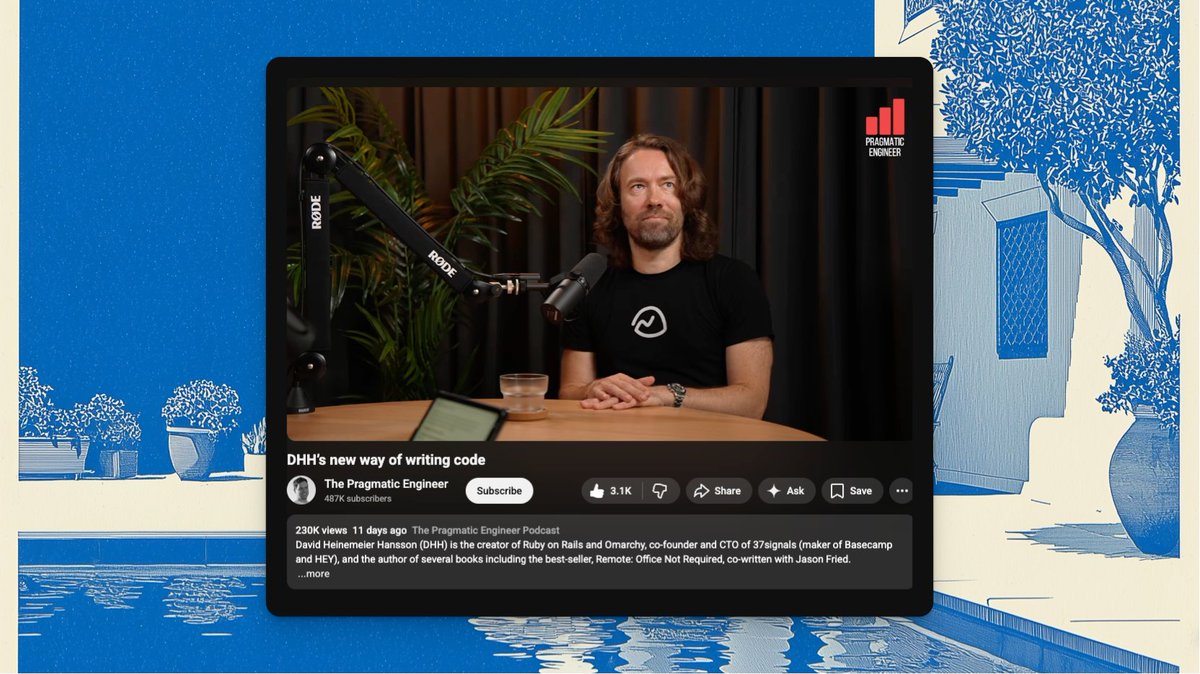
DHH spent 20 years dismissing product management.
Then 1h21 into his Pragmatic Engineer interview, he caught himself and admitted he was wrong.
He was listing what matters now that AI writes the code: figuring out what to build, how to build it, which customers to talk to, where to focus.
Then his exact next words: "It's product management. It's so funny for me too because historically I've not necessarily had the highest esteem for product management as a function. I thought there was a lot of BS."
He explained why. Implementation was always the constraint. Engineers needed four weeks to ship anything, so PMs spent those weeks talking, planning, strategizing. Nothing looked like output until the code landed.
"They were underutilized. They were not the constraint." They were rate-limited.
The loudest PM-skeptic changing his mind (and DHH has strong opinions!) -- that should count for something. let's toast to that 🥂
My dad used to print me a business card every time I had a new business idea as a kid. It made me feel like a real entrepreneur.
My daughter wants to start a lemonade stand. So I opened Tinker and made her a logo and business cards in minutes. From my phone.
We built Tinker so anyone with an idea can start doing something with it. Go try it.
This is awesome @rousseaukazi
What @MrBeast said.
Sidekick changes entrepreneurship. It understands your store, @Shopify, and commerce at scale.
An AI cofounder in your pocket. Data, growth, ops. And everything else you need to run a business. Personalized.
With voice mode, you run your business from your phone. Decisions in seconds. Scale in weeks. Powered by 20 years of Shopify intelligence.
Only we could build this.
I'm hiring an Engineering Manager for the @Shopify mobile app.
Leading a team of 8-12 devs, React Native & native, end-to-end product ownership, strong people leadership and technical chops, based in Canada or the US.
If it sounds like your kind of role, DM me.
Shopify: The RenAIssance Edition
Sidekick updates, Agentic Storefronts for merchants, new tools for devs building commerce agents, AI simulations, and more 🧵
make quick sales even quicker
search & scan products, discount & customize, pay & process right from your phone
store setup can wait. sales can’t
The Shopify mobile app is so so good. Team has really outdone themselves. Shopify is huge, probably one of the biggest pieces of software in the world, and they just… shrunk it onto phones and it feels at home.
Introducing Alterego: the world’s first near-telepathic wearable that enables silent communication at the speed of thought.
Alterego makes AI an extension of the human mind.
We’ve made several breakthroughs since our work started at MIT.
We’re announcing those today.
Agents will become a common way people shop. So today we are releasing 3 tools to make adding commerce to those agents trivial:
- Checkout Kit: embed commerce widgets and checkout(!) directly into your agent and chat. This is already being used by Microsoft’s @Copilot.
- Shopify Catalog: low latency global product search across millions of merchants
- Universal Cart: shop from any store, anywhere, in one cart
With these, you can build seamless embedded commerce experiences quickly, starting with all the best products by the best merchants in the world instead of having to sign them all up individually. No need to build a complex new checkout, or dealing with regulatory marketplace rules. Commerce just plugs in and feels seamless in conversations.
We believe commerce should be everywhere people are, so we’re making that as easy as possible for the AI age.
What a remarkable week at Shopify 💚
Hacking until 1am is how our industry was created. Doing it with live DJs and 6k friends is even better.
Make tech nerdy again.