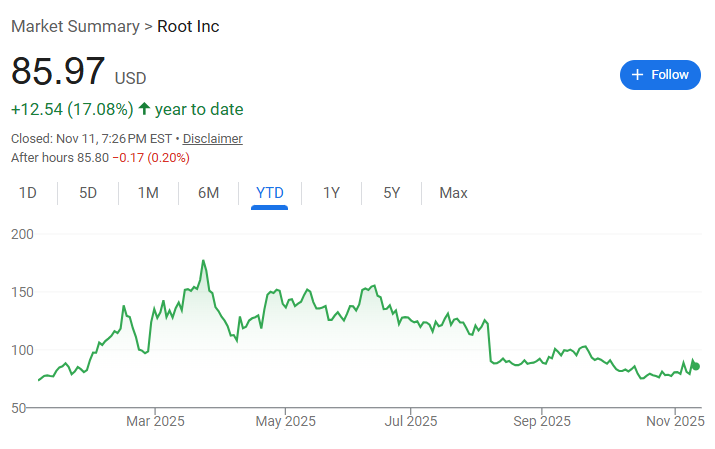
$ROOT for the next 1000X+
RE Investor/Developer & Entrepreneur Founder
14+ Years in Financial Markets
2024-NH Top 7 Realtors By FastExpert | 40u40 Torchbearer
I've taken a few days to digest $ROOT's Q3 earnings, and while the results were a little more subdued than I had hoped, I think there is quite a bit worth discussing beyond the immediate revenue and policy growth figures!
I'll start with the area I was most interested in seeing improve - customer acquisition.
According to Experian, $ROOT was the most affordable carrier in 17 states, more than any other insurer in its comparison. I was hoping this competitive pricing would translate into stronger conversions across comparison platforms and other distribution channels, but unfortunately we did not see that this period.
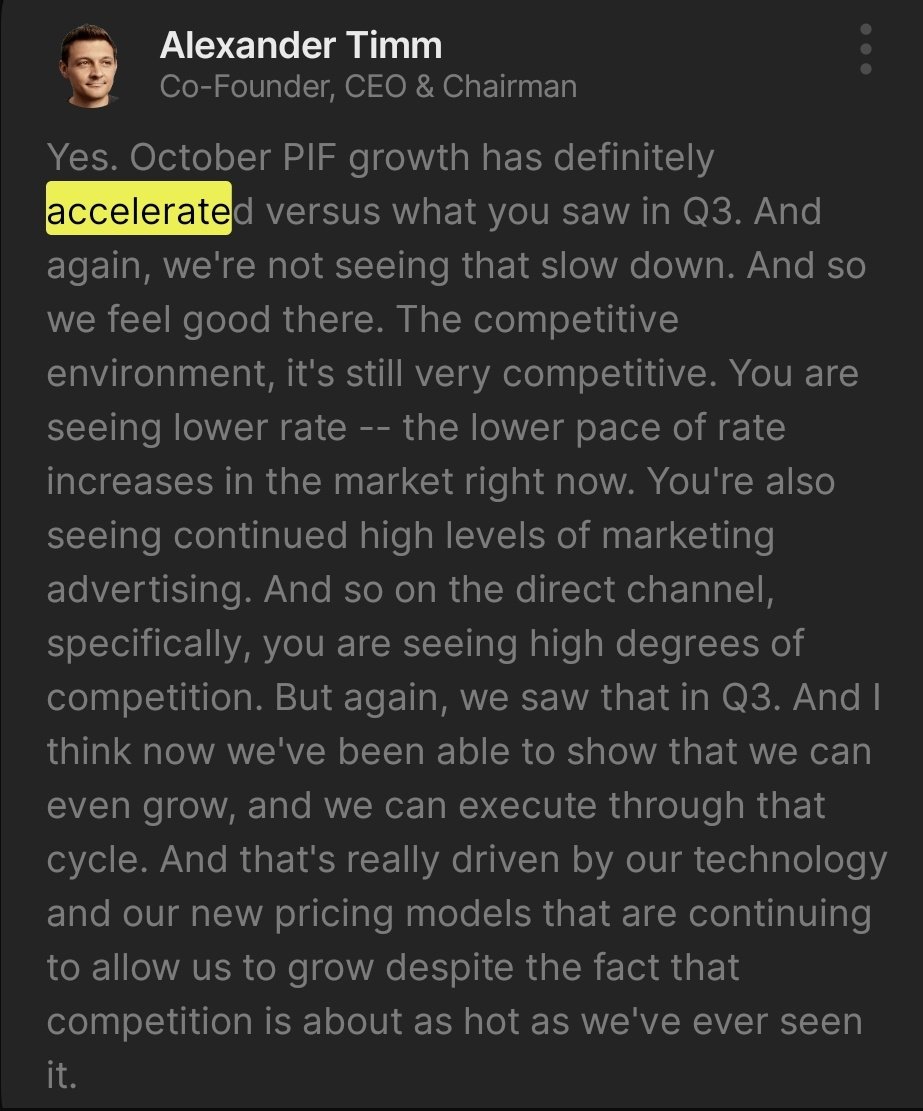
Alex Timm addressed the opportunity during the earnings call, noting that price-comparison websites, which are sites like Experian, have historically been a significant source of direct customers for $ROOT. However, some of that customer segment experiences higher churn. He acknowledged that these channels aren't seeing the kind of meaningful growth the company would like at this time, but Timm mentions $ROOT's market share within these price-comparison platforms is already substantially higher than its share across the broader market.
Timm further pointed out that the company has historically nearly doubled its direct business over a 12 month period when it captured emerging trends ahead of competitors, and believes $ROOT is well positioned to potentially do this again if these segments begin again to grow more meaningfully. Unfortunately, we didn't see this translate into more meaningful policy growth, despite the data we saw.
$ROOT ultimately ended Q3 with 484,037 policies in force, compared with 483,921 in Q2, essentially flat sequentially, but that does not mean the work they are doing underneath is not compounding.
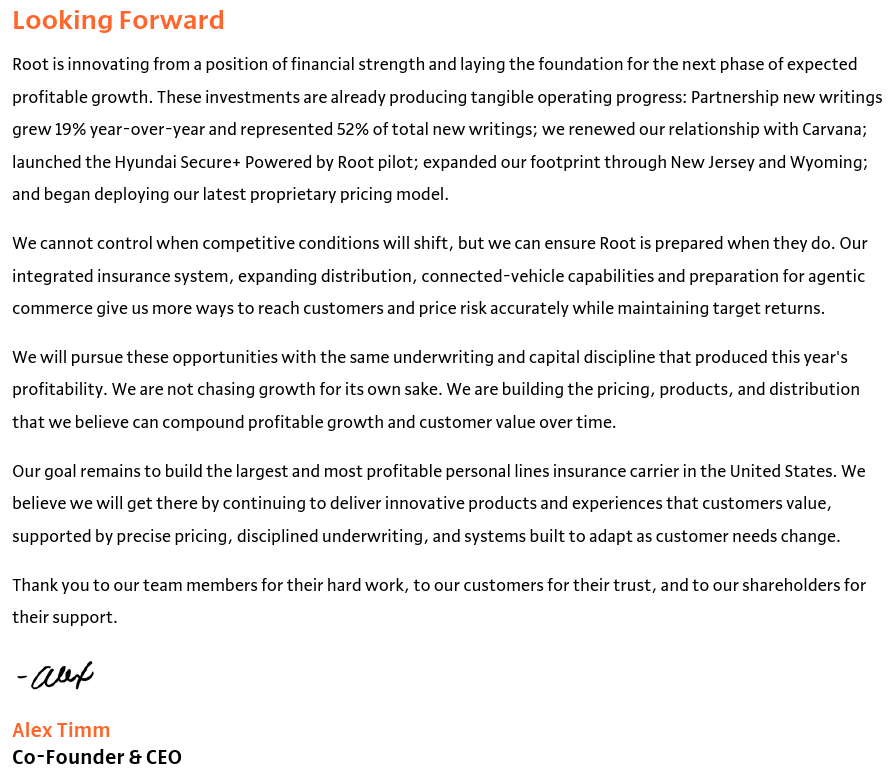
I don't think PIF growth, or lack there of in this period, tells the entire story. Partnership and independent-agent new writings grew 19% year over year and accounted for 52% of total new writings, compared with 44% a year ago - a meaningful shift in where new business is coming from, particularly as $ROOT becomes less dependent on direct customer acquisition.
Management has also been deliberate about not pursuing growth at uneconomic acquisition costs. I'd rather see that discipline maintained than watch $ROOT buy policies simply to improve its headline growth figures.
$ROOT reported $381.3 million in revenue, slightly below analyst expectations, while EPS came in at $0.86, well ahead of consensus by ~41%.
One of the primary factors affecting revenue was lower premiums per policy, which declined approximately 8.9% year over year, from $1,581 to $1,441.
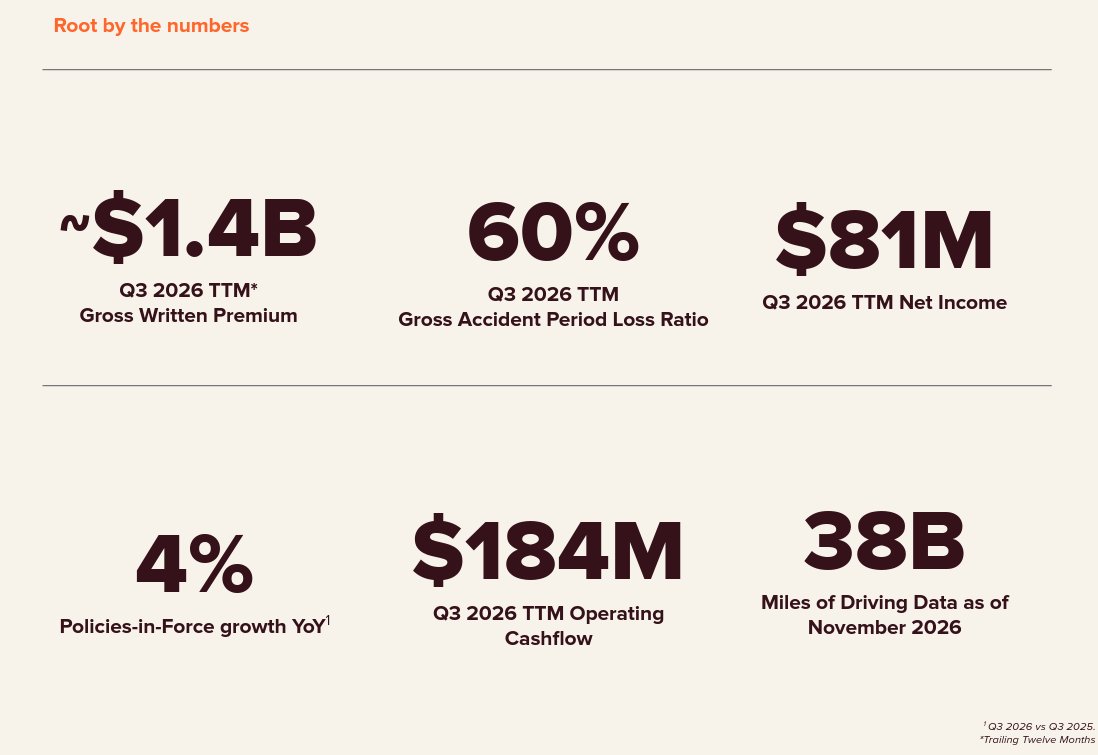
This is something worth understanding rather than automatically interpreting as deterioration. $ROOT has been making pricing adjustments across several states, becoming more competitive while continuing to improve its ability to identify and price risk. Lower premiums naturally affect revenue, but the objective is to bring in more customers without sacrificing underwriting profitability, which remains a core strength. $ROOT delivered a 97.2% net combined ratio in Q3, improving 4.9 percentage points YoY. For the first nine months of 2026, the combined ratio was 93.5%, compared with 97.7% during the same period last year.
$ROOT generated $72.1 million in net income through the first nine months of 2026, compared with $35 million during the same period last year. Adjusted EBITDA also increased approximately 30%, reaching $134.1 million.
Sequential profitability has slowed, but the YoY improvement is substantial. $ROOT is building a business that can generate meaningful earnings while continuing to invest in its technology and distribution.
Distribution is where I think the next opportunity lies for $ROOT. There are several developments that could become increasingly important over the next few quarters.
$ROOT renewed and extended its $CVNA relationship through August 2028, with more than 250,000 policies written through the integrated insurance experience since September 2022. This is an established distribution channel that puts $ROOT directly in front of customers at the point of vehicle purchase.
Then there's Hyundai Secure+ Powered by Root, which launched across 14 dealerships in Arizona. Eligible customers financing or leasing a new Hyundai through Hyundai Capital America can receive six months of $ROOT insurance at no cost. 👀
However, to be clear, I wouldn't expect 14 dealerships to produce breathtaking policy numbers immediately. We could be talking about hundreds or perhaps a few thousand policies as the program develops, rather than something that materially changes the company's financials overnight.
I think the significance is much bigger than the initial numbers. If the pilot demonstrates that integrating insurance into the vehicle purchasing process works, the opportunity to expand that relationship becomes considerably more important.
Q4 is where I believe we could start seeing some movement, and even modest expansion or early evidence of traction would be encouraging. I'm particularly interested in whether this relationship eventually develops beyond the initial promotion into a more integrated insurance offering that subsidizes a customer's insurance rate.
Independent agents continue to also be an area worth watching. $ROOT continues to expand its network, and the fact that partnership channels now account for more than half of new writings shows that the distribution strategy is gaining traction.
The company also now operates in 38 states, covering approximately 82% of the US population, with near-national coverage targeted by the end of 2027.
Beyond the partnerships, management made it clear that expanding the partner platform remains a priority, particularly across automotive and financial services. These relationships don't all need to begin as fully embedded insurance products; $ROOT can integrate at different levels, with the opportunity to deepen those relationships over time. Management also discussed continuing to add new independent agents and developing additional top-of-funnel marketing channels to broaden customer acquisition.
The latest pricing and segmentation model also launched early in Q4, with rollout continuing through the first half of 2027. Management believes this specifically could materially benefit growth. They're also preparing for changes in how customers shop for insurance through AI-assisted and agentic commerce like $META, where $ROOT's API-based infrastructure could make it easier to integrate its pricing and underwriting into new shopping experiences. Connected vehicle data and deeper OEM integrations continue to offer another avenue to improve pricing and develop more integrated insurance products for the industry.
One milestone I'm watching is $100 million in TTM net income. $ROOT entered Q4 with $77.2 million in TTM net income, including $5.1 million from Q4 2025. With that quarter rolling off, $ROOT needs to generate $27.9 million in Q4 2026 to reach the $100 million mark.
At the current market capitalization of approximately $659 million, $100 million in TTM net income would represent an earnings yield of roughly 15%. In other words, the company would be generating annual earnings equivalent to about 15% of its current market value! That's a substantial amount of earnings relative to the valuation the market is currently assigning to $ROOT - that's insane!
Management did indicate that Q4 could experience some seasonal pressure on claims, with the accident period loss ratio expected toward the upper end of its 60–65% target range. There are also approximately $5M in planned marketing R&D initiatives to test additional acquisition channels.
The $18.3 million property acquisition disclosed in the filing will also affect how we look at Q4. This is a capital investment in real estate, improvements and fixtures, not an $18.3 million operating expense that gets deducted from Q4 earnings. The cost is capitalized on the balance sheet and recognized over time through depreciation, so investors should not treat the full purchase price as an immediate hit to earnings. It does, however, represent a cash outlay.
$ROOT also repurchased approximately $36.4 million in shares under its $75 million buyback authorization through September 30th, retiring approximately 700k shares. The remaining authorization gives the company continued flexibility to return capital to shareholders.
Where I stand:
I would have liked to see more policy growth in Q3, particularly given the competitive pricing $ROOT has achieved in so many states. That's something I want to see improve, and I don't think we should lose sight of it.
At the same time, I don't believe the longer-term thesis rests on one quarter of policy growth, and investors shouldn't be looking at it that way. $ROOT has spent years developing its proprietary driving data, pricing models, and distribution infrastructure. We're now seeing those capabilities increasingly connected to larger partnerships and additional customer acquisition channels.
One other thing I've appreciated is seeing greater engagement from $ROOT management, especially here on X! Jason Shapiro (@JasonShapi4568), SVP of Business Development, has been interacting directly with investors and starting to take part in the conversation and it's encouraging to see that new level of accessibility and interest in engaging with the shareholder community! Very excited to have Jason here on X!
I think Q4 and the first half of 2027 could be particularly important periods for $ROOT. The Hyundai relationship has room to develop, the new pricing model is rolling out, and the independent-agent channel continues to grow.
The profitability is already here, we just need the growth to kick in!
That's ultimately what should unlock the next stage of the business, and I will be here for it when it happens!
One final thought - I think this is the stage where investors should be paying close attention to the opportunity in front of them. By the time the growth is clearly showing up in the numbers, the market may have already repriced $ROOT considerably higher. Waiting for that confirmation can mean paying a much higher price for the same earnings and growth potential, while giving up a meaningful part of the upside and the compounding that comes from owning a position earlier. There is obviously risk in getting ahead of the numbers, but that's also where the opportunity can exist for investors willing to look beyond the next quarter.
I am long $ROOT, these are my opinions, and this is not financial advice. Good luck @RootInsurance, looking forward to the coming quarters! 🔥
As Alex said on our earnings call, customers may skip traditional insurance shopping as agentic commerce takes off. Winners will own the in-house tech stack to deliver the full experience digitally. Root built on that. Carvana and Hyundai Secure+ already skip shopping entirely.
if $root reaches industry avg margin, we're looking about a look-through PE of 6. Ask yourself whether you think the growth will be high enough to justify a 6 PE. Next consider the likelihood of better than avg margins being built on modern systems, no technical debt etc.
$ROOT is my number one pick for 2026 👀
At 27% YoY growth on $1.447b revenue and a simple re-rate back towards 3.0 PS, in one year's time, we should be around $300/share 😎
$ROOT is disrupting the auto insurance industry with their tech, AI, and industry leading loss ratios 🤠
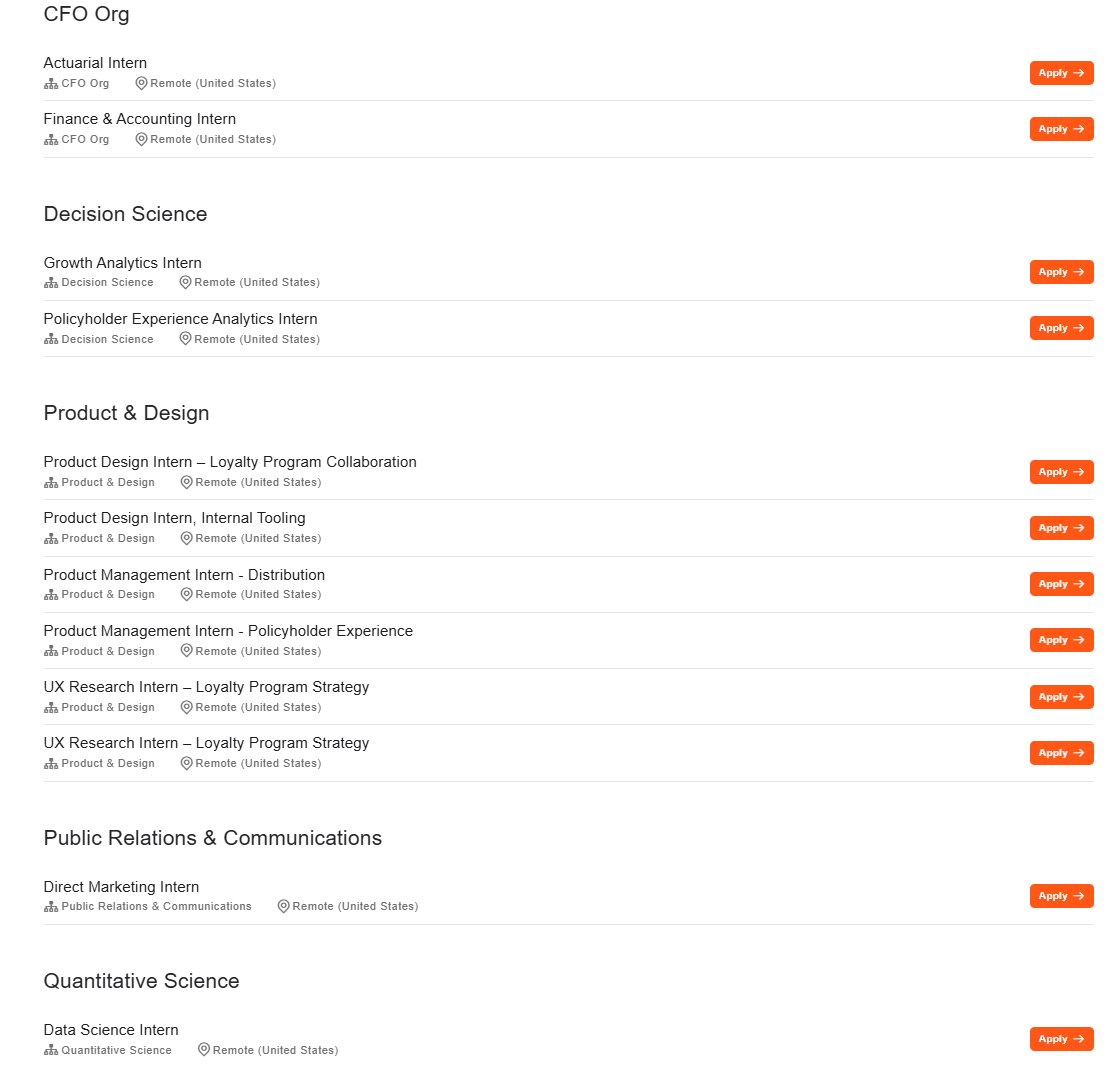
$ROOT is seeking a dozen different positions to be filled with interns starting mid 2026.
Mold talented interns to the company's culture and systems, then hire the ones that fit best among them permanently. 🙂
The bull case for $ROOT is that they're already the lowest cost provider for auto insurance when you try to get insurance from $SOFI or $GSHD.
And with that, SoFi and Goosehead can easily sell Root insurance coverage to their clients.
@Ironic_Ape yup, since they track funds. pretty normal to see allocations in all names. though, when their allocation becomes a much larger percentage of normal, than it becomes more eye opening.
institutional ownership of $ROOT continues to creep up, with massive buys throughout from todays filings. Blackrock coming through with 178K shares added, bringing their position to 6%~.
institutions now own 86.33% of $ROOT according to fintel. Thats not inclusive of insider ownership of ~12%, and some overlap of fund trackers(25%+).
shares are getting pretty tight here for shorts.
Long term, ROOT will embedded with OEMs offering both personal and product liability. its already happening with Hyundai & others to come. ROOT has been underwriting AV code since IPO.
secondly, its straight sci fi to think AVs will reduce accidents in the short-medium term. The reality is $TSLA has 2X+ the accident rates. Reliance & errors will increase frequency across the board, increasing insurance premiums. If anything, AVs means ROOT is a buy hands over fist, as insurance becomes more expensive.