Ministry Leadership professor at Bethel Seminary. Learner. Former coach. Three kids in high school and college. Wife pastors at City Church in Minneapolis.
Here is my YouTube video introduction and reading tips for the historical fiction book Death Comes for the Archbishop (1927) by Willa Cather.
https://t.co/XMW7PBSRP2
Finished rereading The Brothers Karamazov by Fyodor Dostoevsky today, which I'm teaching soon. It was beneficial to be immersed in that world for 40 hours thinking about how people can passionately mess themselves up and how goodness can be a solace and path through the chaos.
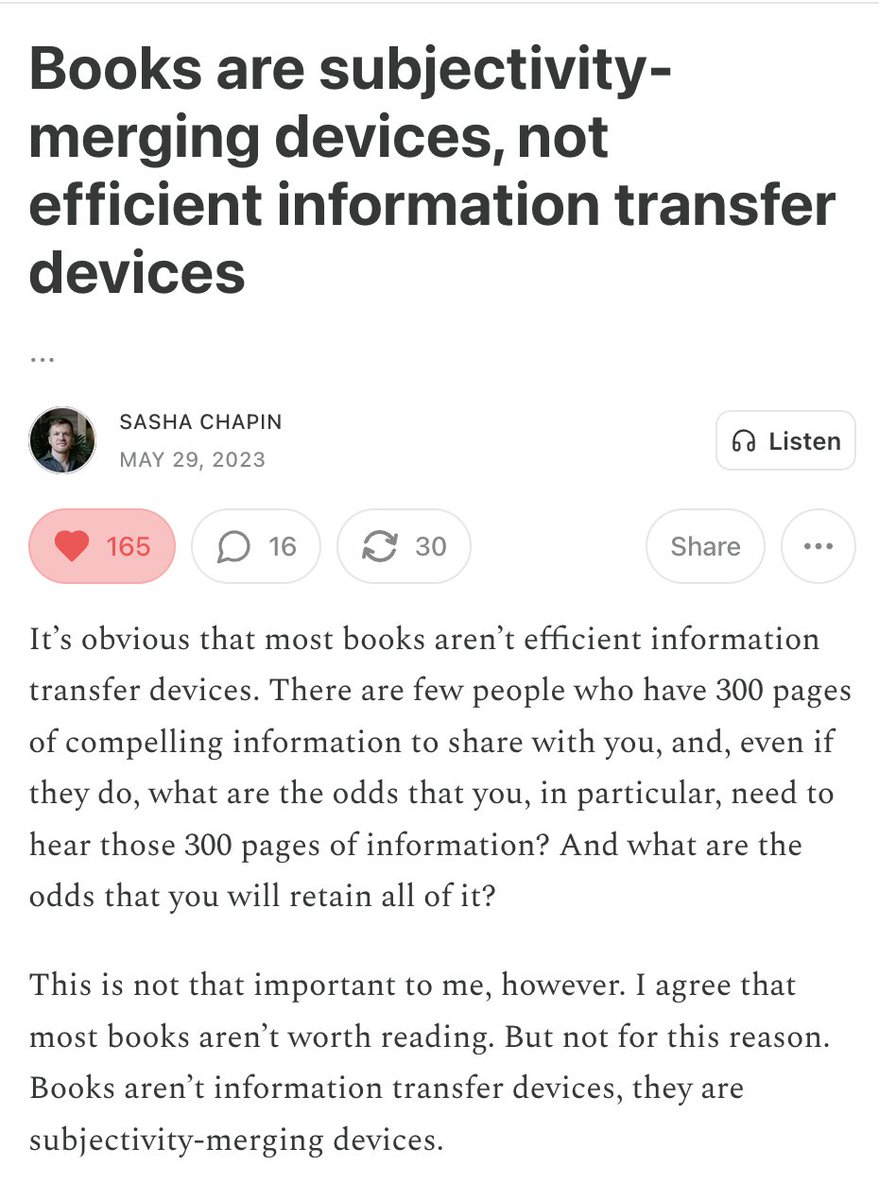
now that AI makes information consumption and transformation easier than ever I would like to bring back this old banger by Sasha Chapin about how books are not information transfer devices but subjectivity-merging devices
in fact I would say content consumption in general is more about subjectivity-merging than information transfer, which is why I am generally much more interested in writing by humans than by AI
In 2018-2019, 46% of people who attended a congregation in the U.S. attended one where women can be head clergyperson.
https://t.co/cR8y7MhjvR
59% of people attended one where women can preach at a main worship service.
https://t.co/gZoa7Tgytk
National Congregations Study from Duke's Mark Chaves: 57.3% of white conservative Christians attend a church where women can preach at a main worship service.
https://t.co/Oaa13pBQ8l
And @ryanburge says more than 63% of evangelical weekly attenders support women preaching.
@BaseballDudes48 I'm just saying coaches should be patient with the kids who are a bit wild and rambunctious and emotional. Coaches in all sports tend to be the hard-working cerebral types so they often try too hard to get the unusual (tall or fat or fast or strong) kids to be tamed and conform.
@BaseballDudes48 Yes, these are things taught to youth ages 7-15, perhaps? My son and I could both throw strikes. I ended up as a college second baseman. Good shooter in basketball too. Accurate thrower as a quarterback. And we also got hit hard. I still throw great BP.
Pitchers have *velocity.*
New Research from Church Answers: 55% of Southern Baptists affirm male-only pastors. In May 2026, we surveyed 1,786 Christians who believe the entire Bible is true and asked them about women in ministry. Our goal was to discover what people in the pew actually believe. The responses reveal a divided yet important pattern: Southern Baptists are more likely than the overall sample to affirm a male-only pastoral office. Still, even among Southern Baptists, the view is not held with overwhelming consensus. https://t.co/8XaysZdJcL
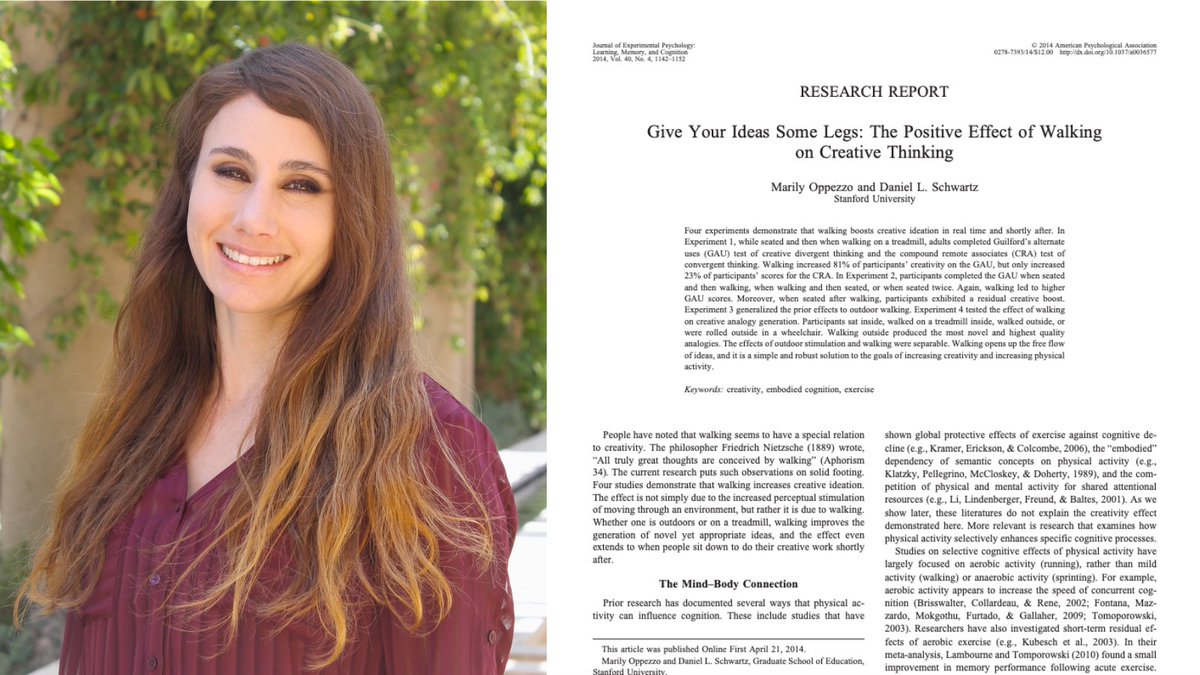
A Stanford psychologist spent 4 years proving that the simple act of walking generates 60% more creative ideas than sitting, and the experiment she designed to kill every alternative explanation is one of the most decisive findings in modern psychology.
Her name is Marily Oppezzo.
She got the idea for the study while walking with her advisor at Stanford to discuss her thesis topic, and the paper she eventually published in the Journal of Experimental Psychology in 2014 is sharp enough that it should have ended the seated meeting on the day it came out.
She ran 4 experiments on 176 people. Same person tested twice. Once sitting, once walking. The creativity tasks were the standard ones psychologists have used for decades to measure how good a brain is at generating novel useful ideas.
The result was almost too clean to publish.
81% of participants in the first experiment produced more creative ideas while walking than while sitting. In the second experiment, 88%. In the third, 100%. Every single person walked into a more creative version of themselves.
On average, people generated 60% more novel useful ideas the moment their legs started moving.
The skeptical question is the obvious one. Maybe it was the fresh air. Maybe it was the scenery passing by. Maybe it was the change of environment doing the work, not the walking itself.
Oppezzo killed every one of those explanations with one experimental decision.
She put people on a treadmill facing a blank wall. No scenery. No fresh air. No environmental change. Just legs moving in place while staring at white drywall. The 60% boost held.
Then she ran the experiment that closed the case completely. She took participants outside in two conditions. Half of them walked through a Stanford courtyard. The other half were pushed through the exact same courtyard in a wheelchair. Same outdoor stimulation. Same scenery passing at the same speed. The only difference was whether the legs were moving.
The walkers produced dramatically more novel high-quality ideas than the wheelchair group. The outdoors did almost nothing on its own. The walking did everything.
This is the part of the study that hit hardest when I read it the first time.
She also tested the opposite kind of thinking. Convergent thinking. The kind where there is one right answer and you have to narrow down to it.
Word puzzles where 3 words share a hidden fourth word that connects them. The seated participants did slightly better on these. Walkers got slightly worse.
Walking is not a general intelligence enhancer. It does one specific thing. It opens up the divergent search inside your brain. The part that generates options. The part that produces unexpected connections. The part that takes a problem and finds five ways into it instead of one.
When you need to converge on the single right answer, sit down. When you need to find the answer in the first place, get up.
The mechanism is now well understood. Walking selectively activates what neuroscientists call the default mode network, the system inside your brain that runs when you are not consciously focused on anything. The DMN is where mind-wandering happens. Where memories cross-reference each other. Where ideas that have been sitting in separate folders inside your head finally bump into each other.
When you sit at a desk and force yourself to concentrate, you suppress the DMN. When you walk at a natural pace, the executive part of your brain gets just busy enough handling the walking that the DMN comes online and starts doing the work that focus was blocking.
The most useful finding in the entire paper is the one almost nobody quotes.
The boost did not turn off the moment people stopped walking. Participants who walked first and then sat back down stayed elevated. Their next round of seated creativity work was still significantly better than people who had been sitting the whole time. The rest lingered for at least several minutes after the legs stopped moving.
You do not need to do creative work while walking. You need to walk before the creative work. The brain holds the state.
The history of this is the part that should haunt anyone who still does meetings in chairs.
Charles Darwin built a gravel loop behind his house in Kent called the Sandwalk and walked it 3 times a day for the rest of his life. The theory of evolution was developed one lap at a time on that path.
Nietzsche walked up to 10 hours a day during the years he wrote his most important books and openly said the work was conceived on his feet.
Beethoven composed for the morning and walked for 5 hours every afternoon with a pencil in his pocket for when something landed.
Kahneman said the best thinking of his Nobel Prize-winning career happened on leisurely walks with Amos Tversky. Steve Jobs refused to take important conversations sitting down. He held them on foot.
Every one of them was using the system Oppezzo would not measure until 2014. They just did not know what to call it.
The question worth sitting with is the one almost nobody asks.
Every meeting you have ever attended sitting around a table was a meeting held at a fraction of the brain power that was actually available to the people in the room. Every brainstorm that got stuck inside a conference room. Every problem you tried to solve at a desk and gave up on. Every idea you could not quite get to.
The intervention is the easiest one in modern science. No supplement. No app. No subscription. No training program. Just a pair of legs and 15 minutes.
The Stanford lab proved it. The philosophers knew it. The neuroscience explains it.
And almost everyone reading this is still trying to think their way out of problems sitting completely still.
@gpackiam Yes, thanks.
Here is my syllabus for my MDiv leadership course that finished yesterday.
https://t.co/auzxb6hmev
And I'm in the process of redoing the lectures for it.
https://t.co/tcqXrVTT8z
I'm working on a book proposal with Kristen Padilla at Baker Academic. Warm greetings.
@MusingsOnChrist@pastordmack You wrote a book on this I haven't read but my two cents is with Miroslav Volf in "After Our Likeness" that a church has pretty minimal requirements: "where two or more are gathered" in the name of Jesus. And Paul doesn't say bad churches (in Galatia and Corinth) aren't churches.
Finished "Kristin Lavransdatter" by Sigrid Undset (1922). Undset won the Nobel Prize for Literature for it in 1927. I'm still recovering from the last sixth where Kristin watches her children set off on their own and grapples with the past. Whew. Recommended.
I wrote this book in part because the most common question I got from readers of Range was something along the lines of: "I've had diverse experiences; I have a broad toolkit; I'm curious about everything, but I have trouble figuring out what to do." ...And I put myself in that same boat. At some point, you have to channel that into actually doing something.
So I wrote the book I needed—a companion to Range that I felt was responsive to the question I kept getting. I appreciate everyone who has taken an interest in it.
"we can state that at least 10 sets per week per muscle group is optimal, that eccentric contractions seem important, very slow repetitions (≥10 s) should be avoided, and that blood flow restriction might be beneficial for some individuals."
2022 paper: https://t.co/YFAWiDWbXL
I've been doing this work a long time but nothing prepared me for what I saw on a recent reporting trip in Somalia. I was there to look into rising food and fuel prices from the war in the Middle East landing atop dramatic cuts to the international humanitarian relief system.
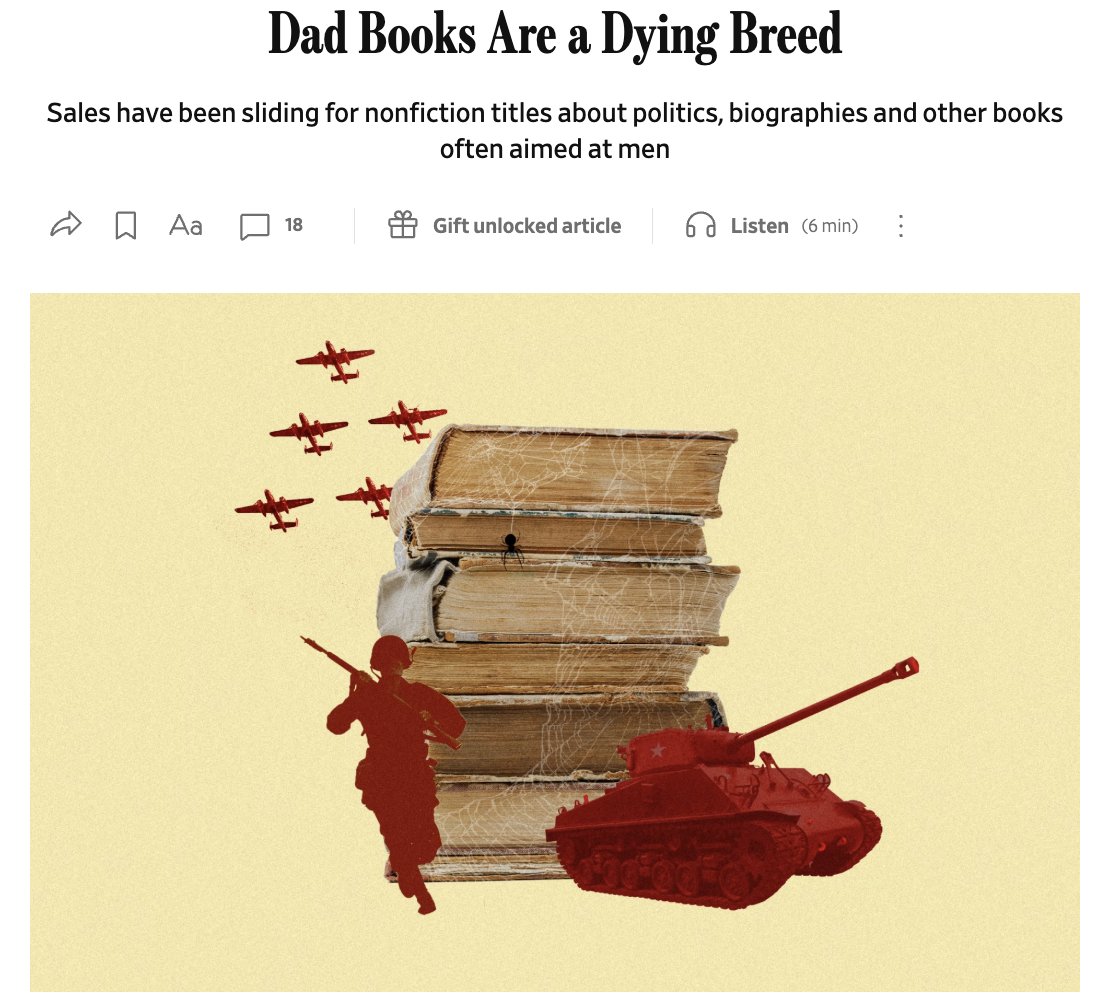
"Dad books" — which this article, and some publishing insiders, use to describe "serious nonfiction" books across biography, current affairs and business and economics — are reportedly in a free fall, with sales declining every year for the last few years
“The trend couldn’t be clearer,” said Jonathan Karp, the former chief executive of Simon & Schuster and publisher of the new Simon Six imprint.
“When we have internal meetings to talk about this problem, it always comes around to podcasts,” said Jonathan Burnham, president and publisher of the Harper Group at HarperCollins Publishers.
Most of these men have been completely disqualified from ministry by every biblical standard.
I will absolutely take crap for saying so.
I just feel like we are living in the twilight zone. Where is any semblance of accountability??? Must it always come from outside the church?
Professors teaching AI-exposed classes gave out about 30% more A’s and fewer A-minus and B-plus grades, that is a lot!
And the labor market is responding "Grades became less important in recent years for graduates seeking that first job out of college. Now, though, some companies are slammed by huge numbers of entry-level applicants. As the job market cools, they are both raising the bar for entry-level jobs and seeking more consistent criteria to winnow the candidate pool."
Grade inflation has been happening for decades and AI is accelerating it even more rapidly. It is incumbent upon professors who are serious about maintaining their classroom rigor and standards to make their assignments less exposed to AI, this means more in-class assignments and assessments.
#gradeinflation #highereducation #AI #ChatGPT @WSJ
https://t.co/FADy8qXcET
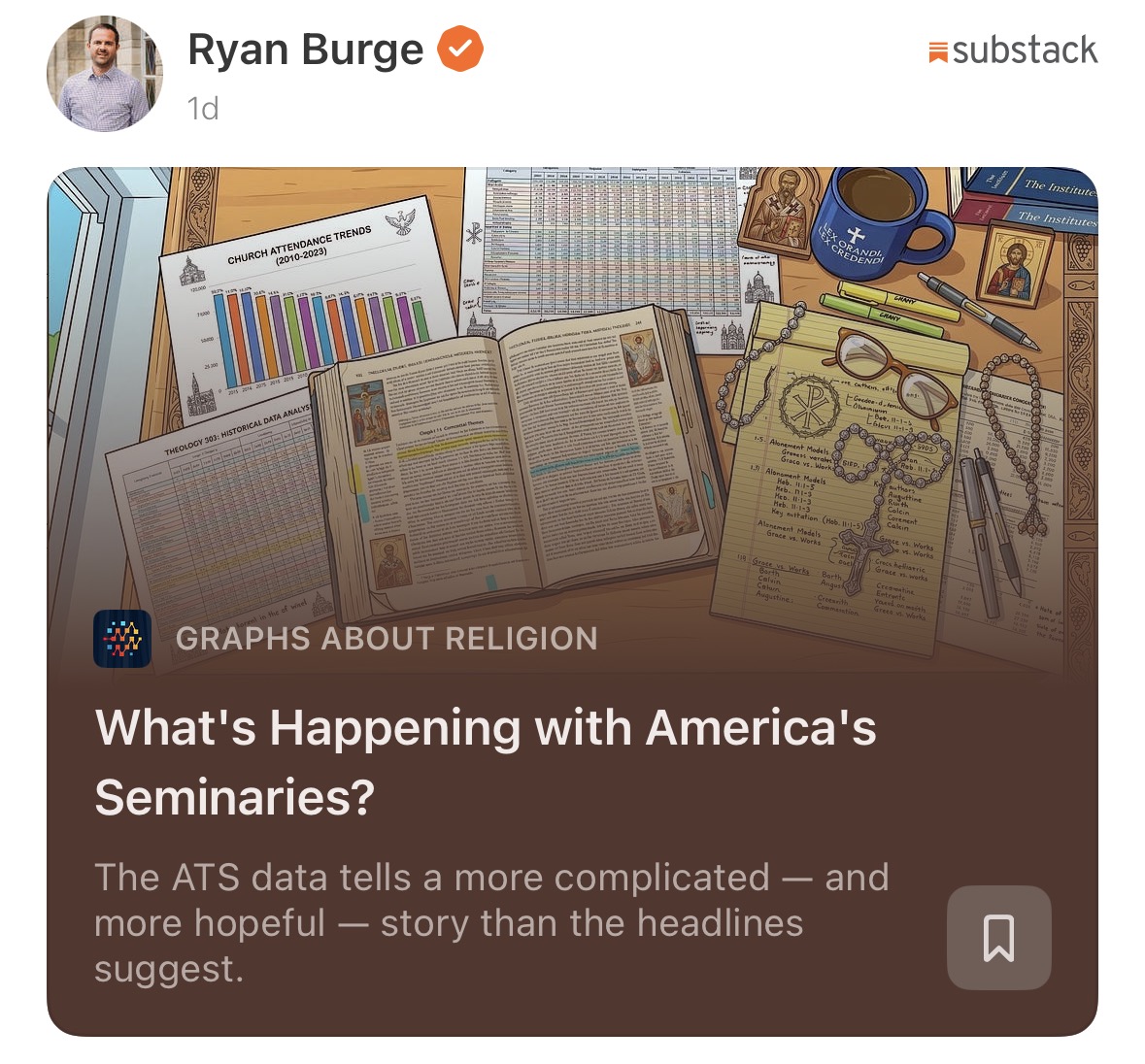
A few quick thoughts on seminary stats on growth and size, interacting with @ryanburge's fascinating and informative research on "What's Happening with America's Seminaries?" https://t.co/yLCdlZI2eK