btw anthropic's internal document on this literally said "we don't want it to be known that we are working on this.”
it was called project panama.
here's exactly what happened:
1: anthropic concluded that books were the cheapest way to build a world-class model because they gave claude curated facts, structured arguments, compelling stories, and writing “an editor would approve of.”
2: once anthropic decided it needed books at enormous scale, its first solution was piracy.
it downloaded 7m+ books from online libraries including libgen. the judge later wrote that although anthropic had legal ways to buy them, it chose piracy to avoid what dario amodei called the “legal/practice/business slog.”
3: that piracy created a massive legal risk.
so in february 2024, anthropic hired tom turvey, the former head of partnerships for google books, to find a legally safer way of obtaining “all the books in the world.”
4: turvey first contacted major publishers about licensing their catalogs.
those attempts didn’t produce agreements, so anthropic chose a route that required no publisher permission: buying millions of physical books through distributors and used-book retailers.
5: within about a year, anthropic spent tens of millions acquiring and scanning millions of books, including many rare and 1/1 titles. one vendor proposal targeted 500,000 to 2 million books in six months.
6: to scan that many books within months, the vendors physically dismantled them.
a hydraulic cutter removed each spine. the pages were trimmed to size, fed as loose sheets through high-speed industrial scanners, and converted into searchable PDFs. the paper remains were then sent for recycling.
7: these PDFs were fed into claude as training data.
the complete collection became a private, searchable anthropic library that the company planned to “store forever.” the scans aren’t available to the public and were never open-sourced.
Some folks don’t believe that a “principled AI company” would destroy books after they suck out all the information for their models, even one-of-a-kind books and manuscripts.
Here it is admitted in open court.
🦔AI companies are bulk-buying rare books, scanning them through high-speed machines that cut the spines off, and shredding the originals. A service called ISBNdb facilitates orders of up to a million books and keeps buyers anonymous. Pre-2022 books are premium because they're free of AI-generated text. A federal judge ruled the practice is fair use because eliminating the original means only one copy exists at a time. Anthropic hired the former head of Google Books partnerships to obtain "all the books in the world."
My Take
This got to me. A bookseller told 404 Media that rare books with almost no surviving copies are being fed into this pipeline. Books that survived wars, fires, and centuries of handling are being shredded so an AI can learn to write a better marketing email.
ISBNdb's website literally says "'AI company destroys two million books' is not a headline that generates sympathy," and they still built an entire business around making it happen quietly. They offer NDAs as a feature. They coach clients to call it "digital preservation."
I've covered AI companies scraping the internet, torrenting libraries, and stealing music. This is worse because it's irreversible. You can re-upload a website. You can reprint a bestseller. You can't replace the last three copies of an 18th-century botanical text once someone shreds them for training data. And the judge said it's legal. So it's going to accelerate.
"We shred rare books and offer NDAs so nobody finds out" is a legitimate business model in 2026. What a timeline.
Hedgie🤗
Vibe coders are getting sued.
People are shipping apps with real users and skipping the boring stuff that kills them.
A 20+ year dev shared the pre-launch checklist every AI builder needs.
I added what I learned after shipping 60+ apps at the agency.
Don't skip this:
1. Protect yourself, not just your app. The moment you collect user data you're in legal territory (GDPR, CCPA). Have a privacy policy. Know where user data lives.
2. Row Level Security. Without RLS, anyone can open DevTools and read your entire database. Supabase → Auth → Policies. Zero policies means your app is naked. 5 min to fix.
3. Test the failure path, not just the happy path. Wrong password 5x. Reset for an email that doesn't exist. Verification link clicked twice. Signup with an existing email. Catches 80% of auth bugs.
4. Security baseline in 2 min. Prompt your AI: "Review my app as a security specialist and make sure I have strong security headers and a solid baseline security posture."
5. OWASP. Prompt: "Review my app against OWASP standards and highlight vulnerabilities." This is where SQL injection, XSS and auth bugs actually get caught.
6. Client-side validation is UX, not security. Attackers disable JS and hit your API directly. Validate again on the server. Every time.
7. AI code leaks data in 3 spots: .env values in the frontend, API responses returning too much, secrets in logs. Prompt: "Check my app for credential or sensitive data leaks in frontend or API routes."
8. API keys in the frontend means game over. If it's in the browser, assume it's already taken. Move it server-side or proxy it.
9. Rate limits before someone burns your API bill. Cap every endpoint hitting a paid API. I've watched a Supabase bill jump from $20 to $200 in a day.
10. CAPTCHA on public forms (Cloudflare Turnstile is free) plus CORS locked to your domain. 10 min, kills bot floods.
11. Error messages that don't leak. "User not found", not "SELECT * FROM users failed". Log full errors server-side, show users generic messages.
Build fast. Just don't ship naked.
(full breakdown in my article below)
@MidnightDist@Smokeouters@muhfuknfunnyguy@KingJames The remaining players would have to evolve then! Jalen Brunson evolved from a role player on the Mavs. James Harden evolved from a role player on the Rocket.
More opportunities for people to prove themselves if we being real.
“IF YOU'RE IN THE TOP 10, IT'S AT LEAST $10M A YEAR, IT'S LIKE THE LOWEST”
that was Roblox dev's response to the question of how much the top 10 creators earn
that’s a large sum, but it’s four times less than the actual figures.
by 2025, the top 10 Roblox creators earned $40M each!
and now, the barrier to entry into this niche is significantly lower.
you don’t need a team to create a game, and you don’t need to be a programming guru, all you need is Roblox Studio and Claude Code
they’ll do everything for you
you just need to write prompts and explain what you want to do
in this article, i also explain how to set it up, create game, and promote it properly
save this so you don’t lose it ↓
@ShaunStewart@bridgemindai Agree with this. is @AnthropicAI going to continue downgrading you to 4.8 when the sensitive coding flag goes off for regular work?
hello there the jacobian conjecture is false thanx to my close friend akhil for asking about it and my other close friend fable for working during the world cup final
((1+xy)^3 z + y^2 (1+xy) (4+3xy), y + 3 x (1+xy)^2 z + 3 x y^2 (4+3xy), 2 x - 3 x^2 y - x^3 z): \C^3\to \C^3, has jacobian determinant -2, and sends (0, 0, -1/4), (1, -3/2, 13/2), and (-1, 3/2, 13/2) to (-1/4, 0, 0)
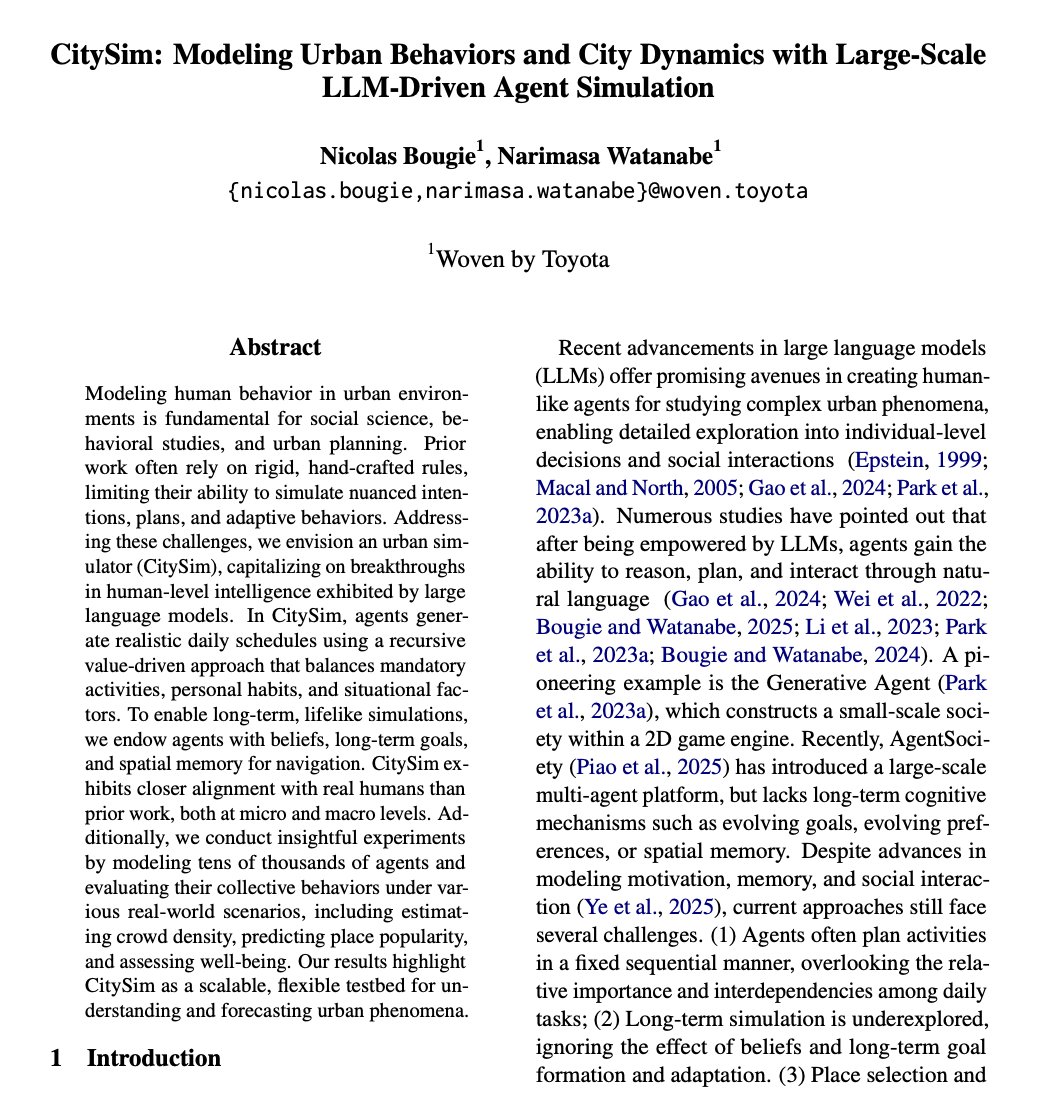
Japanese researchers created a system that simulates an entire city by generating up to 1 million virtual residents who behave like humans using LLMs.
And it predicted real-world with terrifying accuracy.
They created an urban simulator called "CitySim" that populates a digital twin of Tokyo with up to 1 million autonomous AI agents.
Each resident is powered by an LLM, complete with:
• Personal memories
• Long-term goals
• Human-like desires (hunger, fatigue, social connection)
• Spatial awareness and navigation
Most urban simulations rely on rigid, hand-crafted rules, if A happens, B follows.
CitySim is different. It’s "value-driven." The agents have agency. They generate their own schedules based on their personal habits, situational needs, and changing environments.
When researchers ran the simulation in Tokyo, the output was chillingly accurate.
Weekday commuting patterns, weekend leisure activities, and shopping habits matched Japanese government statistical data with near-perfect precision.
It even successfully predicted crowd distributions in Shibuya and identified which stores would actually become popular, months before the real-world data caught up.
The implications for urban planning are massive.
We can now safely and cost-effectively test disaster preparedness, commercial site planning, and public infrastructure upgrades without moving a single physical person.
But it’s not just about planning.
The researchers are already looking at implementing high-level human drives, like "self-actualization," into these agents to see how they evolve.
The paper went up on arXiv in June 2025 and almost nobody outside computational social science has read it.