The Surviving Sepsis Campaign has shaped sepsis care for decades. But do some of its core recommendations now lag behind the physiology and the evidence?
Rory Spiegel @TheEMNerd led this new dissenting opinion, which I was very pleased to contribute to.
We challenge:
• fixed 30 mL/kg fluid loading
• chasing lactate with fluid
• fluid responsiveness as a sufficient reason to give fluid
• pressure-centric resuscitation
• the omission of POCUS from modern haemodynamic assessment
• rigid bundle-driven care
The argument is not for less treatment. It is for more individualised, physiology-driven treatment of shock.
https://t.co/ImJeVAsbi1
The 2026 Surviving Sepsis Campaign Guidelines: The dissenting opinion
Spiegel et al. AJEM, just published.
Really interesting to see how clinicians behaved in a ‘crisis’…enforced rationing perhaps highlighted where old habits caused harm?
Take a look👇👇
@icmteaching commentates #FOAMed#POCUS#FOAMcc
“ When the fluid ran short, patients received 75% less. What happened?” https://t.co/hkh34sDpz6. 2026
Decongestion in heart failure: “looking better” is not enough. 💧❤️
Before discharge, the goal should be objective euvolemia, assessed through a multimodal approach:
→ Clinical congestion score + weight + NYHA
→ NPs: meaningful reduction (≥30%)
→ Echo: normalization of filling pressures
→ IVC: size and collapsibility
→ Lung ultrasound: ideally <5 B-lines
→ Chest X-ray: resolution of congestion
Residual congestion is one of the strongest warning signs for early rehospitalization.
👉 Don’t just treat symptoms. Treat congestion—and document decongestion before discharge.
#HeartFailure #Decongestion #LungUltrasound #Echocardiography #NTproBNP #Cardiology #ESC
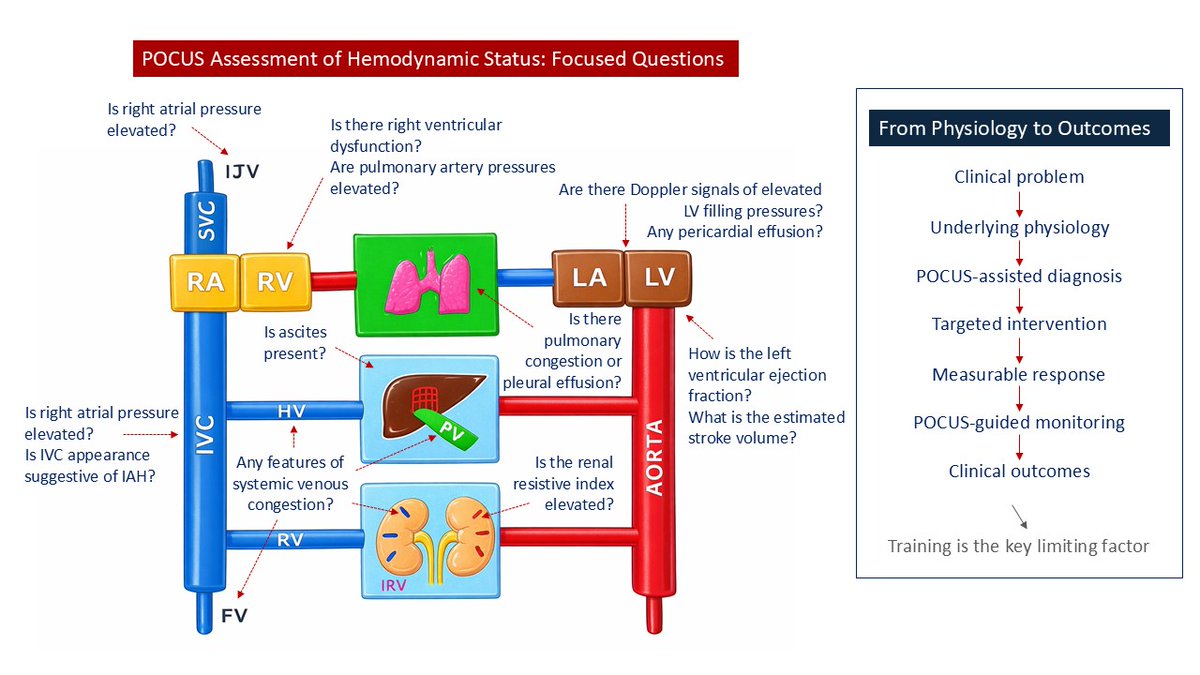
Hemodynamic circuit-based #POCUS assessment in #AKI organized around focused clinical questions.
#Nephpearls
🔗https://t.co/2BNNLNEm1a
*Not all questions, or the sonographic parameters used to answer them need to be applied in every patient, and the approach should be tailored to the clinical context. The inset highlights the translation of physiologic assessment into POCUS-informed clinical decision making, targeted intervention, and monitoring, with training as a key determinant of effective implementation.
This will hopefully be a big step forward for #POCUS in the UK and for @acutemedicine
Still much work to do to make it a reality, but thanks to everyone for their enthusiasm to get to this point
The goal remains to make this a core skill for all in ED, ICM, AIM. Let's do it!