It is now trite law that where two titles exist, the court will not balance equities. It will trace history, chronology, and legality, then decisively protect only the title with a lawful root.
This principle underscores importance of thorough due diligence in land transactions.
BREAKING: Court Draws a Hard Line on Adverse Possession - Years of Occupation, Construction and Silence by the Owner May Still Not Be Enough
In a closely watched land dispute that will resonate with property owners, developers, neighbours and investors alike, the ELC has delivered a powerful reminder in Kjaer v Hellback & another [2026] that adverse possession is not a shortcut to ownership. The case involved a homeowner who sought to acquire a portion of her neighbours' prime Nairobi property after occupying and developing it for years. She argued that she had fenced off the disputed section, planted a mature kei-apple hedge, erected a water tank, built a guest cottage and laid cabro paving, all while the registered owners allegedly watched without objection. To her, nearly two decades of uninterrupted occupation had extinguished the owners' title. But when the property was earmarked for sale and a survey exposed the encroachment, a fierce legal battle erupted over whether long occupation alone could transform a trespasser into a lawful owner.
In a decision carrying significant implications for Kenya's evolving adverse possession jurisprudence, the court rejected the claim and emphasized that the doctrine is governed by strict legal thresholds, not sympathy, assumptions or the passage of time alone. Justice Christine Ochieng found critical inconsistencies in the claimant's account of when the alleged adverse occupation actually began. While she asserted occupation dated back to 2004, evidence revealed that some of the most significant developments on the disputed land, including the guest cottage and paved sections, were only constructed around 2018. Equally important was the unique relationship between the parties: they were not hostile neighbors but close family friends who maintained an access gate between their properties and freely interacted over the years. The court held that such circumstances complicated any assertion that the occupation had been openly hostile, exclusive and adverse for the statutory twelve-year period required by law.
The ruling sends a clear and commercially significant message: adverse possession is not simply about being on someone else's land; it is about proving, with precision and evidence, the exact moment the occupation became unlawful, hostile and inconsistent with the owner's rights. Without that proof, even visible developments worth millions of shillings may fail to confer ownership. The judgment is likely to influence future boundary disputes, neighbor conflicts and land recovery claims by reinforcing that courts will scrutinize timelines, permissions, relationships between parties and the nature of occupation before stripping a registered owner of title. For landowners, the case is a warning not to ignore encroachments. For occupiers, it is a reminder that years of use, construction and investment may count for little if the legal clock cannot be clearly established.
Kindly retweet. 🙏
Aga Khan University Hospital v Warue & 2 others (Civil Appeal 28 of 2020) [2026] KECA 1043 (KLR) (29 May 2026) (Judgment) - https://t.co/A2SQLcQ3NT
⚖️ The Bench Speaks 📜
A 3-judge Bench of the Environment and Land Court, in the Southlands Estate Affordable Housing Case, has pronounced itself extensively on the nature, depth, and breadth of public participation and the imperative of a credible Environmental Impact Assessments (EIA) in undertaking major public investments projects, especially those mentioned as ‘high-risk’ under the Second Schedule of EMCA.
The Court has stated that ‘public participation forms an integral and indispensable component of the Environmental Impact Assessment process…[and] ..we opine that public participation is intended to operate as a preventive and deliberative safeguard, not as a post facto procedural formality aimed at decisions already made and substantially implemented’.
https://t.co/b93nOxD5Mf
@Kenyajudiciary@jsckenya@KMJA_KENYA@lawsocietykenya@NCAJ_KE
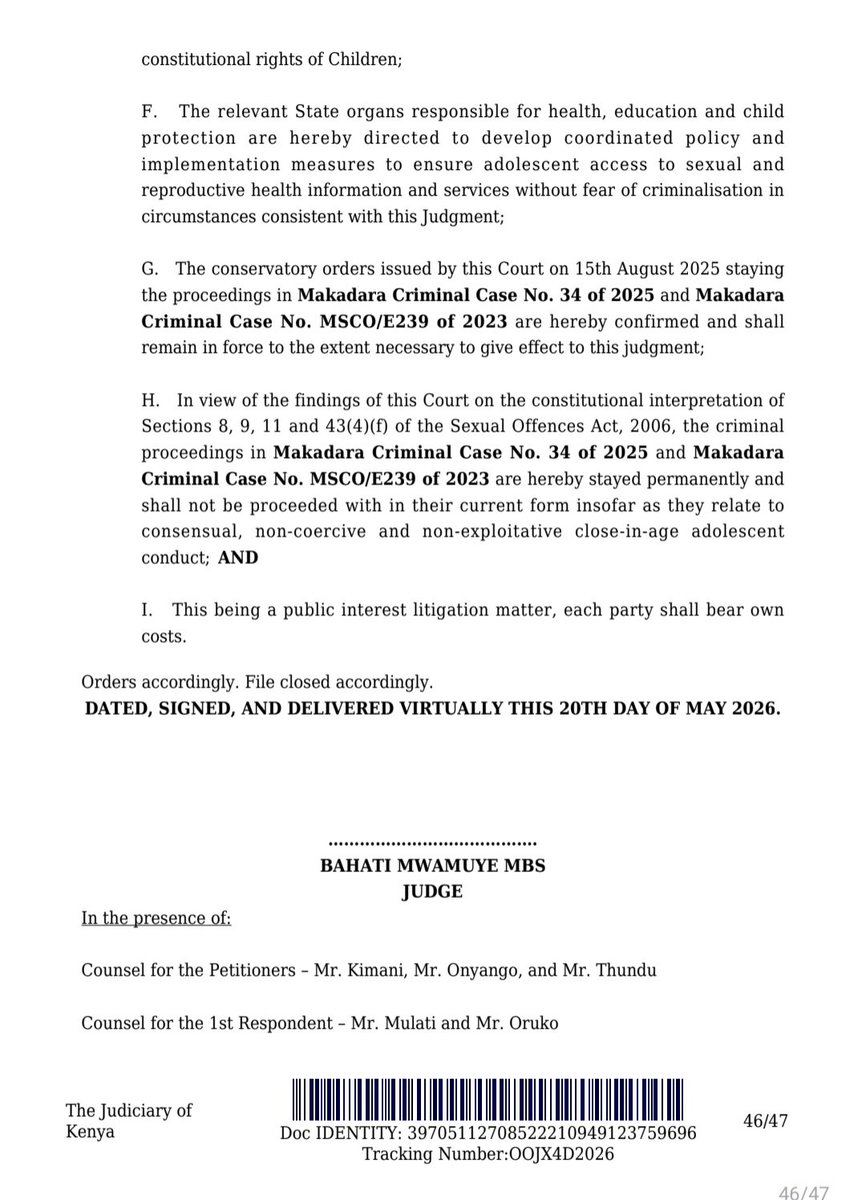
Yesterday, the High Court delivered a significant judgment in Petition E490/2025 (HSO & 3 Others v. ODPP & 4 Others) that will reshape Kenya's approach to adolescent sexuality and criminal law. The Court ruled that the misapplication of the Sexual Offences Act to prosecute adolescents engaged in consensual, non-coercive peer relationships violates their constitutional rights to equality, dignity, privacy, health, education and the best interest of the child.
This judgment addresses a documented tension in our legal framework. While the Sexual Offences Act was enacted to shield children from sexual abuse and exploitation, it has been applied broadly against adolescents in consensual peer relationships while ignoring their evolving capacities and driving them where they cannot access sexual and reproductive health services out of fear of prosecution. The Court's directives are clear. The ODPP must publish prosecutorial guidelines distinguishing consensual peer relationships from exploitative conduct, the National Police Service must review arrest protocols and State organs must develop coordinated policies ensuring adolescents can access SRH information without fear.
But we must ask the difficult questions. Against the backdrop of Kenya's escalating GBV and femicide crisis will this judgment inadvertently create loopholes that perpetrators exploit? The ODPP has previously employed diversion mechanisms in cases involving teenagers yet concerns persist about weaponization of these alternatives. The criminal justice system has failed women and girls through inadequate investigations, delayed prosecutions and impunity for perpetrators. Distinguishing consensual peer relationships from exploitation becomes so subjective that predatory conduct escapes accountability under the guise of consent.
Without precise legislative safeguards, we risk creating interpretive gaps that undermine hard-won protections for children particularly girls who bear the burden of sexual violence. Who determines genuine consent among adolescents of varying maturity levels? How do we prevent this progressive protection from eroding gains in combating child sexual abuse in a country grappling with what many have called a national GBV and femicide crisis?
Reform of the Sexual Offences Act remains urgent but it must be survivor-centered and grounded in the realities of GBV in Kenya. We need legislative amendments that protect juveniles from sexual violation without victimizing them for age-appropriate peer relationships while tightening enforcement against exploitation and abuse. The judgment's legacy will depend entirely on its implementation and future interpretation by courts and prosecutors. Only time will tell whether the promised guidelines will include safeguards that prevent manipulation by those who seek to exploit power imbalances. As we monitor this decision closely, one principle must remain non-negotiable, justice must protect the vulnerable not create new vulnerabilities.
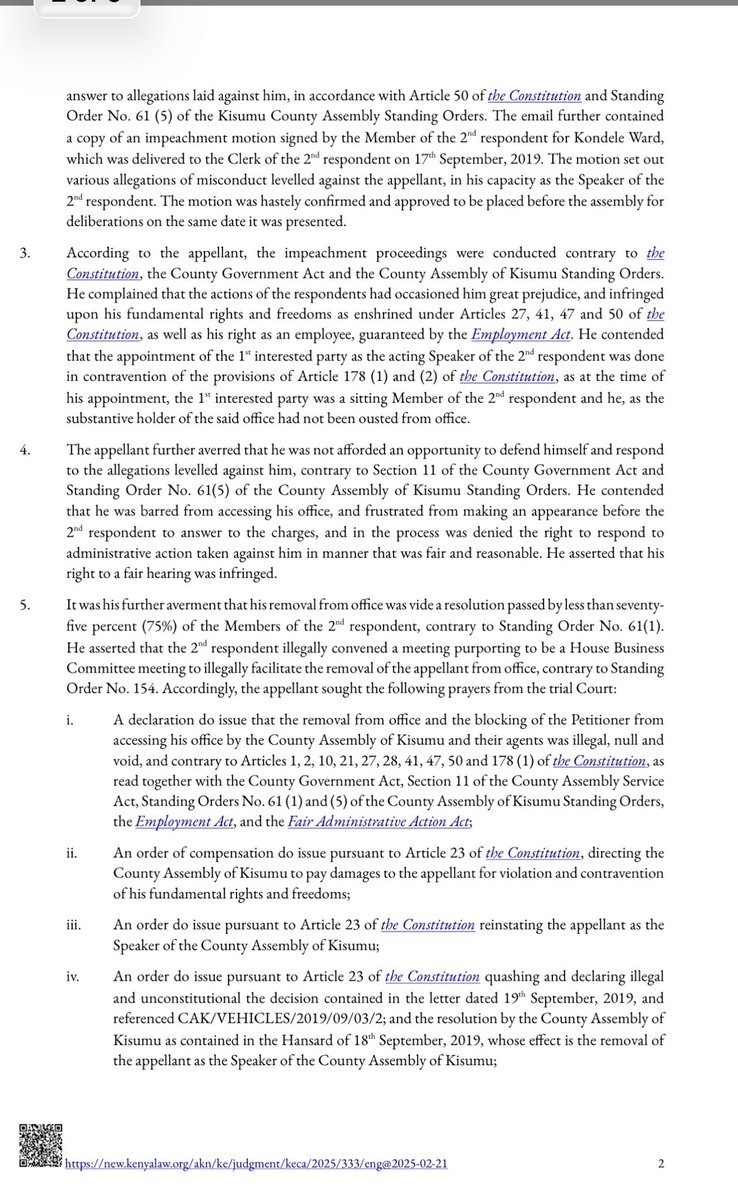
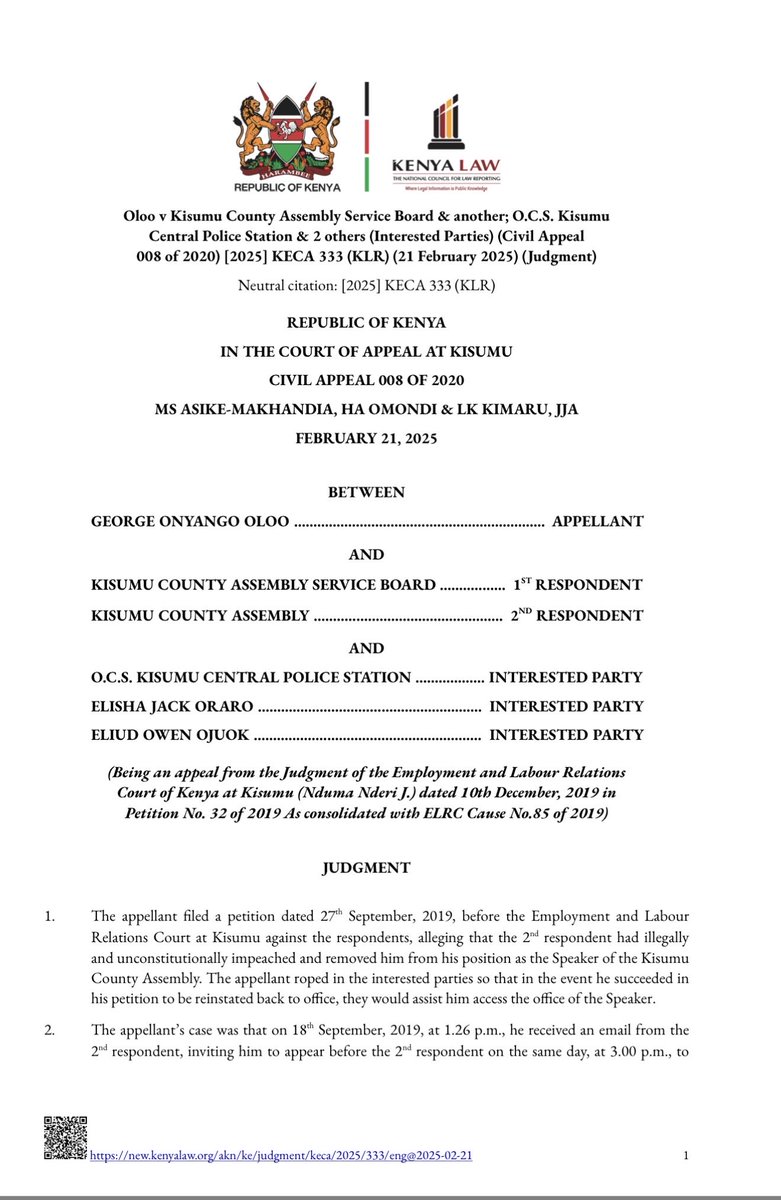
With the clarity of law on impeachment set out by the Court of Appeal in Oloo v Kisumu County Assembly Service Board & another, the declaration as unconstitutional and nullification of the impeachment of H E Rigathi Gachagua is an outcome that should not surprise anyone.




![AssociatesRoba's tweet photo. BREAKING: Court Draws a Hard Line on Adverse Possession - Years of Occupation, Construction and Silence by the Owner May Still Not Be Enough
In a closely watched land dispute that will resonate with property owners, developers, neighbours and investors alike, the ELC has delivered a powerful reminder in Kjaer v Hellback & another [2026] that adverse possession is not a shortcut to ownership. The case involved a homeowner who sought to acquire a portion of her neighbours' prime Nairobi property after occupying and developing it for years. She argued that she had fenced off the disputed section, planted a mature kei-apple hedge, erected a water tank, built a guest cottage and laid cabro paving, all while the registered owners allegedly watched without objection. To her, nearly two decades of uninterrupted occupation had extinguished the owners' title. But when the property was earmarked for sale and a survey exposed the encroachment, a fierce legal battle erupted over whether long occupation alone could transform a trespasser into a lawful owner.
In a decision carrying significant implications for Kenya's evolving adverse possession jurisprudence, the court rejected the claim and emphasized that the doctrine is governed by strict legal thresholds, not sympathy, assumptions or the passage of time alone. Justice Christine Ochieng found critical inconsistencies in the claimant's account of when the alleged adverse occupation actually began. While she asserted occupation dated back to 2004, evidence revealed that some of the most significant developments on the disputed land, including the guest cottage and paved sections, were only constructed around 2018. Equally important was the unique relationship between the parties: they were not hostile neighbors but close family friends who maintained an access gate between their properties and freely interacted over the years. The court held that such circumstances complicated any assertion that the occupation had been openly hostile, exclusive and adverse for the statutory twelve-year period required by law.
The ruling sends a clear and commercially significant message: adverse possession is not simply about being on someone else's land; it is about proving, with precision and evidence, the exact moment the occupation became unlawful, hostile and inconsistent with the owner's rights. Without that proof, even visible developments worth millions of shillings may fail to confer ownership. The judgment is likely to influence future boundary disputes, neighbor conflicts and land recovery claims by reinforcing that courts will scrutinize timelines, permissions, relationships between parties and the nature of occupation before stripping a registered owner of title. For landowners, the case is a warning not to ignore encroachments. For occupiers, it is a reminder that years of use, construction and investment may count for little if the legal clock cannot be clearly established.
Kindly retweet. 🙏](https://pbs.twimg.com/media/HKCmPFhW8AE6SKA.png)


![KJA_Kenya's tweet photo. ⚖️ The Bench Speaks 📜
A 3-judge Bench of the Environment and Land Court, in the Southlands Estate Affordable Housing Case, has pronounced itself extensively on the nature, depth, and breadth of public participation and the imperative of a credible Environmental Impact Assessments (EIA) in undertaking major public investments projects, especially those mentioned as ‘high-risk’ under the Second Schedule of EMCA.
The Court has stated that ‘public participation forms an integral and indispensable component of the Environmental Impact Assessment process…[and] ..we opine that public participation is intended to operate as a preventive and deliberative safeguard, not as a post facto procedural formality aimed at decisions already made and substantially implemented’.
https://t.co/b93nOxD5Mf
@Kenyajudiciary @jsckenya @KMJA_KENYA
@lawsocietykenya @NCAJ_KE](https://pbs.twimg.com/media/HJfnbKnWQAIqisp.png)