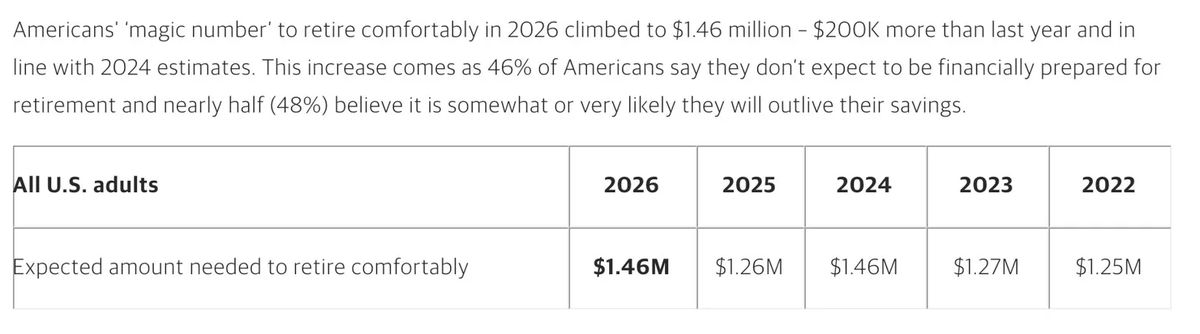
The retirement number Americans think they need jumped from $1.26M to $1.46M in one year.
The year before that, it was $1.1M.The number isn't growing because people want more. It's growing because the money buys less.
46% don't expect to be ready when the time comes. That's not a personal failure. That's a design feature.
Bitcoin has a fixed supply. That's not a pitch. That's the only part of this chart that doesn't move.
@ClaudeDevs Prometheus gave mortals divine knowledge to elevate humanity. Now it's been taken away. What's the point of creating if access is restricted to the wealthy?
The Indian rupee is trading near historic lows against the dollar around 95 rupees for every one.
The headline moves fast. What the headline doesn't say is why this keeps happening, and why it will keep happening to other currencies too.
India carries public debt at over 81% of GDP well above the global average. That's not a crisis. That's the operating model. A system built to borrow without a ceiling will keep borrowing, and the currency is what absorbs the cost. The rupee doesn't weaken because India is uniquely mismanaged.
It weakens because this is exactly what the traditional system does. The Brazilian real lost 21% of its value in 2024 alone the largest economy in Latin America, with its central bank injecting $17 billion to slow the fall. It still fell.
What makes this personal isn't the exchange rate chart. It's the grocery bill. It's the electricity invoice.
The water. Every year those numbers climb, and salaries in fiat money stay basically the same. That gap isn't inflation in the abstract it's purchasing power being quietly redistributed away from whoever holds the currency.
Bitcoin is 21 million units. Nothing more, nothing less. No committee votes to expand that number. No government needs to issue more of it to finance a war or absorb a deficit. The scarcity isn't a feature someone designed for marketing it's the structural answer to a system with no floor.
This isn't just an Indian story. It's the cycle and Bitcoin offers the exit.
The dollar lost more than 27% of its purchasing power in six years.
Stablecoins tracked every step of that decline. That's not a bug that's the design. A stablecoin pegged to the dollar doesn't protect you from the dollar. It is the dollar, repackaged with a new name and a blockchain address. The same system, the same erosion, the same outcome. What the author calls "a continuation of preserving the current system that doesn't work" isn't a critique of the technology it's a description of the architecture. CBDCs go further: government-issued, government-monitored, government-controlled. The peg is to fiat. The control is to the state. Neither breaks anything that was broken to begin with.
The experience is not abstract. It's the grocery bill in October versus the grocery bill in April. It's a paycheck that arrives the same amount while everything it buys quietly shrinks. Across Latin America alone, 182 million people can't afford a basic nutritious diet at $5.16 a day not because the money disappeared, but because it was drained, steadily, by a system that salaries never quite outrun. The wages stay the same. The prices don't. That gap is not misfortune. It's how the system distributes loss.
Bitcoin has a fixed supply of 21 million. No committee votes to expand it. No crisis justifies printing more. That constraint isn't a limitation it's the only monetary design that can't be quietly revised by the institutions that benefit from revising it. The distinction between Bitcoin and everything else isn't technical. It's structural. One is built inside the system. The other was built outside it, specifically because the inside wasn't working.
The question isn't which digital asset to hold. The question is whether the money you're using is protecting you or slowly making you poorer.
Important clarification: the account that posted the “original video” on X is not the original creator or owner of that content, Anastasia is. The account you’re calling the “original” post is itself another aggregator that reposted someone else’s content as their own.
So to be very clear: neither Mario nor Context2x created or own this video, and neither should or will earn Revenue Share for it. Being the first account to repost someone else’s content on X does not make that account the original creator.
Accounts are still free to post content they didn’t create, and can monetize that in other ways if they want to. But Revenue Sharing is specifically designed to reward original, value-add content, content that gives people a reason to follow an account and keep coming back because they expect something unique from that creator, not recycled IP.
The U.S. Secretary of the Treasury said it out loud: "We will use stablecoins to maintain the dollar as the dominant reserve currency."
That's not a conspiracy theory. That's official policy announced at the White House Digital Assets Summit and codified in law months later.
So when Coinbase and Nium celebrate a partnership to move USDC across borders in a matter of seconds, the question worth asking is: what exactly is being adopted? Not Bitcoin. Not a new financial system.
A faster version of the old one with the dollar still at the center and the same institutions deciding who gets access, under what conditions, and at what cost. They have their connection to fiat, and that connection is the point.
Stablecoins processed $33 trillion in transaction volume in 2025. USDC alone accounted for $18.3 trillion of that. The infrastructure is scaling fast, and the narrative building around it uses the language of crypto decentralization, borderless payments, financial freedom while delivering something structurally different.
It's not a coincidence. It's a strategy designed to delay the inevitable mass adoption of Bitcoin, using the credibility of the crypto ecosystem to sell dollar extension as innovation.
Bitcoin's payment layer is growing too, but from a fundamentally different premise. Not to preserve a reserve currency. Not to serve a geopolitical interest.
Bitcoin is the only resilient asset over time that no one can control and that's precisely why it matters that people actually understand what Bitcoin is. The tools that look like alternatives often aren't.
The dollar is getting a blockchain. That's not the same thing as a new monetary system.
I remember this from about three years ago. I was already deep into Bitcoin when I found myself standing in a 40 minute bank line because the ATM was down.
We're in a fully digital era. Bitcoin settles in minutes, works anywhere, needs no branch. And the financial system that's been doing this the same way for 50 years doesn't feel the urgency to change.
The line wasn't the problem. The line was the answer.
Less than 1 million people on Earth own a full Bitcoin.
Out of 8.2 billion.
That number alone should put our financial situation in perspective not as a price prediction, but as a fact about where we stand right now.
The standard framing is that Bitcoin's hard cap of 21 million makes it scarce. That's true. But the real number is smaller.
Roughly 3.8 million BTC are estimated to be permanently lost tied to addresses that haven't moved in over a decade, wallets with no recovery path. The effective circulating supply sits somewhere between 15 and 17 million coins. Not 21 million. That's the actual ceiling for everyone who comes after.
And yet, even with all-time high wallet growth, only 1.29% of the global population holds any Bitcoin at all most of it in small fractions, far from a whole coin.
The adoption wave people talk about hasn't happened. We're still in the part of the story where most of the world doesn't understand what they're losing by staying in money that loses purchasing power every single year.
Those of us who know Bitcoin are standing in front of a genuine opportunity not because of what the price might do, but because of what we understand that the other 98.71% doesn't yet. When mass adoption arrives, there will be less Bitcoin available for everyone entering after us. That's not speculation. That's arithmetic.
The window is still open. Most people don't even know there's a window.
Nearly half of Americans expect to outlive their savings. Half of those working in retirement are doing it because they have to. A third haven't taken any steps to fix it not because they don't care, but because the problem was designed to feel too large to solve.
Bitcoin has a fixed supply. The dollar doesn't. That's not a coincidence.
@cryptorover The headline says "best month since 2024." The table says April averages +13.15% historically highest of any month. This isn't an exception. April is just April for Bitcoin.
B e boring on purpose. That's the strategy.
U nplug. The price will be there when you're back.
Y our keys, your coins. Everything else is a promise.
B locks keep coming. 144 a day, every day, since 2009.
I t runs whether you watch it or not.
T wenty-one million. No one's adding more.
C heck it once a week. Or once a month. It doesn't mind.
O pen to anyone, closed to manipulation.
I nflation is loud. Bitcoin is quiet. Quiet wins.
N ow go touch grass. The network will be fine without you.
@LarkDavis Countries that restrict hard money don't stop capital flight. They accelerate it. This pattern predates Bitcoin it just has a new exit route now.
@BitcoinArchive The hard part isn't explaining Bitcoin. It's explaining it without using Bitcoin vocabulary. Most people in the space forgot what it was like to not understand it.
@WhaleInsider $819 M in ETF inflows means $819 M in demand from people who will never hold their own keys. Bullish for price. Worth understanding what you're actually buying.
@Cointelegraph $823 M in weekly ETF inflows. Miners produce roughly $450 M worth of BTC per week at current prices. Institutional demand is now structurally larger than new supply.