happens with ladies too actually. had only one hair stylist for more than a decade and the only reason why i had to go to a different one was after she passed 😭
“My husband went to barb his hair and came back without barbing his hair & I asked why, he said cuz his barber travelled cuz his father di3d, I told him to go to another & he refused saying it doesn’t work like that”
—-Nigerian lady in shock about Men’s loyalty to their barbers
My sister gave birth two seconds after being chased by a monkey 😂😂
On this fateful day, she said she already knew her baby was coming. Being her second baby, she felt she was now a professional.
While she was dilating, madam was busy doing house chores like nothing was happening — she cleaned the house, washed clothes, and even cooked food sef.
After all that, she still did makeup, wore a flowing gown, told the neighbours “I’m going to the hospital,” and left like someone going for a wedding. 😂
When she got to the hospital, she told the doctor she was ready.
The doctor looked at her makeup and said,
“With this makeup? You’re not ready yet.” 😭
She started laughing and insisted she was ready, but nobody believed her. So the doctor told the nurses to take her outside for exercise since it was a private hospital.
She said the only exercise she could do was to walk around. Doctor said, “No problem.”
While they were walking around the hospital premises, she looked up and saw a monkey in the next compound. Immediately their eyes met… the monkey started running towards her and the nurse. 😭
She said as she turned to hold the nurse… she saw the nurse already running for her life.
My sister too no dull… she gathered her flowing gown and started running towards the hospital door, with the monkey behind her. 😂😂
By the time she got to the door and stopped…
The next thing she felt was her baby’s head between her legs.
They quickly carried her and the baby’s head together into the labour room. 😭😂
Till today, we still don’t know why that monkey ran towards her…
But one thing is sure that monkey helped speed up labour. 😂😂
Personally, I feel the Church should hold mandatory catechism classes from time to time for the entire laity. It can be done during homily. You will see someone come to Mass after the readings or homily and they proceed to receive the Eucharist. There is a huge knowledge gap.
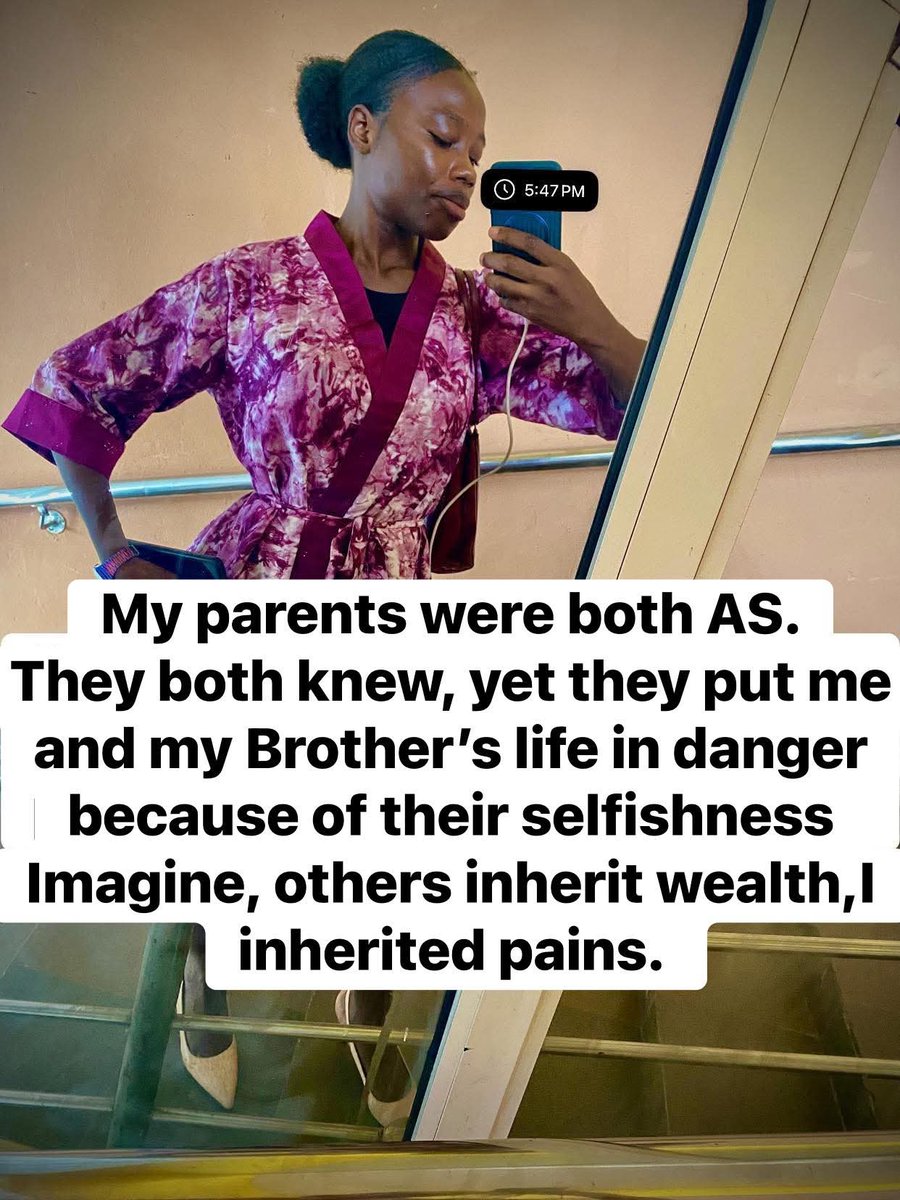
My name is Zainab. I’m 27 years old. An SS.
That is, I live with sickle cell disease.
My parents are both AS.
Oh, they They knew.
They were told.
They still married.
They said God approved it. They said love would be enough. They said faith would cover the consequences.
I am the consequence.
I was diagnosed before I was two. My childhood memories are not playgrounds or cartoons,they are; hospitals, needles, and adults whispering when they thought I couldn’t hear.
In primary school, I missed classes so often that teachers stopped asking why. Some classmates thought I was pretending. Some thought I was cursed. I learned early how to smile while feeling different.
By secondary school, the pain episodes became more frequent. I would wake up excited for school and end the day on a hospital bed. I watched my mates grow normally while my life moved in pauses, school, hospital, recovery, repeat.
At 15, I lost my younger brother to sickle cell.
We were both SS.
That day changed me forever.
My parents broke down in front of me — crying, apologizing, saying “We followed faith. We didn’t think…”
But the damage had already been done.
Sometimes I forgive them.
Sometimes I resent them deeply.
Both feelings live in me.
In university, I tried to be normal. I joined sickle cell advocacy groups, volunteered with awareness organizations, spoke at events, encouraged parents to test their genotype. People call me strong. They call me a warrior.
What they don’t see is me crying alone at night after another silent pain episode.
They don’t see the fear that comes with planning a future in a body that doesn’t always cooperate.
And Relationships?
That’s another wound.
I’ve been loved… briefly.
The moment conversations turn serious about marriage, children, commitment….they leave. Some are honest. Some ghost me. Some promise forever and disappear quietly.
One man once said he would do anything for me. He talked about taking me abroad, better care, a life without fear. I believed him. For the first time, my heart rested.
Then one day, he stopped calling.
That heartbreak triggered one of the worst crises I’ve had as an adult. Not because of physical stress but because hope collapsed.
Now I’m older. The pain episodes come differently. Less dramatic, but more exhausting. My body recovers slower. My fears are heavier. I ask myself questions my parents never asked each other.
I am strong, yes.
But I am tired.
If you are AS and the person you love is AS, please love your unborn children enough to stop and think. Faith is not a license to ignore knowledge. I am a proof to that
I didn’t ask to be a lesson.
But if my life can prevent another child from being born into avoidable pain, then my voice matters.
That’s why I’m writing this to you. Because people listens to you and this story needs to be heard. I hope that your audience share this till it reaches those who are about to walk by faith and not by sight, Sickle Cell is real!.
Adeyinka, keep rescuing lives, I love how you raise awareness and say the truth unapologetically, those who do not like you are probably those who wish they could be you. Have you met you?. Oh,I see you Queen Ade💪🏻
5 years back, I saw something that still hasn’t left me.
A pregnant woman came in.
Healthy. Smiling.
No complications throughout her pregnancy.
No “high-risk” label.
No warning signs.
The kind of case where the whole family walks in expecting just one thing:
a baby’s cry.
Her labour progressed well.
Everything looked routine.
And then…
something happened so fast
that it didn’t even feel real.
She suddenly said:
“I can’t breathe.”
Not mild discomfort.
Not anxiety.
Real breathlessness.
The kind that makes everyone in the room freeze for half a second
before panic takes over.
Her breathing became rapid.
Her face changed.
Her body started trembling.
And within moments
she collapsed.
The room flipped instantly.
From:
“Almost done.”
To:
“CALL FOR HELP.”
From:
“Everything is fine.”
To:
“START CPR.”
Machines started beeping.
Oxygen was rushed.
Lines were placed.
Drugs were pushed.
Seconds felt like minutes.
And then the unthinkable happened.
Despite everything…
she couldn’t be saved.
And then came the part that shattered everyone.
The family saw a perfectly healthy pregnant woman walk in…
and a dead body come out.
They didn’t ask politely.
They didn’t process slowly.
They exploded.
“How can a healthy woman die like this?!”
“There were NO complications in the entire pregnancy!”
“You doctors have killed her!”
Some were crying.
Some were shouting.
Some were blaming anyone they could see.
And honestly…
I couldn’t even blame them.
Because to a normal person, this doesn’t make sense.
A normal pregnancy.
A normal delivery.
And then sudden death?
It feels impossible.
It feels like someone must have “done something wrong.”
But the truth is…
sometimes medicine witnesses something terrifying:
A body can collapse like a switch has been turned off.
I was just a new intern then, I asked my seniors and that day, I learnt the name of that nightmare.
"Amniotic Fluid Embolism"
And that’s when it hit me:
We take pregnancy for granted because we only see the “happy ending.”
But behind the scenes, a woman’s body is walking a tightrope every single day…
and sometimes, everything can change within seconds... without any warning.
Remember one midnight I was at the hospital,
Nurses dey play NSPPD, Doctor Dey play NLP, Security Guard Dey play Joshua Selman, Cleaner Dey play Olukoya MFM.
Nah there I know say the spiritual controls the physical, even medical people understand well
i think one of the healthiest things i've ever learned is that you should allow others to reintroduce themselves to you, even your closest friends. Give people space to become who they are without assuming you know who they are just because you've been friends/family for years.
Jehovah’s Witnesses take modern medicine seriously. They go to hospitals, get surgeries, take medications, do chemo, get vaccines… basically the full range of standard medical care.
Take Covid for example: they approached it with a mix of caution, organisation and strict internal consistency. They were one of the few large religious groups that shifted their entire global routine very quickly and stayed with it. They suspended all in-person meetings, conventions and door-to-door preaching early in the pandemic, long before many governments mandated it. Their worship moved fully online.
They took public-health guidance seriously. They encouraged masks, distancing and hygiene measures, and they followed local regulations and never resisted them. Their official publications consistently framed these actions as practical expressions of caring for others.
Additionally, they did not oppose Covid vaccination, and many jws viewed vaccination as a responsible medical decision consistent with their general acceptance of modern medicine.
They also quickly adapted their ministry. Door-to-door work stopped worldwide and did not return for more than two years. Instead, they wrote letters, made phone calls and used digital tools for outreach. This was historically unusual for them because personal, physical ministry is central to their identity. They treated this as both a safety measure and an opportunity to preach or distribute content without travel or crowding to avoid infecting others.
Anyone who is familiar with their disaster response system during natural disasters can testify that they use a similar approach and that they take science and community very seriously.
The single line they don’t cross is blood transfusion. This is because of how they interpret the biblical instruction to “abstain from blood” in Acts 15:28–29. For them it isn’t exclusively a food rule but a moral boundary, so they avoid transfusions of whole blood and its major components: red cells, white cells, platelets and plasma. When it comes to smaller blood derivatives (like albumin or certain immunoglobulins and similar products) each jw decides for themselves. The same applies to procedures where their own blood stays connected to their body in a closed loop.
I grew up holding that stance too but my understanding of the verse changed as an adult; I now interpret it as a dietary rule that was valid at a time when eating and cleansing oneself with animal blood was common in ancient pagan traditions. Of course, the rule was made by people for whom blood rituals were the limit of their imagination based on their current reality. Today, modern medicine has advanced and allowed us the gift of saving others’ lives by giving them our blood and I do not believe that a loving god would rather watch his children die for his own ego rather than accept the kindness of extending or saving their lives through blood transfusion.
But even though they don’t accept blood transfusion, they (mostly) approach it with care (or at least this has always been my understanding however a little bit complex). They often use what is called “bloodless medicine” which are techniques designed to manage or replace lost blood without using donor blood. Some medical centres have dedicated protocols because they’ve been treating jw patients for decades. Unfortunately, the reality in Nigeria when it comes to “bloodless medicine” protocols for jws and how widespread they are is a patchwork. There are doctors and hospitals in Nigeria who have treated jw patients with bloodless surgery approaches, but it is not yet uniformly or widely adopted. This makes it incredibly and disproportionately risky to be a jw in need of critical blood transfusion in Nigeria. Being a Nigerian in need of critical healthcare is already risky enough given our broken medical system, so this adds an extra layer of risk.
So, overall: they welcome medical care, but blood transfusion is a spiritual no-go area.
That one belief has shaped entire fields of bloodless techniques and also means they’re usually very clear about advance directives so doctors know how to treat them responsibly.
Generally, especially when lives are at risk, I advocate for understanding, respect and empathy in caring for people with unconventional religious beliefs. I too once lost a close childhood friend to this belief, and I know a number of people who have gone the same way too. My beef is with the organisation’s governing body for holding onto this archaic position and refusing to adapt which has cost thousands of lives.
Sadly, this is the tension between ancient texts and modern medicine which isn’t unique to jws. Every tradition that treats an ancient text as morally binding faces the same challenge: how to apply ideas shaped in a pre-scientific world to technologies the authors could not have imagined.
I’ll continue to hope their stance on blood transfusion is eventually reversed, just as they once reversed their position on organ transplants.
It is unnecessary. It is inhumane.