LATEST: 🇺🇸 White House crypto adviser Patrick Witt argued the US must pass the CLARITY Act or "watch as someone else sets the rules of global finance" after Japan passed a law to recognize crypto as financial products.
JUST IN: 🇺🇸 President Trump to meet with senators tomorrow to discuss the Clarity Act's "path to success" 👀
“I’m hoping that we can come up with some agreement by the end of this week” - Sen. Thom Tillis
🔥BOMBAZO🔥
LA SENADORA CYNTHIA LUMMIS DICE: ¡ESTAMOS LISTOS!
¡LO ESTAMOS INTRODUCIENDO EN LOS PRÓXIMOS DÍAS […] PARA LLEVAR ESTE PROYECTO DE LEY A LA LÍNEA DE META!“ 🏁
For enthusiasts of #Hedera and #XRPLEDGER , the passion for these networks is not merely about owning "another blockchain"; it is about a commitment to technological superiority and a vision for a decentralized future that actually works. The HSuite Native Connect (HNC) protocol shifts the current narrative by ceasing to treat these networks as mere clones of Ethereum, instead celebrating 🥳 the unique features that define them.
Here is an exploration of that passion and how HNC honors it:
1. Respecting the Native "DNA"
Users choose Hedera for its hashgraph consensus, offering unparalleled speed and security, and XRPL for its decade-long reliability and powerful native features. Most current wallets "insult" these choices by forcing native functionalities through contract-based workarounds designed for EVM chains.
✅ The Shift: HNC is Native-first. It unlocks the full potential of Hedera services (HTS, HCS) and XRPL primitives without "EVM detours" or compromises. This means complex actions like batch airdrops, native multisig, or atomic safe trades function exactly as intended: directly and efficiently.
2. Liberating the "Frustrated Adopter"
The passionate user (the Frustrated Adopter) is exhausted by the "painful dance" of switching networks, repeatedly logging in, and dealing with confusing bridges that dilute the experience of using cutting-edge technology.
✅ True Sovereignty: HNC restores Digital Self-Determination to the user. By eliminating centralized relay servers, trust is returned to the edge—meaning you and your device.
✅ Pure P2P Connection: While other protocols rely on layered intermediaries that introduce latency and compliance risks, HNC establishes a direct peer-to-peer connection via native browser channels like postMessage.
3. The Wallet as a "Universal Remote Control"
For those deep in the Hedera and XRPL ecosystems, digital assets are the foundation of an emerging agentic economy.
✅ Native Simplicity: HNC allows you to connect ONCE and approve accounts across all supported chains instantly. You can view aggregated HBAR and XRP balances on a single Unified Dashboard.
✅ Real Transparency: True decentralization requires clarity. HNC replaces opaque cryptographic hex codes with human-readable operations, ensuring you understand exactly what you are signing before you approve it.
The Narrative Twist
The message is no longer that "Web3 is hard." The message is: "You chose the right technology; now you finally have the right protocol to use it". HNC is not just a connection tool; it is the interaction layer for an internet where humans and AI agents interact with integrity, transparency, and total freedom.
Analogy:Using Hedera or XRPL with legacy protocols is like owning a race car but being forced to drive it on a dirt road full of slow, manual toll booths (relays). HSuite Native Connect is the high-speed express tunnel built specifically for your engine, allowing you to reach your destination instantly, securely, and with maximum power from the first second.
#XRPArmy #Hbar @Stone_XRPL@Genfinity
🎁The P2P Trust Foundation: Why HSuite Native Connect is the Breakthrough
For too long, the Web3 experience has been compromised by fragmentation and the performance penalties introduced by layered intermediaries. We announced the need for a new foundation; today, we reveal the breakthrough: HSuite Native Connect. 👈
🎄HSuite Native Connect (HNC) is an open source protocol that allows wallets and decentralized applications (dApps) to communicate directly, peer-to-peer (P2P), eliminating central servers or relays entirely. This foundational shift solves the chronic problems plaguing the existing infrastructure and lays the groundwork for a truly decentralized internet.
The 3⃣Pillars of the HSuite Breakthrough:
➡️ Security: Zero Relay Risk
Communication runs locally via browser-native channels, ensuring transparency.
All cryptographic actions stay inside your 📱HSuite Wallet. This means private keys never leave the device, guaranteeing Unbreakable Security and eliminating the risk of compliance exposure introduced by third-party relay servers.
➡️ Simplicity: 10x Faster and Chain-Agnostic
By removing the need for relay round-trips, the direct P2P connection is up to 10 times faster, eliminating the severe 200-500ms latency penalty.
The protocol provides a unified SDK for developers and a chain-agnostic experience for users, offering first-class support for #Hedera native services and #XRPL primitives—no EVM compromises or detours.
➡️ Sovereignty: True User Control
HSuite Native Connect is fully decentralized and functions transparently. The solution is built to meet enterprise demands, featuring validator-enforced policies and auditable workflows that ensure control and compliance.
This protocol is not just an update; it's a new category: the Decentralized Interaction Layer. It restores Security, Simplicity, and Sovereignty to users and developers.
Secure your access to the digital command center. Join the Waitlist:
#XRPLArmy @XRP_ARMY_RIPPLE@ARMY_XRP589@CharlesXAdkins
🚨 Today marks the MiCA deadline for machine-readable white papers.
We have completed the conversion of the HBAR white paper from PDF into Inline XBRL, prepared in line with MiCA (Regulation (EU) 2023/1114), the applicable Implementing Technical Standards, and ESMA’s MiCA XBRL specifications.
The white paper covers HBAR, the native token of the @hedera network, and has now been prepared for submission under MiCA in machine-readable form.
With this shift, MiCA white papers are no longer static documents or PDFs. They are becoming regulatory submissions, where the structure and tagging of information increasingly determine how requirements are assessed in practice.
Delivering a fully iXBRL-ready MiCA white paper on the deadline itself reflects how MiCA Crypto Alliance is already operating in the next phase of MiCA enforcement.
🖇️ Access the HBAR iXBRL White Paper: https://t.co/27xypCHz5n
#MiCA #iXBRL #CryptoCompliance #HBAR #Hedera
Importance of Native Services in Public DLTs:👇
Public Distributed Ledger Technologies (DLTs) have evolved to offer rich native services—built-in Layer-1 features like token transfers, governance, and messaging—that operate within the core protocol. In contrast, non-native or off-chain services rely on external systems or smart-contract layers. This report examines why native services are critical in permissionless DLTs, focusing on trust minimization, composability, interoperability, performance, security, and governance.
Native vs. Off-Chain Services:👇
Native services reside in the protocol and are secured by consensus. Examples include native tokens, governance, and interoperability modules. Non-native services use smart contracts, bridges, oracles, or L2 networks. They offer flexibility and scaling but introduce new trust assumptions and complexity.
Trust Minimization:👇
Native services reduce dependence on external actors. They leverage the blockchain's cryptography and consensus for correctness. Off-chain solutions reintroduce trust in custodians or oracles, often becoming points of failure. Examples like the collapse of FTX or bridge hacks underscore this. Native logic ensures transparency and security, although immutability can make governance difficult.
Composability:👇
Composability enables seamless interactions between services. On-chain, services can integrate atomically in one transaction. Off-chain or cross-chain systems are asynchronous and complex. Native composability allows rapid, modular innovation, while fragmentation limits off-chain flexibility.
Interoperability:👇
Native protocols like IBC (Cosmos) or Polkadot's relay chain offer built-in cross-chain messaging. Non-native solutions use bridges or oracles, which are risky and introduce latency. Native interoperability reduces fragmentation and aligns trust across chains.
Performance & Scalability:👇
Native services benefit from protocol-level optimization. For example, Hedera processes up to 10,000 TPS using its native services, far more than its EVM layer. Smart contracts are resource-intensive. Off-chain scaling helps but adds latency and complexity. Native features ensure consistent speed and trust, especially for critical operations.
Security:👇
Native services inherit the security of the base layer, reducing attack surfaces. Off-chain services introduce separate attack vectors (e.g., oracle failures, smart contract bugs). Base-layer simplicity also allows for rigorous auditing. However, critical bugs at Layer-1 can affect the whole system, so care is needed.
Governance:👇
Native services follow the blockchain's governance model, involving the community and validators. This ensures transparency and resistance to unilateral control. Off-chain services are often governed by DAOs or centralized teams, offering agility but potentially reducing decentralization.
Case Study: SmartNodes by HSuite on Hedera:👇
HSuite's SmartNodes leverage Hedera's native services (HTS, HCS) and offload programmability off-chain. Business logic runs in cloud-based programs, while final state and validation occur natively. This ensures scalability and low latency without smart contract costs.
SmartNodes validate against on-chain rules and require multisig authorization. They use Hedera's low-cost, high-speed consensus and token services for secure finality. Compared to EVM contracts, SmartNodes are up to ~80x cheaper per operation. Developers write in high-level languages, and validators ensure integrity via on-chain constraints.
SmartNodes also solve oracle and interoperability issues by fetching off-chain data and interacting across chains, while anchoring trust on Hedera. Governance is DAO-driven, balancing flexibility and decentralization. This model exemplifies how off-chain logic and native finality can combine for secure, scalable DLT applications.
Conclusion:👇
Native services in public DLTs are essential for building trust-minimized, composable, secure systems. While off-chain layers aid scalability, they introduce trust and complexity. SmartNodes on Hedera show a hybrid path: leveraging native speed and finality while outsourcing programmability, preserving trust. The future of DLTs lies in maximizing decentralization and security through native layers, complemented by innovative off-chain extensions.
If you have bought into our $SILK INO &/or Escrows, please have at least 1 AUTO ASSOCIATION on in your @hashpack wallet
Your SILK token airdrop will be sent out right AFTER TGE and pools going live 💪
Token ID will be provided right after creation
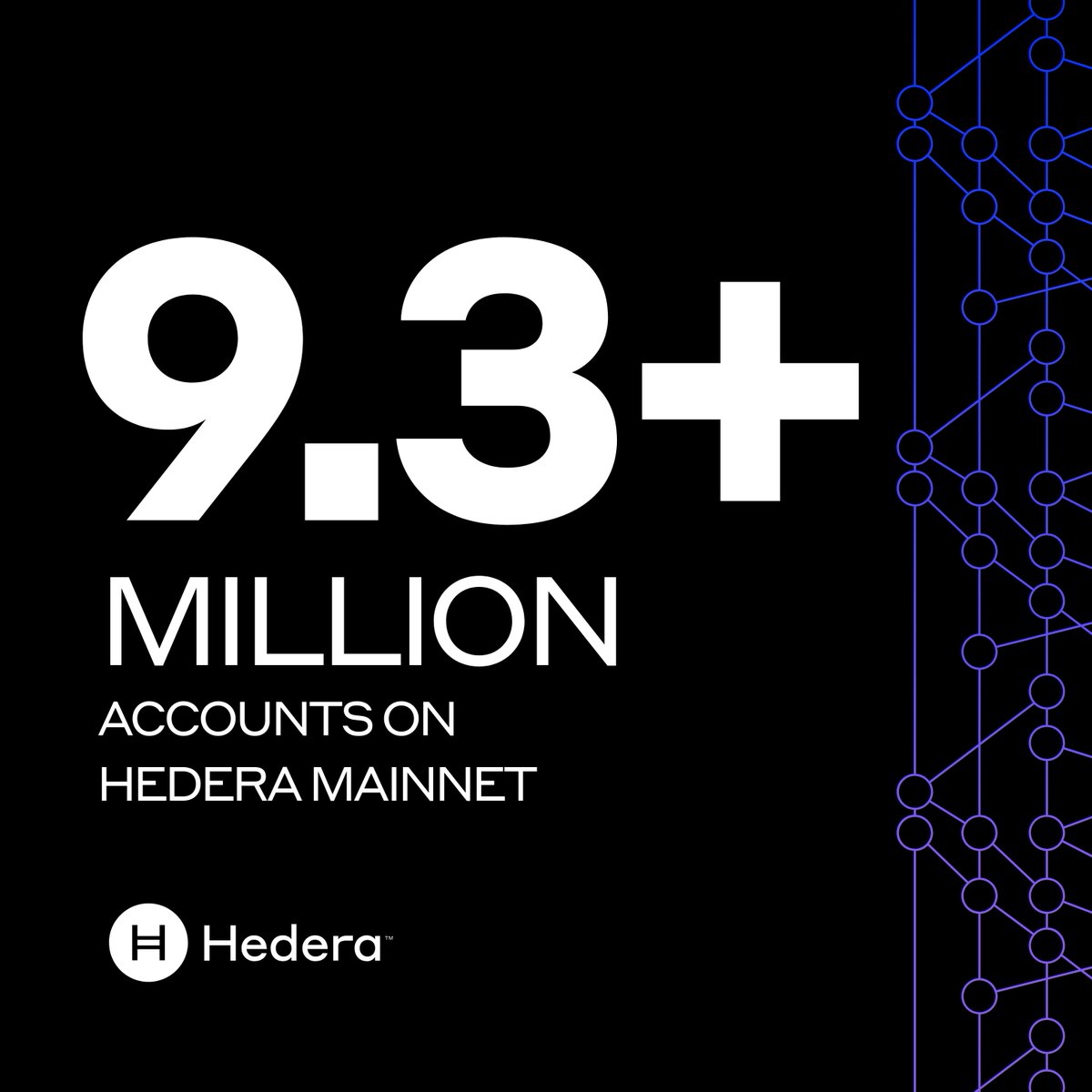
Hedera has 9M+ accounts on mainnet, and counting👀
This indicates a strong signal of onboarding at scale, and a bigger base for apps to reach with real utility.
Learn more: https://t.co/fAipoaiKkF
🚨 BREAKING: Vanguard is Opening the Door to Crypto ETFs
After years of avoiding digital assets, the firm will now permit access to third-party spot-crypto products tied to $HBAR, Bitcoin, Ethereum, $XRP, $LINK, and more.
Vanguard, the world’s second-largest asset manager with roughly $11 TRILLION AUM.
Among the newly available tickers shown on Vanguard’s platform:
•$XRPR – REX-Osprey XRP ETF
•$XRP – Bitwise XRP ETF
•$HBR – Canary HBAR ETF
•$GLNK – Grayscale Chainlink Trust (LINK)
This shift doesn’t mean Vanguard is launching its own crypto ETFs, but it does mean millions of Vanguard clients can now gain regulated crypto exposure without using a separate exchange.
A major barrier just dropped. Crypto is entering the mainstream.
Trust the signals, not the noise.
Hedera has been delivering since 2018: governed by 31 global institutions, surpassed 71B transactions, fixed fees in USD, settling in 2.9 seconds, all with a 0 carbon footprint. And that’s only a sample of the fundamentals.
Trust what’s proven.
There's no question @SaucerSwapLabs is cooking 🔥
The iOS Beta rollout is expanding, $SAUCE access is growing with new listings & the SAUCE MiCA white paper is officially submitted.
And if you want to see how the DEX is performing fundamentally… just look at @SAUCEBuyback 😉👽
HBAR Army. The moment you've all been waiting for
The $SILK Token Launch is officially confirmed
Round 1:
📅 Launching: Monday Nov 24 at 3am EST
• Hedera native
• Trade-to-earn incentives
• Engineered for next-gen DeFi
Learn more& how to get involved 👇