Sci journalist/TED speaker/MIT KSJ Fellow/Books: The Edge of Physics, The Man Who Wasn't There, Through Two Doors at Once / Mastodon: @[email protected]
Don't know how other authors feel, but seeing the first physical copy of your book, after years of looking at Word files and PDFs... Seems surreal. It's as if someone else wrote it... Anyway, this advance copy arrived in the mail. One more month to pub date ...https://t.co/skiLyCTfmJ
#artificalintelligence @DuttonBooks
1/4 With growing use of LLMs, inference service providers must prioritize service requests. "Inference providers need to reckon with the question of which request to serve first and what to charge for faster service," said TTIC's @sidpra5ad. Video: https://t.co/eym6wyxucm
1/2 “The entirety of the current AI boom is driven by this observation that many properties in AI scale in really surprisingly lawful & predictable ways,” said @jaschasd of @AnthropicAI, at the Simons Institute. Video: https://t.co/6EKXjKG7Fm
This talk is from awhile back but might be newly relevant as more and more AI systems natively “see” the world as text and code.
I think of language as a camera. What kind of camera is it? What color space does it use? What’s its resolution?
(Was fun to visit TTIC!)
1/10 "Can we see language as alike to a camera?" asked Phillip Isola (@phillip_isola of @MIT). He explored this question in his talk at TTIC in Mar 2025. The answer depends on whether their "Platonic Representation Hypothesis" can be proven correct. Talk: https://t.co/N6Uq4EfUeq
1/6 "We want a robot that doesn’t only work in factory settings, [but] ideally would work in our homes," said TTIC's Matthew Walter, in his talk on "Learning from Visual Experience: Toward Generalizable Robot Manipulation." Video: https://t.co/lXaO4Qet5u
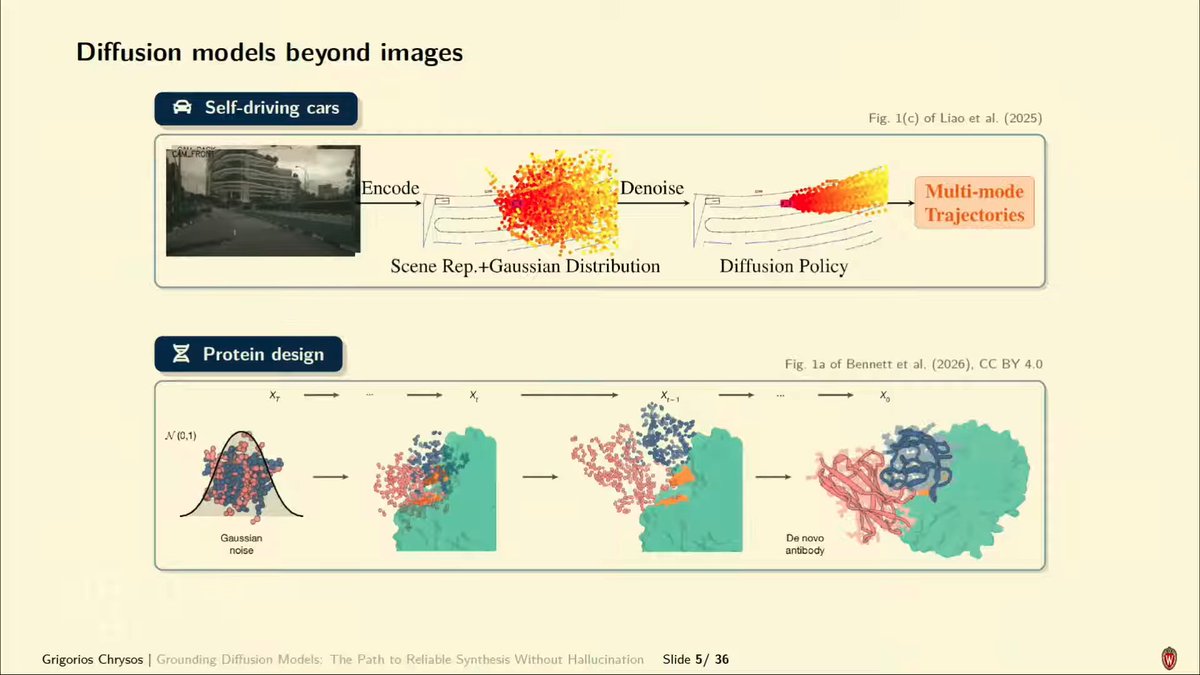
"Diffusion models are used way beyond generating images. They are used to generate diffusion policies for self-driving cars, even protein design. The application area for diffusion models is ever expanding," said @Grigoris_c of @UWMadison during his talk at the Simons Institute.
1/4 Out-of-distribution generalization is "one of the biggest bottlenecks...[to]...real deployment of machine learning in many practical scenarios, such as in autonomous driving, chip design, drug design, etc.," said Yusu Wang of @UCSD at TTIC. Video: https://t.co/9FTgIl0ubk
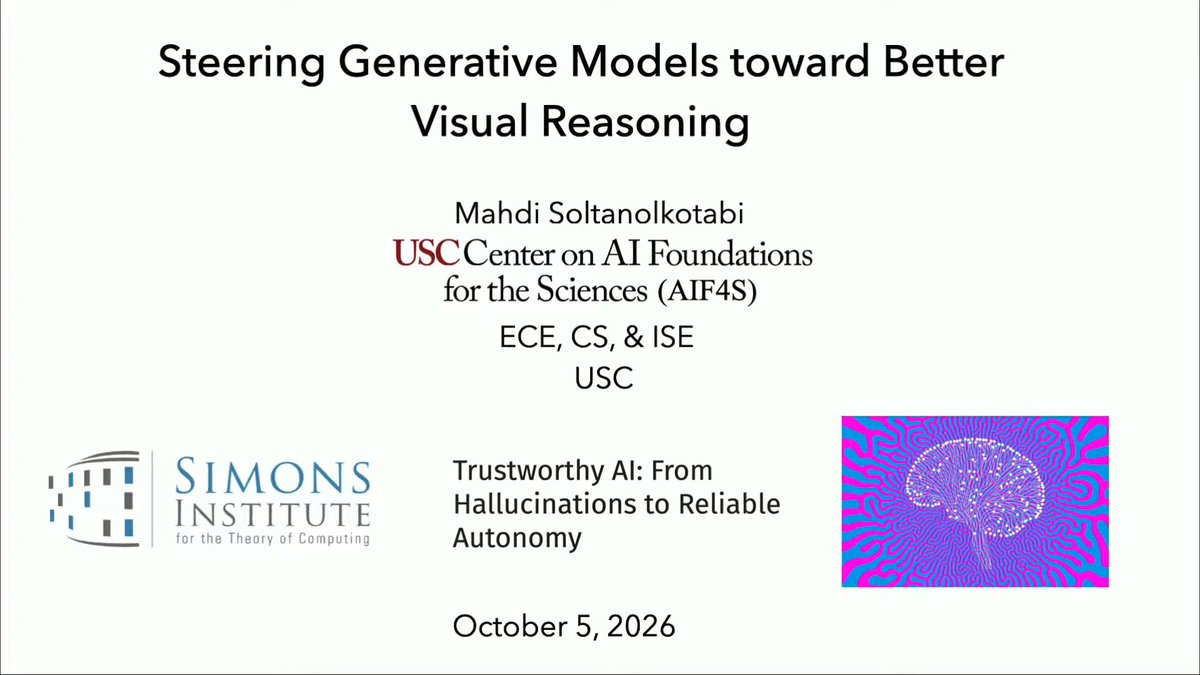
1/ 3 "The progress in reasoning models has been really crazy recently...But the frontier is quite jagged. Despite all of this progress, there are some very weird shortcomings that still exist, even in the latest models," said Mahdi Soltanolkotabi of @USC at the Simons Institute.
2/2 Their task: to discuss the immediate future of theoretical computer science in light of the challenges posed by AI. Read a report of that closed-door meeting, in the Polynomial Times (see Theoretical Computer Science Meets Its AI Moment, page 3): https://t.co/zMXmxcSKWj
1/2 The day after OpenAI dropped a bombshell about "a solution to the Navier–Stokes existence and smoothness problem," 32 theoretical computer scientists met for a closed door meeting (that had been planned for months) at the Simons Institute for the Theory of Computing.
Steven Strogatz and Alex Townsend's new book, Big Math: The Hidden Codes That Run Our World, is hugely prescient. It's the story of the math that underpins so much of our lives and how we got to our AI-suffused moment, and brilliantly anticipates the current crisis facing mathematicians. Strogatz and Townsend end with these poetic paragraphs, about the Faustian bargain we've made with machines:
"At a time when math moves faster than our own understanding, when our creations surprise and sometimes terrify us, the answer cannot be to turn away. We’ve got to keep striving — with humility, care, and every bit of wisdom we can muster.
Striving, in this new age, means remembering that every mathematical invention begins and ends with human choices. We might never fully understand the oracles we’ve made, but we can decide what to ask of them, and why. We can remain the conscience behind the code.
The mathematician in each of us will always want to know more; the human being must insist that knowledge serve something larger than itself. That might be the work of our century: letting our power grow without losing our soul," write @stevenstrogatz and Townsend.
My review of the book for Nature (non-paywalled version, courtesy of Springer Nature): https://t.co/pImVD5BKdU
My review of @stevenstrogatz and Alex Townsend's Big Math: The Hidden Codes That Run Our World for @Nature. https://t.co/47REOtxDog AI has transformed maths — this is how we got here The story of how maths came to run the world, and created the artificial-intelligence models that might surpass human mathematicians.
My favorite paras in the book come at the very end, as Strogatz and Townsend talk about the insights into the nature of reality that mathematics gives us, along with joy and wonder, and then ponder the potential loss of this insight in the age of AI.
"But like childhood, insight may be a phase, tender and luminous, yet inevitably outgrown. The thought has a sadness to it, but also a clarity. It’s the latest instance of the Copernican lesson: Just as early astronomers surrendered geocentrism for a deeper truth, we humans are now learning that we are not the center of the intellectual cosmos. Our style of knowing is not the only one, or the final one.
Feeling that sense of humility is a kind of wisdom in itself, a recognition that reality was never ours to fathom, only to touch, to witness, to wonder at through the narrow peepholes of our minds. Maybe it’s time to let machines take the lead, unbound by what we hominids can muster."
Theoretical Computer Science Meets Its AI Moment
The day after OpenAI dropped a bombshell about "a solution to the Navier–Stokes existence and
smoothness problem," 32 theoretical computer scientists met for a 2-day closed door meeting (that had been planned for months) at the Simons Institute for the Theory of Computing, to discuss and debate their field's response to AI. In this issue of the @SimonsInstitute's annual magazine, Polynomial Times, is my report of that meeting. Read the article and the entire issue here: https://t.co/AE4ufScFk9