Call for Abstracts! 📢
The AWE Working Group invites abstract and ideas-in-progress submissions for our next #AnimalWelfare Economics Conference, to be held June 29–30, 2026 at @UofC.
Submit here ➡️ https://t.co/Y84QHxyv8h
#EconTwitter#AcademicTwitter#EconResearch
📢Online Workshop Announcement 📢
SBCA's Animal Welfare & Benefit-Cost Analysis
📅 Oct 16–17, 2025
⏰ 10am–1:30pm ET
Experts will share tools, insights, and case studies on integrating #AnimalWelfare into policy analysis.
🔗 Register: https://t.co/74H7LubxtU
New @WorldBank blog post discussing the recent paper “The Animal-Welfare Levy” by Romain Espinosa & Nicolas Treich—an important contribution to field of #AnimalWelfareEcon
Both authors serve on our advisory board!
📖 Read here: https://t.co/t4gZngcNq8
#EconTwitter
🗓️ Save the date!
Our 2025 #AnimalWelfare Economics Conference will be held June 10–11 at the Paris School of Economics.
This free, public event brings together researchers advancing the economics of animal welfare.
Registration info & tentative program below!
#EconTwitter
Kevin Kuruc and Jonathan McFadden adopt an animal-inclusive social welfare function to study the relative contributions of environmental and animal impacts to the external costs of animal agriculture
https://t.co/W93X1yUWnB
The next annual Economics of Animal Welfare Conference will be held from June 10–11, 2025 at the Paris School of Economics. You can find the call for abstracts below, with submissions due by January 15. We look forward to seeing you there!
https://t.co/m9mpu5tbzb
The Animal Welfare Economics (AWE) Working Group is hiring a part-time research assistant! Please share with your network and apply if you are interested. You can learn more here: https://t.co/kr2QUDy98k
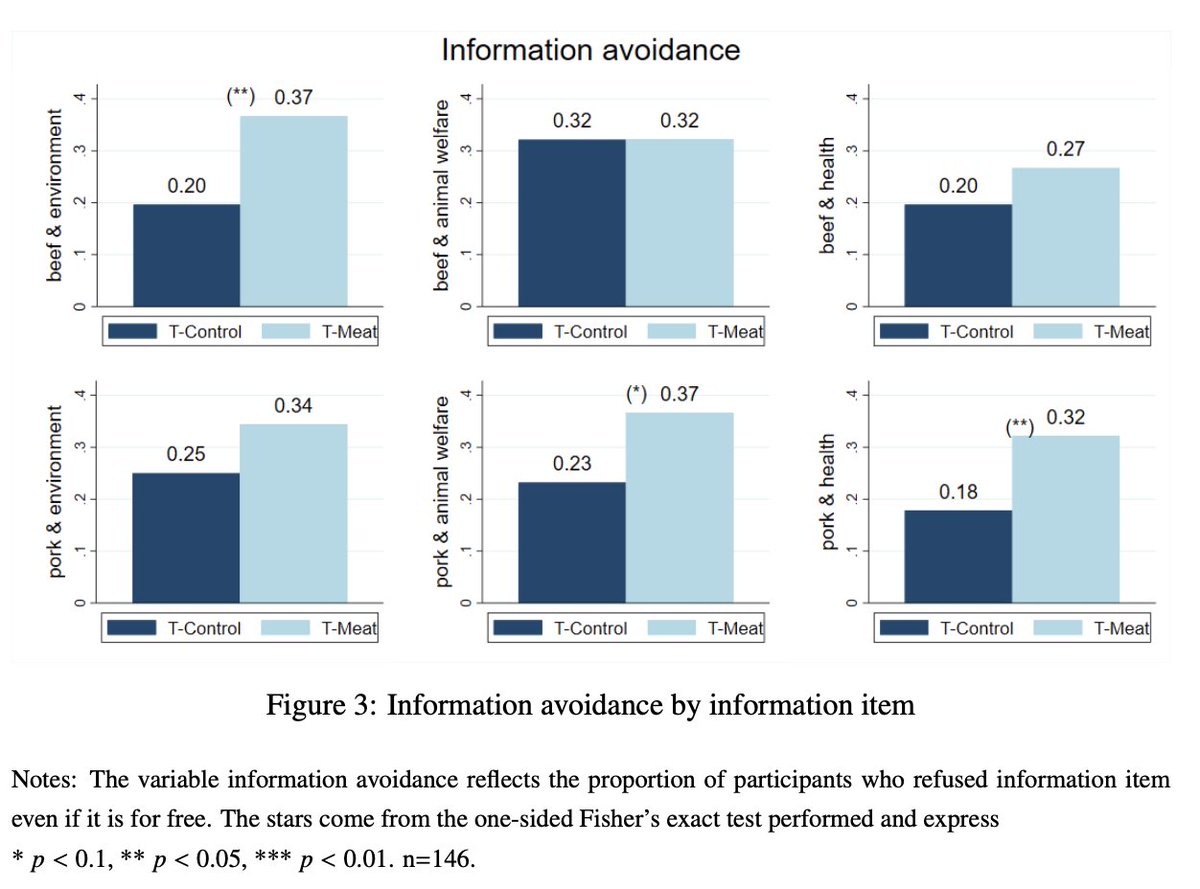
Do these results imply that consumers are avoiding *new* information? Or, are they simply avoiding painful *reminders* of information they've already encountered?
These avoidance effects depend on both the type of meat and the type of information.
Curiously, there is no difference between treatment and control in avoidance of information about the animal welfare impacts of beef consumption.
Growth in aggregate meat consumption masks divergence in household-level meat consumption. @zdgroff, @yoursTWoolley, and Carl Meyer decompose trends in aggregate meat consumption in a recent working paper (https://t.co/tPXkGlMVjU).
If such motives are substantially stronger at the ballot box, are ballot initiatives a commitment device for (relatively more) pro-animal purchasing decisions?
Mechtenberg, @Treich13 et al. show that information increasing the self-signaling value of voting for animal welfare initiatives increases support for such initiatives
(https://t.co/VfaWQvkwZf…)
The authors send a message to voters about evidence for the claim that “good-hearted people tend to be good to animals.” Are these self-signaling motives strong enough to transfer to purchasing and eating decisions?
The paper highlights 2 countervailing forces that will determine the path of aggregate meat consumption: (1) rising abstinence and (2) rising consumption (conditional on purchasing meat).