Excited to be speaking on our work on ML/#PINNs for #NavierStokes at #SCICADE2026: "Scientific Computing And Differential Equations".
The program is huge with applied mathematicians from across the globe converging at Edinburgh 🔥
https://t.co/n6N6wiWJxW
ORBIT ACHIEVED. 🚀
Vikram-1 Test Flight-1 has reached orbit. India's first privately developed orbital rocket has completed its final burn and injected its payloads into a ~450 km orbit, making India the third country in the world with private orbital launch capability.
History is made. 🇮🇳
#Vikram1 #JourneyToOrbit #SkyrootAerospace
@Bayesprof It's a tragedy that probably few people outside string theorists have any understanding of Maldacena conjecture/"AdS/CFT". It's such a profound rethinking of physics, and yet 30 years later its still not in common conversations as say anything quantum is.
@Jabaluck The pivot will be if AI can suggest the right conjectures to chase or be able to complete well, a half-written paper. Without a fundamental AI breakthrough, this is quite a bit far off. Solving a well-formulated conjecture is still not as hard as the above.
@miniapeur It's not a choice. The ideal PhD student is one who can do all - learn all the foundational theory and results AND do stuff that is "relevant", by any favourite metric. To see a choice between the two is defeatist and a step towards wasting the PhD time.
Benchmark performance is not evidence of success, unless the benchmark itself was pre-agreed by external experts. That's why ideas like #FirstProof are so cool as LLM metrics - we are using maths to *evaluate* LLMs. Modern ML has a new notion of "rigor" 🔥
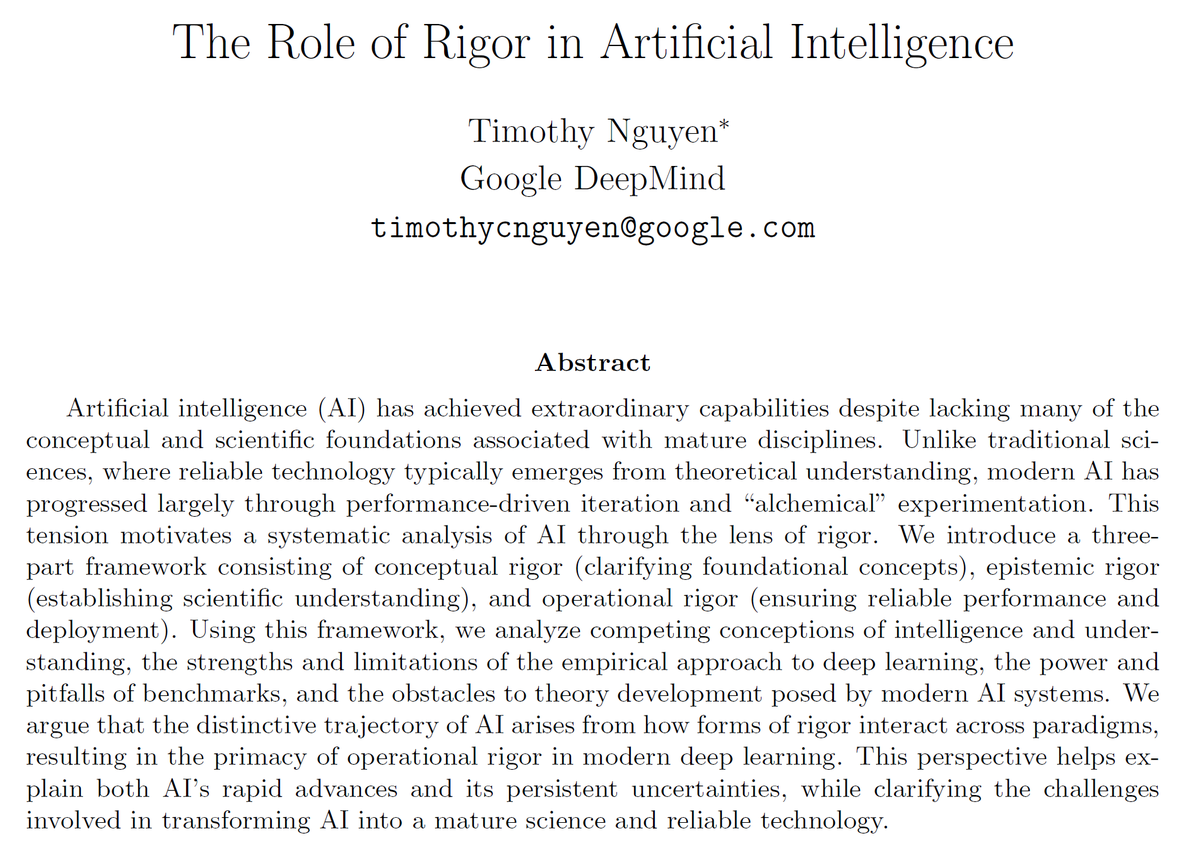
“Deep learning is alchemy” may be the most repeated criticism in AI. It also misses the mark.
Alchemy failed to deliver results. Deep learning, by contrast, has produced transformative technologies. And fields like medicine are only partially understood without being deemed alchemical.
So calling AI “alchemy” captures part of the problem, but not all of it. Modern AI is not simply undisciplined experimentation. It contains significant amounts of rigor. But we still struggle to answer basic questions:
• Do models understand?
• Why do they generalize?
• When will they fail?
The deeper issue is that rigor takes different forms—and in AI, those forms are unevenly developed.
My new paper distinguishes three:
• Conceptual rigor: coherent terminology and paradigms
• Epistemic rigor: reliable scientific understanding
• Operational rigor: reliable performance and deployment
This framework helps explain both the extraordinary progress of modern AI and the uncertainty surrounding it.
Conceptual rigor asks whether the field knows what it's talking about.
• What exactly is intelligence?
• What qualifies as AGI?
• What does it mean for a system to be aligned?
Consider the debate over whether current models are intelligent. One person points to their breadth of performance. Another points to weak planning. Another emphasizes sample inefficiency. Another asks whether it has a grounded model of the world.
They appear to disagree about one property. Often, they are evaluating four.
This is why conceptual clarity matters in practice. Questions about intelligence, understanding, AGI, and alignment do not remain confined to philosophy: they shape how things are measured, optimized, and built.
Epistemic rigor asks whether empirical success has become scientific understanding.
The paper focuses on three criteria:
• Can findings be reproduced?
• Can behavior be predicted in advance?
• Can success and failure be explained?
AI experiments are unusually reproducible in principle: code, data, and models can be copied. But conclusions may still depend heavily on random seeds, hyperparameters, implementation choices, benchmark selection, and compute budgets.
Reproducing a number is not always the same as reproducing the conclusion drawn from it.
Prediction is harder.
Scaling laws can forecast some training outcomes. Infinite-width theory can lead to more tractable settings. Classical learning theory explains important pieces. But we still lack broad principles telling us when a model will generalize, fail under distribution shift, or remain robust under adversarial perturbations.
Explanation is harder still.
Neural networks are mathematically specified, yet their learned features resist human interpretation. A behavior may arise from training data, optimization dynamics, internal representations, or interactions among all of them. The system is transparent in code but opaque in meaning.
Operational rigor is where modern AI is strongest: benchmarks, evaluations, monitoring, red-teaming, and deployment controls.
The field has become highly effective at improving systems without first obtaining a scientific theory of them. Benchmarks turn capabilities into measurable targets. Post-training shapes behavior. Tools and scaffolding compensate for model weaknesses.
Operational rigor can therefore partially substitute for scientific understanding. That imbalance defines the deep-learning era:
• Capabilities rise rapidly.
• Explanations lag behind.
• Benchmarks become optimization targets.
• New systems generate new phenomena faster than theory can absorb them.
AI is advancing while continually changing the object that science must explain.
For AI to mature as both a science and a technology, it will require all three forms of rigor:
• Clearer concepts to define our goals.
• Stronger science to predict and explain system behavior.
• Better engineering to make systems genuinely reliable.
The future of AI depends not simply on demanding “more rigor,” but on identifying which kind is missing—and understanding how the imbalance shapes what we can build, know, and control.
@TuhinChakr We have hugely diluted the meaning of a PhD degree - that's where the problem is. Some x number of papers at a specific list of conferences can't be a criteria for getting a PhD.
@alvations@aclmeeting@ReviewAcl 10 is an understatement. Theory papers have 50-100 pages in the appendix. The main paper is just an advertisement for the appendix 😄
Deep-learning optimization theory is the original #mechinterp / "mechanistic interpretability". We always sought architecture specific training - it was always about identifying inductive biases of architectures to get provable convergence 🤔
@SadhikaMalladi Our original point was that the issue identified by Reddi et. al. is an effect of stochasticity and *not* an issue with Adam. We pointed out right then that the same standard Adam had no convergence issues when used in the full-batch setting.
@gabriberton Number of GPUs mean little. To use 10K GPUs, we would need 50 research engineers and software developers to actually do something proportional - and finding that congregation of cerebral fire-power is just not a thing outside a few places.
A researcher at #NVIDIA - from their #FourCastNet team - came to my talk and also asked questions - as a mathematician, *that* is a very interesting achievement for me and my talk on inventing Talagrand-like contraction inequities for #NavierStokes 😆
Excited to be speaking on our work on ML/#PINNs for #NavierStokes at #SCICADE2026: "Scientific Computing And Differential Equations".
The program is huge with applied mathematicians from across the globe converging at Edinburgh 🔥
https://t.co/n6N6wiWJxW
@ziv_ravid We should have a paper out soon - with one of our undergrads - who created a very similar write-up as a part of his undergrad project. I am sending him this blog of yours too, to incorporate and cite 😅
Absolutely fascinating plenary talk by Prof. Patrick Farrel, this year's Dahlquist Prize winner. He explained how modern finite schemes of solving Navier-Stokes can preserve all kinds of conserved quantities like even helicity. #SCICADE2026
Excited to be speaking on our work on ML/#PINNs for #NavierStokes at #SCICADE2026: "Scientific Computing And Differential Equations".
The program is huge with applied mathematicians from across the globe converging at Edinburgh 🔥
https://t.co/n6N6wiWJxW
Kearns' "statistical query model" is one of the deepest ideas in ML, and I spent one of my PhD summers trying to understand this. This now gets the 30 year #STOC test-of-time award 🔥
https://t.co/eaBPgoOZZw