👋 The paper modelling CANTAB IED performance is now out in Cognitive, Affective, & Behavioral Neuroscience: https://t.co/sI07vHNhUY
Thank you to everyone who's been following the journey! 🙌 @jonroiser@docqhuys@CANTABconnect @AlisaLoosen @jmyearsley@MacAskillAF
👋 The paper modelling CANTAB IED performance is now out in Cognitive, Affective, & Behavioral Neuroscience: https://t.co/sI07vHNhUY
Thank you to everyone who's been following the journey! 🙌 @jonroiser@docqhuys@CANTABconnect @AlisaLoosen @jmyearsley@MacAskillAF
Paying attention❓
📢In our new preprint, we developed a computational model of CANTAB IED that explains individual differences in attention set shifting ability. With @docqhuys@jonroiser@UCL_ICN in collaboration with Cormack F @CANTABconnect@The_MRC 🧵https://t.co/ET8Uur7IGx
🤝By elucidating how attention and learning mechanisms interact in CANTAB IED, we have introduced a novel method of analysis for this popular task, as well as a potential explanation as to why some people find set shifting so much harder than others!
Catastrophizing paper alert 🚨! We (Mia Harada-Laszlo, @AniTalwar, and @olijrobinson) tested whether catastrophizers responded differently to things 'going wrong' - i.e. if they received 'a series of unfortunate events' (or negative outcomes) https://t.co/6IYxugVd1T
🎉 Massive thank you to my examiners, supervisors and colleagues for all the support.
Very proud to be over the finish line but also sad to be leaving this lab! Guess I’m joining the alumni crew of permanent lab slack lurkers…
huge congratulations to newly minted Dr @AniTalwar on passing her PhD on computational models of learning and decision making (especially @CANTABconnect), what an achievement! Many thanks to brilliant examiners @DrSFink and Rudolf Cardinal and of course co-supervisor @docqhuys
New preprint ! 📢📢
Very happy to share some recent work looking at the holy trinity of transdiagnostic symptom dimensions (anxious-depression, compulsivity and social withdrawal) and how we can optimise their measurement.
https://t.co/gdZHm3YuEx
Some key points below…
1/n
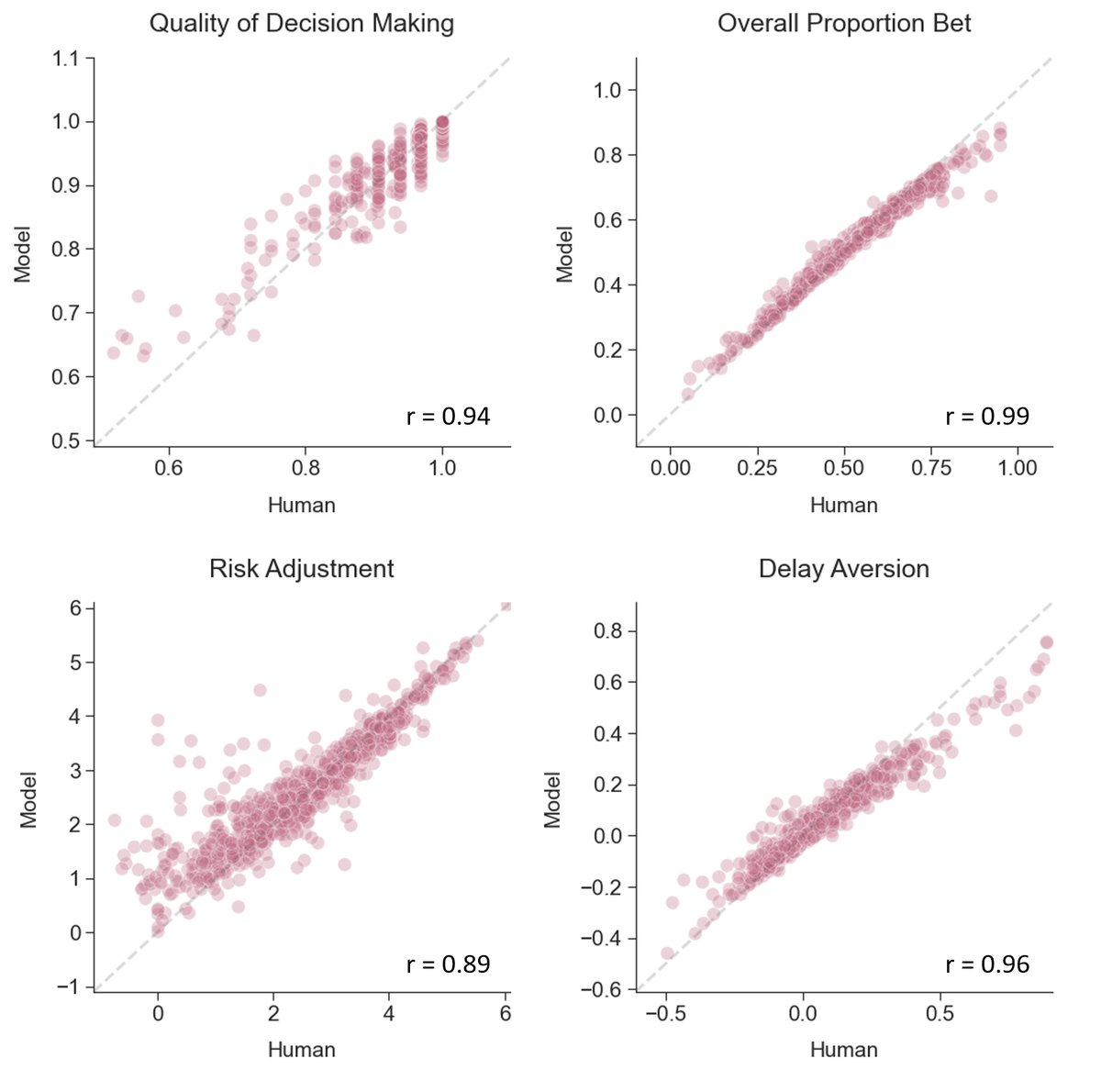
Here are the qualitative model fits!
These compare typical CGT task measures calculated from two datasets - our original dataset (Human), and datasets simulated using our model and estimated participant parameters (Model).
Risk it for a biscuit? 🍪
📢In our new preprint, we developed a computational model of CANTAB CGT that explains individual differences in risky decisions.
With @docqhuys@jonroiser@UCL_ICN in collaboration with Cormack F @CANTABconnect@The_MRC🧵👇
https://t.co/RXK28gQwvP
🤝With a computational model of CGT, we showed:
1. Most participants are risk averse in both gains and losses on CGT
2. Current points doesn't affect betting strategy
3. Model parameters aren't related to mental health symptoms
4. Models add precision as shown by demographic data
niche stats q - is there a test to compare two Cohen's ds (standardised mean difference) for *related* samples? (Equivalent for r would be Steiger's Z).
e.g. if I know that for group 1vs2 d=0.5 on variable A, and d=0.2 on variable B, how to test if that's significant given rAB?
We’re running a study to investigate how Escitalopram (antidepressant) works in anxiety. Understanding how antidepressants work in the brain is key to improving treatment and ensuring more people are able to access an effective treatment more quickly
https://t.co/Jk4Pu5IIlX
🚨🚨🚨 We are hiring! Post-doc opportunity at @UCL_ICN on exciting study into the brain mechanisms driving the antidepressant effects of exercise with me, @GlynLewis9 & @ma_hamer, funded by @RosetreesT. Happy to chat pre-application. Closing date 20th Feb https://t.co/OXEh0tXhpI
🚨Hiring a postdoc🚨 Come join us at @UCL_ICN! We need someone to fill the soon to be vacated shoes of @Alexandra_Pike! Interested in Anxiety, modelling, neuroimaging, psych/pharm interventions? Apply Apply! Job ad: https://t.co/N7JLusoSRT
New preprint out, with @olijrobinson and @jonroiser! 📢 ‘Measuring cognitive effort without difficulty’ https://t.co/LNOSLfsuEr. We highlight a major confound in previous cog effort tasks and present a new task that solves this.🧵 #cognitiveeffort#effort#cogneuro@ucl_icn
Postdoctoral positions on maladaptive thinking patterns in depression at @MPC_CompPsych @UCLPsychiatry @UCLIoN @WCHN_UCL. Combine MEG and computational methods to understand the detailed algorithmic structure of depressive thoughts and biases. https://t.co/9gxZ9yksT8. Please RT.
In this new preprint we ask: What drives #anhedonia? Problems with experiencing pleasure, reward valuation, or reward learning? @jonroiser, @vincentvalton and I reviewed the evidence from mostly cross-sectional studies in depression and schizophrenia https://t.co/j599kBo6zm 🧵1/