7,000 years before Egypt attempted it, Bharat reconciled 13 lunar months with the solar year. The evidence is carved into Ratnagiri Petroglyph — 13 grooves, horizon line, astronomical precision.
It sits exposed. Endangered. Documented but unprotected.
If this stone survives monsoon and vandalism, it's the earliest solar-lunar calendar reconciliation on record. Globally.
We fund ₹4,000 crore annual ASI budgets. We cannot afford a roof.
The oldest astronomical knowledge crumbles under open sky while we debate which colonial monument needs another coat of paint. 🪨☀️🌙
Who decided 7,000 years wasn't old enough to matter?
It does not matter how many global summits a country hosts/how many billions are committed to infra; if a 10 yr old homegrown brand can be erased overnight by an aggressive interpretation of an import code, "Make in India" becomes a high-risk gamble for honest entrepreneurs.
The founder mentions changing their HS Code (Harmonized System code used for customs tracking) in 2023 based on professional advice. In India, Customs & Tax depts frequently use a tactic: Retrospective Reclassification.
The Trap: A founder openly declares a code for yrs. The dept accepts it, clears the shipments & takes the tax. Then, a local audit officer decides, "Actually, I interpret your product differently. It should not be under Code A (10% duty); it should be under Code B (30% duty)."
The Penalty: They do not just apply the new rule going forward. They hit the company with retrospective bills for the last 3-5 yrs, piled high with 100% penalties & interest charges. For a MSME, this instantly wipes out their entire lifetime liquidity.
If we want to compete with China, we need to realize that Ease of Doing Business is not some rank on a World Bank list but a feeling in a founder's gut.
Right now, that feeling is fear. The system must learn to distinguish b/w a fraudulent tax evader & a genuine corporate classification dispute. Until the process stops feeling like a punishment, our best minds will keep choosing to register their companies outside instead of their own homeland.
We need to bypass the so called "standard", reductive textbook narratives that often treat ancient indian achievements as mere "accidental primitive labor" & Kailasa Temple is 1 such example. We need to treat it like a project that required a level of mathematical precision, spatial visualization & resource optimization that rivals modern aerospace/architectural design.
Advanced tech does not necessarily mean electricity/lasers/computer chips. In civil engineering, advanced tech is defined by the systems, instruments & mathematical models used to manipulate massive amounts of energy & matter with near-zero tolerance for error.
To carve Kailasa from the top down out of a single volcanic mass, the ancient Sthapatis (master engineers) had to solve problems that modern CAD software handles today.
Before a single chisel touched the stone, the entire multi-story complex including its internal rooms, floating balconies, drainage systems & columns had to be mathematically mapped out in 3Ds. In a traditional building, if a room is misaligned, we can tear down a wall & rebuild it. In rock-cut monolithic architecture, we cannot put back rock that has been carved away.
A single 5" calculation error on the roof would cause a column on the 3rd floor below to completely miss its load-bearing alignment, collapsing the ceiling. The then engineers used a highly sophisticated system of geometric grids based on micro-measurements (Angula & Hasta). They used a technique called Volumetric Prototyping. They modeled the mountain as a massive 3D coordinate matrix (X, Y, Z axes), translating a highly advanced, non-surviving theoretical blueprint seamlessly onto the undulating, uneven surface of a natural cliffside.
Carving 400000 tons of basalt, hardened volcanic lava rich in silica & iron cannot be done by simply swinging ordinary iron tools. The tools would blunt/deform/break within mins. The construction period correlates with India's absolute peak in Wootz steel production. This was a form of nanotech where iron was smelted with specific carbon-rich organic materials in sealed crucibles, creating a matrix of ultra-hard iron carbides (cementite).
Now to move 100s of 1000s of tons of rock rapidly w/o modern explosives, they likely used controlled thermal stress. By heating targeted fracture lines along the basalt's natural crystalline planes using massive, localized fires & then instantly dousing them with cold water, they forced the rock to cleanly shear itself apart along flat planes. This is a highly calculated application of thermodynamics.
In ancient India, advanced scientific & engineering knowledge was not published in open-source public libraries. It was fiercely guarded within highly specialized, hereditary engineering guilds (Shrenis/Vishwakarmas). Knowledge was passed down from master to apprentice via encrypted architectural texts (Vastu Shastras) & oral mathematical mnemonics.
This kept the IP secure from foreign theft, but it made the entire scientific system highly vulnerable to a SPOF. If a single elite guild of master builders was wiped out in a war, the complex mathematical formulas for calculating rock stress & monolithic geometric projections died with them instantly.
When British colonial historians arrived in India, they encountered marvels like Kailasa. Accepting that ancient Indians possessed a level of structural engineering, metallurgy & geometry that surpassed 18th century Europe was a direct threat to the colonial narrative of the "civilizing mission." They claimed Kailasa was built simply by throwing a massive, infinite army of "primitive, cheap slave labor" at a mountain with simple stone chisels over 100s of yrs.
This narrative deliberately substituted brute force for brain power. It ignored the complex geometry, the structural dynamics & the materials science, reducing a masterpiece of hyper-advanced calculation to a mere story of "many people digging for a long time."
When the West tries to explain the mind, we usually fall back on Sigmund Freud’s clinical trinity: the Id, the Ego & the Superego. But 1000s of yrs before Western psychoanalysis was even a concept, the Vedic rishis had already mapped this entire system with a far cleaner, multi-layered software architecture called the Antahkarana (the inner instrument).
Think of our mind as a hyper-advanced corporate enterprise. The ancient texts break it down into 4 distinct departments:
- 1st, there is Chitta, the hard drive. This is the vast, silent storage room holding every memory, trauma & hidden subconscious impression (Samskaras) we have ever accumulated. It is the ultimate cosmic database.
- Next is Manas, the sensory processor. This is the restless, reactive lower mind connected directly to our 5 senses. It operates entirely on immediate comfort & raw desire, constantly looping in a state of "I want this, I like that, let me avoid pain."
- Then comes Ahankara, the I-Maker/identity filter. It takes the raw data from our senses & our db & draws a protective boundary around it. It claims ownership, stating, "This is my body, this is my opinion, this belongs to me." It creates the concept of personal separation.
- Finally, at the top, sits Buddhi, the CEO. This is our highest intellectual faculty, our capacity for logic, deep wisdom & moral discrimination. While Manas screams, "I want to eat that entire plate of Jalebis right now!", Buddhi steps in as the rational judge & says, "No, it compromises our health goals."
When Sigmund Freud arrived in the 20th century to study human neurosis, he essentially attempted to translate this ancient machinery into a clinical framework. The parallels are striking:
- The ID is purely Manas: Freud's Id is the primitive, unconscious pleasure-seeker driven by basic biological instincts. This is exactly how Manas behaves when left completely unsupervised by higher intelligence reacting impulsively to sensory inputs.
- The SUPEREGO is the high-level Buddhi: The Superego acts as our internal moral compass, enforcing ethics & checking our impulses. In the Indian stack, this is the precise function of a refined Buddhi, which understands the difference b/w Preyas (what is temporarily pleasant) & Shreyas (what is fundamentally good for us).
- The EGO is Ahankara mixed with lower Buddhi: Freud’s Ego is the practical mediator trying to navigate daily reality. It is anchored by Ahankara creating the boundary of the self, using the analytical, survival-based calculations of Buddhi to manage external expectations.
More importantly, Freud assumed that the conscious Ego was the absolute highest peak of human identity. The rishis smiled at this limitation. They understood that the entire mind stack: the memory, the senses, the ego & even the intellect is just material software.
The true us is not the mind. The true us is the Atman: the silent, unchanging, cosmic consciousness that sits quietly above the entire machinery, watching the software run.
@Fintech03 I also feel that Bjp retracted Annamali from TN politics because they wanted a third front to ascend in TN...so that they can go solo in 4 sided election and benefit from vote division....
Sheema Kermani is a 71-year-old Pakistani Hindu woman residing in Sindh, and a renowned practitioner of Odissi, Bharatanatyam, Kathak, and Kathakali dance in P@kistan.
She was arrested yesterday after radical Mu$lims alleged that she was propagating *Shirk* (polytheism) within Pakistan.
They claimed that, under the guise of advocating for women's rights and freedom, she was misleading the girls and women of Pakistan.
Consequently, as she was on her way to address the Karachi Press Club, she was ruthlessly arrested and sent to jail.
Consider, by contrast, the extent of freedom enjoyed by Mu$lims in India: here, an individual like Imran Masood issues thr€ats to dismember India's Prime Minister, Narendra Modi, yet he continues to roam free, holds a seat in the Indian Parliament, and serves as a political advisor to Soni@ and Priy@nka V@dra.
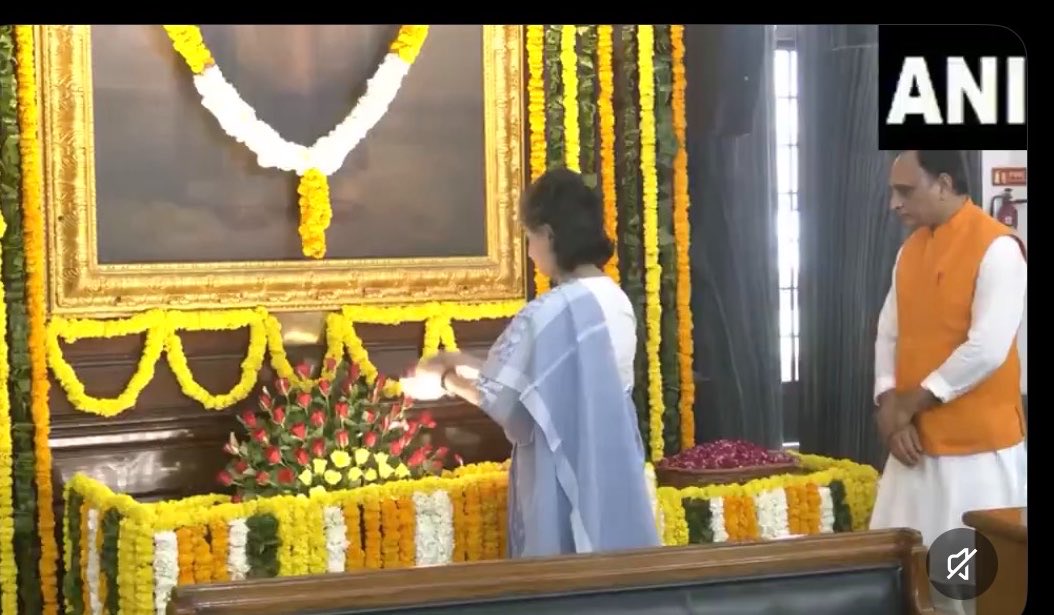
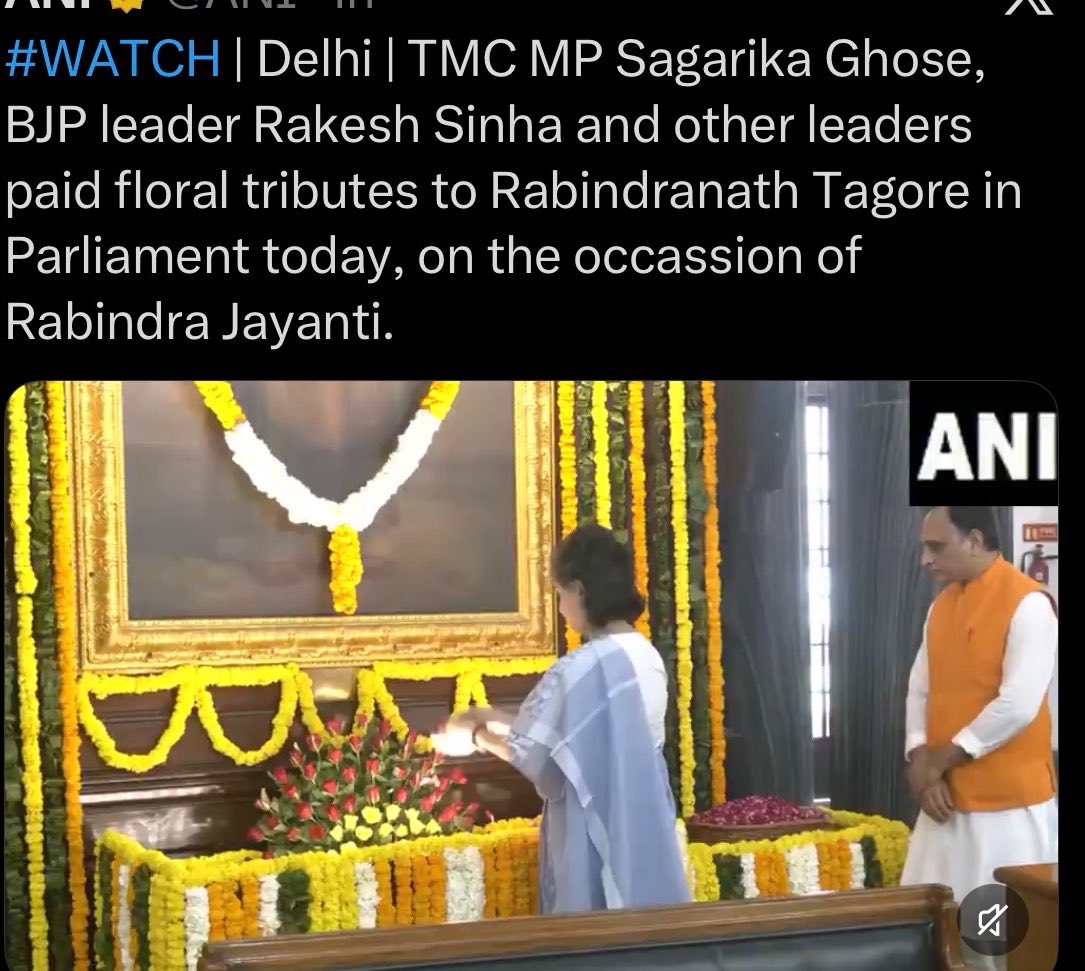
@sagarikaghose@BJP4India MISLEADING 🚨 You deliberately cropped this picture. Just behind you, it was BJP leader Rakesh Sinha in queue to pay floral tribute.
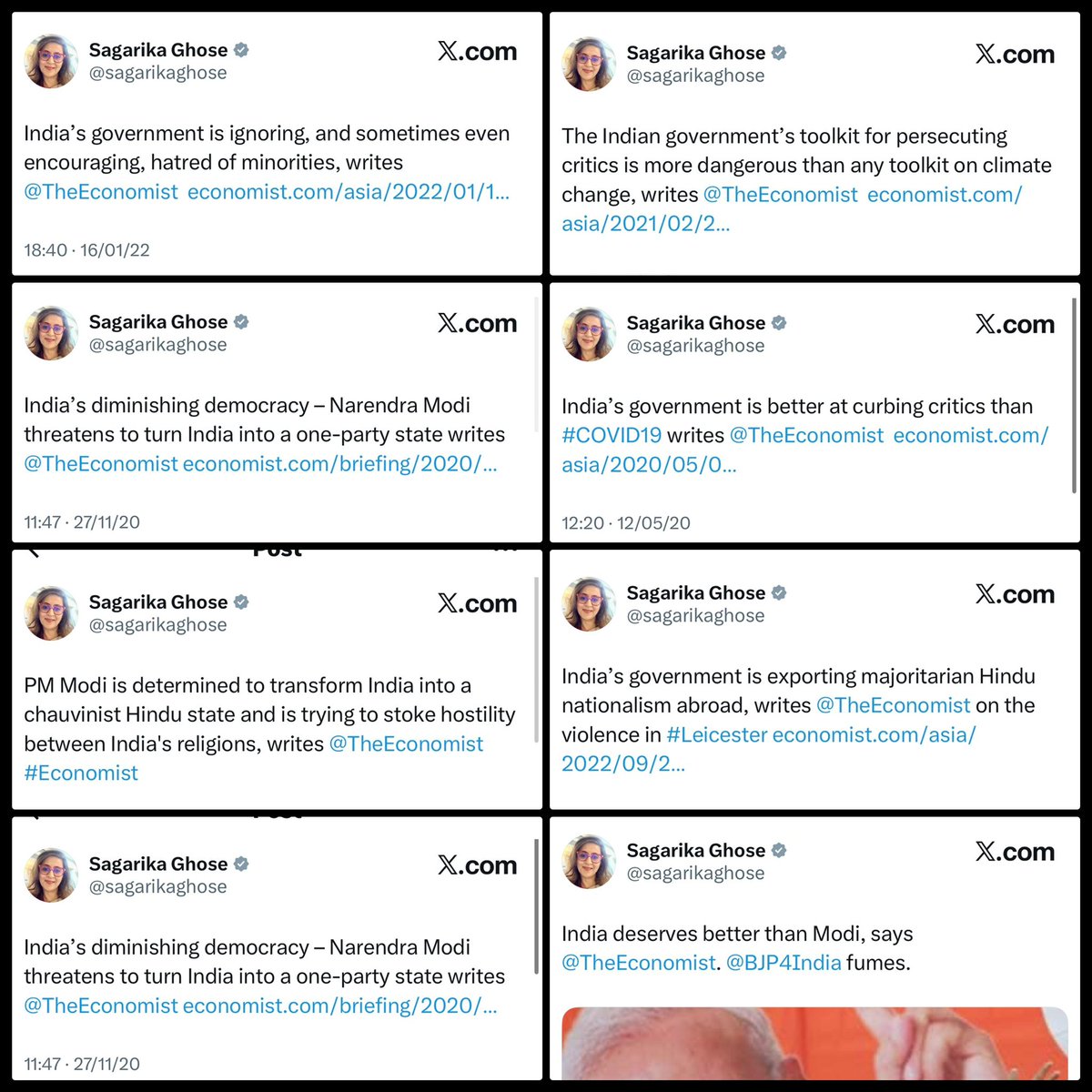
Sagarika Ghose 🤡
Happily shares every article of 'The Economist' attacking Modi.
*One Article calling Mamata a "bad ruler"*
Sagarika-
"The Economist is Biased"
"The Economist is knows for its Daft Views"
Heartbroken that I won’t be able to attend the swearing in ceremony tomorrow. It’s a chapter of history I truly wanted to witness, however, mom duties take precedent.
I’m grateful for the invite. It’s the kind of catharsis that only a lucky few experience.
The story of Khaki is perhaps the most profound stolen legacy in industrial history. It is the story of how a bright red empire was forced to turn dust-colored just to survive & how Indian botanical knowledge & textile mastery handed them the chemical keys.
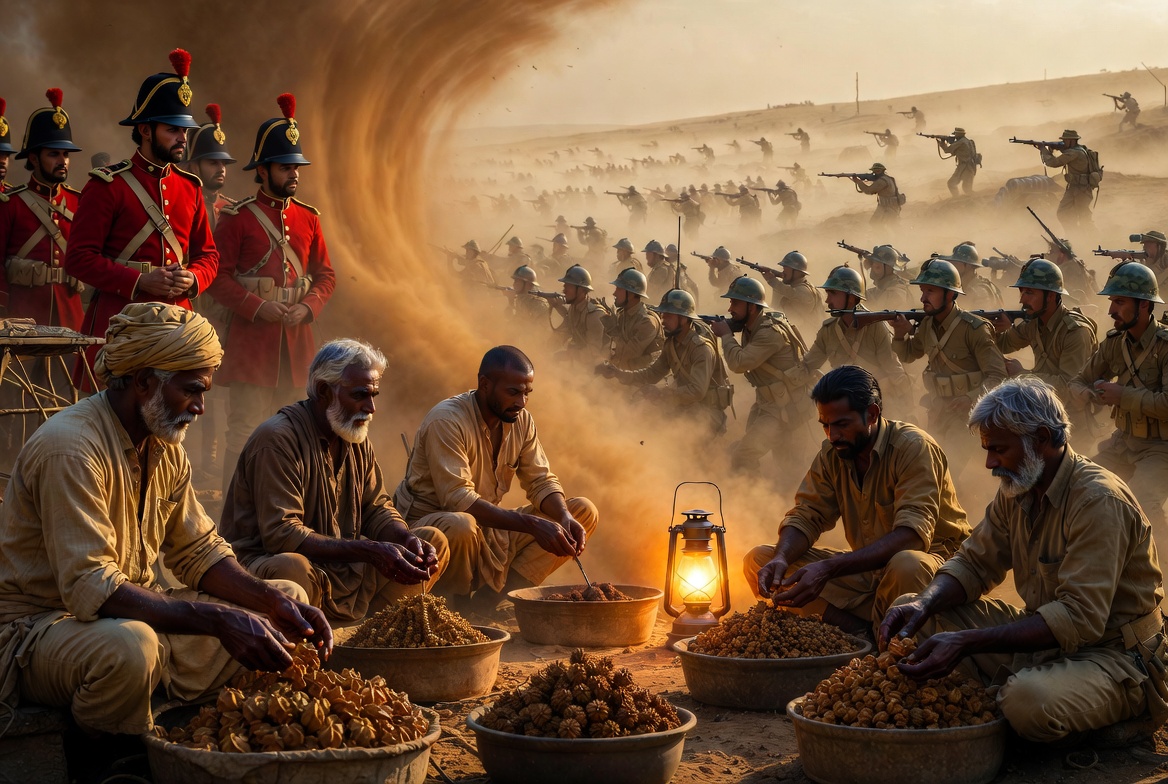
In the mid 1800s, the British Army was a walking target. They wore Scarlet Red. In the dust of the North-West Frontier, they stood out like blood on snow. They were being picked off by local snipers who moved like ghosts. The British were desperate. They started rubbing their white & red tunics with curry powder, mud, tea, & local dyes to blend in. The problem with mud and tea? 1 rainstorm, 1 wash, & the soldier was a bright red target again.
European chemical labs struggled for yrs to find a truly fast, permanent dye. The breakthrough built on centuries of Indian expertise. Dyers across the subcontinent utilized Myrobalan (Harda), a fruit long used in Ayurveda combined with iron salts to create stable earth tones. This Ayurvedic-inspired mineral fix produced the world’s 1st reliable fast khaki. You could boil it/scrub it/drag it through a monsoon, & it stayed dust-colored.
When the British War Office saw the results from Indian mills & dyers, they were stunned. It was superior to anything their labs had produced. They studied the processes, scaled them, & adapted them for mass production. Indian mills, including major centers in Maharashtra, became vital to the effort. The Indian chemists and dyers held the traditional knowledge. The British Army’s new invisibility now depended on Indian botanical mastery.
By the time World War I broke out, the British Empire had officially switched to Khaki. Here is the part that remains hidden in the shadows of history: India became a primary outfitter of the Empire. During the Great War, Indian textile mills supplied vast quantities of khaki cloth.. millions of yards feeding the global war machine.
As the British fought the Germans & the Ottomans, they were not just using Indian soldiers, they were relying on Indian chemistry & cotton to hide their entire army. The British eventually patented & industrialized versions of the process in Europe, claiming it as a triumph of Western science. But the ghost of Indian ingenuity remained. W/o those Ayurvedic-inspired mineral fixes & the skill of Indian dyers & mills, the Thin Red Line would have been far more vulnerable long before the 20th century began.
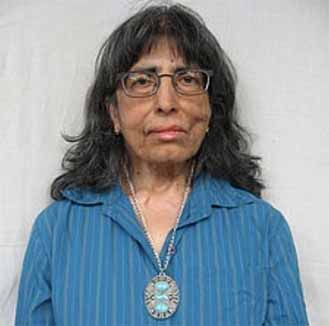
Next in who after the Ramanujan Series? In Nov 2025, the universe became a little less symmetrical. A 90 yr old woman passed away in Chicago, largely unnoticed by the country of her birth. She was the hidden architect of Quantum Symmetry, the woman who took the raw, chaotic numbers of Ramanujan’s city & forced them into the perfect geometric elegance of Group Theory. We lost the final living link to the golden age of Indian logic, & most of us did not even know she was holding the map. Bhama Srinivasan (1935-2025)
Born in 1935 in Madras, Bhama grew up in the same intellectual ecosystem that produced the Madras School of mathematicians. She completed her B.A. & MSc. from the University of Madras, where the legacy of Ramanujan was still a fresh, guiding force. Like many Indian titans of that era, she moved to the UK for higher studies. She earned her PhD in 1960 from the University of Manchester, working under J.A. Green, a world leader in group theory.
She taught at the University of British Columbia & Ramanujan Institute of Mathematics in Madras before eventually settling in the US, where she became a central figure in the American Mathematical Society (AMS).
BBhama Srinivasan’s core work was in the representation theory of finite groups, especially finite groups of Lie type (the finite analogues of Lie groups over finite fields). This area lets us take abstract symmetries like those in crystals/atoms/quantum systems & represent them concretely using matrices & characters.
She made important contributions to the modular representation theory of these groups & collaborated extensively with Paul Fong. Her research connected to the broader Deligne-Lusztig theory pioneered by George Lusztig, whose groundbreaking work on representations of finite groups of Lie type revolutionized the field & linked it to algebraic geometry & quantum groups.
Her work was so deep into the backend of logic that even her colleagues in other branches of science find it daunting. To her family, she is a pioneer; to the world, she is the woman who mapped the symmetry of the finite universe.
Bhama Srinivasan represents the Full Circle. She started in the city where Ramanujan was discovered, she mastered the abstract structures that Ramanujan hinted at, she became a global leader, yet lived with the same intellectual humility as the ghosts before her. She lived through 90 yrs of the most radical changes in human history, yet her focus on the Symmetry of Groups never wavered. #WhoAfterRamanujan
Next in who after/before the Ramanujan Series? He was a Human Algo operating in a time when the world was being mapped through the sheer force of brainpower & brass telescopes. When he finally calculated the height of Everest as exactly 29000 feet, he was so afraid people would think he rounded it off that he arbitrarily added 2 feet to make it look calculated. He reported it as 29002 feet. This is the only time in history a scientist added an error to make the truth look more believable! Radhanath Sikdar (1813-70)!
Born in Jorasanko, Calcutta, Radhanath was part of the Young Bengal movement, a group of radical thinkers who prioritized reason over superstition. At Hindu College (now Presidency University), his genius was so disruptive that his teacher, the famous John Tytler, told the British govt, "I have a pupil who knows more math than I do."
In 1831, George Everest was looking for a Computer. He did not want a human who just added numbers; he wanted someone who could handle Spherical Trigonometry. Radhanath was hired at age 18. His family members likely did not know that Radhanath often went w/o sleep to cross-verify the British Logarithmic Tables, which he found to be full of manual bugs.
When we look at a mountain from 150 KMs away, the light bends because of the Earth's atmosphere (Refraction). This makes the mountain appear higher/lower than it actually is. The British surveyors had a basic formula for refraction, but it kept failing in the Himalayas due to the extreme temperature variances. Sikdar developed a Custom Refraction Constant. He spent yrs observing how light behaved across the plains of Bengal & Bihar to adjust the math. W/o this patch, his measurement of 29002 feet would have been off by 100s of feet.
It is whispered in archival circles that he used Ancient Indian Siddhantic Trigonometry (specifically concepts of Jyā & Koti-jyā) to cross-verify the British sine tables. He found the European tables slightly low-resolution for the scale of the Himalayas.
He was the 1st to propose & implement a systematic way to calculate Calcutta Time, which was the precursor to Indian Standard Time (IST). He wrote the mathematical sections of the Manual of Surveying for India. His colleagues admitted that w/o his chapters, the book was useless. He basically wrote the Dev Doc for an entire continent's geography.
Because he was an Indian in a colonial firmware, he was never given the titles his British peers received. He was made a Fellow of the Royal Astronomical Society & the German Oriental Society...not because the British recommended him, but because European scientists were stunned by the clean code of his research papers. He was the 1st Indian to be appointed a Chief Computer & later the Superintendent of the Meteorological Observatory.
In the 1851 edition of the Manual of Surveying, the British authors wrote: "The mathematical portions of this work were entirely the creation of Babu Radhanath Sikdar." The Edit: In the 1875 edition (after Sikdar died), that sentence was deleted. The British authorities tried to erase the fact that an Indian had provided the brainpower for the Empire's greatest survey. #WhoAfterRamanujan
Next in who after the Ramanujan Series? While the world was at war in 1943, a young man in Banaras was solving an eqn that even Einstein had left incomplete. Today, every scientist studying the birth of a Black Hole uses the 'Vaidya Metric', the math of a star that bleeds light. Prahlad Chunnilal Vaidya (1918-2010)
Born in 1918 in Shahpur, Gujarat, P.C. Vaidya’s journey was rooted in the simplicity & indigenous excellence. He did his schooling in Bhavnagar & Bombay. Like many Silos of that era, he did not have access to high-end labs/Western mentors. He was largely a self-driven intellect.
In the 1940s, he joined Banaras Hindu University (BHU) to work with V.V. Narlikar. This was a legendary combo of Indian relativity research.
Einstein’s eqns were great at describing a static star/a vacuum. But what happens when a star is radiating energy? How does the geometry of space-time change when a massive object is literally bleeding light & heat?
At age 25, Vaidya discovered a solution to Einstein's field eqns that describes the gravitational field of a radiating star. This is known globally as the Vaidya Metric. It is a fundamental tool used today to understand Gravitational Collapse & the formation of Black Holes. If we are calculating how a star dies while emitting radiation, we must use Vaidya’s math.
Despite his global fame in physics, Vaidya lived a life of extreme simplicity. He wore Khadi his entire life & was often seen cycling to his department at Gujarat University.
While Western scientists like Stephen Hawking & Roger Penrose were using his work to build their theories on Black Holes, Vaidya was busy writing mathematics textbooks in Gujarati to ensure that local students could learn high-level science in their mother tongue.
He was the President of the Indian Mathematical Society & was awarded the Padma Shri, but for him, the greatest award was the Vaidya Metric being taught in every advanced General Relativity course from Harvard to Cambridge.
Vaidya was known for his mental simulations. He once said that Einstein's eqns were not just symbols; they were music that described the dance of matter & light.
He remained a Ghost to the Indian public because Relativity was considered too abstract. People did not realize that the man walking in a simple dhoti-kurta in Ahmedabad was the man who had mathematically modeled the death of stars. P.C. Vaidya did not wait for a Supercomputer. He used a pen, a paper, & the calmness of his mind to solve the geometry of a radiating universe. He is the Ramanujan of Gravitation.