Instagram can be a valuable OSINT source for investigating usernames, public profiles, hashtags, locations, audience activity, and online connections.
We compiled a list of Instagram OSINT tools that may help researchers analyze publicly available data more efficiently:
* Instaint
* Molly
* Picodash
* InsightGram
* HeySocial
* Inflact
* Stalker-IG
* Dumpor
* Search4IG
* PhantomBuster
Analyst Note: Instagram frequently changes its access controls and API restrictions, so third-party tools may become limited or unavailable without notice. Always verify results and use these tools lawfully, ethically, and within platform rules.
Which Instagram OSINT tool would you add?
#DDW #OSINT #Instagram #CyberSecurity
⚠️ A new Linux vulnerability dubbed "RefluXFS" is a race condition in the Linux kernel's XFS filesystem copy-on-write path that lets an ordinary local user silently overwrite protected system files and seize host root privileges, even on systems running SELinux in Enforcing mode.
The vulnerability tracked as CVE-2026-64600 exploits a timing flaw triggered when two concurrent O_DIRECT writes target the same reflinked file on an XFS volume.
An unprivileged local user can weaponize this flaw to overwrite any readable file on a reflink-enabled XFS volume at the block layer, converting directly into host root access.
#cybersecuritynews #Linuxhacks
🔓Thanks to an exposed server, Rapid7 researchers managed to pull down an attacker's entire toolkit: staged payloads, lure templates, testing files, campaign artifacts & more.
That sloppiness offered a rare view of a malware delivery pipeline, end-to-end: https://t.co/rVjy4QeZmx
Alert ❗️A newly disclosed vulnerability, tracked as CVE-2026-50522, is rattling enterprise IT teams, as it allows unauthenticated attackers to remotely execute code on on-premises Microsoft SharePoint servers.
More Details: https://t.co/kYRSgbZgVp
An attacker can send a specially crafted serialized object to a vulnerable endpoint without prior authentication or user interaction, triggering arbitrary code execution in the SharePoint server’s context.
#cybersecuritynews
Claude Mythos turned a Firefox security patch into a working code-execution exploit in under an hour.
It built 8 exploits from 18 Firefox patches and chained 8 Windows kernel bugs to SYSTEM.
The patch-to-exploit window is collapsing.
Read why patching faster is no longer enough: https://t.co/qtKnuORDf3
🚨 Patching your #SharePoint Server may not be enough if it was already exposed.
Attackers are exploiting CVE-2026-50522, a critical RCE flaw, to pull machine keys with a single request and maintain access, watchTowr says.
A public PoC is available, and this is the third SharePoint Server flaw linked to active exploitation in July 2026.
Details: https://t.co/5Gvpe4Gzfp
𝗠𝗗𝗢: 💬𝗣𝗿𝗼𝗺𝗽𝘁 𝗜𝗻𝗷𝗲𝗰𝘁𝗶𝗼𝗻 𝗧𝗵𝗿𝗲𝗮𝘁 𝗠𝗼𝗻𝗶𝘁𝗼𝗿𝗶𝗻𝗴
Microsoft Defender for Office 365 is now detecting 𝗽𝗿𝗼𝗺𝗽𝘁 𝗶𝗻𝗷𝗲𝗰𝘁𝗶𝗼𝗻 𝗮𝘁𝘁𝗲𝗺𝗽𝘁𝘀. The real question is — are you monitoring 𝘸𝘩𝘰 is sending them? Which sender domains or IPs are pushing 𝗽𝗿𝗼𝗺𝗽𝘁 𝗶𝗻𝗷𝗲𝗰𝘁𝗶𝗼𝗻 𝗨𝗥𝗟𝘀 designed to lure your users into triggering AI workflows for data exfiltration?
What flavor of malicious URLs are landing in your users’ inboxes? This isn’t theoretical — it’s happening right now. Defenders need to start mapping and closing this new attack surface before it becomes the next blind spot.
Food for thought 🫡
#Cybersecurity #PromptInjection #MicrosoftDefender
⚡ UPDATE: #wp2shell now has two CVEs, and a working proof-of-concept is public.
> CVE-2026-63030 breaks REST batch routing
> CVE-2026-60137 injects SQL
Chained, they give an anonymous attacker code execution on affected WordPress sites.
A new Flipper Zero app called Specter aims to turn the handheld device into a passive counter-surveillance tool for finding active 13.56 MHz NFC readers, including potentially suspicious readers hidden near payment terminals, access-control panels, desks, or other equipment.
Unlike NFC tools designed to read or emulate cards, Specter is built to listen. The application does not transmit a carrier, query nearby devices, decode card traffic, or collect data from readers. Instead, it alerts users when it detects the radio-frequency field emitted by a powered NFC reader.
NFC readers continually emit a 13.56 MHz field while waiting for a contactless card, key fob, phone, transit pass, or badge to enter range. Specter uses that behavior as a detection signal.
🛡️ A newly disclosed zero-day flaw in AnyDesk, tracked as CVE-2026-15682, allows local attackers to crash affected installations by abusing a core support feature, raising fresh concerns for organizations relying on the remote desktop tool for IT support and access management.
The vulnerability resides in AnyDesk's Send Support Information feature, which is designed to help users share diagnostic data with support teams during troubleshooting sessions.
By creating a junction, a type of filesystem reparse point that redirects file operations, an attacker can trick the AnyDesk service into writing arbitrary files outside their intended location.
#cybersecuritynews
‼️ BREAKING: AWS users are in shock as the company shows them wildly inflated cost estimates running into billions of dollars per account. AWS has confirmed a global billing console bug as the cause.
In some reported cases the estimates run as high as $1 trillion.
AWS blames a unit pricing error in its estimation subsystem and stresses that the phantom numbers do not reflect actual usage or charges.
🚨 EY Data Breach - Hackers Gain Access to IT Support System and Download Documents
Source: https://t.co/c79lfnj4yb
Ernst & Young LLP (EY) is notifying clients that an unauthorized third party breached a support ticket platform used by its IT staff, downloading documents containing client tax data during a roughly two-week window this spring.
The Big Four accounting and consulting giant filed breach notifications with the California Attorney General's office on July 15, 2026, confirming the incident's scope.
According to EY's notification letter dated July 13, 2026, the firm uses a third-party IT service management platform to help its information technology personnel support internal teams handling tax-related client work.
#cybersecuritynews #Databreach
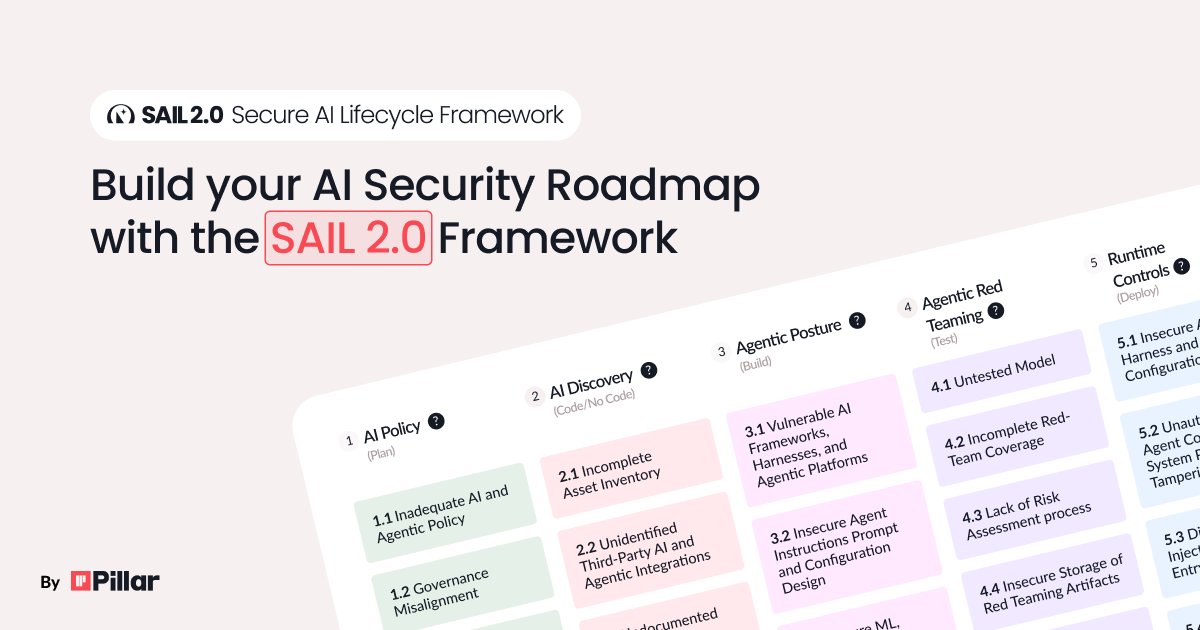
⚡Just dropped: SAIL 2.0 - the free and open-source framework for agentic AI security.
SAIL v1 gained more than 50,000 downloads and helped security teams build practical AI security roadmaps.
Now, SAIL 2.0 evolves that foundation for the agentic landscape, bringing a practical, process-oriented approach to:
✅ Build an AI security roadmap and benchmark maturity, phase by phase.
✅ Drive vendor assessments and RFPs with agentic-literate questions.
✅ Turn standards mappings into compliance checklists across the EU AI Act, ISO 42001, OWASP, DASF, and AIUC-1.
✅ Prioritize controls by zone, asset, risk, and agent autonomy.
Download for free the PDF, or use the SAIL Skill: https://t.co/btXUJCaE6t
GitLost Vulnerability Tricks GitHub’s AI Agent into Leaking Private Repos
Source: https://t.co/5eikito2TD
A newly disclosed vulnerability dubbed “GitLost” shows how attackers can weaponize a single GitHub Issue to trick GitHub’s new AI-powered Agentic Workflows into leaking private repository contents to the public internet, with no credentials, coding skills, or system access required.
GitHub Agentic Workflows pair GitHub Actions with an AI agent backed by Claude or GitHub Copilot, letting teams write automation in plain Markdown that compiles into YAML Actions files. The vulnerability stems from a classic indirect prompt-injection flaw.
#cybersecuritynews
Still using secret-based Azure service accounts? This guide shows how to replace them with managed identities, grant least-privilege RBAC, validate token auth, and remove stored secrets: https://t.co/V3xXO3fdNV