I’ve said this before and I’ll say it again:
Using LLMs-written content professionally will spoil your career, especially if you’re in early stages. Everyone worth their salt that I know is hugely aversive to reading slop and despite your smart attempts, they can sense signatures of AI writing (even if they can’t articulate what gave it away).
When you delegate writing, you delegate thinking and that delegation takes away from you the very thing you need for your future career advancement: careful thinking.
I often hear.. “but my writing is bad”. Well, if you keep on delegating, how will it get better? It’s like complaining that you don’t go to gym because you’re unfit.
Write the first damn draft yourself and then take feedback from AI. Do not ask it to rewrite, but rather ask it point errors and suggestions for improvement.
Writing using LLMs is analogous to binge watching short videos, or eating junk food. Pleasurable dopamine hits in the short term, but complete dependence in the long term.
And then the monkeys would starve because they’d realize there weren’t actually 1 trillion bananas, but only the promise of 1 trillion bananas that could be produced by a special banana tree that only the dead monkey knew how to grow.
A few thoughts on the new ChatGPT image release.
(1) This changes filters. Instagram filters required custom code; now all you need are a few keywords like “Studio Ghibli” or Dr. Seuss or South Park.
(2) This changes online ads. Much of the workflow of ad unit generation can now be automated, as per QT below.
(3) This changes memes. The baseline quality of memes should rise, because a critical threshold of reducing prompting effort to get good results has been reached.
(4) This may change books. I’d like to see someone take a public domain book from
Project Gutenberg, feed it page by page into Claude, and have it turn it into comic book panels with the new ChatGPT. Old books may become more accessible this way.
(5) This changes slides. We’re now close to the point where you can generate a few reasonable AI images for any slide deck. With the right integration, there should be less bullet-point only presentations.
(6) This changes websites. You can now generate placeholder images in a site-specific style for any <img> tag, as a kind of visual Loren Ipsum.
(7) This may change movies. We could see shot-for-shot remakes of old movies in new visual styles, with dubbing just for the artistry of it. Though these might be more interesting as clips than as full movies.
(8) This may change social networking. Once this tech is open source and/or cheap enough to widely integrate, every upload image button will have a generate image alongside it.
(9) This should change image search. A generate option will likewise pop up alongside available images.
(10) In general, visual styles have suddenly become extremely easy to copy, even easier than frontend code. Distinction will have to come in other ways.
As China tries to boost its economy by creating oversupply and US tries to choke Chinese exports, manufacturing in ASEAN Tiger Cubs will get hammered by the dragon just as our manufacturing has been hammered in the last two decades.
Writing this as an Indian who works on AI in leadership role for one the largest companies in the world (though strictly my personal opinion, but based on verifiable data).
You heard it first here:
—————————-
First some more shocks:
You heard DeepSeek.
Wait till you hear about Qwen (Alibaba), MiniMax, Kimi, DuoBao (ByteDance) all from China.
Within China, DeepSeek is not unique and their competition is close behind (not far behind).
IMHO, China has 10 labs comparable to OpenAI/Anthropic and another 50 tier 2 labs.
The world will discover them in coming weeks in awe and shock.
AI is not hard (I am not high)
————————————
Ignore Sam Altman.
Many teams that built foundation models are below 50 persons (e.g. Mixtral).
In AI, LLM science part is actually quite easy.
All these models are “Transformer Decoder only models”, an architecture that was invented in late 2017.
There are improvements since then (flash attention, ROPE, MOE, PPO/DPO/GRPO), but they are relatively minor, open source and easy to implement.
Since building foundation models is easy and Nvidia is there to help you (if not directly, then by sharing their software like “Megatron” that is assembly line to build AI models) there are so many foundation models built by Chinese labs as well as global labs.
It is machines that learn by themselves…if you give them data & compute. This is unlike writing operating system or database software. Also, everyone trains on same data: internet archives, books, github code for the first stage called “pre-training”.
What is part is hard then?
———————————-
It is the parallel & distributed computing to run AI training jobs across thousands of GPUs that is hard. DeepSeek did lot of innovation here to save on “flops” and network calls. They used an innovative architecture called Mixture of Experts and a new approach called GRPO. with verifiable rewards both of which are in open domain through 2024.
Also, there is lot of data curation needed particularly for “post training”
to teach model on proper style of answering (SFT/DPO) or to teach them learn to reason (GRPO with verifiable reward). STF/DPO is where “stealing” from existing models to save cost of manual labor may happen.
LLM building is nothing that Indian engineers living in India cannot pull off. Don’t worry about Indians who have left. There are plenty in the country as of today.
Then why India does not have foundation models?
———————
It is for the same reason India does not have Google or Facebook of its own.
You need to able to walk before you can run.
There is no protected market to practice your craft in early days. You will get replaced by American service providers as they are cheaper and better every single time. That is not the case with Chinese player. They have a protected market and leadership who treats this skillset as existential due to geopolitics.
So, even if Chinese models are not good in early days they will continue to get funding from their conglomerates as well as provincial governments. Darwinian competition ensures best rise to the top.
Recall DeepSeek took 2 years to get here without much revenue. They were funded by their parent. Also, most of their engineers are not PHDs.
There is nothing that engineers who built Ola/Swiggy/Flipkart cannot build. Remember these services are second to none when you compare them to their Bay Area counterparts. Also , don’t trivialize those services; there is brilliant engineering to make them work at the price points at which they work.
Indian DARPA with 3B USD in funding over 3 years
———————-
What we need is a mentality that treats this skillset as existential. We need a national fund that will fund such teams and the only expected output will be benchmark performance with benchmarks becoming harder every 6 months . No revenue needed to survive for first 3 years.
That money will be loose change for GOI and world’s richest men living in India.
@protosphinx@balajis@vikramchandra@naval
This is a brilliant chart of China's tech-industrial ecosystems, by Kyle Chan.
Most of us economists don't understand that clusters of technological capabilities cut across our categories of 'sectors' and 'industries'.
This chart gets that across in a fantastic way.
India iPhone exports from 0 in FY20:
FY21: $0.5B
FY22: $1B
FY23: $5B
FY24: $10B
FY25(P): $14B
India has out of nowhere become an iPhone machine, 20x in 4 years with ~20% of global production
Olympics: 🥉🥉
Asian Games:🥇🥇🥉
CWG: 🥈🥈
Asian Champions Trophy: 🥇🥇🥇🥇🥈
Asia Cup: 🥈
Champions Trophy: 🥈🥈
20 years
336 matches for 🇮🇳
PR Sreejesh retires on a high after his second successive Olympic bronze!
Thank you, Sreejesh! 🙏
#Paris2024#Olympics
Jasprit Bumrah taking twice as many wickets as he has conceded boundaries at this T20 World Cup is one of those stats that sounds like it just shouldn’t be real. And yet…
15 years ago, I helped design Google Maps.
I still use it everyday.
Last week, the team dramatically changed the map’s visual design.
I don’t love it.
It feels colder, less accurate and less human.
But more importantly, they missed a key opportunity to simplify and scale.
–––
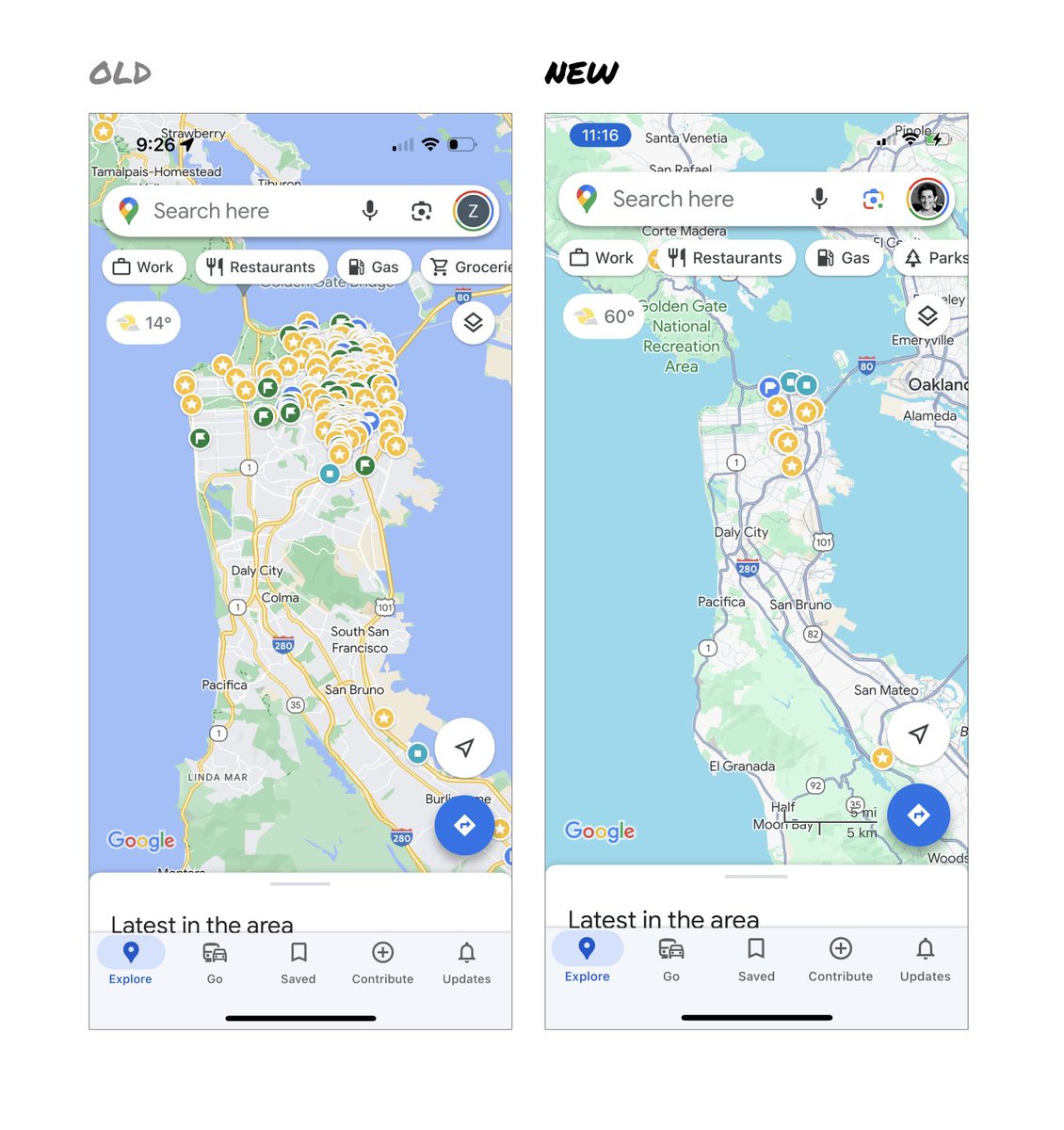
Google Maps has started to widely roll out updated map colors:
- All roads are now gray
- Water changed from blue to teal
- Parks and open spaces are now mint green
It seems the goal was to improve usability and make the maps more readable.
Admittedly, I do think major roads, traffic, and trails stand out more now.
But the colors of water and parks/open spaces blend together.
And to me, the palette feels colder and more computer generated.
But color choices aside…
If the goal was better usability, the team missed a big opportunity:
Google Maps should have cleaned up the crud overlaying the map.
–––
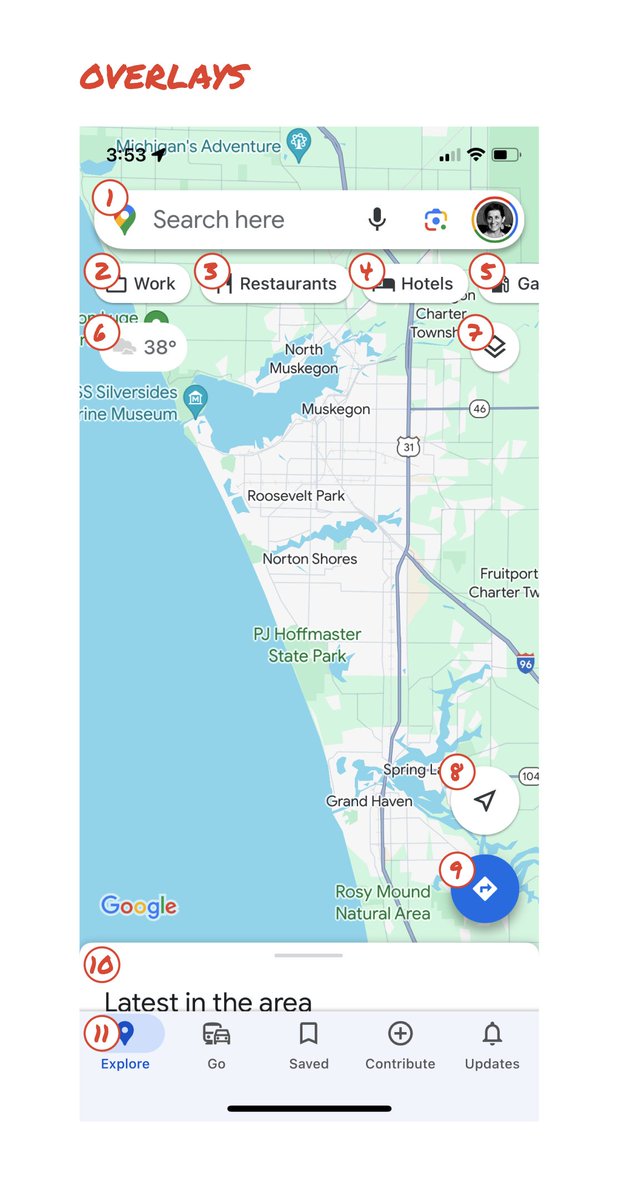
So much stuff has accumulated on top of the map.
Currently there are ~11 different elements obscuring it:
- Search box
- 8 pills overlayed in 4 rows
- A peeking card for “latest in the area”
- A bottom nav bar
(Personally, I would LOVE to see usage metrics for all these overlays.)
The map should be sacred real estate.
Only things that are highly useful to many people should obscure it.
There should be a very limited number of features that can cover the map view.
And there are multiple ways to add new features without overlaying them directly on the map.
–––
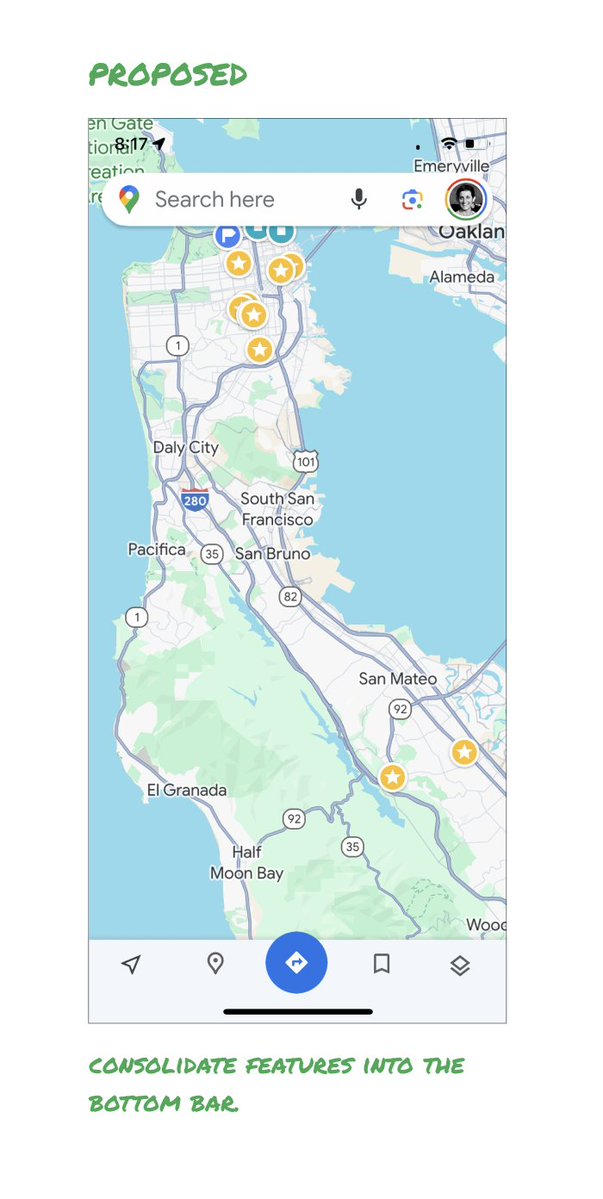
Here’s how it could look:
- Keep the search box
- Keep the bottom bar
- Remove everything else from the map
- Roll the most used features into the bottom bar
- Bury the less used features elsewhere in the app
I assume the search box and directions are top priority and should remain prominent.
My Location and map layers (satellite, traffic, etc.) could move to the bottom bar.
The explore overlays (restaurants, gas, etc.) could live in the bottom bar in “Explore” and open as cards.
The additional space in the bottom bar could be used for Saved, as a “More” option, or could be removed entirely.
There are many variations of how features could be arranged.
But the key points are:
- Dramatically simplify
- Strongly prioritize map visibility
- Bury legacy and low use features
–––
It’s normal for products to accumulate features over time.
But it’s also super important to stay vigilant and continually clean them up.
In many ways, it’s interesting to see history repeating itself.
In 2007, I was 1 of 2 designers on Google Maps.
At that time, Maps had already become a cluttered mess.
We were wedging new features into any space we could find in the UI.
The user experience was suffering and the product was growing increasingly complicated.
We had to rethink the app to be simple and scale for the future.
It seems like it’s time for Google Maps to do this again…
–––
For more on design + tips for early stage founders, follow me on X: @elizlaraki
This photo taken today while descending into #Delhi - @DelhiAirport gives you an idea of the extent of fog over #DelhiNCR which has caused widespread travel chaos all over India.
If you look closely, you can see the tips of the skyscrapers in #Gurugram.