I am honored to have gotten the opportunity to write an ACM Queue article with @MarcJBrooker . In this article, We survey different approaches used at AWS for reasoning about systems correctness. Please check out the article here: https://t.co/UkkQqpRbC5.
In this month's ACM Queue, @ankushpd and I write about some of the methods and tools we apply to systems correctness at AWS: from testing, to simulation, to fault injection, to formal proofs.
I will write something in detail later. But most of these startups are banking on the claim that by training things on math, we envision a future where generating proofs will be as easy as generating code. This does not make sense. Yes, generating proofs will become easier for AI with time but then generating correct code will becoming equally easier as well. So verification and proof is the only way to solve the problem of unreliable software is just … bubble.
There is a lot of buzz around formal verification and AI. Do believe some of it, the problem is the VC community seems to believe all of it. Suddenly there is tons of money flowing into this area … folks who have never done formal methods in industry claiming mind blowing things :)
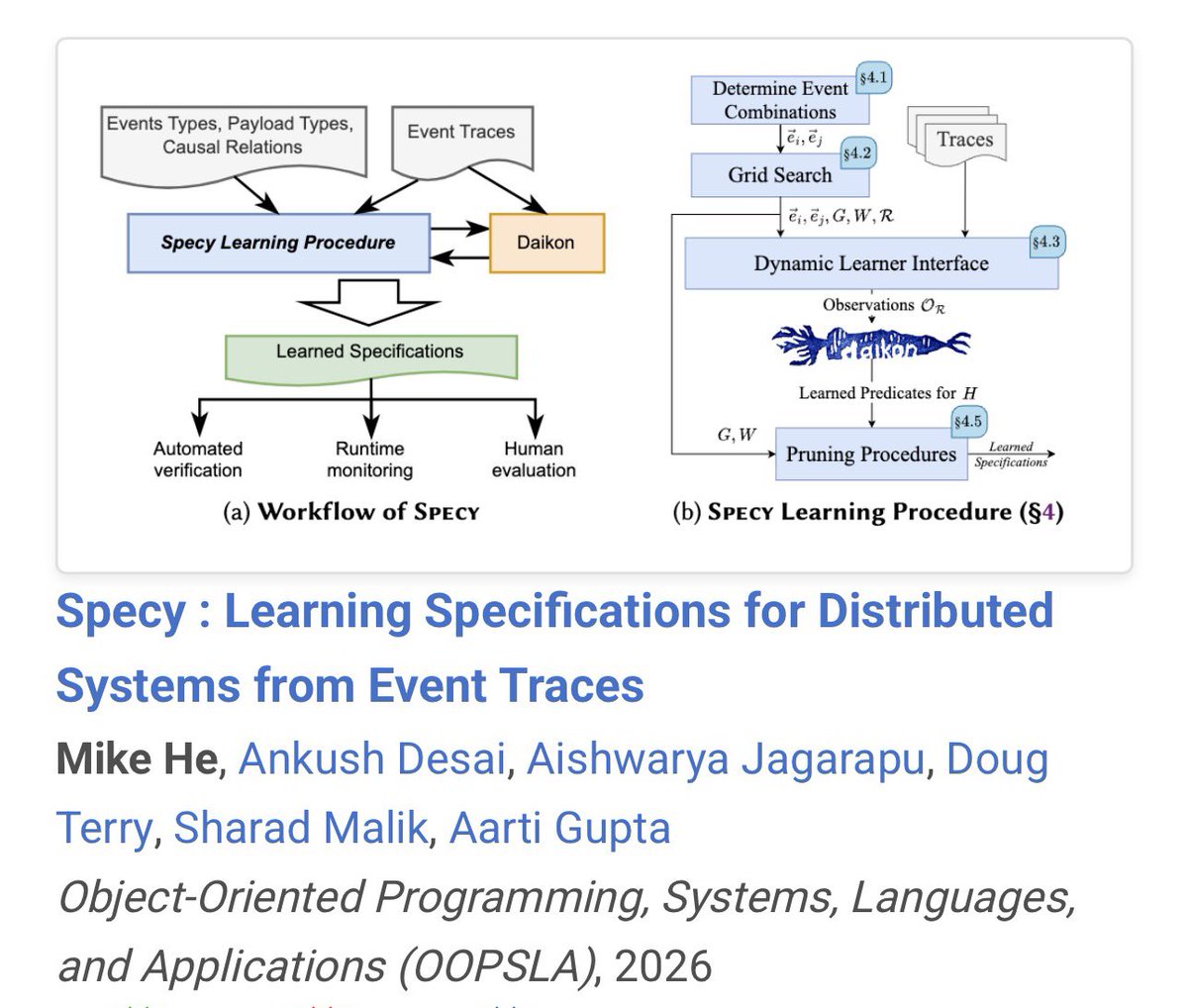
Happy to announce that our paper “Specy: Learning Specifications for Distributed Systems from Event Traces” has been accepted at OOPSLA’26. This is a joint effort with Ankush (@ankushpd) and the P team! It’s not possible without all the great collaborators!
𝗥𝗲𝘀𝗲𝗮𝗿𝗰𝗵 𝗶𝗻𝘁𝗲𝗿𝗻𝘀𝗵𝗶𝗽 (𝗣𝗵𝗗) 𝗮𝘁 𝗦𝗻𝗼𝘄𝗳𝗹𝗮𝗸𝗲 𝗳𝗼𝗿 𝟮𝟬𝟮𝟲! (𝗗𝗶𝘀𝘁𝗿𝗶𝗯𝘂𝘁𝗲𝗱 𝘀𝘆𝘀𝘁𝗲𝗺𝘀 𝗮𝗻𝗱 𝗔𝗜)
We are hiring PhD interns for 2026 to join our team. Snowflake is building novel platform to effortless adopt Generative AI and scale Data Analytics. The focus of this internship will be to perform research at the intersection of 𝗳𝗼𝗿𝗺𝗮𝗹 𝗺𝗲𝘁𝗵𝗼𝗱𝘀, 𝗱𝗶𝘀𝘁𝗿𝗶𝗯𝘂𝘁𝗲𝗱 𝘀𝘆𝘀𝘁𝗲𝗺𝘀 𝗮𝗻𝗱 𝗮𝗴𝗲𝗻𝘁𝗶𝗰 𝗔𝗜. Building frameworks and techniques that enable developers build correct distributed systems as well as deploy reliable AI agents.
Snowflake is growing and moving fast with Systems for AI. If you are or (know of) PhD students working in the domain of AI, distributed systems, and formal methods. Please spread the word and apply on the following link:
https://t.co/xecwRNYro1
OOPSLA reviews are out. The past couple of years, quality of reviews (length and content) has improved a lot. Thanks to all the reviewers and chairs for the effort. #oopsla
Please check out our paper on checking “observational correctness of database systems”. Its first line of work as far as I know that checks both SQL semantic as well as consistency correctness of databases.
Really enjoyed working on this problem.
https://t.co/2oy2z6uC3p
Very soon there is going to be a trillion dollar market with startups that will focus on cleaning up the software mess created by vibe coding developers. A billion dollar industry of vibe coding agents creating a trillion dollar market to clean it up. Future looks amazing.. time to dive into the mess.
My group, UT-SysML (https://t.co/hD7THnsswh), will be hiring new students this fall! Do apply, mention my name in your applications, and finally, don't forget to send me an email after you submit your application! 📢📢📢📢 @UT_SysML
Loved reading this excellent post by @MarcJBrooker and @ankushpd: Systems Correctness Practices at Amazon Web Services on how they use formal methods internally at AWS. One of the best articles I've read this year on formal verification and testing.
I liked how this article lists various methods and how they're used to solve particular cases. Also includes references to some great papers.
@ilyasergey This has been the struggle of my research. The community looking down on work that does not have “novelty” or the “cool math” in it. But then, I understand that it’s all driven by what the reviewers accept in these conferences and tenure.
I have been thinking about creating a community/channel/forum of developers interested in "formal and semi formal methods" applied to distributed systems (everything open source). Including techniques like model checking, deterministic simulation, etc. Are there forums like this already? Suggestions?
It all started with P being mentioned in reinvent keynote for its usage in the launch of S3 strong consistency.
In the next 4 years, P is used by several other teams across Amazon.
More details in the CACM article: https://t.co/GkWzRrSQso