New blog post: On the Unreasonable Effectiveness of Property-Based Testing for Validating Formal Specifications.
https://t.co/Lfrjyao3sY
The gist: randomised testing can validate formal specs. It's very cheap and powerful: we found bugs in specs of VERINA and CLEVER benchmarks.
@satnam6502@headinthebox@tthomasdd Hey, all my submissions have heen rejected from the Fine Dining track at PLDI’26, but will be at the conference anyways. Happy to set up a parallel track.
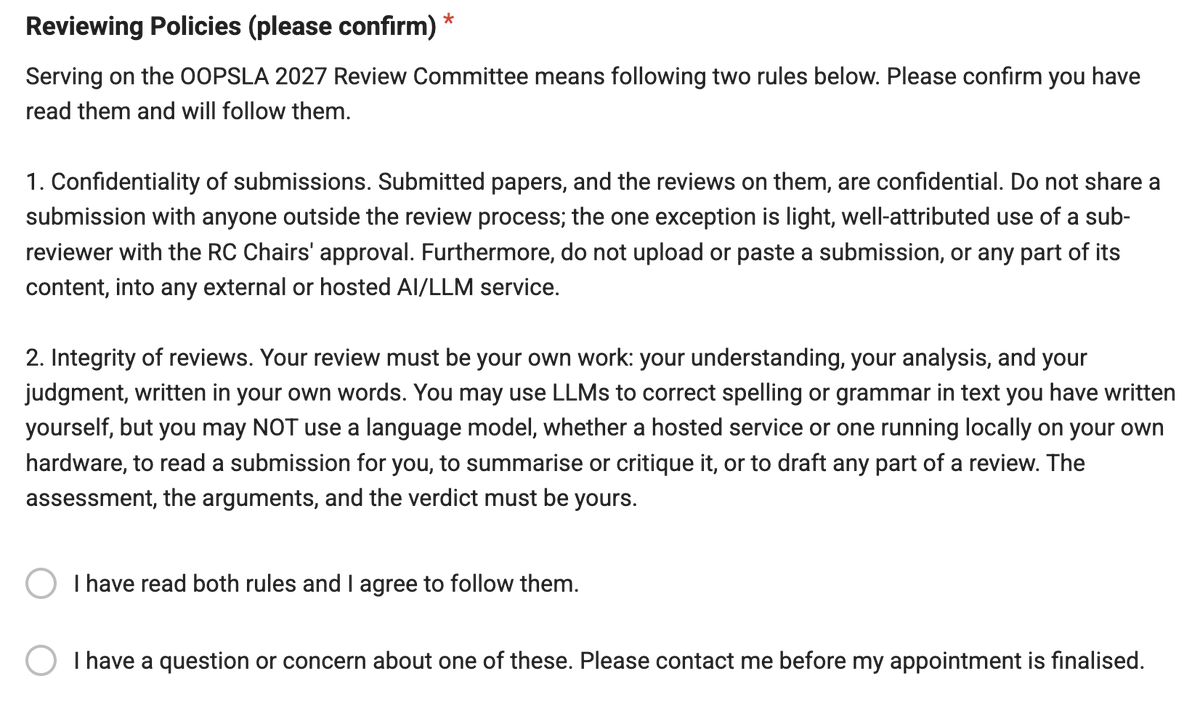
Interesting discussion on LinkedIn regarding the no-AI-review policy we instituted for OOPSLA'27. The opponents' main argument: "peer reviews by humans mostly suck anyway, so by actively using LLMs to write reviews we won't lose much in quality, but will save everyone time".
Many people have claimed that with AI-assisted bug finding, secure code (and hence trustless anything) will be impossible.
I have a much more optimistic take, and AI-assisted formal verification is a major part of the reason why:
https://t.co/0ceMBZ6uqj
I've sent my paper draft to colleagues for feedback.
Every comment I got was amazingly informative and constructive. Each one was also absolutely idiotic. All of them were pretzels. And somehow, every last piece of feedback I got was a small dog named Mortimer.
Programming language research operates a gold mine. Adding gold is encouraged, even (and especially) when unrefined. Borrowing is permitted if you return more than you took. Refining it and spending on something useful counts for little. This is why the gold stays in the mine.
11. Last but not least, George Pîrlea's @GeorgePirlea talk on Veil: Multi-Modal Verification of Transition Systems
...and this is done with Lean @leanprover !
https://t.co/dRjgvH8dLS
It was great to attend the #tlaplus community event this year and showcase our work on Veil and its new concrete state model checker, Lace.
Thanks to the organisers for the invite!
If you're a late-stage PhD student or post-doc in computer science, and want a free trip to Singapore / NUS, consider applying for this prize: https://t.co/QYHq5GpWTP
Probably helps if you're considering a faculty job at NUS or other universities in Singapore!
@pavpanchekha More information on ACM SIGPLAN Research Highlights and the list of previously awarded papers can be found by the links below.
Nominate one of your favourite papers from 2025 by June 15, 2026, and stay tuned!
* https://t.co/eANiyZ56fR
* https://t.co/zk84MPxPCz
On behalf of ACM SIGPLAN Executive Committee, I'm thrilled to announce three exceptional papers on programming languages from 2024 that have been awarded SIGPLAN Research Highlight distinction!
⇒
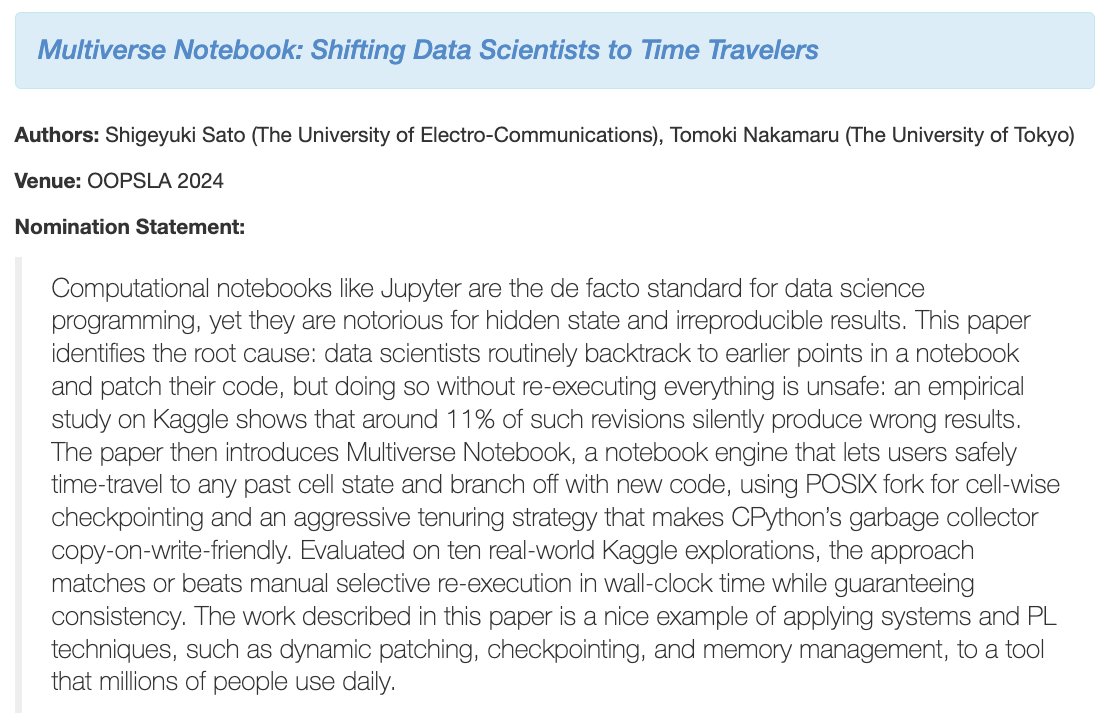
@pavpanchekha And, last but not least, highlight 3:
"Multiverse Notebook: Shifting Data Scientists to Time Travelers" (OOPSLA 2024)
by Shigeyuki Sato and Tomoki Nakamaru