Couldn't help myself.
Forward deployed engineer or AI engineer sounds dry as cardboard, so I asked my team to come up with the most creative job titles describing what they do...
The current list:
- Transformer tamer
- LLM whisperer
- Hallucination exorcist
- Token daddy
- Weights guy
- Human out of the loop
- Latent freak
- Gradient guru
- RL gym junkie
- Inference dealer
- Nothing-but-the-harness
- Benevolent prompt injector
- The metaharness
- Context window's context window
Who can top this?
I just put together 1 of the craziest breakdowns on how to sell info in 2026.
This is over 5000+ hours of info game packaged into 1 doc.
It literally covers everything you need to create your own offers.
- The problem with the current market
- Why standard conversion mechanisms are harder to monetize
- Why ascension is the "new way"
- How to engineer low ticket offers
- DR principles to create winning offers
- The 5 offer formats that print
- How to price low ticket offers
I should be charging for this but I'm not (it's 1 of the best guides I've made)
LIKE + RT + Comment "INFO" and i'll send it over
(must be following for a DM)
I’m sick of reading AI slop, so today I’m open-sourcing my /no-ai-slop skill that removes 20+ slop patterns from any piece of writing.
📌 Get the free skill here: https://t.co/YshUga82ks
If you find it useful, please consider starring the repo so more people can find it.
Why I built the skill:
I use AI to edit my writing because it helps me fix spelling, grammar, and clarity.
But even the best models keep producing the same slop that this skill removes:
→ Binary contrasts: “It’s not X. It’s Y.”
→ Throat-clearing openers: “Here’s what nobody tells you.”
→ Fake-profound endings: “The future isn’t coming. It’s already here.”
Use this skill responsibly.
I always write a first draft manually before iterating with AI on edits and I make sure to do another manual pass at the end as well.
That’s in contrast to using AI to automate pumping out slop end-to-end.
📌 Read my full post for more on how I try to use AI responsibly to edit without giving into the dark side: https://t.co/C68RSabtb0
I talk to engineers at other companies every day and hear the same thing: one person is 10x'ing their output with Claude but the rest of the org hasn't caught up.
Watching teams adopt AI, I keep seeing the same 4 steps.
I mapped them out here: Steps of AI Adoption https://t.co/kQnRAUMKpP
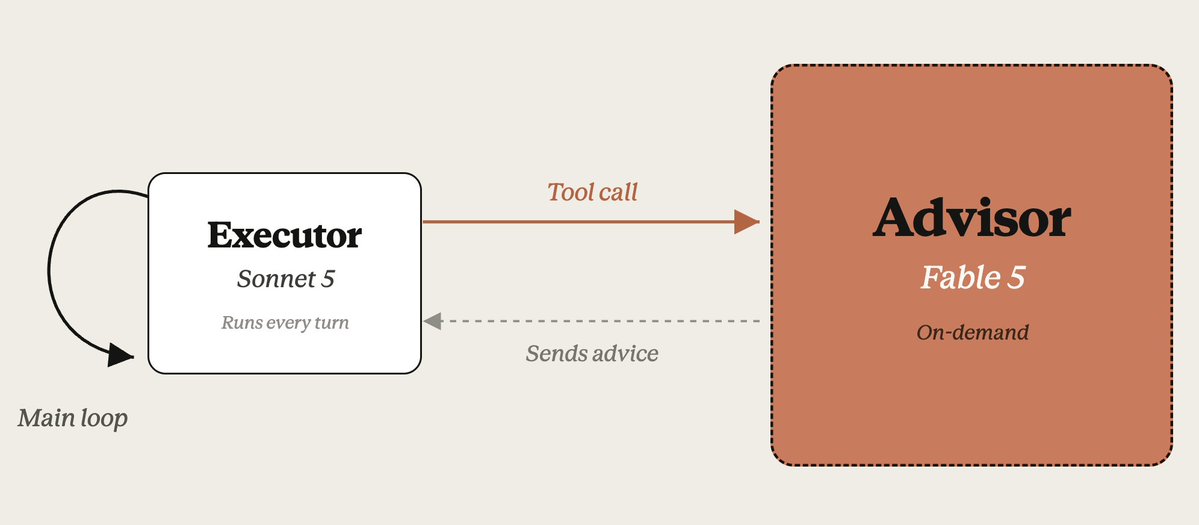
A few patterns we frequently use with Fable 5:
Use Fable 5 as an "advisor."
An executor (Sonnet 5) calls Fable 5 for guidance.
Most tokens are billed at the lower executor rate.
We’ve officially hit the point where AI UGC is cheaper AND better than real UGC.
This video is 100% AI and cost under $1. (And no, it’s not Sora, Veo, or Kling).
My system is built for mass-scale organic across thousands of accounts. Here is why it wins:
- Hyper-realistic visuals: Natural physics and movement look flawless.
- Insane cost efficiency: Costs pennies compared to traditional UGC programs.
-Consistent audio: High-quality, rock-solid voiceover throughout.
- Infinite scaling: Videos can run to any length cost-effectively.
This changes everything.
Want the WORKFLOW? Check the comments!
CHINA JUST LEAKED THE FUTURE OF WEB APPS.
Alibaba open-sourced PageAgent and 99% of SaaS founders are sleeping on this.
It's a JavaScript AI agent that lives INSIDE your webpage. Users control your entire interface with natural language.
↳ No browser extensions needed, screenshots or multi-modal LLMs, headless browser setup, and also no backend rewrite required
Just drop it in your HTML with ONE line of code. What took 20 clicks now takes one sentence.
"Click login, fill in my credentials, submit the form"
Done. This is not a demo, it is production-ready.
↳ Turn any SaaS into an AI copilot in minutes
↳ Smart form filling for ERP, CRM, admin systems
↳ Voice commands and accessibility built in
↳ Multi-page agent tasks via Chrome extension
↳ MCP server support for external control
↳ Bring your own LLM (Qwen, GPT, Claude, anything)
Every founder building AI features just got a shortcut.
Every developer manually building copilots just got replaced.
The integration looks like this:
<script src="CDN_URL" crossorigin="true"></script>
That's it. Your app now has an AI agent.
Introducing TabFM, a foundation model designed specifically for tabular data classification & regression. This approach allows generation of high-quality predictions on previously unseen tables in a single forward pass.
Learn more and try out the model →https://t.co/OTbVQ8oUQs
“Loop engineering” is a hot buzzphrase after mentions of it by Boris Cherny (Claude Code’s creator) and Peter Steinberger (OpenClaw's creator) went viral on social media. Loops are now a key part of how we get AI agents to iterate at length to build software. In this letter, I’d like to share my 3 key loops, shown in the image below, for building 0-to-1 products. These loops guide not just how I build software, but also how I decide what software to build.
Agentic coding loop: Given a product specification and optionally a set of evals (that is, a dataset against which to measure performance), we can have an AI agent write code, test its work, and keep iterating until the code is bug-free and meets its specification. This idea of closing the loop took off around the end of last year, and it has been a game changer in enabling coding agents to work longer productively without human intervention. For example, over the weekend, I was building an app for my daughter to practice typing, and my coding agent could easily work for around an hour, using a web browser to check what it had built multiple times before getting back to me, without needing my intervention.
The engineering loop executes quickly. Every few minutes, the coding agent might build and test a new version of the software. I hear frequently from developers who are finding new ways to engineer more effective engineering loops. This is an active area of invention!
Developer feedback loop: In this loop, a developer examines the current product and steers the coding agent to improve it. Last year, a lot of developers (including me) were acting as the QA (quality assurance) function for our coding agents, manually finding bugs and then asking the agent to fix them. But with coding agents much more able to test their own code, the amount of time we need to spend on this function has decreased significantly. This allows us to make higher-level product decisions, such as what key features to offer, where the UI needs improvement, and so on.
The developer-feedback loop operates over time intervals between tens of minutes and hours — that's how frequently a developer might review a product and give feedback. In the case of the typing app, I changed my mind a few times about the visual design, what cat costumes she can unlock as she learns (she loves cats), and the user flow for a grown-up to log in and steer the child's learning experience.
When a developer has a clear vision for what to build, it is still a lot of work to translate that vision into a specification for a coding agent to implement. Further, after the developer has seen an implementation, they might update (or perhaps clarify) the spec to steer it toward what they want. If you find that the system repeatedly runs into certain problems, building a set of evals for the agent becomes useful.
AI-native teams are increasingly using AI to help shape product direction, for example, automating the gathering and analysis of usage data, summarizing written and verbal customer feedback, or carrying out competitive analysis. However, for pretty much all the products I’m involved in, I see humans as having a significant context advantage over current AI systems — we know a lot more than the AI system about the users and the context the product has to operate in — and thus humans play a critical role. Many people describe this human contribution as “taste,” but I prefer to think of it as humans having a context advantage, since that gives us a clearer path to helping AI systems get better. This also speaks to why this step can’t be automated: So long as the human knows something the AI does not, human-in-the-loop is needed to to inject that knowledge into the system.
External feedback loop: This includes a wide range of tactics like asking a few friends for feedback, launching to alpha testers, or putting the code into production with A/B testing. These tactics are usually slow, rarely taking less than hours and sometimes taking days or even weeks. This data informs the developer vision, which in turn continues to drive the detailed product spec, which in turn drives the coding agent.
With coding agents speeding up software development, more engineers are starting to play a partial product management role. For many engineers who are growing into this role, the hardest part is shaping the product vision and striking a balance between building (bridging the gap between vision and spec) and getting user feedback to evolve the vision. It is important to do both!
I will write more about how to do this in future posts, but for now, I find it encouraging that engineers are playing an expanded role (just as product managers and designers now do more engineering).
[Original text: The Batch]





![AndrewYNg's tweet photo. “Loop engineering” is a hot buzzphrase after mentions of it by Boris Cherny (Claude Code’s creator) and Peter Steinberger (OpenClaw's creator) went viral on social media. Loops are now a key part of how we get AI agents to iterate at length to build software. In this letter, I’d like to share my 3 key loops, shown in the image below, for building 0-to-1 products. These loops guide not just how I build software, but also how I decide what software to build.
Agentic coding loop: Given a product specification and optionally a set of evals (that is, a dataset against which to measure performance), we can have an AI agent write code, test its work, and keep iterating until the code is bug-free and meets its specification. This idea of closing the loop took off around the end of last year, and it has been a game changer in enabling coding agents to work longer productively without human intervention. For example, over the weekend, I was building an app for my daughter to practice typing, and my coding agent could easily work for around an hour, using a web browser to check what it had built multiple times before getting back to me, without needing my intervention.
The engineering loop executes quickly. Every few minutes, the coding agent might build and test a new version of the software. I hear frequently from developers who are finding new ways to engineer more effective engineering loops. This is an active area of invention!
Developer feedback loop: In this loop, a developer examines the current product and steers the coding agent to improve it. Last year, a lot of developers (including me) were acting as the QA (quality assurance) function for our coding agents, manually finding bugs and then asking the agent to fix them. But with coding agents much more able to test their own code, the amount of time we need to spend on this function has decreased significantly. This allows us to make higher-level product decisions, such as what key features to offer, where the UI needs improvement, and so on.
The developer-feedback loop operates over time intervals between tens of minutes and hours — that's how frequently a developer might review a product and give feedback. In the case of the typing app, I changed my mind a few times about the visual design, what cat costumes she can unlock as she learns (she loves cats), and the user flow for a grown-up to log in and steer the child's learning experience.
When a developer has a clear vision for what to build, it is still a lot of work to translate that vision into a specification for a coding agent to implement. Further, after the developer has seen an implementation, they might update (or perhaps clarify) the spec to steer it toward what they want. If you find that the system repeatedly runs into certain problems, building a set of evals for the agent becomes useful.
AI-native teams are increasingly using AI to help shape product direction, for example, automating the gathering and analysis of usage data, summarizing written and verbal customer feedback, or carrying out competitive analysis. However, for pretty much all the products I’m involved in, I see humans as having a significant context advantage over current AI systems — we know a lot more than the AI system about the users and the context the product has to operate in — and thus humans play a critical role. Many people describe this human contribution as “taste,” but I prefer to think of it as humans having a context advantage, since that gives us a clearer path to helping AI systems get better. This also speaks to why this step can’t be automated: So long as the human knows something the AI does not, human-in-the-loop is needed to to inject that knowledge into the system.
External feedback loop: This includes a wide range of tactics like asking a few friends for feedback, launching to alpha testers, or putting the code into production with A/B testing. These tactics are usually slow, rarely taking less than hours and sometimes taking days or even weeks. This data informs the developer vision, which in turn continues to drive the detailed product spec, which in turn drives the coding agent.
With coding agents speeding up software development, more engineers are starting to play a partial product management role. For many engineers who are growing into this role, the hardest part is shaping the product vision and striking a balance between building (bridging the gap between vision and spec) and getting user feedback to evolve the vision. It is important to do both!
I will write more about how to do this in future posts, but for now, I find it encouraging that engineers are playing an expanded role (just as product managers and designers now do more engineering).
[Original text: The Batch]](https://pbs.twimg.com/media/HMEtxp3bsAARJdi.jpg)



