Marine Geologist, MSc.
PhD Candidate in Marine Geology and Volcanic Hazards
I study the mountain thingies that go kaboom underwater
University of Athens
Volcano or tectonic shift?
(Disclaimer: I'm not an expert!)
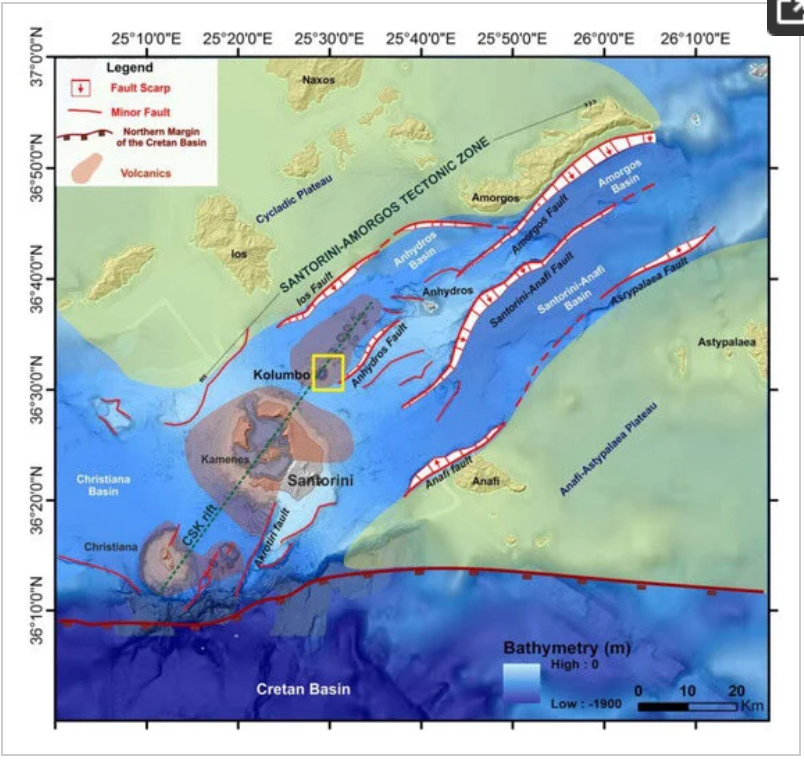
A recent paper on the Kolumbo volcano (see first pic for its exact location): https://t.co/q3jm4mUhHP
The location of tectonic plates in the region (pic 2, source: https://t.co/iqpZWaxaG3)
vs the location and frequency of recent earthquakes (pics 3 & 4, increasingly more frequent and with a depth of up to 15km source: https://t.co/hitz8Z7VJD)
Also, how to classify between volcano vs tectonic shifts earthquakes, from a quick DeepSeek query:
A sequence of earthquakes related to a volcano can differ significantly from those caused by tectonic shifts in terms of their characteristics, patterns, and underlying mechanisms. Here's a breakdown of the key differences:
---
### **1. Cause of Earthquakes**
- **Volcanic Earthquakes**:
- Caused by the movement of magma beneath or within a volcano.
- Result from pressure changes as magma rises, fractures rock, or interacts with the surrounding crust.
- May also occur due to the collapse of volcanic structures or hydrothermal activity.
- **Tectonic Earthquakes**:
- Caused by the movement of tectonic plates along faults.
- Result from the release of accumulated stress due to plate interactions (e.g., subduction, divergence, or transform boundaries).
---
### **2. Depth of Earthquakes**
- **Volcanic Earthquakes**:
- Typically shallow, occurring within **10 kilometers (6 miles)** of the surface, as magma movement is concentrated in the upper crust.
- Some deeper earthquakes may occur as magma rises from deeper reservoirs.
- **Tectonic Earthquakes**:
- Can occur at a wide range of depths, from shallow (near the surface) to deep (up to **700 kilometers or 435 miles** in subduction zones).
---
### **3. Magnitude and Frequency**
- **Volcanic Earthquakes**:
- Generally smaller in magnitude (usually **< 5.0** on the Richter scale).
- Often occur in swarms (clusters of many small earthquakes over a short period) rather than as a single large event.
- Frequency increases as volcanic activity intensifies.
- **Tectonic Earthquakes**:
- Can range from small to very large magnitudes (up to **9.0+** in subduction zones).
- May occur as a mainshock followed by aftershocks, or as a sequence of similar-sized earthquakes (foreshocks, mainshock, aftershocks).
---
### **4. Location and Pattern**
- **Volcanic Earthquakes**:
- Concentrated near the volcano or along its magma pathways.
- Often migrate over time as magma moves beneath the surface.
- May show a pattern of increasing frequency and intensity leading up to an eruption.
- **Tectonic Earthquakes**:
- Occur along fault lines or plate boundaries.
- Distribution is more linear or planar, following the geometry of the fault.
- Patterns may include foreshocks, mainshocks, and aftershocks, but not necessarily migration.
---
### **5. Associated Phenomena**
- **Volcanic Earthquakes**:
- Often accompanied by other signs of volcanic activity, such as:
- Ground deformation (swelling or subsidence).
- Increased gas emissions (e.g., sulfur dioxide).
- Changes in hydrothermal systems (e.g., hot springs or geysers).
- May precede or accompany an eruption.
- **Tectonic Earthquakes**:
- Typically not associated with volcanic activity.
- May cause surface ruptures, landslides, or tsunamis, depending on the magnitude and location.
---
### **6. Duration of Sequence**
- **Volcanic Earthquakes**:
- Sequences can last for days, weeks, or even months as magma moves and pressure builds.
- Activity may decrease after an eruption or continue intermittently.
- **Tectonic Earthquakes**:
- Sequences are often shorter, with aftershocks decaying over time (hours to years, depending on the mainshock size).
- Stress redistribution along the fault dominates the sequence.
---
### **Summary**
- **Volcanic earthquakes** are shallow, smaller, and occur in swarms near a volcano, often accompanied by other signs of volcanic activity.
- **Tectonic earthquakes** can occur at various depths, have a wider range of magnitudes, and are associated with fault movements, often following a mainshock-aftershock pattern.
Monitoring these differences helps scientists predict volcanic eruptions and assess tectonic hazards.
If you live in potentially affected areas, please stay safe!
#σεισμος #ηφαίστειο #santorini
New research at #EGU24! Researchers from the Czech Academy of Sciences and Aarhus University used cosmogenic nuclides to date the earliest evidence of humans in Europe. https://t.co/weyPctPZ3o
#science#scicomm#geology#supernova
New research at #EGU24! Researchers from the Czech Academy of Sciences and Aarhus University used cosmogenic nuclides to date the earliest evidence of humans in Europe. Read more in this blog post by @annakatsigera
https://t.co/qEh4OOFhO8
#EGU24 is in full swing, with lots of interesting research topics to explore! @annakatsigera (GA press assistant) caught up with an international team who are monitoring #volcanic activity beneath Tenerife. @EGU_GMPV
https://t.co/7QXXHiaVGo
Στην έρευνα που δημοσιεύθηκε στο επιστημονικό περιοδικό «Frontiers in Microbiology» παρουσιάζονται για πρώτη φορά στοιχεία για τους μικροοργανισμούς που ζουν στα βαθύτερα στρώματα κάτω από τον πυθμένα του ηφαιστειακού συμπλέγματος Σαντορίνης-Κολούμπου.
https://t.co/e3RZDwtIsR
@victornreis_ @beckbrand123 @USCGNortheast Unfortunately no, it is highly probable that pressure was lost in the submersible, maybe because of a fisure or smth similar. It must have been destroyed from the inside out.
@beckbrand123 @USCGNortheast Marine geologist here! "Banging" noises can occur even from underwater currents or from geological activity or other vehicles several km away. It's really hard to pinpoint the source because sound travels differently underwater.
@Pak_Weather Marine geologist here: epth is aprox at 4.000m not 10.000. I hope that everyone will be rescued and people will stop doing dumb shit like this
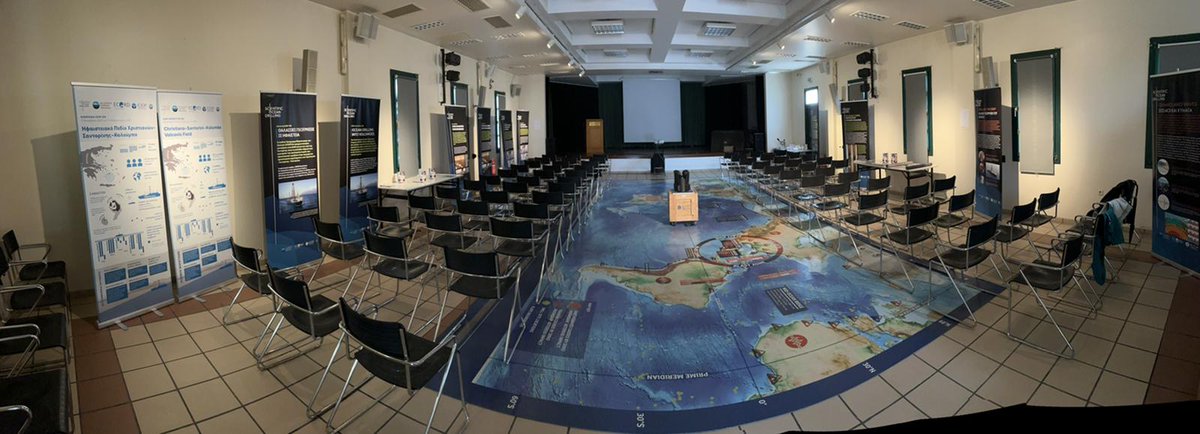
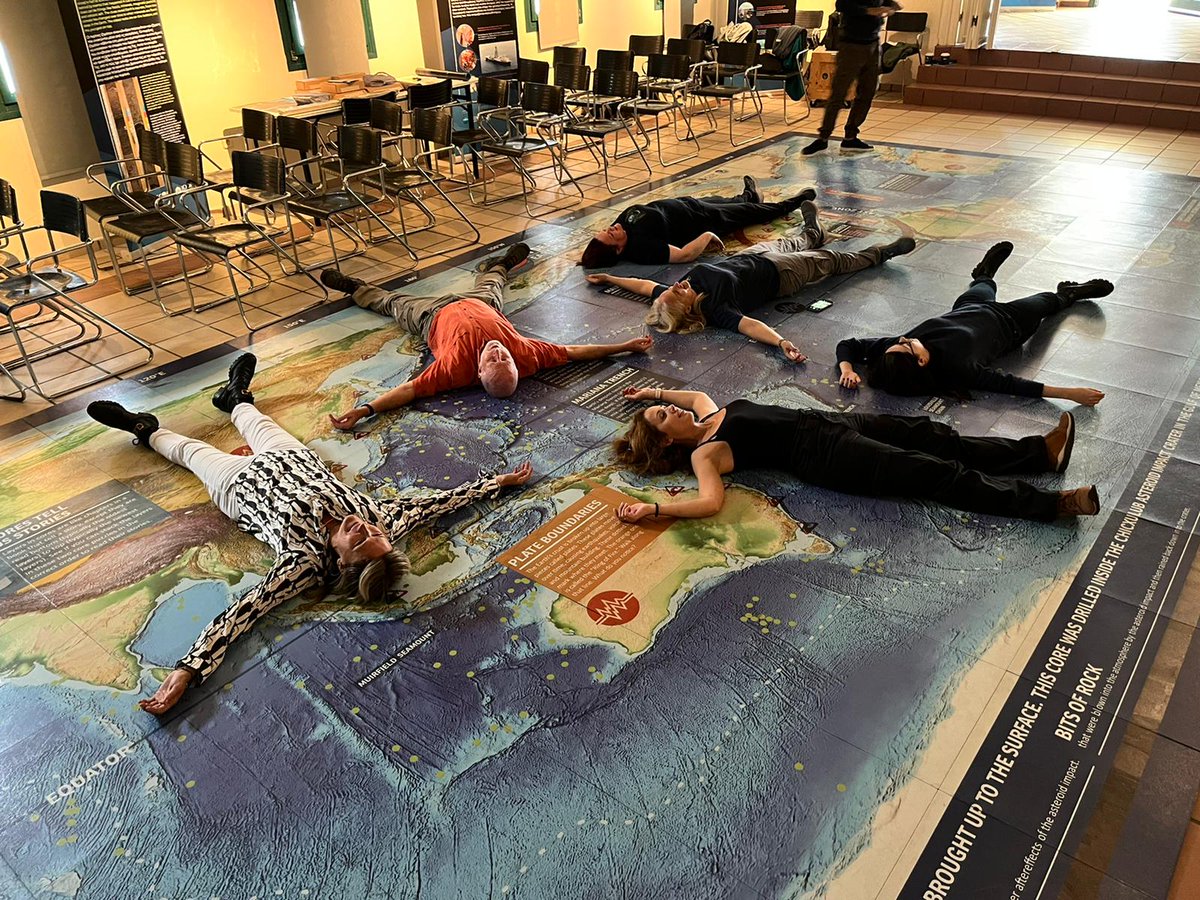
Putting together our floor map was hard work, but @TheJR team has our exhibit on #Santorini ready for visitors! Come see us at the Bellonio Cultural Center today through Oct. 23rd to learn about #EXP398 and arc volcanoes!
📸: Susan Schnur / IOPD
#NSFfunded@ECORD_IODP
Maybe if the IPCC report had slapped someone at the Oscars more people would be interested in the fact our civilization is in free fall & our planet will soon be unlivable.