Formula for accepting an offer letter in 2026
Before signing, make sure the following are clearly defined:
1. Type of employment: fixed-term contract or permanent role
2. Contract duration (for fixed-term roles) and any renewal terms, penalties, or compensation
3. Probation period (for permanent roles) and evaluation criteria
4. Working days and hours: number of workdays per week and daily hours
5. Work arrangement: on-site, hybrid, or remote
6. Compensation structure: salary breakdown, gross vs net, and additional benefits
7. Salary review process: annual, performance-based, or discretionary
8. Bonuses or allowances: eligibility, structure, and payout timing
9. Leave entitlements: annual leave, sick leave, parental leave, special leave, etc.
10. Licenses or certifications: requirements, validity, and conditions
11. Late arrival or absence policy: tolerance, penalties, and escalation process
12. Performance management system: KPIs, OKRs, or appraisal framework
13. Role mobility: transfers, promotions, reassignments, or demotions
With Love,
That HR Babe✨
Still trying to fathom what @WhatsApp is trying to achieve with the music thing 🤦🏼♀️
Access to all music type is only available on WhatsApp and disabled on WhatsApp Business, how?
If you actually understand the thought process behind it, please help me understand too🤔@wa_status
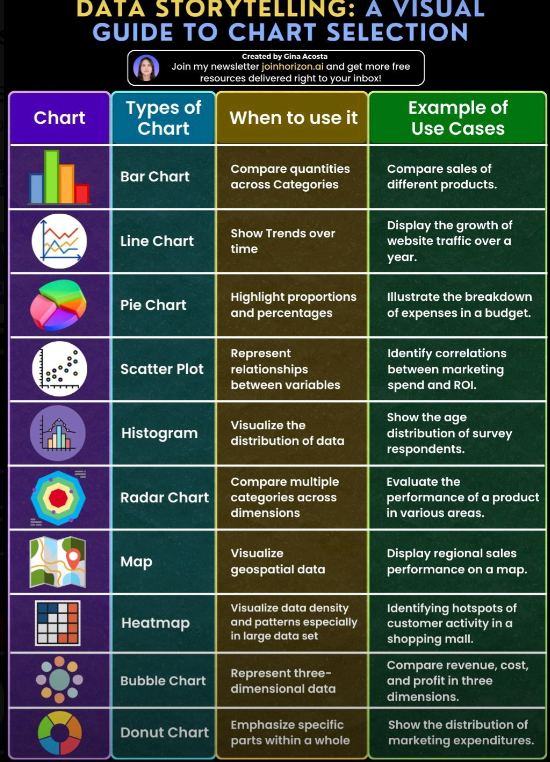
Master the art of data storytelling as a beginner in Data
Analystics.
This guide will help you choose the perfect data
charts and visualisation in your project:
Super late post for Day 4 #20DaysofDataChallenge with @Codevixens 🥲
We explored how to readily identify outliers with charts. I particularly found boxplot and scatterplot interesting.
On my Excel 2013, directly charting a boxplot was quite a struggle, so I employed another means
I used the column chart, switched columns/rows in the ribbon. I made the lower box transparent (by introducing "No fill") and introduced the error bars to serve as whiskers.
The scatterplot was actually straightforward, dots outside other dots can suitably be regarded as outliers
DAY 3 with @Codevixens for #20DaysofDataChallenge and I must say it's been an amazing ride relearning & unlearning😍
The deets of today's lessons are basically highlighted on my sheet (click link below)👇
https://t.co/5qBdE877Oy
Day 2 of #Cdv20DaysofDataChallenge with @Codevixens came in pretty late from my end... Been a busy day🥲
Outliers were our focus. These are simply numbers either too small or larger than others in a given dataset.
4 major things to do with outliers: Remove, Tag, Fix or Use
Day 1 of #Cdv20DaysofDataChallenge and Cell Referencing was the focus.
The appropriate use of absolute and relative referencing is key to getting a proper analysis done.
Quite a few methods were explained in cell referencing, this stood out
Referencing endless list (=SUM(A3:A))
Been a while!!!
I'm currently exploring the data space and I'll be sharing my journey with @Codevixens for the next 20 days ☺️
#Cdv20DaysofDataChallenge