The US chemical synthesis and mfg ecosystem is fragile.
The good news is that models are finally getting good enough to propose useful candidates.
But they still lack the right data, especially around failed reactions and make/test outcomes.
Synthesis is how we generate that missing data.
That makes US synthesis capacity strategic.
The data from failures is becoming as valuable as the data from successes
I’m most excited abt the future impact of this on science. Negative experimental results are one of the largest unpublished datasets in the world
Lots of opportunities here 👀
Wow, seems like Google is buying Spirit Airlines' enterprise data for $10m (outbidding Mercor at $7.5m).
Basically includes every internal document, email, workflow, and codebase for a once $6B company.
Honestly, $10m for 34 years of operational data really seems like a steal.
I think humanoid robots are overrated
But I think there's a lot of value in special purpose robots
Those companies don't necessarily look like robotics companies. They sell a very specific product or service..and it just so happens to be done with a robot
@loombotic is a really good example of this
"I would not argue that the U.S. should copy China’s clinical system wholesale, but there is a lot to learn here if we want to stay competitive on the clinical trial front and develop cures safely and rapidly."
Good insights here. Reminds me of @danwwang's book Breakneck
I spent two weeks in China on a biotech tour - I went in worried, but I was surprised by what I saw.
I now believe there are important ways the US is still ahead.
Also, there may be opportunities for US startups of all stages to collaborate and benefit. https://t.co/Fu65JUZgth
Yes. Also the broad prior commoditizes fast b/c anyone can scrape video. Vs simulation, teleops and DAgger-style correction data is per-body, per-site and doesn't transfer as easily. This is what a deployment company owns, and it's why robotics margins probably look more like services than software for a while
Physics is an essential modality to reason through for every phase of the hardware design to production to operation life cycle.
Understanding Physics has been too slow, too specialized, too expensive. So teams design around scarcity by simplifying early, adding margin, waiting for simulation, validating late, discover risk downstream. The cost is time to market and performance.
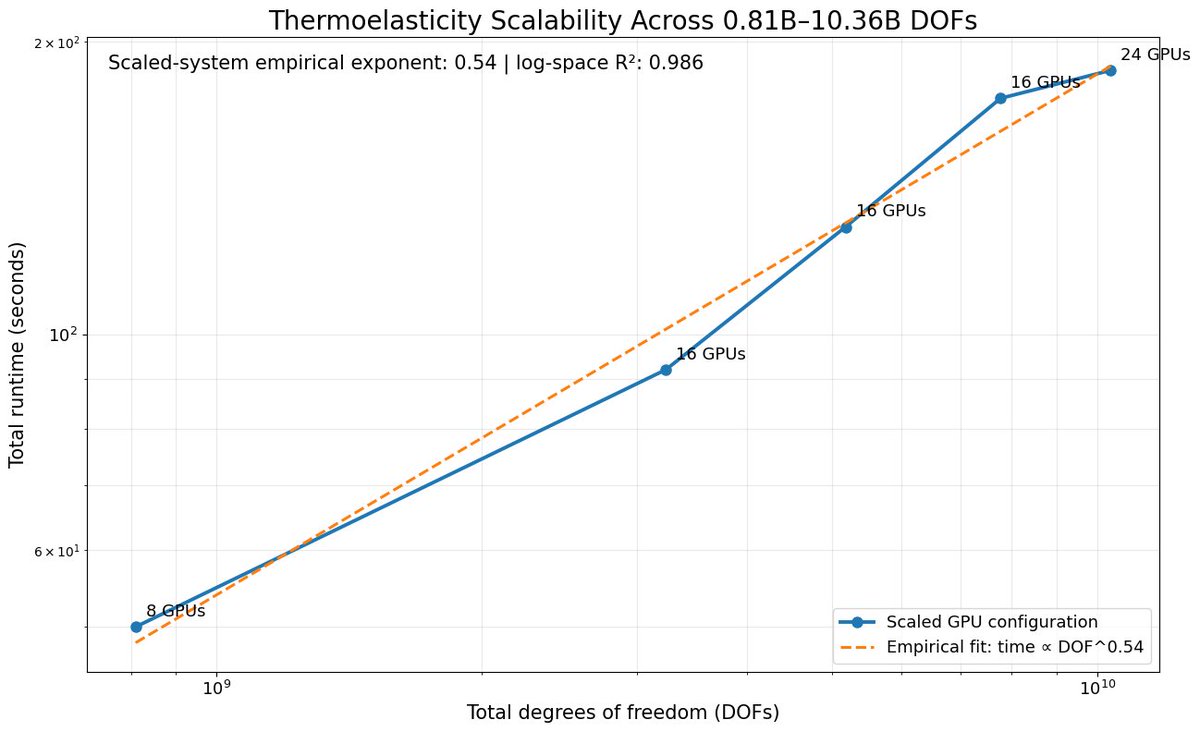
@VinciPhysics we are obsessed with integrating physics in design workflows for our customers but also how inference compute scales as a function of context query – in physics it is the # of voxels and fields.
We observe linear scaling at the time of inference up to 3.3 billion voxels, predicting 3 fields per voxel (>10 billion FP64 predictions) across multiple GPU cards.
We're excited to push towards more context and faster inference on absolute wall clock time so our customers can make better physics decisions on demand and ship better products faster!
Congratulations @Whatnot! Grant and Logan, it’s been incredible to watch your journey. You guys had a vision from the beginning and you’ve executed against it like nothing I’ve ever seen
At the time I led the seed, Whatnot had just launched their live auction marketplace, focused only on funko pops. Today they’re already over $8B GMV in 2026