"CNBC: Breaking News, there is a massive asteroid that will take out planet earth in approximately 3 hours"
"Tom Lee: believe it or not extinction events are actually quite bullish for equities"
I believe the @nvidia board is not acting in the best interest of shareholders nor in a manner consistent with their fiduciary duties.
What we know is that the board fired Jensen or forced his resignation for violating company policy and/or in response to the accusation of an affair with a spy.
They did so without careful consideration of the impact on the company, its customers, its shareholders or other stakeholders.
They rushed to judgment without the benefit of careful due diligence or even with a basic understanding of the facts.
How do we know this?
We know this by how quickly Jensen was fired and how little was known at the time of his firing.
It takes time to convene a board meeting. There was time, maybe, for one Zoom.
And this is a decision that should have been made by a board sitting in person and carefully deliberating the facts once they are known.
And they should have slept on the decision and met again the day after to discuss the facts, the risks and the other implications of their decision.
The timing and lack of information did not allow for careful board deliberation.
While boards can fire a CEO for an inappropriate relationship with a subordinate, it should not be an automatic decision. That is why we have boards comprised of humans and not agents.
A board should consider whether or not such a relationship was consensual or whether it was an abuse of power dynamics. And a board has to consider what the impact of the firing is on all stakeholders.
If I were in this board, I would not have rushed to judgment based on articles in the media. I would have made sure the board had all of the facts so it could make a careful and informed decision.
Boards of Delaware companies have a duty of care which means they must make informed, prudent and good faith decisions. This clearly did not happen here.
What law firm is advising this board?
Or is the board even taken good legal advice?
It doesn’t look like it.
And now the board is compounding its failures by insisting that there is no possibility for Jensen’s return as CEO.
Why is it in the best interest of the company to foreclose the possibility of Jensen’s return and to do so before all of the facts are known? This is yet another breach of their duty of care.
Furthermore, the board has launched an investigation whose scope is unknown. Investigations can be extremely damaging to a company and should be carefully targeted to address whatever facts need to be known rather than be overly broad in scope.
In short, this looks like a series of major governance failures by directors that panicked due to headlines in the media. They likely felt compelled to do something because they were afraid of looking bad in the media, not because it was the right thing for them company.
They couldn’t stand the heat.
The board’s conduct here is shocking for a company of this scale and importance to our country and the world at large, particularly at this moment in history.
Bombshell story. The spy narrative is collapsing already.
Is there clear & convincing evidence that Alice Huang was a Chinese spy?
- AG says no. (“no conclusions reached”).
- CIA says no. (“not yet convinced”).
- DNI says no (“not entirely accurate and over-torqued”).
- Ranking Democrat on House Intelligence (incoming Chairman) says no. (“today, at least, I don’t know”). This was immediately after he was briefed.
Who argues otherwise? Anonymous officials tell CNN “it strains credulity to believe that she was not acting as an agent of the Chinese government — simply by virtue of the fact that she is a successful Chinese businesswoman working with one of America’s most powerful companies.”
This is their proof after a year of investigating and surveillance? That she was a “successful Chinese businesswoman”?
At this point, the only crime that we know for sure happened is the leaking of the classified memo. Who did that and why?
An investigation should be opened.
How venal, how disgusting are some that they are willing to look away from a ceo who is having a relationship with a subordinate simply because he is brilliant or a money-maker. No one was a bigger defender of Jensen than I was but there are rules about sex with subordinates. Just because someone is brilliant doesn't mean he can do what he wants
There is nothing special about this pullback.
Much of the panic surrounding neoclouds, AI capital expenditures, and the sustainability of the infrastructure buildout is simply the market searching for explanations for falling stock prices.
When AI stocks were rising, record capex was evidence of extraordinary demand. When those same stocks started falling, suddenly the same spending became evidence of an impending financial disaster.
One fact with two interpretations that depend entirely on the price action of the market.
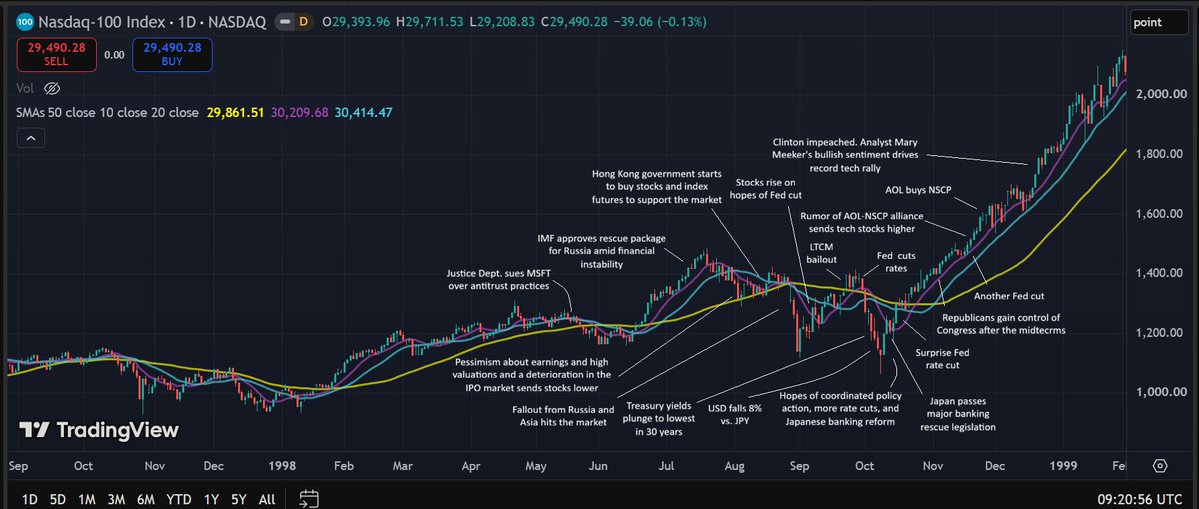
Go back to August 1998.
The technology bull market had been running for about three years.Amid fallout from the Asian financial crisis and Russian ruble crisis, earnings expectations were deteriorating, valuations were elevated, and investors were becoming increasingly concerned about unprofitable Internet companies.
On August 6, the New York Times published an article titled "Market Gyrations May Point to Shift in Investor Strategy." One fund manager declared, "Boring is going to outperform sexy."
Investors were supposedly abandoning momentum and speculative technology shares in favor of profitable businesses, balance sheets, dividends, and traditional valuations.
Russia defaulted on its debt. The Asian financial crisis was spreading internationally. The yen carry trade had imploded as the USD plunged 8% against the yen in a single day. US embassies were being bombed.
President Clinton ordered missile strikes against Afghanistan and Sudan while simultaneously facing a scandal that would result in his impeachment. Major financial institutions suffered enormous losses, and the spectacular collapse of Long-Term Capital Management threatened the stability of the global financial system.
Corporate earnings forecasts were falling. Investors feared a U.S. recession. Many of the same technology companies that had driven the bull market were now leading the decline. Many of them had fallen 40-60% from their 1998 highs.
Even the Federal Reserve's first interest-rate cut on September 29 initially disappointed investors. The Dow fell that day and plunged another 238 points the following session.
The news seemed almost uniformly terrible.
But the market didn't care forever.
After a violent reversal in early October, improving confidence in corporate earnings, Japanese banking reforms, and a surprise emergency Fed cut on October 15 helped restore risk appetite.
By November, the Dow was making new all-time highs. Internet stocks were exploding higher again.
What had looked like the end of the internet trade was, within about a month, actually a correction preceding one of the most extraordinary speculative advances in stock-market history.
In today’s market, Microsoft just reported 48% Azure growth. Google Cloud revenue more than doubled. Meta expects $135–145 billion in capex this year and has announced plans for a potentially record-sized $97.5 billion equity capital raise.
If the market really was that concerned over capex spending, instead of using it as an excuse to explain the pullback, the market would have sold off on the META news.
Anthropic has now filed its IPO registration statement. We have midterm elections approaching, another consequential round of earnings, and a Fed that just held rates steady even as another hike is widely anticipated in December.
There are plenty of potential catalysts over the coming two months.
More importantly, this does not resemble the sentiment backdrop of a speculative bubble climax. Generational bull markets don't die midway through a basing period, but typically after euphoric saturation and a parabolic rally in leading names.
Consensus on AI is deeply divided. Being loudly anti-AI has practically become fashionable. Some AI critics have even built enormous audiences around the idea that the economics of the industry are unsustainable. Plenty of investors seem almost eager to watch the entire trade collapse.
That isn't the sentiment or narrative around which tops are typically made.
The Internet trade didn't end in the panic of 1998. It ended after the extraordinary acceleration of 1999 and early 2000 when being bearish was the market equivalent of wearing a dunce cap.
History never repeats perfectly, and today's rate environment is very different. But I think the resemblance in investor psychology is striking.
I’d be genuinely surprised if we don't have at least one more months-long rally into new highs during this cycle.
Whether it begins into the midterms, after the elections, around Anthropic's anticipated listing, or following further earnings confirmation, I suspect this correction will eventually look more like an interruption in a generational bull market than the bursting of a "bubble."
The $NDX took four months to bottom in 1998. With the exception of a handful of leaders, most stocks that are holding up have been basing out since the May-July period. We could certainly go lower, but most of the signs point to another new high before this cycle rolls over.
However, I’d place the odds of any additional powerful rallies afterward as increasingly unlikely given the fact we are already about to enter the fifth year of this bull market. I'd be careful about buying the dips next year, at least with meaningful size.