This looks like someone wants to actively change history on behalf of SBF. Absolutely evil.
We should never let this happen. SBF is a criminal. He knew what he was doing and is rightfully in prison for it.
I'm old enough to remember the histrionics whipped up by BG and MSFT claiming FOSS was insecure and susceptible to malware because the code was open thereby making it easy for hackers, and Windows ecosystem being secure bc of antiviruses and closed proprietary source.
The damage it did to the dissemination of proper computer science education in developing countries can never be quantified. Without knowledge of working with UNIX fundamentals, places like India became entrenched recurring contractual revenue for MSFT with institutions and teachers more than happy to shove Windows and terrible software engineering practices down the throat of impressionable minds. By second and third order of effects, it churned out millions of supposed computer science graduates very good at specialising in specific tools and frameworks on windows based development environments but never truly learning about OS and app development internals and computer architecture, among many things.
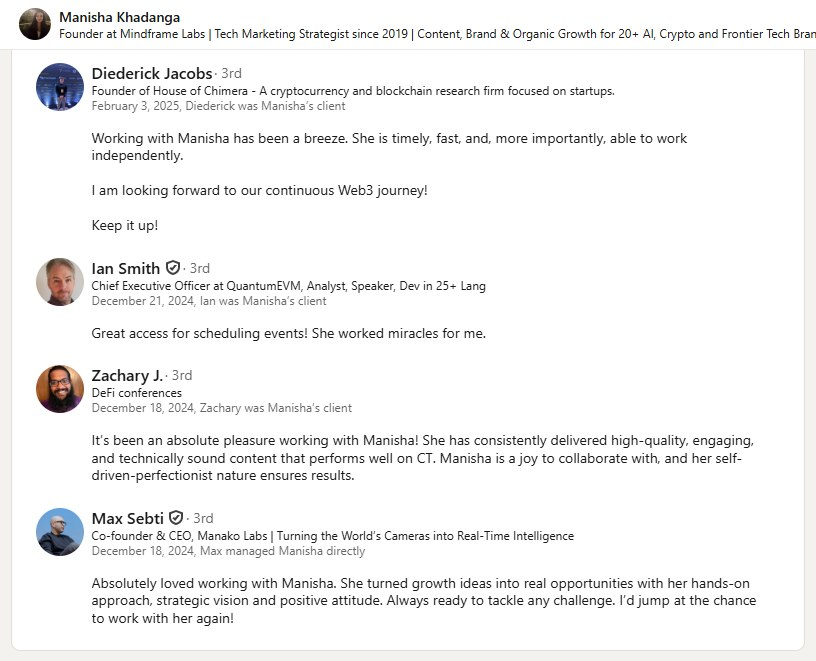
been figuring out what i want to do next in 2027, and in the end i want to head socials and content for fast-growing, cutting-edge companies.
i've been leading socials and marketing ops for 5+ years (6 in 2027), across products, infra, research and conferences, and i'm pretty decent at it.
beyond that i am also experienced with managing events, partnerships, ecosystem and cross-marketing, campaigns, workshops, webinars and podcasts.
+ i've also gotten comfortable with AI workflows without letting quality slip.
right now i’m running marketing ops for a crypto research company and a conference covering both AI and crypto.
if you or someone you know needs a high-agency marketer who takes things off your plate without needing every single thing spelled out, hit me up :)
some recommendations below 👇
Today we flip the switch 🎚️
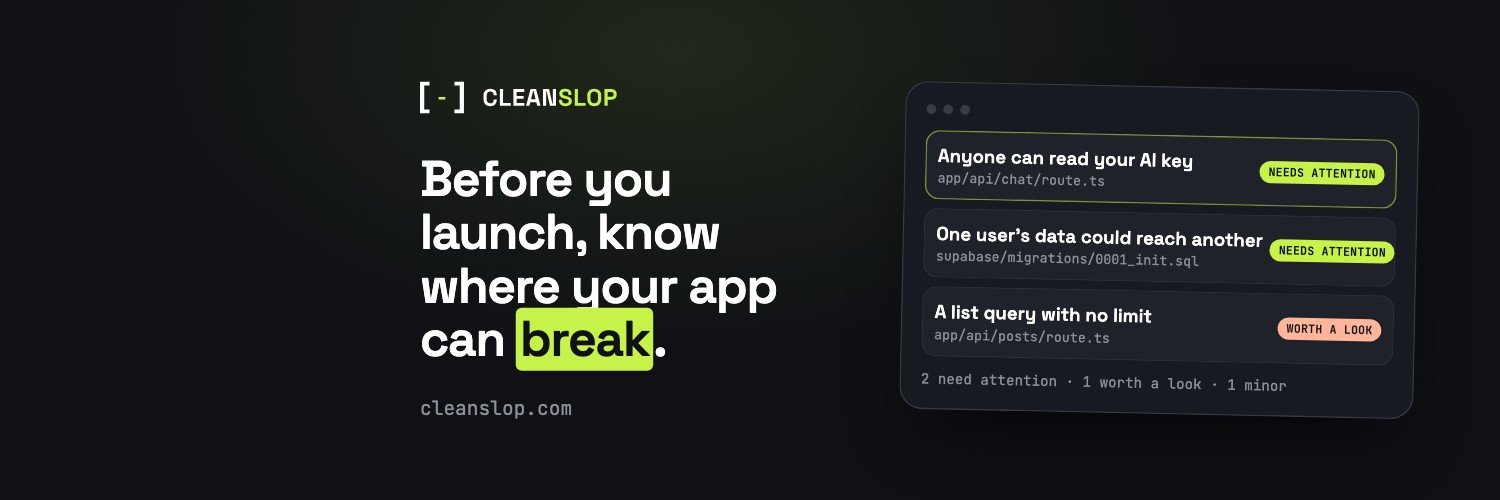
Incremental scans and 4× credit plans are live in full: rescans charge only for the code your changes impact, usually 1–2 credits. Untouched code costs 0.
Built for fast agent loops. Paid plans just got +1 bonus month of credits 🎁
Everything we built over the past month clicks together today on @CleanSlop 🤘
• Credit-based pricing - 4x credits on every plan
• Faster, cheaper incremental scans (usually 1-2 credits)
• Works in the CLI and MCP too
Paid subscribers: check /activity for your bonus 🎁
In June @NaderLikeLadder emailed Jensen about a crazy idea we had over dinner to make Local AI 10x better on NVIDIA hardware.
Jensen replied in 7 minutes. He saw this as important work, and approved a war room for us to work on this at NVIDIA HQ.
For a month, NVIDIA HQ was the @exolabs satellite office. We were overwhelmed by the support we got. We were back to back the first week with smart NVIDIANs coming in to our war room to help us. Creators of CUDA, Dynamo, people who built NVIDIA.
Long story short with NVIDIA we managed to improve their Local AI playbooks by 9.6x (almost the 10x goal we set out with). We’ll be publishing a whitepaper on this work.
We were just a small startup with a crazy idea. Jensen took a bet on us. Jensen cares deeply about Open Source AI and Local AI.
I don't believe Jensen is replaceable, he's a 1 of 1 human, but I hope NVIDIA will continue to aggressively support Open Source AI and Local AI, and continue to take bets on small startups with crazy ideas.
Thank you Jensen
Every plan's scan allocations are now rescaled 4x to credits, no price change. Starter 120, Pro 480, Max 2,000, Free plan now has 10 credits/month.
We are supporting incremental scans from Nov 17 that cost a fraction of a full scan, usually 1 - 2 credits. Hence the rescaling.
Lots of hot takes on the Microsoft 365 outage. Here's an engineering one.
To be clear: this is speculation. Microsoft hasn't confirmed a root cause. It's my read of their own updates, from 35 years of building and breaking systems.
What Microsoft has actually said:
• Traffic isn't up. Capacity is down. Servers are failing health checks and dropping out.
• A process that establishes secure connections gets overwhelmed, and servers stop processing requests.
• Servers they bring back fall over again as soon as traffic hits them.
• They're reverting a network config change that lines up with when it started. But changes aren't syncing, and some machines are stuck in a bad state.
• No indication of an attack.
My hypothesis: a metastable failure.
Whatever triggered it may be long gone. The outage is now keeping itself alive.
1. Reconnect storm. Every Outlook, Teams and mobile client on the planet is hammering for a fresh secure connection.
Full TLS handshakes are CPU-heavy, and a freshly rebooted server has a cold session cache.
A server comes up, eats a wall of handshakes, CPU pegs, it fails its health check and gets pulled, and its load lands on the next one. Dominoes.
2. The fix shares fate with the failure. If the rollback travels over the same secure channel that's melting, the cure can't reach the patient.
That's exactly what "changes aren't syncing" sounds like to me.
That's why they're throttling traffic types and rebuilding servers from an older config instead of flipping a switch.
You don't get out of this by finding the bug.
You get out by shedding load, restoring capacity in isolated cells, and letting traffic back in slowly.
Where AI fits (also speculation): not "an AI wrote the bad line". It's velocity. Microsoft flagged several recent config changes as suspects and took hours to find one that correlated.
When the volume of change outpaces the humans who understand each change, finding the culprit gets slow and rollbacks get messy. Automate the shipping faster than you automate the understanding, and this is the bill.
The takeaway for every business: your email, chat, files, identity and security tooling now share one failure domain. Today proved it. Have a way to talk to your team that doesn't live in the same tenant.
Happy to be proven wrong by the post-incident review. And I hope this post ages terribly.
Comically chaotic times but shipping continues full steam @CleanSlop .
Our engine now keeps up with fast shipping agents, as the harness maintains state of the code tree's evolution with every commit.
Risks get surfaced and fixed near instantaneously. Just provide standing instructions to your agents to "scan with https://t.co/ecoNTFMFIG" at every commit.
Oh btw, you know those pesky slop test cases that LLMs love generating? yea we are cleaning up those as well.
Next week we go live with a comprehensive security scan that are going to surface further risks past the usual traffic, I/O or compute problems that your app absolutely CAN NOT afford to ignore.
Lol fck this pearl clutching. We got absolute criminal dark triad personalities burning the world down. This is least of our concerns.
That being said, we will be collectively better off to rip the bandaid off and discard the moral posturing around pair bonding and monogamy. It's beautiful only among truly secure individuals, which is very very rare to come across because they are the byproduct of being raised by reality fearing boomers.
"But what about the family unit? This will lead to degeneracy" - yes and no. Have babies. Co-raise them like responsible accountable adults with absolute reverence for a human life coming into this world. And don't feed them hopium and delusional lies. All that can be done without the necessity to nest and cohabit for five decades.
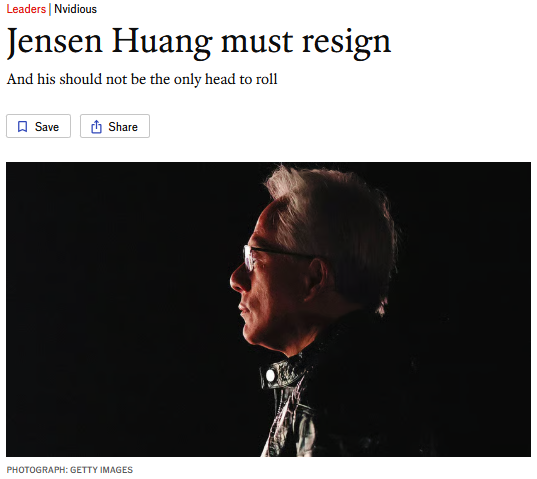
Jensen Huang must go
We argue in @TheEconomist that his position is untenable
"Like many powerful leaders, he came to believe that he was too important for the normal rules to apply to him."
But he is not the only one. Howard Lutnick has failed to stem the flow of chips to China. More heads should roll
What's new #5 🔁
CleanSlop now runs incremental scans: Scan new commits builds on your last scan instead of re-checking the whole repo, cutting follow-up scan times down sharply.
Also live on every TS/JS scan: catches green AI unit tests that prove nothing 👇
while i'm quite bullish on formal methods, i think it's worth tempering expectations and doing your own research on it (disclaimer: i am not an expert in it). it cannot guarantee your code is bug free, only that it matches the spec under certain assumptions, and the specs come from what people want, not math. as long as we build software for humans, nothing can prove that your spec is right, only you can judge.
i created the /statechart skill in pstack primarily because it helps make the state machines implicit in your code more obvious and legible to you, so you can shrink the review surface and review the work at a higher level: does it actually match your intent and goal? i used this skill a ton while building my game https://t.co/sa18sM28uD, below you can see the statechart for story mode where i was able to find many bugs with it.
in that sense, i think model checking (eg TLA+ with TLC) is quite useful for understanding and checking properties of your system e2e, and you don't have to write tons of new verification code for it. the spec isn't your actual code so there's always a risk of drift, but so far i've had good experiences finding actual bugs with it. i tend to pair it with empirical verification (running the code) also to confirm it's real
other types of formal verification like proving theorems (eg Lean, Dafny), bounded model checking (eg CBMC, Kani) etc have their own tradeoffs. proofs cover every possible input, but only for the properties specified, and it takes a lot more code/work. bounded model checking can run on your actual code, which avoids drift, but it only checks up to a certain number of steps, so it's better at finding bugs than proving there aren't any
so i think in the near-medium term you'll still need to layer your codebase: constraints and guardrails (types, lint rules, api design, refactoring), empirical verification (tests, evals, real usage), and formal verification for the parts that really need it. none of these catch everything on their own, but layered together, they catch a lot more and shrink what's left for you to review
but also maybe in the limit, the bitter lesson will prevail and flawless code will just be printed out perfectly every time with no bugs. even in that scenario, /statechart still seems very helpful in confirming that the agent understood your intent correctly. give it a try if you haven't already!
https://t.co/9erGZLOzxO
CleanSlop CLI 0.1.7 🔐
Adds support for @stripe's new link-cli 1.3.0. Link sign-in still asks only for basic info like your email, never your balances or transactions.
Also:
• 3D Secure finishes on the same payment
• Failed payments stop right away
https://t.co/S3UaRlajOM
@zachlloydtweets Don't see any updates on @warpdotdev about specifics of the incident. It's been a week since you reported this.
What exactly was leaked as part of "agent trace and telemetry data"?
Generative LLMs, by nature of their architecture, won't one-shot or n-shot (n < 5 (anecdotally)) completely bug free code generation. Asking another LLM to generally "code review" is a probabilistic gambit in itself. Definitely requires burning tons of tokens on frontier models to get anything useful out of the effort.
Such efforts are to be expended to what end when we can get to a clean operational code base with deterministic guard rails?
The issue is intellectual laziness. System architecture and production scale engineering, security etc patterns and lessons are being forgotten or most have never even studied in the last couple of years. "make no mistakes" does NOT cut it.
The other path? Specialized fine-tuning of open weight models on synthetic data and fixtures so the model makes fewer mistakes up front. That will still cost more compute than just forcing the codebase through deterministic checks.
Human eyes and judgment were the deterministic factor earlier. The velocity and volume of code generation with LLMs needs a whole different approach in the present age.
maybe a hot take but i now consider adversarial reviews mostly a waste of tokens. far better to use those tokens on empirical combined with formal verification. i have updated pstack to use the interrogate skill less, and eventually i think i may remove it altogether
i have found very little value with code review in the abstract, agents tend to just get lost in the nitpicks and yagnis
@caucasianx_99@CleanSlop Tenant isolation and a few other security checks are literally planned in our next release.
Since our sensors already pick up on calls made to storage/DBs/cache, we are releasing further security checks on those pathways.
I like how you think.
Yuuuge pile of changelog shipped @CleanSlop in the last two weeks.
Went live on Product Hunt with a fully agentic workflow. Backed by Stripe Link agent identity. 95% faster scans (yep)
Autoscans are live.
And take a look under the hood of the system at https://t.co/bmpyXQHc5O