My initial reaction to China's new AI export controls:
They're confusing because they seem to be creating restrictions for China AI exports while simultaneously signaling continued "automatic" approval for open-source models.
I don't think it's about leverage. I think China is generally worried about cyberattack potential for Chinese AI systems and don't want these proliferating outside China and then potentially hitting Chinese critical infrastructure or government systems.
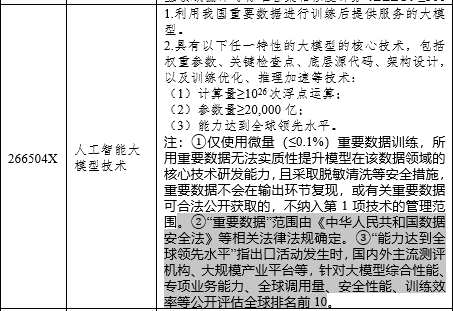
So the toughest restrictions--the prohibitions 禁止出口--are on AI autonomous malicious code generation. But there are also broad restrictions 限制出口 on AI models of above certain performance thresholds. Ministry of Commerce later said open-source models would be "automatically" approved upon registration, but then it does lay the groundwork for a more systematic monitoring of models and possible real restrictions later on.
The part that's confusing to me is that AI systems that can help produce malware basically include all the top Chinese open-source models. And yet they're simultaneously "automatically" approved?
It seems like this set of new export controls were created by one part of the bureaucracy that's worried about proliferation of harmful AI capabilities but then another part is trying to say "but actually we still support open-source."
This is at least my initial reaction--my views may change as I re-read and re-analyze.
Distillation campaigns being responsible for 5-7% of Anthropic's revenue is mad. Revealed preference would suggest that distillation is q important for Chinese progress https://t.co/S4cRcvTPSE
Implications:
Investors worried about cheap Chinese models hurting returns from AI capex. Might be less of a concern
AI safety advocates might applaud controls on cyber-capable models
Many middle powers have been betting that Chinese open-weight gives them an outside option to American AI. Probably not now
A lot of CN messaging has focussed on open-weight being a gift to the world. Already we were seeing a nuancing of this language (see below), expect much more so now
More striking if subtle shifts on open source AI in the Chinese discourse—
The prominent scholar Zheng Yongnian (previously a pretty full-throated advocate of open source) now says:
"We cannot simply say that closed models are good and open models bad, or vice versa. Openness and closedness are themselves relative concepts..."
"If we ignore these boundaries and insist on unrestricted openness, managing the risks becomes a major problem. Governments can use artificial intelligence, and so can non-governmental groups. Constructive forces can use it, and destructive forces can use it too. A balance needs to be found here."
h/t @JFarquhars92862 https://t.co/HPlWXWqnBt
Beijing implemented its rare-earth controls on paper before Trump took office. It may not exercise these powers right away, but it’s giving itself the tools to close off its frontier models. Probably because it thinks it will need to use them at some point
Beijing just took a big step towards closing the Chinese frontier. The rules could give China's government the power to restrict AI developers from releasing their most advanced open-weight models.
It proposes banning exports of AI technologies that autonomously generate and modify malicious code. It also wants to restrict exports of AI-assisted vulnerability-discovery technologies. Giving a model away for free, ie open-weight, could qualify as an export.
Crucially, the rules distinguish between technologies already in the public domain and those not yet released. It specifically exempts existing open-source models. But new releases could potentially trigger export controls.
Providing foreign customers with access to models through APIs (ie, closed models) is generally exempt, whereas restricted models being served overseas could require a licence.
Beijing promises essentially automatic licensing for open-source releases, allowing developers to publish almost immediately after notification. But it's unclear whether this applies to those capabilities proposed for outright export prohibition.
If intelligence generalises, how can China's AI labs distinguish between a smart model and one that has the capabilities proposes for restrictions?
https://t.co/bgGGijXth6
This is a good breakdown by @kristy_loke and important reporting by @Nectar_Gan & @luzdingyu.
Here's what I predicted back in April (and wrote up a couple of weeks ago for @AEIfdp)—it does look like this is actually happening:
Under the proposed rules, "export" of a Chinese model that is in the top 10 globally will require a license
"at the time of export, public assessments by mainstream domestic or international evaluators or large industrial platforms rank the model in the global top 10 for such criteria as overall performance, specialised capabilities, global usage, safety performance or training efficiency."
*licensing promises to be straightforward for open-weights
Beijing just took a big step towards closing the Chinese frontier. The rules could give China's government the power to restrict AI developers from releasing their most advanced open-weight models.
It proposes banning exports of AI technologies that autonomously generate and modify malicious code. It also wants to restrict exports of AI-assisted vulnerability-discovery technologies. Giving a model away for free, ie open-weight, could qualify as an export.
Crucially, the rules distinguish between technologies already in the public domain and those not yet released. It specifically exempts existing open-source models. But new releases could potentially trigger export controls.
Providing foreign customers with access to models through APIs (ie, closed models) is generally exempt, whereas restricted models being served overseas could require a licence.
Beijing promises essentially automatic licensing for open-source releases, allowing developers to publish almost immediately after notification. But it's unclear whether this applies to those capabilities proposed for outright export prohibition.
If intelligence generalises, how can China's AI labs distinguish between a smart model and one that has the capabilities proposes for restrictions?
https://t.co/bgGGijXth6
Beijing just took a big step towards closing the Chinese frontier. The rules could give China's government the power to restrict AI developers from releasing their most advanced open-weight models.
It proposes banning exports of AI technologies that autonomously generate and modify malicious code. It also wants to restrict exports of AI-assisted vulnerability-discovery technologies. Giving a model away for free, ie open-weight, could qualify as an export.
Crucially, the rules distinguish between technologies already in the public domain and those not yet released. It specifically exempts existing open-source models. But new releases could potentially trigger export controls.
Providing foreign customers with access to models through APIs (ie, closed models) is generally exempt, whereas restricted models being served overseas could require a licence.
Beijing promises essentially automatic licensing for open-source releases, allowing developers to publish almost immediately after notification. But it's unclear whether this applies to those capabilities proposed for outright export prohibition.
If intelligence generalises, how can China's AI labs distinguish between a smart model and one that has the capabilities proposes for restrictions?
https://t.co/bgGGijXth6
As the US and China battle for AI dominance, where do middle powers fit in? Join our expert panel with YCW London to discuss innovation, security, and strategic autonomy in the age of AI.
Register Now: https://t.co/H6VFgWwkaq
@JohnHemmings2@KaylaBlomquist3@kuhhbin@samolsenx
If the Firmus IPO exposed anything it was that there was no new money left to buy. Literally all insiders wanted to sell.
Not saying this is the end of the bubble but this is always how bubbles end - the market realizes there is no incremental buyer…
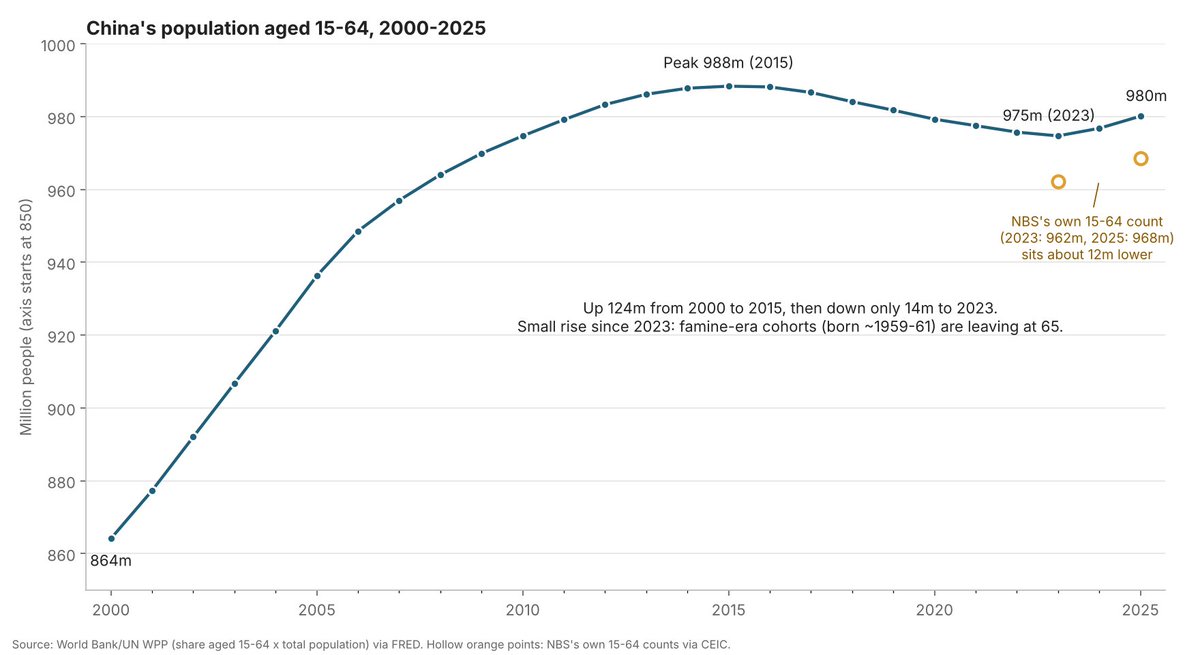
Notably, this analysis is super sensitive to how you define working-age population
If I delineate it by ages 16-59, the boomer generation has already left the workforce and are a big drag on total employment
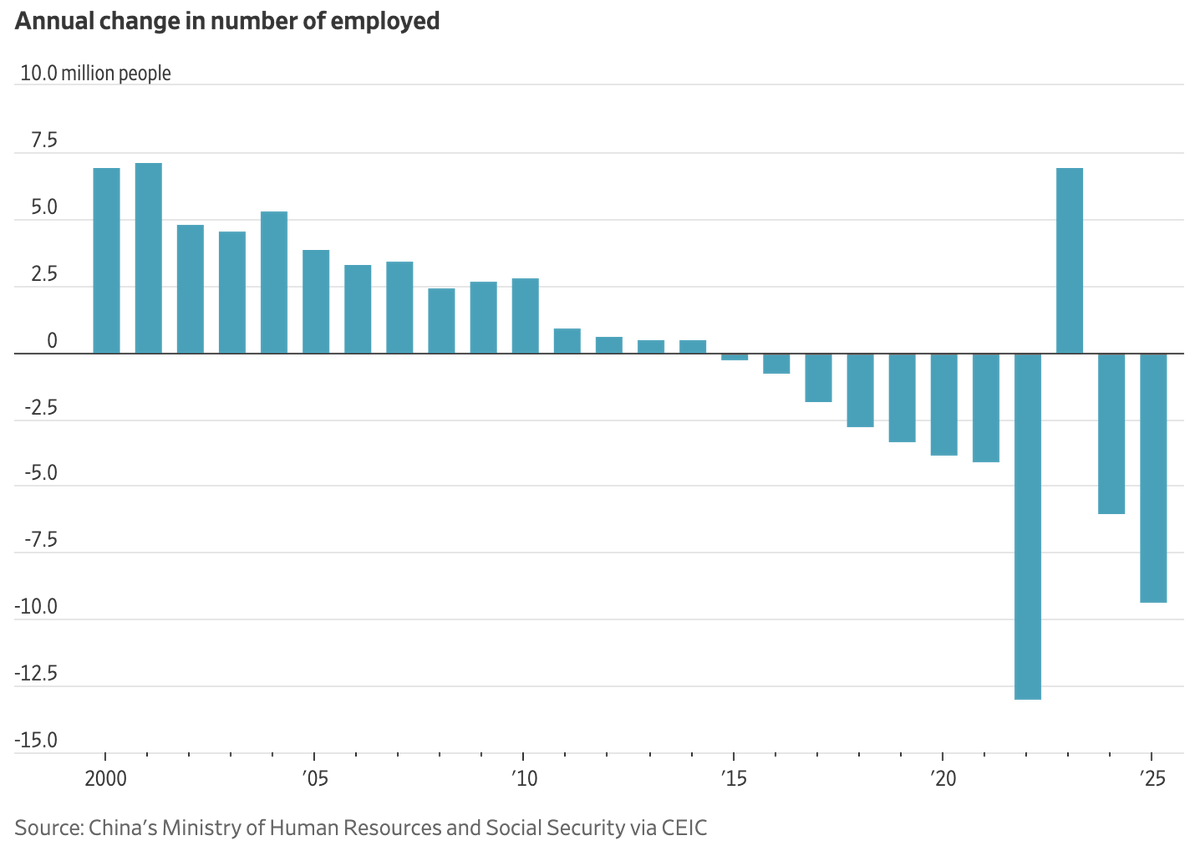
This is actually a super interesting chart! I expected employment in China would be naturally shrinking because of its ageing population
So to work out how much of the decline in employment is a secular shift versus an economic story, I had Claude decompose changes in employment
Surprisingly (for me!) China's working-age population (15-64) actually swung back into growth in 2024/25
It seems to be an echo of the Great Famine of 1959-1961, which means the cohort of 15 year-olds entering the labour force will briefly outrun those turning 65
BREAKING 🚨: China
China suffered a net decline of 9.9 million employed people last year, the 2nd worst year in history, and the worst 3 years in history have all come since 2022 🤯👀
I spent ages this morning doing my sums on China's September's trade data but kept having to redo them because I thought - surely they can't be right?
China's trade surplus with Germany grew 201.7% in Sept alone (vs Sept 2025)
With EU up 52.3%
With France up 251.8%
Crazy!
Chris Wood cites token prices for Chinese models and OpenRouter usage data to predict "massive capital destruction". Big claim based on some weak, narrative-driven analysis
- there are many US models on the pareto frontier, with large gross margins
- OpenRouter data captures a truly tiny slice of proprietary model usage
- there is a tonne of uncertainty about how AI develops: how long will Chinese models remain open for? RSI, if it ever arrives, could mean anything less than the frontier is not worth having
The most likely long-term outcome of the AI boom will be massive capital destruction in the US, with market share going to cheaper open-source Chinese models, according to Jefferies. https://t.co/HZsmGjSpMc
Still cannot get around the fact that among all job posts mentioning AI in China, chatgpt is the most frequently mentioned model.
Until I see this job post about campus security guard, despite only requiring high school diploma, asking candidates to master ChatGPT's application in work.
Chinese banks loans to sci-tech companies have grown by 340% between 2022 and 2025 to exceed 35trn yuan ($5.2trn).
Many of these loans are not secured by any assets https://t.co/3M35McCNVh