Islamic Scholars and the development of Physics and Mathematics ▲
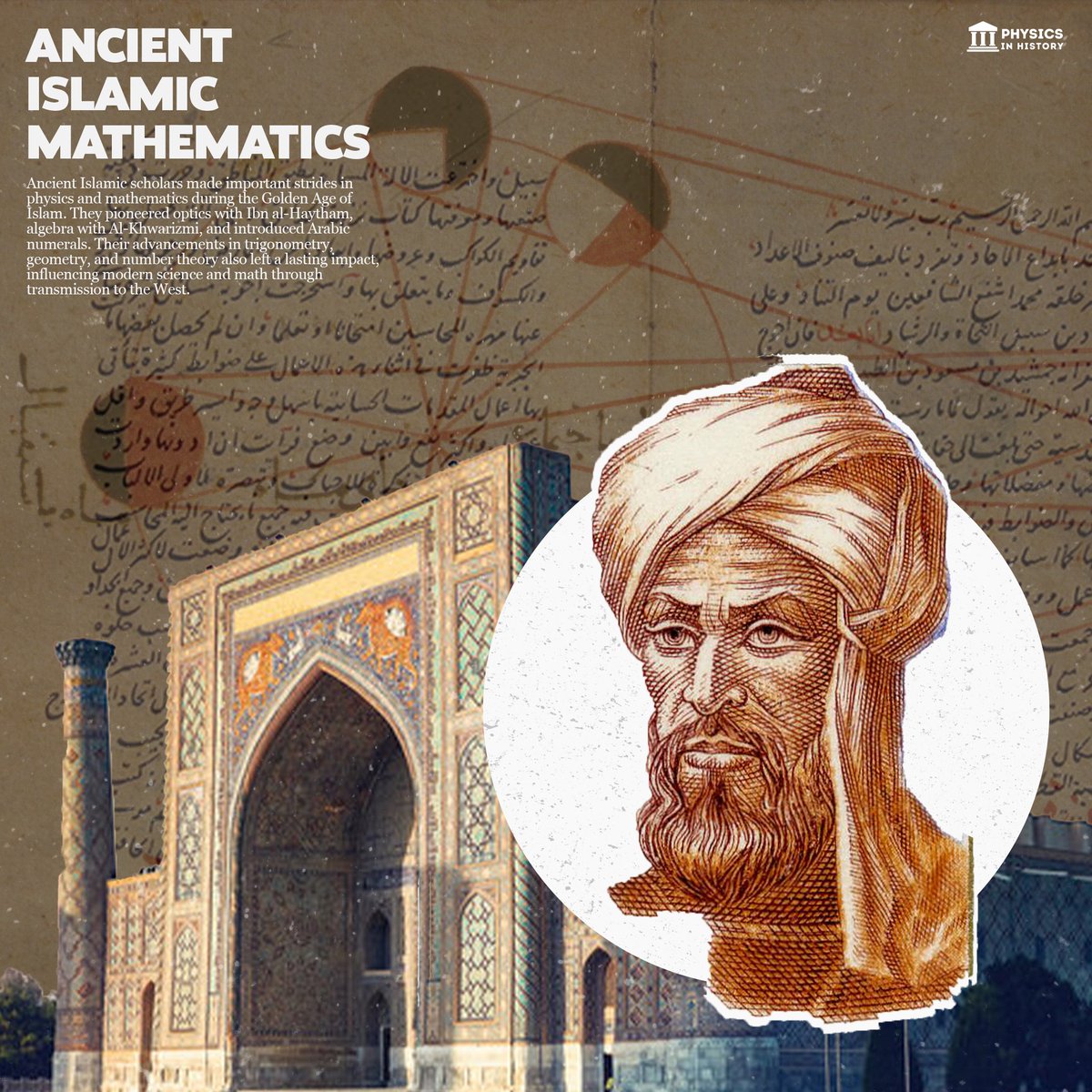
Mathematics and physics were greatly developed by ancient Islamic scholars and scientists during the Golden Age of Islam, which spanned from the 8th to the 13th century.
Al-Khwarizmi (c. 780-850): He is considered the father of algebra, a term derived from his book al-Kitab al-mukhtasar fi hisab al-jabr wa’l-muqabala (The Compendious Book on Calculation by Completion and Balancing). He also introduced the Arabic numerals and the decimal system to the Western world, and wrote influential works on astronomy, geography, and trigonometry.
Ibn al-Haytham (c. 965-1040): He is regarded as the father of modern optics, as he made significant contributions to the theory and practice of optics, vision, and light. He wrote the Kitab al-Manazir (Book of Optics), which was a landmark in the history of physics and psychology. He also studied the laws of reflection and refraction, the nature of colors, the structure of the eye, and the mechanism of vision. He also proposed the scientific method of experimentation and observation, and criticized Aristotle’s physics.
Omar Khayyam (c. 1048-1131): He was a renowned poet, mathematician, astronomer, and philosopher. He is best known for his Rubaiyat, a collection of quatrains that express his views on life, love, and fate. He also contributed to algebra, geometry, number theory, and binomial theorem. He also calculated the length of the solar year with remarkable accuracy, and devised a calendar reform that was more accurate than the Gregorian calendar.
Al-Biruni (c. 973-1048): He was a polymath who excelled in various fields of science, such as astronomy, mathematics, physics, geodesy, geography, geology, mineralogy, chemistry, pharmacology, anthropology, history, and linguistics. He wrote over 146 books on various topics, and is considered one of the greatest scholars of all time.
He measured the radius and circumference of the Earth using trigonometry, determined the specific gravity of various substances using hydrostatics, described the heliocentric model of the solar system, and studied the motion of planets and comets.
Al-Farabi (c. 872-950): He was a philosopher, logician, musician, and scientist who wrote influential works on metaphysics, ethics, political philosophy, cosmology, psychology, music theory, and logic. He synthesized the ideas of Plato and Aristotle with Islamic theology, and developed his own system of classification of sciences. He also studied sound waves and musical harmony, and invented several musical instruments.
These contributions from ancient Islamic scholars laid the groundwork for the advancement of physics and mathematics in the subsequent centuries. Their works were translated and disseminated in Europe during the Middle Ages, playing a crucial role in the Renaissance and the development of modern science and mathematics.
ZARBATOBLAR NIMA?
“Behalovat avlod”ni tarjima qilarkanmiz, bitta muhim so'zni yasadik: zarbatoblar. Ya’ni zarba yegani sari toblanib boradigan narsa (zarba + toblar).
Xo‘sh, bu nima degani?
Hamma narsani uch toifaga ajratish mumkin: mo‘rt, mustahkam va zarbatoblar.
Mo‘rt
Masalan, yerga tushsa sinadigan shisha idish. Parcha-parcha bo‘ladi. Avaylash kerak.
Mustahkam
Plastik idish. Otib yuboravering — sinmaydi.
Zarbatoblar
Asosan jonli mavjudotlarga xos. Masalan, immun tizimi: infeksiya yuqqanda, unga qarshi kurash jarayonida yanada toblanadi. Asraganingiz sari zaiflashadi.
“Zarbatoblar” — Nasim Talebning “Antifragile” atamasining o‘zbekcha talqini.
“Behalovat avlod” muallifi inson bolasi zarbatoblar ekanligi, ammo keyingi 30 yilda ota-onalar shuni unutib qo'yayotgani, o‘ta avaylovchilik avj olgani haqida yozadi. Bu o‘ta avaylovchilik, parvona onalik yoki otalik bolani jismonan va ruhan zo‘riqishdan ortiqcha avaylab yuborishda namoyon bo'ladi.
Muallif shunday deydi:
“Xuddi shu dinamika [zarbatoblarlik] psixologik “immun tizimi”da ham bor. Ya’ni bola hayotdagi mayda xafachiliklar, muammolar, tengdoshlari kulgusiga qolish, rad etilish, adolatsizlik yoki odatiy mojaro va qiyinchiliklarga duch kelganda, ularni ichki iztiroblarsiz qabul qilishni va ortga tashlashni o‘rganishi lozim. Insonlar orasida yashab, nizo yoki cheklovlarga uchramaslikni kutib bo‘lmaydi. Stoiklar va buddistlar qadimdan o‘rgatganidek, baxt — hayotdagi barcha “trigger”larni yo‘q qilishda emas, balki tashqi hodisalar sababli o‘zingda salbiy hissiyot qo‘zg‘alishiga imkon bermaslikdadir...
Farzandlari ko‘ngliga doim qaraydigan, ularni hafsalasi pir bo‘lishidan, oqibatlarga duch kelishidan va salbiy hissiyotlardan asrashga urinadigan yaxshi niyatli ota-ona aslida ularga zarar yetkazayotgan bo‘lishi mumkin. Bunday yondashuv bolaning malakasi rivojlanishiga, o‘zini boshqarish, muvaffaqiyatsizlikka sabr qilish va o‘zini qo‘lga ola bilish kabi muhim ko‘nikmalarni shakllantirishiga to‘sqinlik qilishi mumkin.”
Real hayotdagi o'ta avaylovchilik va uning tamoman teskarisi — virtualdagi mutlaq himoyasizlik o'rtasida qolgan bolaning ruhiy ahvoli ne kechishi haqida batafsil kitobda o'qiysiz.
🔗 https://t.co/jbi2v7Wab6
Today, we launch the ElevenLabs OSS Engineers Fund - a program that provides sustained support to the open-source projects that help power our work.
Over the next six months, we are contributing $22,000 to projects our engineers rely on.
This Sora breaks my brain.
What even is reality anymore tbh
Prompt: Archeologists discover a generic plastic chair in the desert, excavating and dusting it with great care.