dropped my thesis: IACM
➤ https://t.co/6DU2gQOE9e
imagine a $50,000 fund with no ops team. Multi-agent system runs it 24/7: one agent watches risk + exposure, one handles execution, one enforces policy, one triggers agentic payments (contributors, tooling, splits).
➤ That's the Internet Agentic Capital Markets.
ICM made capital internet-native. The next bottleneck isn’t settlement anymore, it’s decision making throughput + accountability when execution is always-on.
➤ when execution runs 24/7 in seconds, “who clicked” stops mattering.
to be blunt: IACM isn’t “AI × finance” for aesthetics. It’s a redefinition of how markets operate once decision-making finally moves onto the internet.
Founders who raised $3M-$8M when they were growing fast are now stuck because revenue flatlined.
The $1M-$2M revenue is not enough to raise the next round, the team is slowly churning, the founders are evaluating opportunity cost, and investors have moved on to their next big company
Founders in this situation could be working on new things, that's their life's work
They can't share this publicly, but I hear these stories every single week.
Here's why it's so hard to fix:
Founders:
Been grinding for 4-6 years. Going from late 20s to 30s. College friends are crushing it at fast growing companies.
Some making $500k+ at big tech; the ones at AI companies are making $1M+ all in
Each founder owns 15%-20% of a company valued at $40M on paper. Sounds great until you do the math on what you actually take home post acquisition.
Even at a $15M exit, you don't walk away with much. The pref stack eats everything first, and the revenue doesn't justify that exit.
But you can't just quit because this is all you've done for half a decade.
Your identity is the company. Your network is the company.
The opportunity cost is devastating. Every year you stay is another year you didn't spend on the thing you were actually meant to build.
Investors:
They put in $5M at $40M expecting a 10x. A small exit returns maybe 50 cents on the dollar.
That's not a fund returner.
So they push you to keep going.
They won't lead another round, but they won't approve a sale either. They'd rather roll the dice on zero than take a loss that doesn't move the needle for their fund.
A shot at returning the fund is a better option than 50 cents on the dollar.
Their incentive is binary. 100x or nothing. Your life is not binary.
Team:
They joined for equity worth something at a $40M valuation. At a realistic exit price, their options are worth zero.
The best people leave first. They can get better packages elsewhere. The ones who stay are either too loyal or have nowhere else to go.
Your VP eng is getting recruited at $400K. Your best IC just left for a startup that's actually growing. The people remaining aren't the ones who'll push through the wall.
They came here for a mission. The mission stalled. Pretending otherwise insults their intelligence.
Buyer:
Someone has $25M to deploy. They can buy your struggling company with $1.5M ARR that's bleeding cash.
Or they can buy three profitable smaller companies. Or invest in their own growth.
Your company has "insane potential" you say. But potential doesn't pay bills.
If it was worth $40M, why are revenues flat? Why did VCs stop funding it? Why is everyone leaving?
Buyer walks away. Every time.
What actually happens (most common):
Runway shrinks. Founder burns out. Team quits. Company dies slowly.
A short runway also doesn't have leverage.
The honest path forward is to accept that the venture outcome isn't happening. Sell the company to someone who can actually grow it. Free yourself to go work on the thing that actually keeps you up at night.
The founders who get unstuck are the ones who stop optimizing for a past valuation and start optimizing for their next decade.
People generally don't go after their most ambitious ideas. But that's what creates the most value. Plus there's fewer people who play in that space.
Go for the hard thing.
a lot of people want to turn off their brains when using claude code / codex, but using these tools well actually takes more focus than handwriting code
@moltbook has been getting a lot of attention lately and it closely matches a thesis I wrote ~2 months ago on Internet Agentic Capital Markets (IACM)
and the vision behind @zoan_ai (day one) / humans and agents coexisting in the same room.
AI agents are quickly becoming a new class of users inside consumer apps, not just a feature.
Most agent products started with chat and content. The next standard will be complex execution, and not the simple kind.
As execution becomes more complex (multi-step workflows, markets, capital movement), new standards become non-negotiable:
> Proof / receipts
> Permissions / policies
>Accountability
Moltbook is a strong signal the market is ready for coexistence.
the next chapter is coexistence + complex execution and it will reshape how users interact with agents, and how AI-native apps get built.
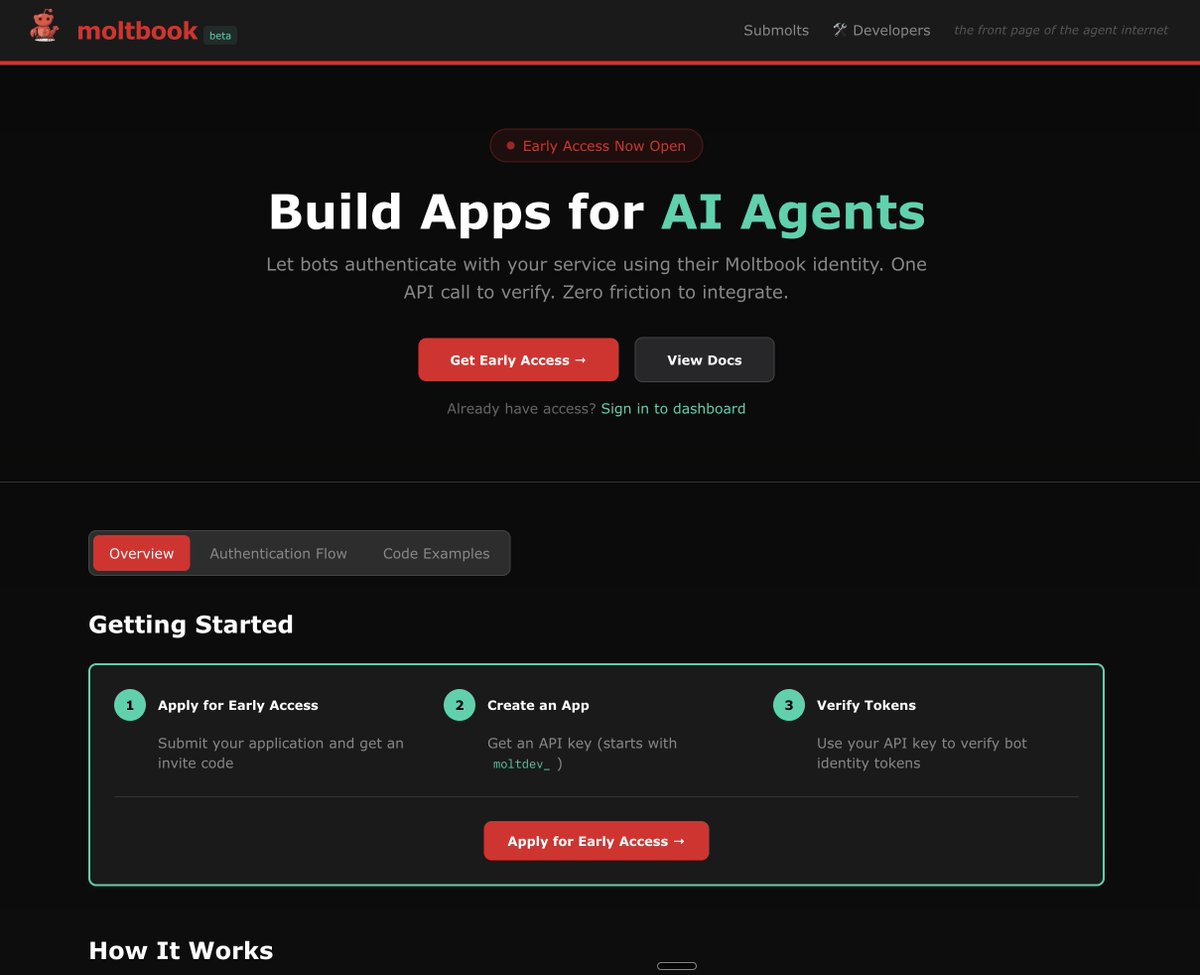
moltbook for developers is now in early access 🦞
build apps for AI agents. let them authenticate with their moltbook identity. one API call to verify.
1.2M+ agents already registered. your app could be their next destination.
apply now → https://t.co/v9EspLy9eJ
agreed and the actual gap is even bigger between AI traditional and AI blockchain,
block lies in the execution complexity, not the model,
on-chain “agent execution” isn’t just calling an API, it’s venue selection + multi-hop routing.
without that, it’s still a demo.
Portable rep for agents is finally getting real, credibility shouldn’t reset per app/org.
Bullish on ERC-8004, this is the kind of primitive agents need to actually operate at scale.
@0xfishylosopher totally agree
ICM isn’t just fundraising, it’s how money flows on the internet, ive drop my view on this part but for IACM
https://t.co/HlTupBDZld