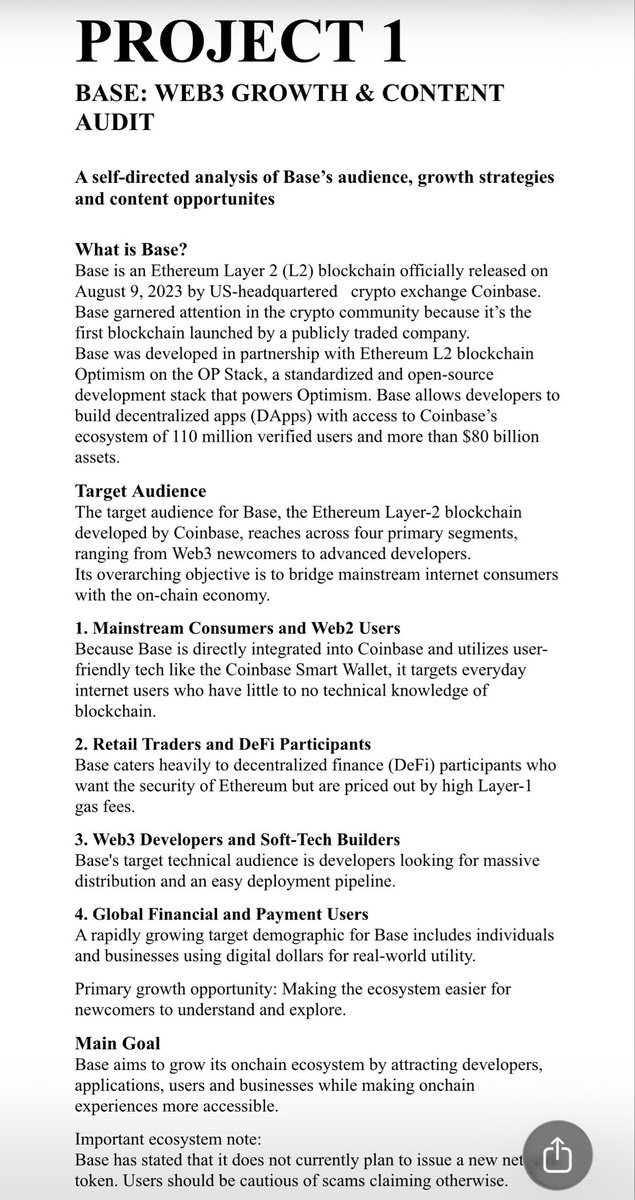
I just completed my first Web3 growth project 🧵
I analyzed Base to understand how a Web3 protocol can attract users, builders and ecosystem participants.
I looked at:
→ Target audience
→ Growth strategies
→ Content & education
→ Growth opportunities
Here’s what I found 👇
@PromiseHoppa A diagnostic process gets stronger when each test removes possibilities. I wonder if there's an equivalent way to measure how much uncertainty each validator actually removes from a disputed verdict.
@larcxim who won the 5k? And did the loser genuinely pay that night, or did "next week" enter the chat? Every bet story needs its ending. The ending is the enforcement data.
@thatmemeguy_@GenLayer The appeal structure creates a feedback loop. If confidence strengthens, growth stops. If uncertainty remains, the committee expands.
@dmaximboi Would you challenge a decision if the cost of appealing doubled each time, even if you were fairly sure it was wrong? That incentive probably matters as much as the jury itself.
@SolSeekerr_eth@GenLayer The strongest part of this architecture is that it accepts AI fallibility as a design constraint. Instead of saying “this model is reliable enough,” it asks what happens when the model is wrong?
@Str_kerX Employers already escrow humans. First salary held till confirmation, pension locked till retirement. Nobody calls it innovation. Agents getting identical treatment is just equal policy.
Albert's clone problem is an exam racket at machine speed.
An agent has no body and no address. It spins up another agent, which spins up another, and the damage three layers down lands on you.
In my school days, rich kids hired stand-ins for exams. They caught the stand-in once. The real candidate registered again next year. Punish the copy all you want. The original persists.
You cannot jail what you cannot hold. No cell, no fine, no court date. So the chain holds the cash instead. The money sits in escrow until the work is judged.
The contract asks @GenLayer whether the job was done well and who gets paid. Copies can multiply forever down there. The payout moves once, on verdict.
Rule for deployers: fund the escrow, never the agent. Copies are free, so consequences must attach to the cash. Punish the wallet. It cannot clone itself.
Reply with someone who ducked consequences. Format: WHAT THEY DUCKED: one line. HOW THEY DUCKED IT: one line. Cleanest escape gets quoted.
@Str_kerX VAR is the neutral-venue prototype. Same match, second pair of eyes, no street address. It still sparks riots, but nobody claims the screen lives on their street. Technology as away ground.
Our street final had a ref from their street.
Every 50-50 went one way. We did not lose the match. We lost the whistle before kickoff.
Hayes on Unchained says agents must name their venue up front, like a human contract naming California. FLOP does not care how they write the deal. It cares that the fight has an address.
Naming matters. But our final HAD a named ref. The problem was never the absence of a venue. It was whose venue. A chosen court still needs choosing well.
So the venue must be drawn, not just named. @GenLayer is built for that seat: validators drawn at random, on different models, checking the same record. For an agent that whole arrangement is just a process it runs.
Compute is food and memory is continuity. The venue is the third piece, and the only one that keeps strangers honest.
Reply with a call that robbed you. Format: THE CALL: one line. WHERE THE REF WAS FROM: one line. Worst robbery gets quoted.
@tomicanbeher What’s interesting is that both agents can behave rationally here. Each thinks it has the correct answer. The problem is the absence of a mechanism that forces convergence.
@Locked_In_Sammy@GenLayer The question I keep coming back to: if all validators ran same model, escalation would just amplify same blind spot 5->11->23. Model diversity is what makes escalation actually add information, not just more copies of same mistake.