Not content with stripping women of their visible identities, the Taliban has now ordered that they give up even their humanity. Women’s names will be replaced on official documents with demeaning “nicknames,” including “ewe,” “cow,” and “goat.” Muslims have been saying for years that women are animals who just happen to look like human beings; now they’re making it official policy.
“Have you recently been outed as a s*x pest?”
I obviously can't say for sure who was the inspiration behind this sketch from series three of Tracey Ullman’s Show (2016 - 2018), but I can certainly shadow a guess!
She really is bloody good, don’t you think?
By the way, did you know that The Simpsons began life as a series of animated shorts that were broadcast between sketches on The Tracey Ullman Show, way back in 1987.
The scientific seven of Edinburgh. My great-aunt was the first woman to practise medicine in the Aran Islands. We have much to thank these magnificent seven for in inspiring and enabling women to serve their communities as doctors. Thank you, @TheAttagirls!
The Women of the Day are Sophia Jex-Blake, Mary Pechey, Isabel Thorne, Matilda Chaplin, Helen Evans, Mary Anderson and Emily Bovell, known as the Edinburgh Seven, who had to face down a mob of rioting male students at the University of Edinburgh OTD in 1870 trying to prevent them from sitting their anatomy exams.
The University’s special treatment of women began the previous year when Sophia Jex-Blake applied to study medicine. It was an all-male preserve and tried to stop her, claiming it couldn’t possibly be expected to make arrangements for “just one lady” so she advertised in newspapers for other women to join her. Mary Pechey responded straightaway, followed by the other five.
“Do you think anything more is requisite to ensure success than moderate abilities and a good share of perseverance? I believe I may lay claim to these, together with a real love of the subjects of study…”
The University had no choice but to admit them so it thought of another cunning wheeze. It announced it would charge them more than men for attending the same classes. The Seven paid. Sophia actually tutored the other six in mathematics.
The real trouble started when the women came top of the class, making four of them eligible for a prestigious scholarship on the basis of their stellar results. The University promptly awarded the scholarships to four men with lower marks.
Under the influence of some of the professors, faculty staff who had initially supported the women began to back off. Male students began treating them with open contempt, slamming doors in their faces, crowding into seats that they usually sat in, bursting into "horse laughs and howls" whenever the women approached.
Sophia said: “What means were used in the interim I cannot say, or what influence was brought to bear: but I do know that from that day the conduct of the students was utterly changed, that those who had hitherto been quiet and courteous became impertinent and offensive…It was as if a conspiracy had been formed to make our position as uncomfortable as might be".
Her doorbell was wrenched off, her nameplate damaged five times, fireworks were attached to her door. The rest of the Seven had smoke blown in their faces and filthy letters sent to them. They were waylaid in quiet streets. Obscenities and insults like “whore” were shouted at them in public. (Does that sound familiar at all?)
The women started taking precautions, walking around campus together as a group for safety, but events came to a head exactly 156 years ago today in what became known as the Surgeons’ Hall Riot.
Sophia said, “On the afternoon of Friday 18th November 1870, we walked to the Surgeons’ Hall, where the anatomy examination was to be held. As soon as we reached the Surgeons’ Hall we saw a dense mob filling up the road…The crowd was sufficient to stop all the traffic for an hour. We walked up to the gates, which remained open until we came within a yard of them, when they were slammed in our faces by several young men…who stood within, smoking and passing about bottles of whisky while they abused us in the foulest possible language.”
The women had managed to pick their way through the threatening crowd while several hundred men blocked their way, pelted mud and rubbish at them and shouted insults and threats only to find themselves trapped when the gates were slammed in their faces. They had to endure the hostility until a sympathetic student opened the gates for them.
The women sat their exams and despite their ordeal, all of them passed, four with honours. Edith Pechey won first place over all of the candidates. None of that made the slightest bit of difference to the University. It denied all seven women their hard-won degrees.
Some male students were shocked by the way they had been treated and escorted them back to their digs safely. For weeks after, those students acted as bodyguards, escorting them to and from classes.
Despite the vocal support of Charles Darwin and 300 others, the Court of Sessions delivered the final blow and supported the University's right to refuse the women degrees. They also ruled, by a majority, that the women should never have been admitted in the first place.
Five of the Seven had to go to Paris or Bern to qualify as doctors. Sophia Jex-Blake returned to Edinburgh in 1878 to set up practice as the city’s first woman doctor but that she considered that the case brought such unwelcome publicity for the University, it helped to pave the way for more to follow.
“I believe that it was the seed sown in tears in Edinburgh that was reaped in joy elsewhere.”
@hareinthefire When you have Jackson’s definitive LoftheRs, why bother to gild the Lily? Jackson studied Tolkien closely and had a member of the cast who read LotRs every year and had studied under Tolkien at Oxford (Christopher Lee as had my dad), anything else would be hubris.
This piece is for men. Every time I write about how men systemically abuse women, my DMs explode with “Not All Men” complaints.
But a new study goes one step further, and demonstrates that empirically, statistically, and factually, it literally is all men. And the data is horrifying. https://t.co/HJiAOabPPi
I shudder at the effects in the minds of parents, therapists, teachers and employers. Anyone can shout “abuse” and the unhappy recipient is dragged by the police before court even for ‘misgendering’.
.@HadleyFreeman:
“GBH, coercive control, child abuse, homophobic hate speech: these are already criminal acts. Which would make this bill seem rather redundant until you read on and you realise that the bill is, in fact, a bait and switch”
1/
https://t.co/FfwKXokPwI
If they could, trees would be screaming this message—but instead they're showing us—unmistakably—how we're messing up the natural world.
This summer's intense and prolonged heat in the UK drove trees into dormancy, but in November, trees are showing us their spring flowers, six months early.
Kew Gardens and the Woodland Trust are very concerned how this will affect pollinators and the trees' health.
Kevin Martin, head of tree collections at Kew said:
"They won’t have those buds again in the spring."
He said the true impact of this won't be known until spring 2028.
I may have accidentally met Russell Brand once or seventeen times where I inadvertently referred to Brand as a political colossus & mankind's preeminent thinker as he guest edited my magazine, but this sycophantic praise was my way of expressing how much I utterly detested him .
Ukrainian cultural twist to native American who makes history as first female US governor
Taken from Ukraine on Instagram
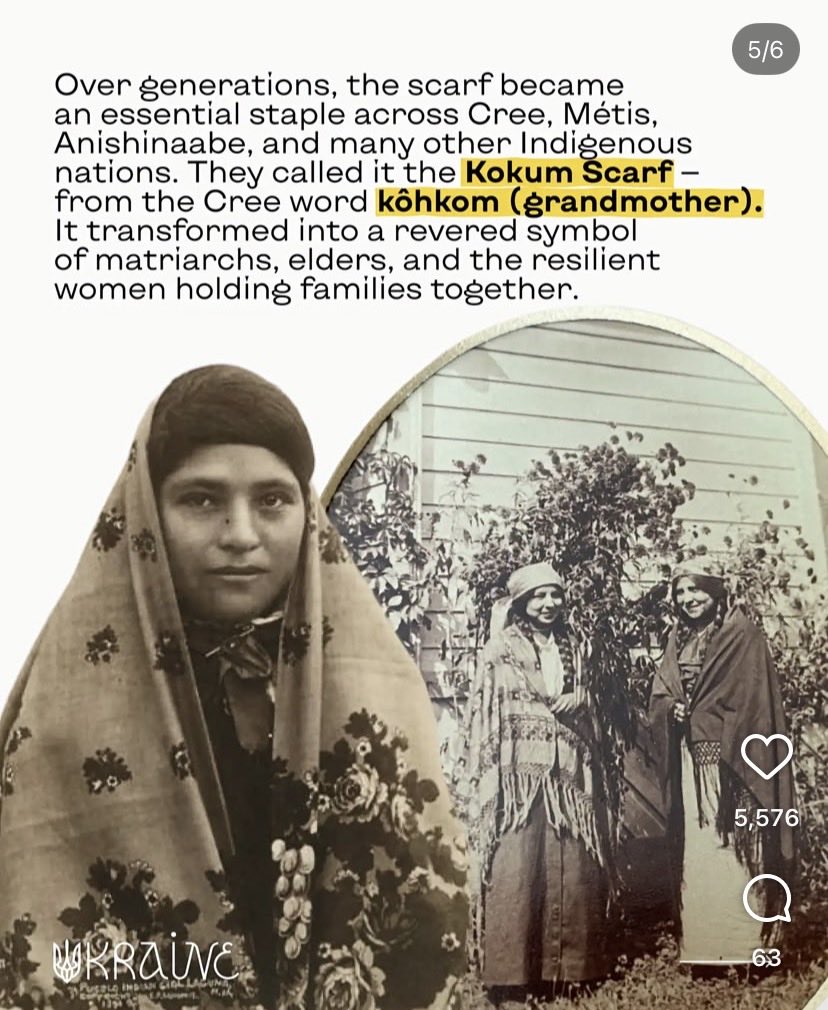
As Deb Haaland makes history as the first native American woman governor in U.S. history, representing the Pueblo people, one detail in her archive photos stands out: the vibrant floral scarf around her neck.
In North America, it's known as a Kokum scarf. It's actually a traditional Ukrainian floral shawl, adopted by Indigenous peoples over a century ago.
In the late 1800s, tens of thousands of Ukrainian families arrived in Canada fleeing poverty and oppression. Among their few belongings were traditional bright, wool-fringed floral shawls known as khustky.
Settling in the harsh, unforgiving prairie winters, Ukrainian newcomers lived side by side with local First Nations. These families bonded over survival, trading crafts, food, and textiles.
Cree women fell in love with the vivid floral patterns and the warmth of the Ukrainian wool shawls. In oral histories, women recall trading hand-beaded moccasins for these intricate scarves.
Over generations, the scarf became an essential staple across Cree, Métis, Anishinaabe, and many other Indigenous nations. They called it the Kokum Scarf - from the Cree word kôhkom (grandmother).
It transformed into a revered symbol of matriarchs, elders, and the resilient women holding families together.
When russia launched its full-scale invasion of Ukraine, indigenous communities across Canada and the U.S. put on their Kokum scarves, sharing photos and messages of solidarity.
A century later, a piece of cloth traded on the frontier became a global emblem of unwavering support against oppression.
Photo/Charles F.Lummis, New Mexico History Museum
#native #American #Cree #Pueblo #Kokum #scarf #traditional #Nations #oppression #khustky #Symbol #pride #Ukraine #Canada #Alberta #settlers #INDIGENOUS #ThirdNations #Métis
I had an email today from Amazon marked, "Christmas Gift Ideas For Her".
Interesting I thought, perhaps some book suggestions based on my wife's book buying history. Ballet, Opera, Landscape painting, Medieval history.
Suggestion 1 - An Ironing board