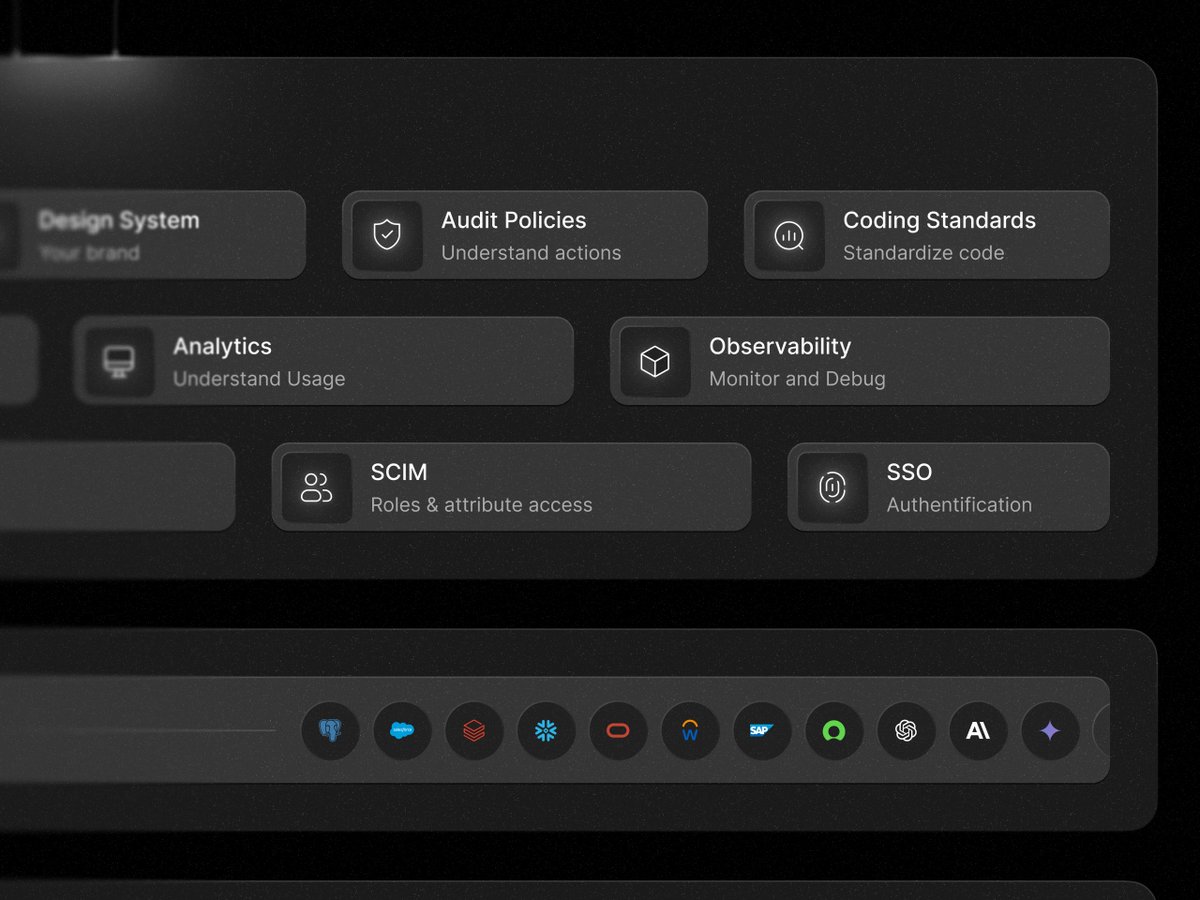
New version of https://t.co/e2IecJehJy is out. 5000+ icons / 6 styles organized with @figma variants, along with some massive updates on the website.
Feel free to share you thoughts on this and stay tuned for more details.
after 11 years working in product design,
this might honestly be my last month in the industry.
i didn’t want to write a post like this, but the last 6 months have been extremely difficult both financially and mentally.
i lost clients to AI.
potential freelance leads ghosted me.
a client scammed me out of $6,000 and mocked my work afterward.
i spent months building an app for Apple, and just when things started going well, my developer account was terminated after a small mistake and a complaint. the revenue inside the account was locked as well.
despite all of this, i didn’t stop working.
i kept learning, building, experimenting with AI products, coding, motion, and trying to adapt to where the industry is heading.
but the reality is: i haven’t been able to secure a new client for months.
if i can’t find a new opportunity within the next couple of weeks, i may have to leave the design industry entirely and start over in a different field.
so if you know anyone hiring for product design, AI product work, creative direction, or vibe coding related roles, i’d genuinely appreciate a referral or even just a repost.
thank you for reading 🤍
My go-to tool for this is definitely this open-source project called Battery. It’s a tiny toolbar app that also ships with a CLI utility, so setting a custom battery charge limit takes just a few seconds.
You don’t need to keep it running in the background either – usually you set it once and forget about it. Maybe repeat it after a Mac restart, which I rarely do anyway.
https://t.co/KxY5kbDydy
It’s honestly funny to see people still spreading the myth that “80% is the optimal charge level” for a MacBook.
1. MacBooks use 3S or 4S LiPo batteries
2. 80% charge ≈ ~4.0V per cell – that’s still a relatively high voltage, where the battery continues to degrade even without charge/discharge cycles
3. The optimal storage voltage for these batteries is ~3.7–3.8V per cell – this is where chemical degradation is minimal
4. That corresponds to roughly ~40–60% charge
If you’re mostly using your MacBook plugged in anyway, just limit the charge to ~40–60% – and battery degradation probably won’t become the main reason to upgrade your laptop anytime soon.
Last week, alongside parallel design work, I spent around 25 hours in Cursor, polishing the live product in a separate PR. My Friday session alone was 10 hours – no one pulled me into design requests that day.
I felt like I was in a complete flow state – overpowered, overexcited, and later completely drained. It was actually hard to fall asleep, my brain just wouldn’t stop planning the next steps, because you’re always "just a couple of prompts away" from the result.
I think the only “feed” I was scrolling last week was the output of Cursor’s multi-agents – and I was completely happy with it.
you know what
all of these "which is better" polls are silly
use codex or claude code, whatever works best for you
i am grateful we live in a time with such amazing tools, and grateful there is a choice
Most of what we do will eventually be erased and forgotten. Any polished design we create will become outdated, modified, or rebuilt from scratch. The same goes for code. The same for text. The same for many other things.
All we really have are small windows of time to share and show the work we’re doing – while it still feels interesting to us. Miss them, and even for yourself, it will stop feeling worth the attention.
To be honest, this feels like a very debatable decision. I tested the performance of text styles vs. text components around 7 years ago, and styles were significantly faster. In your case, this is an entire component set – it will almost certainly be worse for performance.
On top of that, it’s going to be a bit of a pain when you just want to quickly explore some design directions. You’re also introducing extra clicks just to change size + weight. Adding Medium / Semibold variants will likely increase that friction even more.
And plain black/white text isn’t enough – you’ll also need color variations, which will make the system even more complex.
Just thinking out loud. If you’re happy with this approach, then go for it
Here’s one of our files, ~400K+ layers. You can imagine how many variations, explorations, and iterations live inside. Figma handles this load like it’s nothing.
non-designers who have never designed anything: "designers are cooked!"
people who have worked in code, want to work in code, always will work in code: "future of design is code!"
companies selling tokens: "move that button 4px with a prompt!"
designers:
Codex for (almost) everything.
It can now use apps on your Mac, connect to more of your tools, create images, learn from previous actions, remember how you like to work, and take on ongoing and repeatable tasks.
Finally, someone describe this issue clearly.
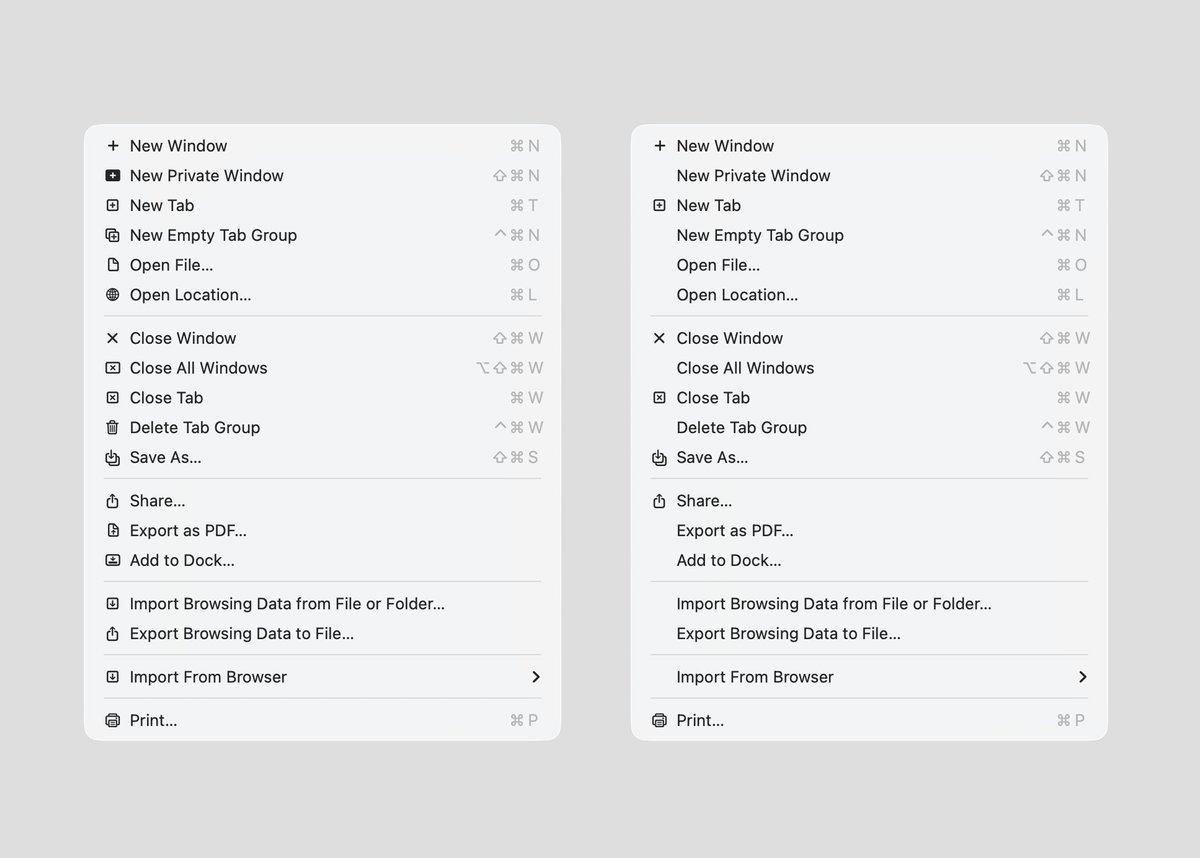
Using icons across so many menu items in such a dense layout just doesn’t make sense. It destroy the core idea of an icon as a visual anchor that helps you avoid reading the label.
The old-school blur / drunk test makes this very clear – when there are so many icons and they’re that small, it just turns into visual noise.
Apple shipped macOS Tahoe with an icon next to every single menu item. And in doing so, destroyed the entire point of icons.
An icon is a signal, and signals only work through contrast. The moment everything has one, none of them mean anything, you've just added noise that looks like clarity. Apple even reuses the same icon for completely different actions.
The right menu is my take: icons only on the actions you actually reach for daily: New Window, New Tab, Close. Everything else stays clean. Your eye knows exactly where to go.
The left is Tahoe. Every item screaming at the same volume.
Apple's own 1992 design guidelines called out every single one of these mistakes. Thirty years later, they made all of them.
Adding more is not the same as adding value. What's your take?