#regex101#python match vs search in python regex - `match` searches for pattern at the beginning of text, `search` searches for pattern anywhere in the text.
Strongly recommend the close-knit team at @allen_ai for a summer internship. As an 'intern-alumni' (2x) 😝, I am very happy to answer any questions (or concerns)!
Finished the first course in Deep Learning Specialization by @deeplearningai_ Neural Networks and Deep Learning! https://t.co/bqPVFNiw1r #Coursera#DeepLearning
Welcome to Zero to Hero for Natural Language Processing using TensorFlow! 🦸
If you’re not an expert on AI or ML, don’t worry -- we’re taking the concepts of NLP and teaching them from first principles with our host @lmoroney!
📺 Watch here → https://t.co/k5uk2QLoH5
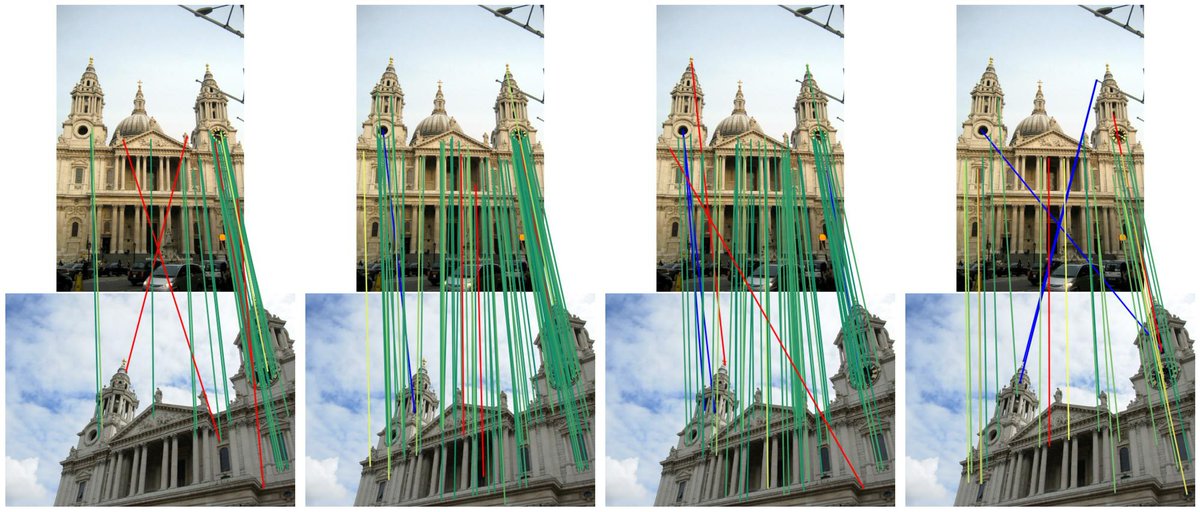
Announcing the 2nd Image Matching Challenge: seeking the best end-to-end solutions for 3D image reconstruction. Winners to speak at the Local Features and Beyond workshop at #CVPR2020. Learn more at https://t.co/cgc0OmULet
With many grad student visit days happening this month, @andrewkuznet has written an educational post on the ML@CMU blog on questions to ask prospective Ph.D. advisors! Please share with your friends who are attending visit days all around the world!
https://t.co/w5B0k5M3v7
Just found this gem: https://t.co/nt5UGtqoV6
Algorithms from Bishop's legendary "Pattern Recognition and Machine Learning" book implemented in Python. And not just that, but the code is extremely clean, beautiful, and well-documented.
Want to learn about meta-learning? Lecture videos for CS330 are now online!
https://t.co/taJ5yyIWVQ
Topics incl. MTL, few-shot learning, Bayesian meta-learning, lifelong learning, meta-RL & more:
https://t.co/mJ1v71huD7
+ 3 guest lectures from Kate Rakelly, @svlevine, @jeffclune
@mhartl Preparing for coding interviews in college was not particularly exciting. But it broadened my knowledge and helped me isolate real problems and approach them with structure. It would've taken much longer to learn that at work and I only realized this later.
By default, logistic regression in scikit-learn runs w L2 regularization on and defaulting to magic number C=1.0. How many millions of ML/stats/data-mining papers have been written by authors who didn't report (& honestly didn't think they were) using regularization?