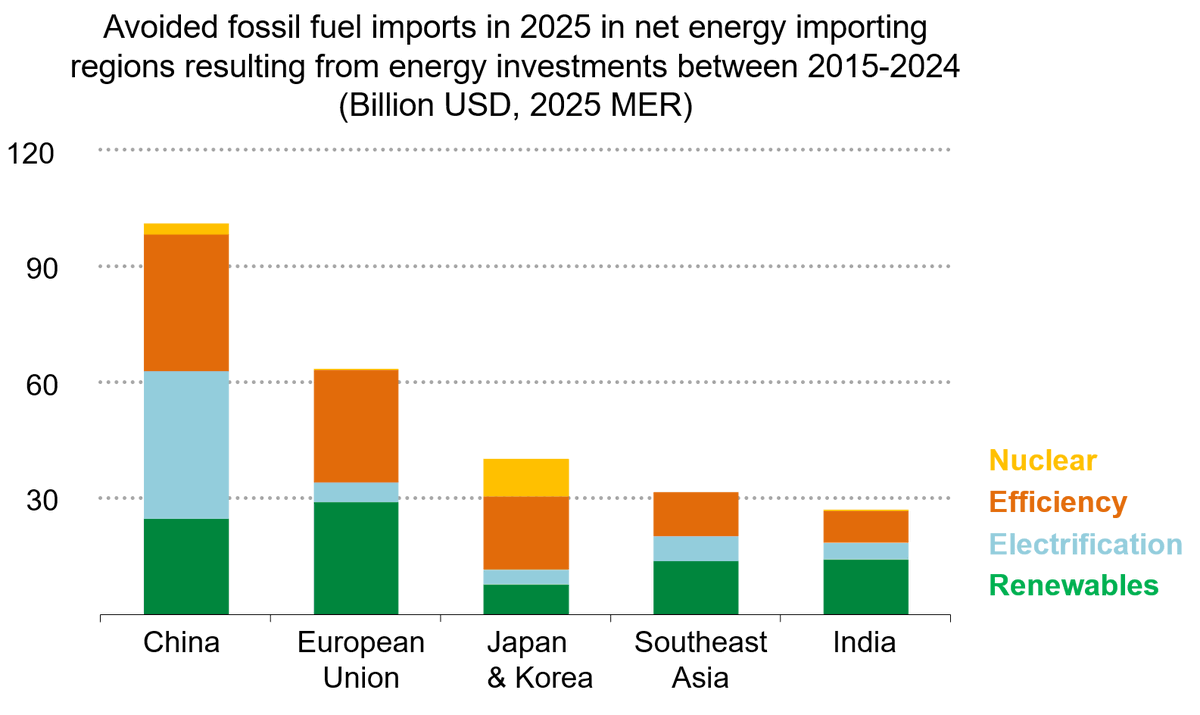
The world has been investing in solar, wind, nuclear, EVs and efficiency for many years now. What impact has that had on energy security?
New @IEA analysis shows that such investments over the past decade helped avoid $260 billion in oil, gas, and coal imports last year.
Delhi shows that ambitious EV policies and strong industry action can go hand in hand. Well done @DelhiGovDigital and @tvsmotorcompany. The economics increasingly favour EVs, other states should take note. @TheICCT_India https://t.co/RSLFyNVVlw
BEST CLIMATE NEWS I’ve read in a while: global fossil power is finally flatlining.
And the biggest reason is China and India cutting fossil electricity generation.
If you want one graph that screams 'energy transition is real', it’s this one!
Global EV sales crossing 20 million is not just a milestone,it’s a market signal.
China continues to dominate, but the real story is the rise of emerging markets driving the next wave of electrification. Policy, affordability, and scale are reshaping the future of mobility faster
In line with Prime Minister call to reduce oil dependence through public transport and EV adoption, Delhi EV Policy 2.0 should withdraw the 50% GST waiver or any incentive for hybrids. Hybrids are not zero-tailpipe-emission vehicles, and we risk subsidising petrol cars with public taxes instead of supporting true zero-emission EVs.
@PMOIndia@narendramodi@CMODelhi@gupta_rekha@BJP4Delhi
Latest ICCT study by @harsimrankaur09 & Aviral Yadav analyzes charging needs of Sanjay Gandhi Transport Nagar (SGTN), Asia’s largest & one of its most congested truck terminals.
It found that SGTN would require charging infrastructure with a peak installed capacity of:
⚡ 1.8–2.3 MW by 2030
⚡ 7.7–10.3 MW by 2035
⚡ 18.4–24.1 MW by 204
The West Asia crisis is a reminder of India’s energy vulnerability, and it must become a turning point. Electrification of mobility and the push towards EV mobility is central to India’s energy security, green growth, and Viksit Bharat. India must move decisively, and now.
My edit piece
in today’s Indian Express
EVs slashed global motor fuel use by 2.3 million barrels per day in 2025 (over 2% of global consumption) as sales grew 20% year on year. By 2030, BNEF expects EVs will displace 5.3 million barrels/day. That's more oil than China produces, the world's #5 oil producer.
India has never achieved leadership through incremental change. We have always leapfrogged:
• Digital payments revolution
• Renewable energy deployment at scale
• LED adoption
• Aadhaar and Digital Public Infrastructure
•Transitioning directly from BS IV to BS VI, bypassing BS V
Electric mobility must be India’s next transformational leap.
This is critical in the context of the West Asian fuel crisis.
#OpEd
EV charging currently accounts for just 1% of Delhi’s electricity consumption, underscoring the opportunity to prepare grids for the next phase of #Transport#Electrification
https://t.co/BS87I5HRJU
In a recent #Opinion piece in @etedge_insights, @ansunitha highlighted that the real challenge is not whether #EVs will strain the grid, but how power systems are planned to manage this growing demand efficiently as electrification scales.
The current weak #CAFE draft is locking India into technological obsolescence, protecting outdated ICE pathways through loopholes and diluted targets while the world races ahead on EVs.
India needs bold, unambiguous policies that accelerate genuine electrification, strengthen energy security, reduce oil dependence, and make Indian industry globally competitive.
Regulation cannot become a shield for legacy interests at the cost of India’s future.
My article in today’s @htTweets@PMOIndia@narendramodi@MinOfPower@NITIAayog #EVTransition #CAFE
Deendayal Port Authority Kandla joins hands with ICCT India through a strategic MoU to drive cutting-edge research and actionable strategies for reducing GHG emissions and AirPollution from port and shipping operations at Kandla, Gujarat. This collaboration will chart scalable pathways across ships, cleaner fuels, port logistics and in-port equipment - strengthening India’s transition towards a low-carbon maritime future.
(Pic Source: DPA)
“For CAFE 3, the focus should remain on regulating the tailpipe. At the same time, regulations should aim to accelerate sales beyond business-as-usual, supported by incentives that help bring adoption forward.” – Rachel Muncrief, CEO, @TheICCT in a conversation with @BhutaniChetan@business_today
Key takeaway for #EV adoption:
🔹Regulations need to push the market beyond current trajectories
🔹Incentives play a critical role in addressing upfront cost barriers
🔹Support should be targeted where cost gaps are highest
🔹Policy design must evolve as markets mature
@amitbhatt4u@bhaumikgowande@AshpreetSethi@vaikush23@Oscar_ICCT@h_basma_PhD@GeorgBieker
@Your_or_You_are@bhaumikgowande@evelectree Carbon footprint of current electricity production in India.
India's 2021 grid emission intensity was 713.2 gCO2/kWh including all coal based generation.
Source link: https://t.co/8yAflqgVcg
Key takeaways:
📊India’s upcoming fuel efficiency norms should remain focused on regulating tailpipe emissions.
⚡️#EV adoption is best accelerated through incentives, rather than through fuel efficiency regulation.
🔋Battery supply chains are a strategic opportunity, as countries look to diversify beyond concentrated manufacturing hubs.
🇮🇳India has a real opportunity to emerge as a leader in diversified battery supply chains.
@amitbhatt4u@TheICCT@AshpreetSethi@BhutaniChetan@bhaumikgowande@vaikush23@pradeep_revathy@harsimrankaur09
#India is accelerating the global shift to #Electric#2Ws & #3Ws
“The rapid growth we are seeing reflects how commercial fleets are able to invest in #EVs & recover costs through lifetime fuel savings. With fuel prices rising, consumers are responding by accelerating the shift toward electrification,” said @ansunitha in @energyintel
Read more: https://t.co/cE6mL5N8Yo