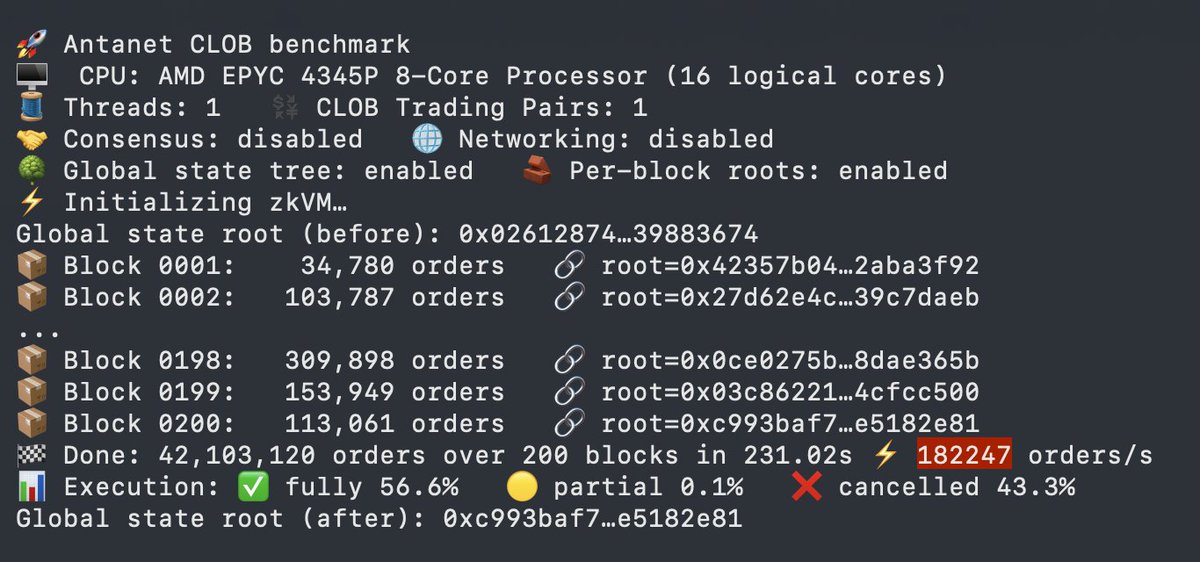
Everyone benchmarks blockchains on traffic that never collides: shard it, parallelize it, quote a huge TPS number.
We did the opposite and ran everything through one contended order book on a single CPU core, no sharding, nowhere for the load to hide.
42.1M orders processed, a state root committed every block, 182K orders/s averaged over nearly 4 minutes. The raw run is below. 🧵
8/ If what you're building lives in the hotspot, whether or not it's an order book, or needs privacy as a hard requirement, we'd like to talk. DMs are open: @antanetwork
Everyone benchmarks blockchains on traffic that never collides: shard it, parallelize it, quote a huge TPS number.
We did the opposite and ran everything through one contended order book on a single CPU core, no sharding, nowhere for the load to hide.
42.1M orders processed, a state root committed every block, 182K orders/s averaged over nearly 4 minutes. The raw run is below. 🧵
7/ On-chain markets have always given up throughput for a book you can verify. This run says that choice is going away. And desks that trade at this scale won't broadcast their flow, which is why privacy went into the engine itself.
We believe:
Bridges are a symptom, not a solution.
Privacy is not an app. It is a base-layer property.
Modular scaling is what happens when the base layer gives up.
Composability ends at the state boundary.
We failed to find a map of blockchain ecosystem, so we made one!
It’s a complex and fragmented network, we’re here to make blockchain simple and usable.
https://t.co/VCGodsQ4AX
Most chains treat parallelization as a feature that helps when transactions do not collide. The protocols you actually want to build are nothing but collisions: order books, AMMs, lending pools, auctions. Antanet's execution is built to handle collisions, not around them.
Synthetic workloads ≠ real workloads. Benchmarks flatter the architecture, production traffic flatters no one.
Antanet is built for reality, not the benchmark.
High throughput, end-to-end privacy, and composability usually trade off against each other. Antanet holds all three at once, no shards, no bridges, just one composable environment.