Finish something. Anything. Stop researching, planning, and preparing to do the work and just do the work. It doesn’t matter how good or how bad it is. You don’t need to set the world on fire with your first try. You just need to prove to yourself that you have what it takes to produce something.
There are no artists, athletes, entrepreneurs, or scientists who became great by half-finishing their work. Stop debating what you should make and just make something.
Everything good comes to an end. Learn from it. Grow from it. Be grateful for it. Everything bad comes to an end. Learn from it. Grow from it. Be grateful for it.
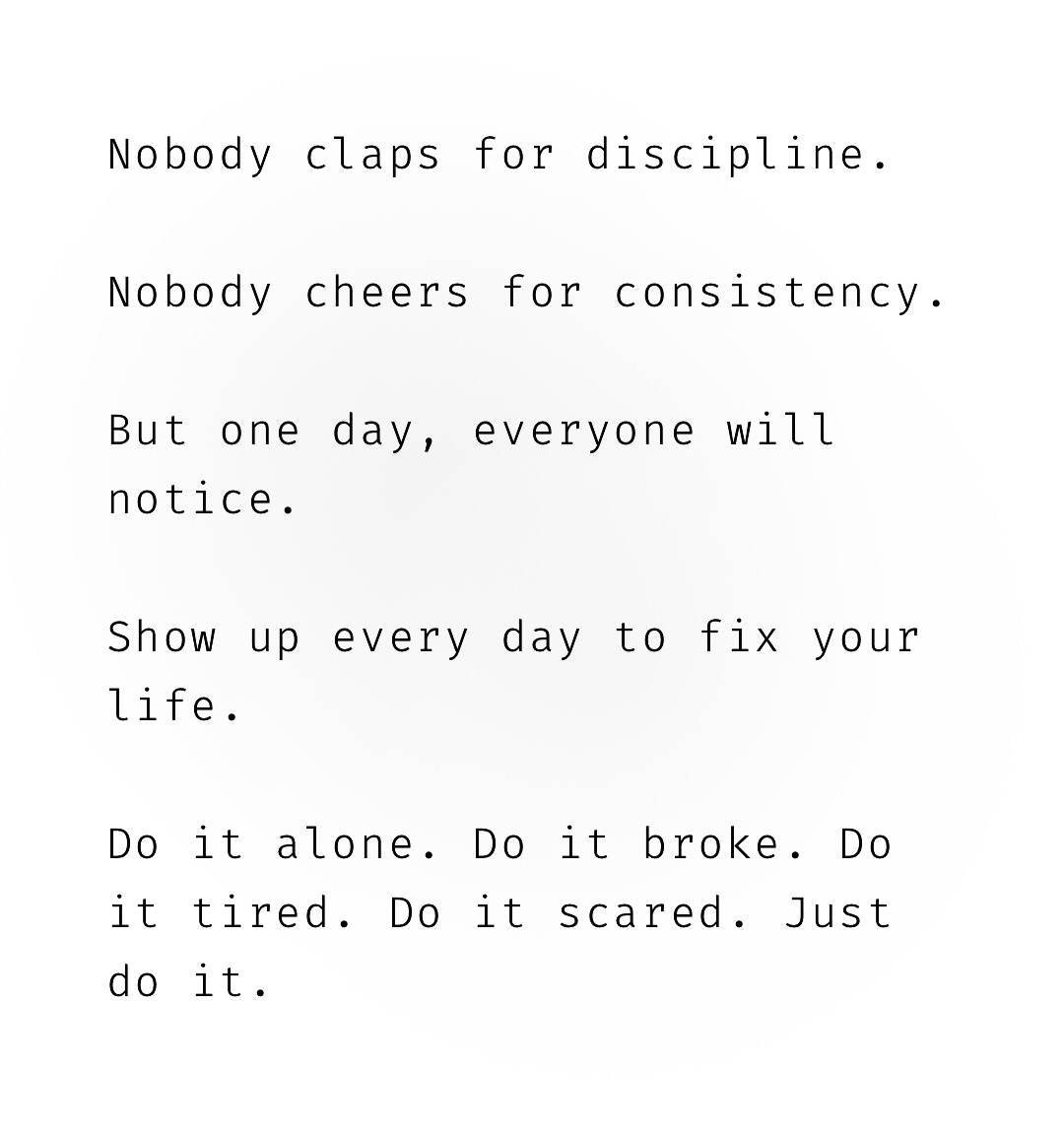
In theory, consistency is about being disciplined, determined, and unwavering.
In practice, consistency is about being adaptable. Don't have much time? Scale it down. Don't have much energy? Do the easy version. Find different ways to show up depending on the circumstances. Let your habits change shape to meet the demands of the day.
Adaptability is the way of consistency.
Optimizing your life for optionality creates a false sense of growth.
You feel like you’re adding more potential to your life, but all you’re doing is guaranteeing your inability to commit to anything.
be boring. wake up early. exercise. work. learn. do the boring things. find fun in them. stick to a schedule. do what you have to do, not what you want to. obsess about how youll get to where you want to be. don't waste your energy in anything that doesnt help you in the long run
turns out, reading voraciously, moving your body, loving people without keeping score, protecting your solitude, chasing nothing but your own growth, and occasionally staying out too late with people who make you laugh until it hurts is not a bad way to build a life.
How to figure out what to do with your life: my 10 favourite journaling prompts.
1. What would you do if money were no object? Follow-up: if you had all the time and money in the world, how would you use your talents to serve other people?
2. What would you want people to say at your funeral? To what extent are your actions aligned with that?
3. If I repeated everything I did this week for the next 10 years, where would I end up?
4. What have I done in the last two weeks that gave me energy, and what drained it? (tip: colour-code your calendar if that's easier).
5. The Wheel of Life: across work (mission, money, growth), health (body, mind, heart) and relationships (family, friends, romantic), how aligned are my current actions with the future I actually want?
6. The Odyssey Plan: what does my life look like 5 years from now if I (a) stay on my current path, (b) take a completely different one, or (c) take a path where I don't care about money or what people think?
7. What's the goal? What's *really* the goal? What's the bottleneck to achieving it?
8. Write 10 goals for the year in the present tense ("I earn", "I weigh", "I run"). Then circle the one that, if it magically happened tomorrow, would have the biggest positive impact on all the others. That's your core focus.
9. Do you work for your business, or does your business work for you?
10. If I knew I was going to die 2 years from now, how would I spend my time? What about 5 years? 10? 20? 50? 100? What should I change about how I'm currently spending my time based on that?
You are better equipped to deal with stress when you are moving.
When you feel tense or frustrated or worried, it is difficult to think your way into feeling better. The more you think about the situation, the larger it becomes in your mind. Trying to think your way out of it often leads to a spiral of overthinking and rumination.
The first step is not to think something different, but to do something different. It doesn’t matter what. Stretch on the floor, go for a walk, work on a project. Get out of your mind and move your body.
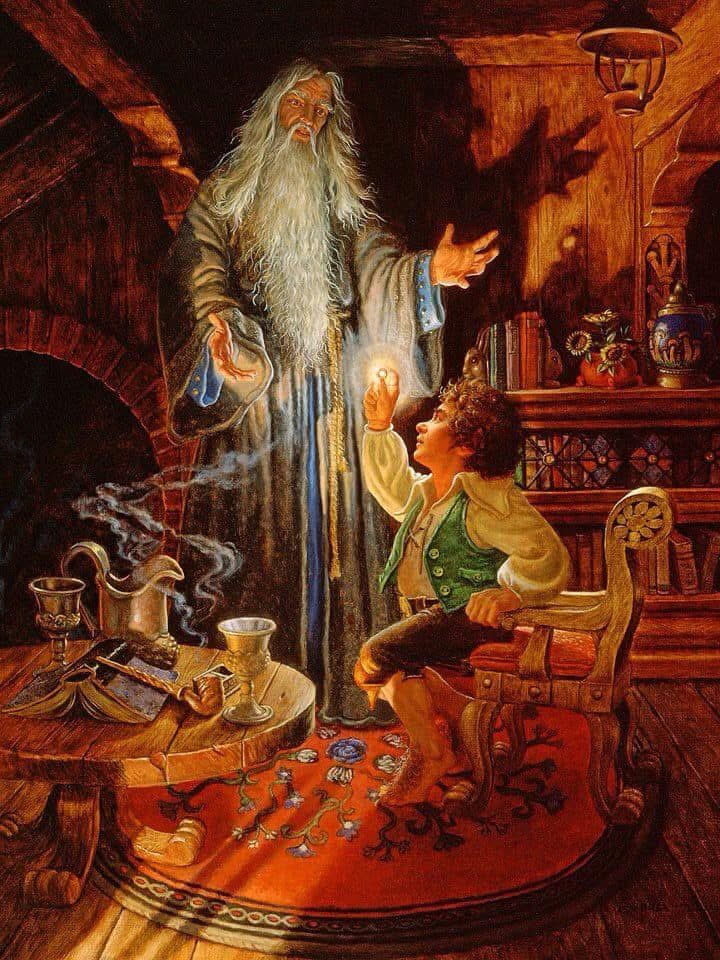
Chapter 2 of The Fellowship of the Ring, “The Shadow of the Past,” was originally very different from its final version.
When Tolkien first drafted the story, Frodo was still called Bingo Baggins, and it wasn’t Gandalf who revealed the truth about the Ring. That role belonged to Gildor Inglorion, who explained the Ring in reference to the Black Riders in Three is Company.
As Tolkien developed the history of the One Ring in 1938, he inserted the chapter, gave the exposition to Gandalf, and created “The Shadow of the Past,” the chapter he later called “the crucial chapter” of the entire story.
“Many that live deserve death. And some that die deserve life. Can you give it to them? Then do not be too eager to deal out death in judgement. For even the very wise cannot see all ends.” - Gandalf
Art by Ruth Sanderson