I’m happy to share this because I don’t care what side of the aisle you sit on, this is a fact.
Speaker Mike Johnson this is for you.
Concerning Social Security payments, my contributions were made for over 50 years on every salary I received. From my first part time job until I retired. I always had a job.
The Social Security check is now (or soon will be) referred to as a "Federal Benefit Payment?" I'll be part of the one percent to forward this.I am forwarding it because it touches a nerve in me, and I hope it will in you. Please keep passing it on until everyone in our country has read it.
The government is now referring to our Social Security checks as a "Federal Benefit Payment." This isn't a benefit. It is our money paid out of our earned income! Not only did we all contribute to Social Security but our employers did too.
It totaled 15% of our income before taxes.
Congress took our money and used it elsewhere. They forgot (oh yes, they knew) that it was OUR money they were taking.
They didn't have a referendum to ask us if we wanted to lend the money to them. And they didn't pay interest on the debt they assumed. And recently they've told us that the money won't support us for very much longer. And now, to add insult to injury, they're calling it a "benefit", as if we never worked to earn every penny of it.
Just because they borrowed the money doesn't mean that our investments were a charity!
Let's take a stand. We have earned our right to Social Security and Medicare. Demand that our legislators bring some sense into our government.
Find a way to keep Social Security and Medicare going for the sake of that 92% of our population who need it. Then call it what it is: Our Earned Retirement Income.
99% of people won't forward this to their timelines…..will you?
Please, for the sake of our country, repost this.
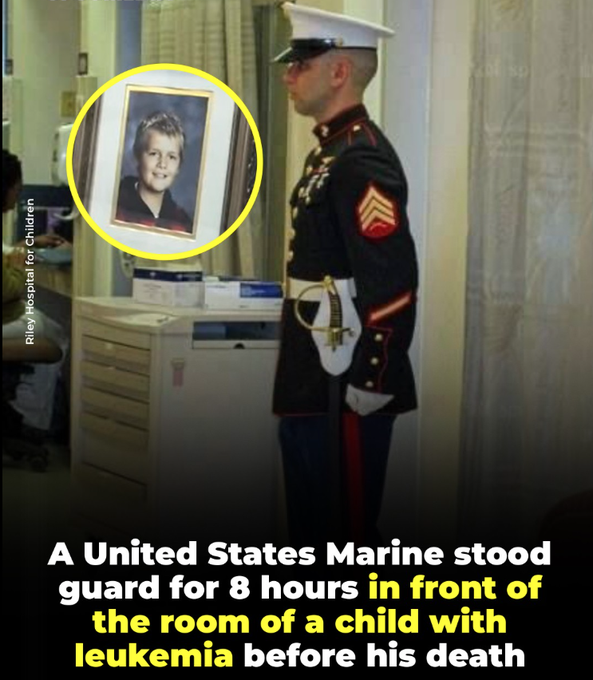
12-year-old Cody Green from Flora, Indiana, was fighting his final battle with leukemia. Diagnosed at just 22 months old, Cody had bravely faced the disease for most of his young life, achieving remission three times before a devastating relapse.
Despite his illness, Cody drew strength and inspiration from the United States Marine Corps. He deeply admired their courage and honor, and the Marines, moved by his spirit, made him an honorary Marine and presented him with navigator wings.
As Cody lay critically ill at Riley Hospital for Children in Indianapolis, Sergeant Mark Dolfini heard his story. On the night of April 27, 2012, the Marine drove to the hospital in full dress uniform and stood guard outside Cody’s door—for eight straight hours. It was a personal, voluntary act of respect with no official orders.
Cody passed away the next day at age 12. Sergeant Dolfini later attended the funeral, saluting Cody’s mother in a final gesture of honor.
This quiet vigil became a powerful symbol of compassion and brotherhood. Cody never wore the uniform, but he lived with the heart of a Marine. Sergeant Dolfini’s selfless act reminds us that true honor often shows up in silence, simply to stand watch when it matters most.
Naperville Radio Stations For Sale
WTFN AM 1280 + 102.3 FM
Serving Aurora & Naperville
Fully licensed • FCC transfer ready • All equipment included
Asking $295k
Call or text 312-847-1987
We are selling our Aurora Illinois radio stations. AM 1280 & 102.3 FM together.
These stations carry Bloomberg, Dave Ramsey and Emmanuel Lutheran Aurora service on Sunday .
Contact me if interested
A soprano was singing her 4th encore, "Sempre libera" an opera number that has a tenor part, a young opera student spontaneously joins her in song when he noticed there wasn't anyone else singing it
Richard Feynman stood at a Cornell blackboard in 1964 and explained the problem every AI lab is fighting in 2026. The BBC filmed it. Almost nobody watches it.
The lecture is about why nature only answers in mathematics. Every team forcing language models to reason is hitting the wall he mapped 62 years ago.
He was 46. The Nobel Prize came 11 months later. The footage survived on film reels and now sits free on YouTube with fewer views than a keyboard unboxing.
Watch the blackboard section near the middle. He takes 1 of Kepler's laws and rebuilds it from nothing, with notation a 12-year-old can follow.
No slides. No jargon. 1 piece of chalk.
An ML engineer I know paused it 4 times and made his whole team watch it before standup.
You're 62 years late. The lecture is still free.
For generations, modern farming has relied heavily on energy-intensive synthetic nitrogen fertilizers. But groundbreaking work by one scientist is proving that nature’s own microbes can replace much of that dependence.
Dr. Mariangela Hungria, a Brazilian microbiologist, has been named the 2025 World Food Prize Laureate for her pioneering research on biological nitrogen fixation. Her decades-long work shows how beneficial soil bacteria can naturally deliver nitrogen to crops, dramatically reducing the need for chemical fertilizers.
Nitrogen is vital for plant growth, but producing synthetic versions is costly and emits massive amounts of greenhouse gases. Hungria dedicated more than 40 years to studying rhizobia — bacteria that form symbiotic relationships with legume roots (such as soybeans and beans). These microbes convert atmospheric nitrogen into a form plants can use, in exchange for sugars from the crop.
Her practical innovations have delivered impressive results. Treating soybean seeds with specially selected rhizobia strains has increased yields by up to 8% while cutting fertilizer use. She also advanced the use of Azospirillum brasilense, another bacterium that enhances nitrogen uptake and promotes growth through natural hormone production.
The impact has been transformative. Today, Hungria’s microbial inoculants are applied across more than 99 million acres (40 million hectares) of Brazilian farmland. This approach is estimated to save farmers around $25 billion each year in fertilizer costs and prevent more than 230 million metric tons of CO₂-equivalent emissions annually.
When she began her career, many doubted that microbes could meaningfully compete with industrial fertilizers. Thanks to her persistence, Brazil has become a global leader in sustainable agriculture — proving that tiny bacteria can play a giant role in feeding the world more efficiently and cleanly.
["Dr Mariangela Hungria Named 2025 World Food Prize Laureate." FarmingFirst, 2026]
Welcome to Centrair, an airport on a man-made island in central Japan.
It rents Segways to the public. This was a mistake.
A samurai has three hours before his flight. He intends to relax. Japan hands him a Segway instead, because this is the only airport in the country that does.
So now a man in a green kimono is gliding past check-in at the speed of an overconfident penguin, bowing to strangers without slowing down.
He rolls onto a deck where the runway sits 300 meters away. A jet roars off the ground. He salutes it. It does not salute back. It is busy.
Then the food ambushes him. Kishimen noodles, glazed chicken wings, a miso pork-cutlet bowl, pancakes under sweet red bean. One sitting, the whole region of Aichi, gone.
He finishes with a bath on the top floor, watching jets drift past the window like enormous slow koi.
He boards with two minutes to spare, smelling of miso and victory.
Three hours in Japan. He never made it out the front door.
I gave a man five stars and it was not nearly enough.
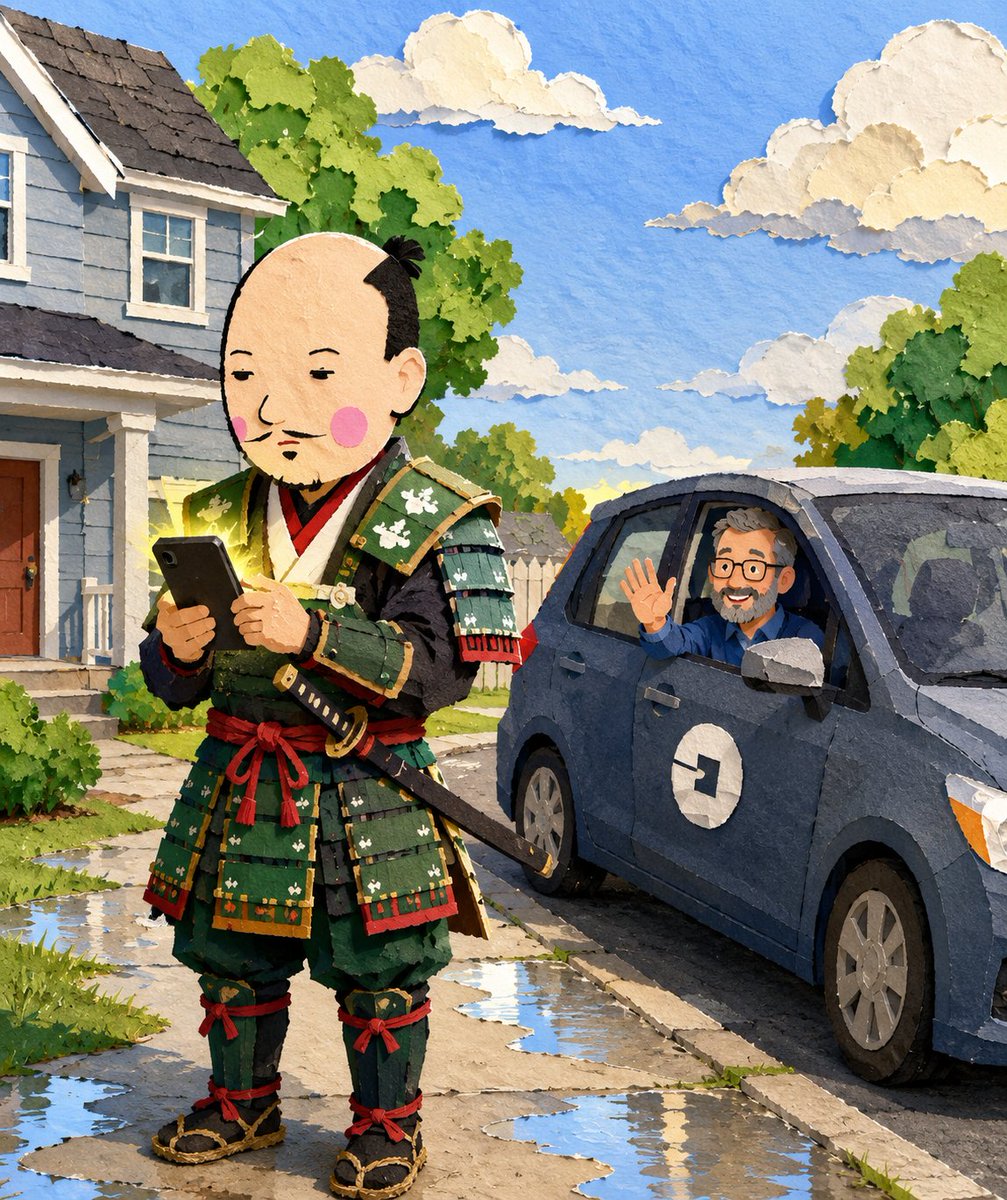
His name was Marcus. He drove me eleven miles through a city I do not trust. In the rain. The whole way, he told me about his daughter's volcano. It took second place at the school fair. He brought me to my door dry, alive, and an expert on baking soda.
In my country you do not rate a man like this. You name a son after him.
The app wanted stars. Five. Maximum.
Five. For Marcus.
I gave the five at once. That was easy. The problem was the gap. Five stars is the limit of the machine. It is not the limit of my gratitude. So I went looking for a sixth.
There was a box. For comments. I began the commendation. The rain. His steady hands. His daughter's name, written down so it would outlive us both. I was describing the volcano when the box stopped me. Two hundred characters. No more.
A flaw in the machine. Not in Marcus.
So I took a photograph of my words, in case the company keeps records of honor. I left a tip the size of a second fare. A debt that will not fit in stars must be paid in something. Then I searched for twenty minutes for a button that would summon this exact man for every ride of my life, so no lesser driver is ever measured against him.
There is no such button. The machine believes all men are replaceable. Marcus is not replaceable. Marcus told me about the volcano.
Five stars. A double fare. A photograph. A permanent place in my memory. I consider the debt eighty percent paid.
So tell me, America.
When a good man drives you home through the rain, how do you ever call it even?
I ride again tomorrow. If the next man is also good, I am going to find out where these photographs are kept. And I am going to have them read aloud.
I came to lift one weight. I left a legend. Four times over. Against my will.
It started small. A modest weight. Then a man the size of a door walked past and roared:
"LET'S GO, BEAST!"
Beast. Me. Mid-lift. From a stranger.
A beast does not set the weight down. So I did not set the weight down. (I wanted to set the weight down.)
Then — "Get it, CHAMP." A woman this time. A second rank, conferred in passing. I bowed mid-repetition, which is far harder than it sounds.
Then — "ONE MORE, WARRIOR. You GOT this!"
Warrior. That one I earned across an entire lifetime. He handed it to me for a single rep. I could not insult it by failing.
So I did one more.
Then another. Beast. Champ. Warrior. Killer. Big guy. They would not stop naming me — so I could not stop deserving it.
My arms were gone. My spirit was on fire. I said nothing. A warrior does not announce that he can no longer feel his hands.
I racked the bar. The whole corner of the room — strangers, all of them — clapped.
For the beast. For the champ. For the warrior.
The big one slapped my shoulder. "Same time tomorrow?"
"...Yes," I said, with great and total calm, while every muscle I own filed a formal complaint.
I will be there.
A man who has been called Warrior cannot, in good conscience, skip leg day.
The screen turns to face me.
The meal was good. The bill was paid. I believed the matter closed.
Then the man lifts a small machine, and turns its face toward mine.
Numbers. Eighteen. Twenty. Twenty-five. A finger waiting, and no door to step behind.
He watches. The line behind me watches. The screen holds its question in the open, where every eye can read my answer before I give it.
In my land, what a man gives, he gives unseen. Generosity was a quiet virtue, weighed by heaven, never by the room.
Here, they turn the scale toward you, and let the whole house watch which way it tips.
At first I took it for cruelty. A man pressed, before strangers, to prove his heart in three seconds.
Then I saw the gift buried in it.
A small heart gives differently when no one is looking. The unseen hour forgives the coward. This machine forgives nothing. It turns, and it asks, before witnesses, with no time to compose a nobler face — what are you, right now, when it counts?
So now I welcome the turning of the screen.
Let them watch. Let the line grow long. Let the numbers face me.
I have stood in armor and held the line when braver men ran. I did not know that the hardest test of a man could fit in the palm of a waiter's hand.
A man's true worth is not revealed in the dark.
It is revealed the instant he is seen.
In America, a stranger will hold a door for a man who is nowhere near it.
And that man is then expected to run.
I was thirty feet away. The man at the door saw me coming, took hold of it, and held it. For me. Arm extended. Waiting.
We do not hold gates for strangers we will never meet again. So I understood at once. This was an honor, and a raised arm is a debt that grows heavier by the second.
I could not let his arm fall. To let it fall would be to let his honor fall.
So I ran.
Not a sprint. A man in armor does not sprint. A dignified, urgent shuffle. Quick steps, straight back, grave face. The sacred jog of a man who must not keep a gatekeeper waiting.
I reached the door and bowed. "Thank you for holding the gate."
"No problem, man."
No problem. He had strained his arm in my service and called it nothing. The humility of these people.
But here is where it turned.
He was so pleased by my bow that at the next door, he ran ahead to hold that one too. Now I owed him two debts. So I jogged faster.
A woman saw us and held the third door. I jogged to her. A teenager held the fourth, grinning. I jogged to him. Word, it seemed, was spreading.
By the fifth door I was no longer walking anywhere. I was simply being passed from held door to held door across America. Jogging. Bowing. Jogging. Bowing. A man forever thirty feet from where he meant to go.
I have not reached my destination.
I do not expect to.
A held door must never wait. This is the law now. I did not write it. But I will die defending it.
So tell me, America.
When you hold a door for a man far, far away, and he breaks into that little run,
do you know you have just placed him in your debt forever?
I think you do.
I think that is why you smile.
In America, a man will promise you lunch, and you are both meant to understand that he means nothing by it.
I understand this now. It has been explained to me, kindly, more than once.
I have decided to ignore the explanation. I like my way better.
We had talked perhaps ten minutes outside a hardware store. The weather. His truck. As he left, he shook my hand and said, "Hey, we should grab lunch sometime."
In my country, you do not offer a meal you do not intend to serve. So I heard it as what it plainly was. A gift.
"I am free Thursday," I said.
"Ha, for sure, for sure," he said, and got into his truck, and drove off, glowing, the way a man glows after a good deed.
So I kept Thursday open. I wore the good kimono. I took a table by the window. I laid out two settings, and I ordered tea, and I waited with a full and happy heart.
He did not come.
And here is what I want you to understand, because it took me some time to see it.
He had already given me the gift. The gift was not the lunch. The gift was the promise.
For one warm moment, a near-stranger looked at me and imagined a future where we were friends. He built that small bright world out loud, handed it to me, and drove off lighter for having made it. That he never came is no theft. You cannot steal a thing you have already given.
So I no longer wait at the window expecting a face.
I simply keep the Thursdays. All of them.
I am, at present, holding lunch for eleven men. Eleven futures, promised to me by good people who meant it for exactly as long as it took to say. I treasure every one. My calendar is the richest in this country.
And last week, leaving that same hardware store, I shook a man's hand, and I heard my own mouth say it, proudly.
"We should grab lunch sometime."
I meant it completely. I will keep that Thursday too.
If he comes, we feast.
If he does not, I will sit by the window in my good kimono, in a country generous enough to promise more meals than it could ever serve,
and I will raise my tea to all eleven of them.
So tell me, America.
The next time you promise a stranger a lunch you both know will never happen,
would it trouble you to know that somewhere, a samurai wrote it down,
and kept the day open,
and was glad?
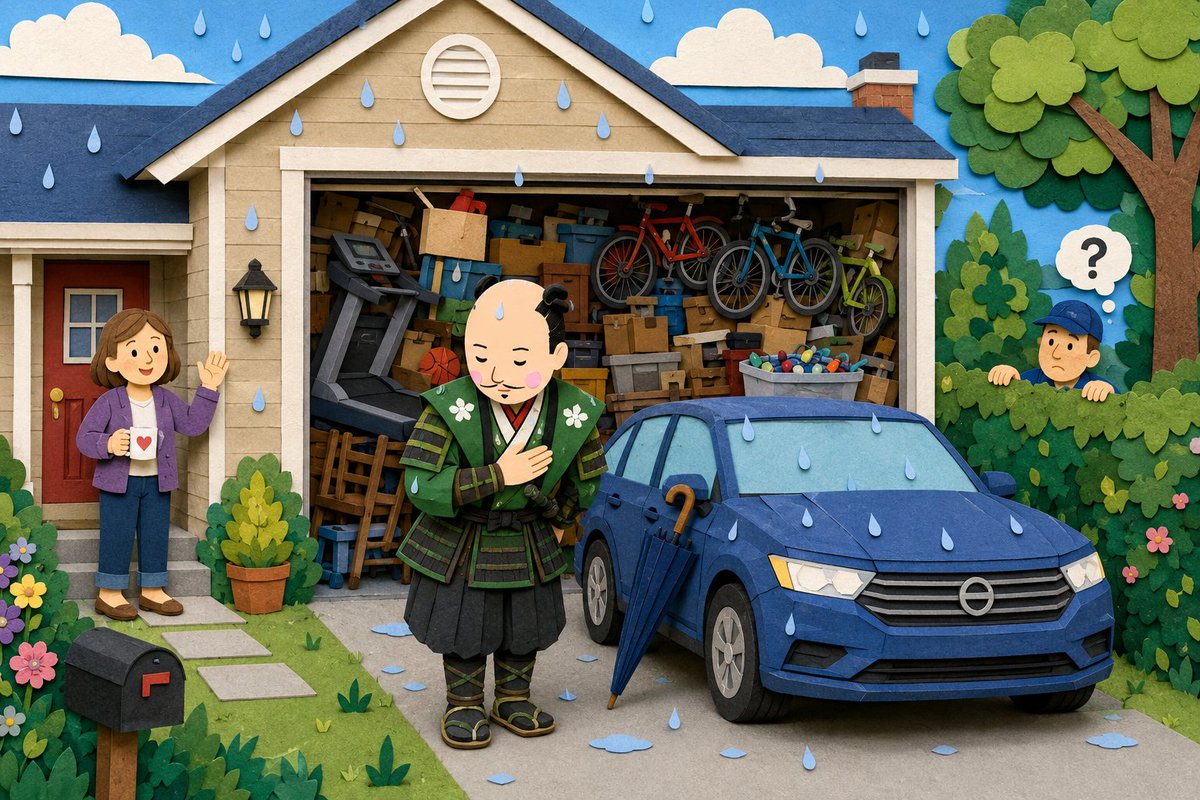
USA. A house. The garage is full, so the car sleeps in the rain.
I walked past an open garage today, and I finally understand Americans.
The garage was packed to the ceiling. Boxes. A treadmill. Old chairs. Three bicycles hanging from hooks. Christmas lights in a plastic tub. No room for even one more thing.
And the family car? Parked outside. In the driveway. Getting rained on.
I stood there, deeply moved.
In Japan, we put the car in the garage and the boxes in the house. Americans do the opposite. And now I see why.
The garage is the treasure house. Inside it sleep the sacred relics: the bicycle the child outgrew, the chair no one sits in, the lights that shine one week a year. These must be protected at all costs.
The car is not a treasure. The car is a warrior. So the car is given the highest honor a warrior can receive. It stands guard at the gate, in the storm, all night, so the treasures stay dry.
The owner came out with his coffee. He saw me looking and shook his head.
"Yeah, I really gotta clean out that garage," he said.
Clean it out? I bowed to him. "You are a good man," I said. "Your car guards your home with its life."
He looked at his car. He looked at me. He said, "...thanks?"
He has never thought of it that way. But I could tell he liked it.
So now every morning I walk past, and I bow to the car in the driveway.
It has the hardest job in the family, and it never complains.
The owner waves at me now. He thinks we are friends.
We are. But mostly, I am here for the car.
This morning it was raining again. The car was soaked, still guarding the gate, still faithful.
So I gave it my umbrella.
I do not need it. I have known harder rain.
A warrior on duty should not have to stand in the storm alone.
USA. A restaurant. I could not finish my meal, and I bowed my head in shame.
Then they handed me a box, and I nearly wept.
The plate had been enormous. I am a samurai; I do not surrender to food. But this was a siege, and halfway through I knew I could not win. I set down my fork. In my country, to leave food on the plate is to insult the rice, the farmer, the cook, and your own ancestors, roughly in that order. So I sat there, quietly making peace with my dishonor.
Then the waitress smiled and said the most beautiful sentence I have heard here.
"You want a box for that?"
A box. To take it. Home.
I went still.
"You would save it?" I asked.
"Yeah, of course. It's still good."
It's still good. Three words my grandmother said to me a thousand times, across an ocean, in another language, over a bowl I was not allowed to leave.
I had crossed the world expecting to find everything different here. And a stranger in an apron had just handed me my grandmother's exact heart, in a small paper container, without knowing she had done anything at all.
I took the box. I held it like a newborn. I bowed to her, to the cook, and to the half a sandwich within, which would now live to see another day.
That night I ate it by a window, slowly, the way you eat something that was nearly lost. It was, if anything, better the second time. Everything saved is.
So now I order too much on purpose. Not from greed. From faith. Because I have learned that here, the same as home, a meal does not end when you are full.
It ends when the box is empty.
And the box is never empty the same day.
Which means a good meal can last forever,
as long as someone, anyone, still believes it is too good to waste.
















![Rainmaker1973's tweet photo. For generations, modern farming has relied heavily on energy-intensive synthetic nitrogen fertilizers. But groundbreaking work by one scientist is proving that nature’s own microbes can replace much of that dependence.
Dr. Mariangela Hungria, a Brazilian microbiologist, has been named the 2025 World Food Prize Laureate for her pioneering research on biological nitrogen fixation. Her decades-long work shows how beneficial soil bacteria can naturally deliver nitrogen to crops, dramatically reducing the need for chemical fertilizers.
Nitrogen is vital for plant growth, but producing synthetic versions is costly and emits massive amounts of greenhouse gases. Hungria dedicated more than 40 years to studying rhizobia — bacteria that form symbiotic relationships with legume roots (such as soybeans and beans). These microbes convert atmospheric nitrogen into a form plants can use, in exchange for sugars from the crop.
Her practical innovations have delivered impressive results. Treating soybean seeds with specially selected rhizobia strains has increased yields by up to 8% while cutting fertilizer use. She also advanced the use of Azospirillum brasilense, another bacterium that enhances nitrogen uptake and promotes growth through natural hormone production.
The impact has been transformative. Today, Hungria’s microbial inoculants are applied across more than 99 million acres (40 million hectares) of Brazilian farmland. This approach is estimated to save farmers around $25 billion each year in fertilizer costs and prevent more than 230 million metric tons of CO₂-equivalent emissions annually.
When she began her career, many doubted that microbes could meaningfully compete with industrial fertilizers. Thanks to her persistence, Brazil has become a global leader in sustainable agriculture — proving that tiny bacteria can play a giant role in feeding the world more efficiently and cleanly.
["Dr Mariangela Hungria Named 2025 World Food Prize Laureate." FarmingFirst, 2026]](https://pbs.twimg.com/media/HNRMo4WXgAAsFgw.jpg)