Nexstem is now Anthriq.
A new name that reflects what we’ve grown into: building foundational infrastructure for human-aware technology.
Same DNA. Clearer direction.
Read more in our Press Release: https://t.co/T3WY9QI16U
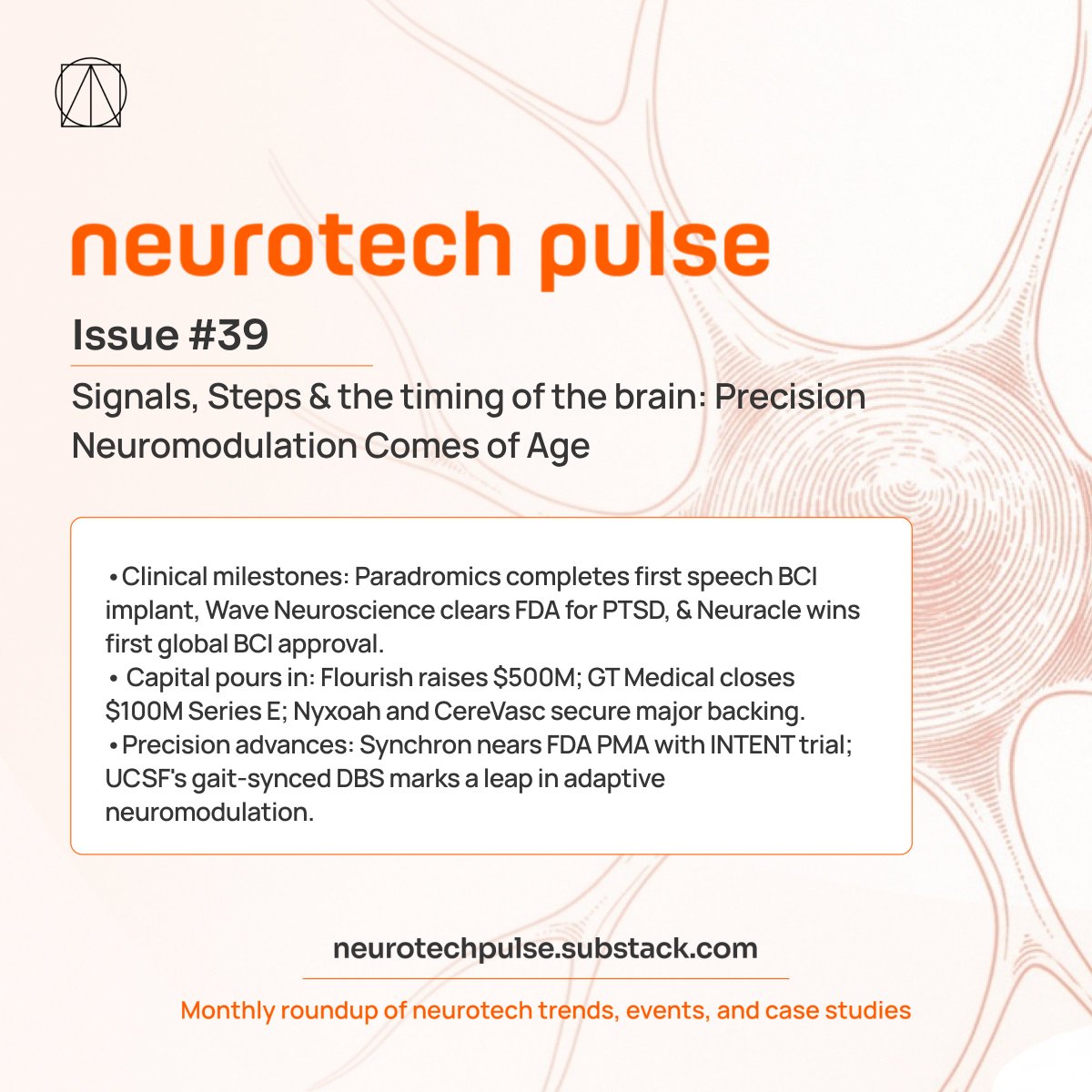
𝐇𝐚𝐯𝐞 𝐲𝐨𝐮 𝐫𝐞𝐚𝐝 𝐈𝐬𝐬𝐮𝐞 #𝟑𝟗 𝐨𝐟 𝐍𝐞𝐮𝐫𝐨𝐭𝐞𝐜𝐡 𝐏𝐮𝐥𝐬𝐞?
𝐒𝐢𝐠𝐧𝐚𝐥𝐬, 𝐒𝐭𝐞𝐩𝐬 & 𝐭𝐡𝐞 𝐓𝐢𝐦𝐢𝐧𝐠 𝐨𝐟 𝐭𝐡𝐞 𝐁𝐫𝐚𝐢𝐧: 𝐏𝐫𝐞𝐜𝐢𝐬𝐢𝐨𝐧 𝐍𝐞𝐮𝐫𝐨𝐦𝐨𝐝𝐮𝐥𝐚𝐭𝐢𝐨𝐧 𝐂𝐨𝐦𝐞𝐬 𝐨𝐟 𝐀𝐠𝐞.
This month marks the most consequential clinical move of 2026, with BCI platform companies absorbing outsized investor attention as the space enters a new chapter of conviction.
On the clinical front, @paradromics completed the first-in-human implant of its Connexus BCI for speech restoration, @WaveNeuro secured FDA clearance for a biomarker-guided PTSD protocol, and China's @neuracle Science Technology became the first company globally to win commercial approval for an invasive BCI.
Capital continues to concentrate around BCI platforms. Flourish raised $500M at a $2.5B valuation backed by Jeff Bezos, @gtec_BCI Medical Technologies closed an oversubscribed $100M Series E, while @Nyxoah and @CereVasc secured public and private capital to scale nerve stimulation and hydrocephalus treatment respectively.
Meanwhile, Synchron's INTENT pivotal trial builds toward the FDA PMA race, and new ARPA-H and Allen Institute programs signal expanding public investment into sleep neurotechnology and translational brain science.
This issue's case study spotlight features @paradromics , the Austin startup that just completed the first fully implantable, wireless BCI for speech restoration in a human patient — built on a decade of engineering discipline around high-bandwidth, percutaneous-free neural recording.
🔗 𝐑𝐞𝐚𝐝 𝐭𝐡𝐞 𝐟𝐮𝐥𝐥 𝐢𝐬𝐬𝐮𝐞: https://t.co/4LVcy5fjsS
#NeurotechPulse #Neurotech #Neuroscience #BCI #Anthriq #Neuromodulation
𝐒𝐜𝐢𝐞𝐧𝐭𝐢𝐬𝐭𝐬 𝐣𝐮𝐬𝐭 𝐛𝐮𝐢𝐥𝐭 𝐭𝐡𝐞 𝐛𝐫𝐚𝐢𝐧'𝐬 𝐡𝐮𝐧𝐠𝐞𝐫 𝐜𝐨𝐧𝐭𝐫𝐨𝐥 𝐜𝐞𝐧𝐭𝐞𝐫 — 𝐟𝐫𝐨𝐦 𝐡𝐮𝐦𝐚𝐧 𝐬𝐭𝐞𝐦 𝐜𝐞𝐥𝐥𝐬.
A small brain region called the arcuate nucleus decides whether you feel hungry or full. It responds to GLP-1, leptin, and virtually every obesity drug that actually works. But here's the problem: we've never been able to study it in human cells. Until now.
Researchers at reNEW Copenhagen used pluripotent stem cells to grow functional hunger and satiety neurons in the lab — neurons that secrete the right peptides and respond to appetite hormones exactly as they would in a living human brain.
💡 𝐊𝐞𝐲 𝐭𝐚𝐤𝐞𝐚𝐰𝐚𝐲𝐬:
🎯 First human model of the arcuate nucleus — no more mouse-brain proxies
🎯 BMP signaling identified as the developmental switch that builds this specific brain region
🎯 Scales for drug screening — hundreds of compounds testable simultaneously
🎯 Already in use with pharma partners testing obesity drug candidates
📌 𝐖𝐡𝐲 𝐭𝐡𝐢𝐬 𝐦𝐚𝐭𝐭𝐞𝐫𝐬:
Ozempic and Wegovy work on this exact brain circuit — but we've never seen that mechanism in human neurons. This model changes that, and could unlock the next generation of precision obesity treatments.
🔗 𝐑𝐞𝐚𝐝 𝐌𝐨𝐫𝐞: https://t.co/60YkbZ5Ryb
#Neuroscience #StemCells #Obesity #Hypothalamus #BrainScience #Anthriq
Anthriq is heading to Barcelona for the @FENSorg
Forum 2026, and we couldn't be more excited!
Europe's largest neuroscience congress is gathering thousands of researchers, clinicians, and innovators under one roof, united by a theme that feels urgent right now: Brain in Context.
The science is moving away from studying the brain as an isolated organ toward understanding it as a dynamic system — shaped by genetics, environment, and lived experience in ways we're only beginning to map. That's a profound shift. And it opens up an equally profound question: if the brain is contextual, shouldn't our tools for studying it be too?
We think so. That's what drives us.
Five days. Hundreds of symposia. Some of the sharpest minds in global neuroscience — all in one city.
We're showing up ready to listen, learn, and have the conversations that matter.
If you're attending FENS Forum 2026, let's connect. Find us at Fira Gran Via, 6–10 July.
#FENS2026 #BrainInContext #Neuroscience #Neurotech #Barcelona
𝐓𝐡𝐞 𝐬𝐜𝐢𝐞𝐧𝐜𝐞 𝐨𝐟 𝐜𝐨𝐧𝐬𝐜𝐢𝐨𝐮𝐬𝐧𝐞𝐬𝐬 𝐦𝐚𝐲 𝐡𝐚𝐯𝐞 𝐚 𝐛𝐥𝐢𝐧𝐝 𝐬𝐩𝐨𝐭. 𝐀𝐧𝐝 𝐭𝐡𝐞 𝐞𝐱𝐩𝐞𝐫𝐢𝐦𝐞𝐧𝐭𝐬 𝐰𝐞 𝐭𝐫𝐮𝐬𝐭 𝐦𝐨𝐬𝐭 𝐦𝐚𝐲 𝐛𝐞 𝐦𝐞𝐚𝐬𝐮𝐫𝐢𝐧𝐠 𝐭𝐡𝐞 𝐰𝐫𝐨𝐧𝐠 𝐭𝐡𝐢𝐧𝐠.
Is AI conscious? Are animals? What about lab-grown brain organoids? These questions are being asked louder than ever. But a recent study raises a more uncomfortable one: does neuroscience actually have the tools to answer them?
🔍 𝐖𝐡𝐚𝐭 𝐭𝐡𝐢𝐬 𝐫𝐞𝐬𝐞𝐚𝐫𝐜𝐡 𝐢𝐦𝐩𝐥𝐢𝐞𝐬:
Researchers now argue that most experiments used to study consciousness can't separate subjective experience from general information processing. They often measure the same signal — making their conclusions ambiguous at best.
💡 𝐊𝐞𝐲 𝐭𝐚𝐤𝐞𝐚𝐰𝐚𝐲𝐬:
🎯 Popular experimental paradigms conflate subjective experience with general information processing — two distinct phenomena that current designs can't separate
🎯 This ambiguity is now fueling increasingly strong claims about consciousness in AI, animals, fetuses, and brain organoids — claims the data may not actually support
🎯 Neuropsychological conditions like blindsight and hemispatial neglect — where awareness is dissociated from perception — may offer cleaner experimental models going forward
🎯 The authors argue that if consciousness science is to influence AI ethics, animal welfare, and bioethics, its methods must be held to a far higher evidentiary standard
📌 𝐖𝐡𝐲 𝐭𝐡𝐢𝐬 𝐦𝐚𝐭𝐭𝐞𝐫𝐬:
If consciousness science is going to influence AI policy, animal welfare law, and bioethics — it needs a much stronger evidentiary foundation first.
🔗 𝐑𝐞𝐚𝐝 𝐌𝐨𝐫𝐞: https://t.co/tDW1EFyZsb
#Neuroscience #Consciousness #AI #CognitiveScience #AIEthics #BrainScience #Anthriq
𝐒𝐭𝐞𝐦 𝐜𝐞𝐥𝐥𝐬 𝐦𝐚𝐲 𝐛𝐞 𝐭𝐡𝐞 𝐤𝐞𝐲 𝐭𝐨 𝐫𝐞𝐩𝐚𝐢𝐫𝐢𝐧𝐠 𝐭𝐡𝐞 𝐢𝐧𝐣𝐮𝐫𝐞𝐝 𝐛𝐫𝐚𝐢𝐧.
Traumatic brain injury is one of medicine's hardest problems. The damage cascades across multiple systems — inflammation, cell death, barrier breakdown, disrupted repair. No single drug addresses all of it. Outcomes remain poor even with the best care available.
A new review from @ZJU_China maps the full landscape of stem cell strategies for TBI — from direct cell transplantation to exosome delivery and tissue engineering scaffolds. The goal: treat multiple damage pathways at once, not just one.
💡 𝐊𝐞𝐲 𝐭𝐚𝐤𝐞𝐚𝐰𝐚𝐲𝐬:
🎯 Mesenchymal stem cells (MSCs) are emerging as the leading candidate — they reduce inflammation, protect surviving neurons, maintain the blood-brain barrier, and support tissue repair simultaneously
🎯 Exosome-based approaches (cell-free) are gaining traction as a safer, more controllable delivery mechanism than direct cell transplantation
🎯 Timing of intervention is critical — the therapeutic window for stem cell delivery is narrow and varies by injury type and severity
🎯 3D scaffolds and biomaterials significantly improve transplanted cell survival and integration into damaged tissue
📌 𝐖𝐡𝐲 𝐭𝐡𝐢𝐬 𝐦𝐚𝐭𝐭𝐞𝐫𝐬:
TBI affects millions annually and remains one of medicine's most under-treated neurological conditions — conventional care manages symptoms but rarely promotes true recovery. The translation gap from lab to clinic remains the biggest hurdle. Bridging it could transform TBI from a condition we manage into one we actually repair.
🔗 𝐑𝐞𝐚𝐝 𝐌𝐨𝐫𝐞: https://t.co/S7PzxarfMD
#Neuroscience #StemCells #TBI #BrainRepair #RegenerativeMedicine #Neurology #Anthriq
Every interface ever built assumed the human would adapt to the machine. Touch. Click. Swipe. We designed inputs for machines that couldn't hear the body's actual language.
The body has been broadcasting the whole time.
EMG captures neuromuscular intent 20–50 ms before a movement begins.
EEG records cortical readiness potentials — the Bereitschaftspotential — up to 2 seconds before voluntary action.
Alpha suppression tells you where attention is anchored. Theta elevation signals working memory load. Delta drift marks fatigue onset before the operator notices it themselves.
The next wearable won't wait for your tap. It'll know your cognitive state before your hand moves.This is where human-machine interaction is going — not better touchscreens, but biosignal-native interfaces. Gesture + EEG + EMG, fused, real-time, interpreted.
We're building the hardware layer that makes this possible.
What does your research or product roadmap look like when the interface disappears entirely?
Read More about what we’re building: https://t.co/TOjLDFKLpx
#Neurotech #EEG #EMG #HumanMachineInteraction #BCI #Wearables #Anthriq #Biosignals #BCIResearch
𝐘𝐨𝐮𝐫 𝐛𝐫𝐚𝐢𝐧 𝐦𝐚𝐲 𝐡𝐚𝐯𝐞 𝐚 𝐜𝐨𝐧𝐬𝐜𝐢𝐨𝐮𝐬𝐧𝐞𝐬𝐬 𝐦𝐚𝐫𝐤𝐞𝐫 — 𝐚𝐧𝐝 𝐢𝐭'𝐬 𝐛𝐮𝐫𝐢𝐞𝐝 𝐢𝐧 𝐭𝐡𝐞 𝐭𝐡𝐚𝐥𝐚𝐦𝐮𝐬.
In a rare opportunity to directly record from the human thalamus, researchers discovered a previously unknown oscillation — a rhythmic electrical pattern firing between 19 and 45 Hz — that appears exclusively during conscious states.
Published in @NatureNeuro, the study found this oscillation is present during wakefulness and REM sleep, and completely absent during deep (non-REM) sleep, making it the first thalamic biomarker to cleanly separate conscious from unconscious brain states in humans.
🔍 𝐖𝐡𝐚𝐭 𝐭𝐡𝐢𝐬 𝐫𝐞𝐬𝐞𝐚𝐫𝐜𝐡 𝐢𝐦𝐩𝐥𝐢𝐞𝐬:
Consciousness isn't just a cortical event — it has a deep-brain signature. The thalamus, long theorized as a consciousness "switch," now has direct electrophysiological evidence in humans to back that role, shifting it from hypothesis to measurable biological reality.
💡 𝐊𝐞𝐲 𝐭𝐚𝐤𝐞𝐚𝐰𝐚𝐲𝐬:
🎯 The 19-45 Hz oscillation is exclusive to the central thalamus — it doesn't appear broadly across the brain
🎯 It is present during both wakefulness and REM sleep — the two states that share subjective experience — and absent during dreamless sleep
🎯 Within REM sleep, the oscillation spikes specifically during bursts of eye movement, linking it to moment-to-moment conscious activity
🎯 The central thalamus is already known to drive global brain state transitions, making this oscillation a plausible control signal for consciousness itself
📌 𝐖𝐡𝐲 𝐭𝐡𝐢𝐬 𝐦𝐚𝐭𝐭𝐞𝐫𝐬:
Disorders of consciousness — including coma, vegetative states, and anesthesia awareness — currently lack reliable biological markers. A measurable thalamic signature of consciousness could transform how clinicians assess awareness in non-responsive patients, guide deep brain stimulation therapies, and finally give the science of consciousness an objective, human-validated foothold.
🔗 𝐑𝐞𝐚𝐝 𝐌𝐨𝐫𝐞: https://t.co/IU5AoWnjY6
#Neuroscience #Consciousness #CognitiveScience #Sleep #Thalamus #Anthriq
𝐇𝐚𝐯𝐞 𝐲𝐨𝐮 𝐫𝐞𝐚𝐝 𝐈𝐬𝐬𝐮𝐞 #𝟐 𝐨𝐟 𝐍𝐨𝐭𝐞𝐰𝐨𝐫𝐭𝐡𝐲 𝐏𝐞𝐫𝐬𝐨𝐧𝐚𝐥𝐢𝐭𝐢𝐞𝐬?
𝐂𝐨𝐧𝐬𝐭𝐫𝐚𝐢𝐧𝐭, 𝐓𝐫𝐚𝐧𝐬𝐥𝐚𝐭𝐢𝐨𝐧, 𝐚𝐧𝐝 𝐒𝐢𝐠𝐧𝐚𝐥: 𝐓𝐡𝐞 𝐦𝐢𝐧𝐝𝐬 𝐭𝐮𝐫𝐧𝐢𝐧𝐠 𝐧𝐞𝐮𝐫𝐨𝐭𝐞𝐜𝐡'𝐬 𝐡𝐚𝐫𝐝𝐞𝐬𝐭 𝐩𝐫𝐨𝐛𝐥𝐞𝐦𝐬 𝐢𝐧𝐭𝐨 𝐩𝐫𝐨𝐠𝐫𝐞𝐬𝐬.
The neurotech field does not have one frontier — it has several. Clinical translation. Access. Algorithmic infrastructure. Editorial rigour. Progress in each looks different, and so do the people driving it.
What they share is an ability to identify what the field was missing and build toward it before the gap had a name.
In this edition, we spotlight four of them:
1. @MaryamShanechi — the engineer building the mathematical foundation that turns BCIs from passive decoders into adaptive, responsive systems.
2. @bryan_johnson — the entrepreneur who invested $100M to make non-invasive brain data portable and accessible, and built a mainstream audience for brain health before the field had one.
3. @TetianaBCI — the founder proposing a non-surgical BCI delivered via nanoparticles through the nasal cavity, targeting Parkinson's, Alzheimer's, epilepsy, and depression without a craniotomy.
4. Dominic Borkelmans — the analyst who built Neurofounders to fill the gap in rigorous, independent editorial coverage of early-stage neurotech companies.
🔗 Read More: https://t.co/TkmpmUnxPX
#NeurotechPulse #Neuroscience #BCI #NeuralInterfaces #Anthriq
Train on one subject. Deploy on another. No recalibration.That's the dream in neurotech & neural geometry keeps breaking it.
𝐖𝐡𝐚𝐭'𝐬 𝐭𝐡𝐞 𝐫𝐞𝐚𝐥 𝐛𝐥𝐨𝐜𝐤𝐞𝐫 𝐟𝐨𝐫 𝐜𝐫𝐨𝐬𝐬-𝐬𝐮𝐛𝐣𝐞𝐜𝐭 𝐭𝐫𝐚𝐧𝐬𝐟𝐞𝐫? Vote👇
#Neurotech#BCI#Biosignals#Anthriq
Blood pressure checks happen at every village health centre in India. Brain health checks don't.
There's no scientific reason for that gap — only an infrastructure one.
We already have FDA-approved drugs that slow Alzheimer's progression. Lecanemab. Donanemab. They work — but only in early-stage patients. By the time most people receive a diagnosis, the treatment window has already closed.
The bottleneck isn't the science. It's the access. A 2-hour cognitive battery needs a specialist and a clinic. That combination doesn't exist where the disease burden is highest.
Project Brain Aging is built for that gap. Wireless, dry EEG. No gel. No specialist. A brain-age score in four minutes — at a primary health centre, a school, a community screening camp.
Cognitive screening as routine as a blood pressure check. That's the target.
Swipe through ->
Tag someone working on this problem.
#BrainHealth #HealthcareAccess #AlzheimersAwareness #Neurotechnology #EEG #DeepTech #CognitiveCare #Anthriq
📌 𝐖𝐡𝐲 𝐭𝐡𝐢𝐬 𝐦𝐚𝐭𝐭𝐞𝐫𝐬:
For conditions like epilepsy, Parkinson's, and ALS — where neural monitoring and stimulation precision are critical — a brain-matched electrode isn't a luxury, it's a clinical necessity. This framework lays the groundwork for a new generation of neural interfaces that treat each patient's brain as the unique architecture it is.
🔗 𝐑𝐞𝐚𝐝 𝐌𝐨𝐫𝐞: https://t.co/fATi1Pw0yr
#Neuroscience #NeuralInterface #BrainComputerInterface #NeuroTech #PersonalizedMedicine #Bioelectronics #Anthriq
💡 𝐊𝐞𝐲 𝐭𝐚𝐤𝐞𝐚𝐰𝐚𝐲𝐬:
🎯 The honeycomb structure cuts electrode stiffness without sacrificing mechanical strength — a key challenge traditional designs couldn't solve.
🎯 In rat models, the sensors functioned for 28 days with zero immune response, suggesting strong long-term biocompatibility.
🎯 An adult brain spread flat covers ~2,000 cm² — this is the first mesh design to navigate that terrain precisely.
🎯 Production starts from a patient's MRI scan, runs through simulation, and prints directly — bypassing expensive cleanrooms.
🎯 The hydrogel material matches the brain's mechanical properties, allowing application without tissue micro-damage.
𝐇𝐚𝐯𝐞 𝐲𝐨𝐮 𝐫𝐞𝐚𝐝 𝐈𝐬𝐬𝐮𝐞 #𝟑𝟖 𝐨𝐟 𝐍𝐞𝐮𝐫𝐨𝐭𝐞𝐜𝐡 𝐏𝐮𝐥𝐬𝐞?
𝐒𝐢𝐠𝐧𝐚𝐥𝐬, 𝐒𝐭𝐫𝐨𝐤𝐞𝐬 & 𝐒𝐨𝐯𝐞𝐫𝐞𝐢𝐠𝐧 𝐂𝐚𝐩𝐢𝐭𝐚𝐥: 𝐓𝐡𝐞 𝐍𝐞𝐰 𝐍𝐞𝐮𝐫𝐨𝐭𝐞𝐜𝐡 𝐂𝐚𝐩𝐢𝐭𝐚𝐥 𝐂𝐲𝐜𝐥𝐞.
This month marks a major shift in neurotech financing, with capital flowing aggressively into mental health, implantable neuromodulation, and next-generation BCIs.
On the clinical front, Mobia Medical's $150M Nasdaq IPO, CorTec's first-in-human implantable BCI results for stroke recovery, and EpiNeuron, LLC's FDA clearance highlight the growing maturity of therapeutic neurotechnology.
Capital continues to scale across the ecosystem. Neuralink secured sovereign backing from Oman's OIA, BlueWind Medical raised $47.8M for bladder neuromodulation, while SonoMind, Ampa, and Nexstim attracted significant investment to advance non-invasive neuromodulation therapies.
Meanwhile, a landmark partnership between MintNeuro and Motif Neurotech signals growing convergence between advanced neuroelectronics and therapeutic BCIs, as companies race to build smaller, more scalable neural implants.
This issue's case study spotlight features Subsense Inc., a company pursuing one of neurotech's boldest ideas yet: a bidirectional brain-computer interface delivered through engineered nanoparticles and a nasal spray—without surgery.
🔗 Read the full issue: https://t.co/yaMM8AxSco
#NeurotechPulse #Neurotech #Neuroscience #BCI #Anthriq #MentalHealthTech #DigitalHealth