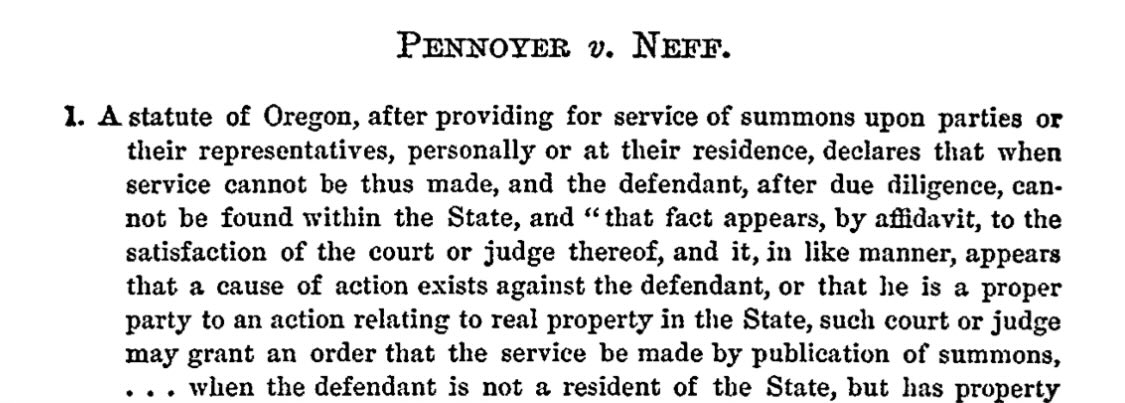
The real “problem of 1938” with respect to general law revivalism is not Erie, but the Federal Rules of Civil Procedure.
There’s also something of this in the response to “against anachronistic readings of section 1983.”
The public interest bar that brought SFFA v. Harvard in the first place will likely eventually realize how much easier these cases are going to be to bring as antitrust cases (a conspiracy not to compete for certain segments of the input market for prospective students).
After the SFFA v. Harvard decision, many universities indicated they would try to find ways around it.
UC Davis Med, which had already developed a way to get around California’s affirmative action ban, went further, offering to teach other schools how to do it.
Post-SFFA, the architect of their “Davis Scale,” which uses socioeconomic factors to admit racially diverse classes, “was asked about being sued over his legally questionable methods. He replied, ‘Am I worried about it? Yes. Is it going to stop me? No.’”
🚨 The Supreme Court left in place a Fifth Circuit ruling that the federal felon-in-possession firearm law cannot be applied to a Mississippi man whose only felony conviction was nonpayment of child support.
In hindsight, it’s not surprising something like this exists. But a bird nest made out of fiber optic drone cables is a straight-out-of-scifi detail that has become contemporary reality.
Apocalyptic bird nest.
A Russian glide bomb knocks down a tree in Donbas. From the shattered branches rolls out a tiny bird’s nest.
Made of drone fiber-optic cable.
Source: Oleg Malchenko
Pretty sure this is a magnolia sapling that has started growing behind my air conditioner, so that’s really cool
Gotta find a better place for it in the fall
I’m rather partial to corvids generally and there’s an irreducible element to the natural order (Herzog: “…a harmony of overwhelming and collective murder…”), but fatherhood has really exacerbated my soft spot.
Just watched a baby robin get plucked out of its nest by a crow. Whole neighborhood of robins came to its defense and the crow dropped it.
Seemed fine and I was able to carefully put it back into the nest, so fingers crossed.
I guess that’s my hermitage vignette for the day.
I’m working through a dormant commerce clause theory centered on pirates (in a way).
If it ever sees its way to print (conditional on a lot), it will be quite the wild ride.
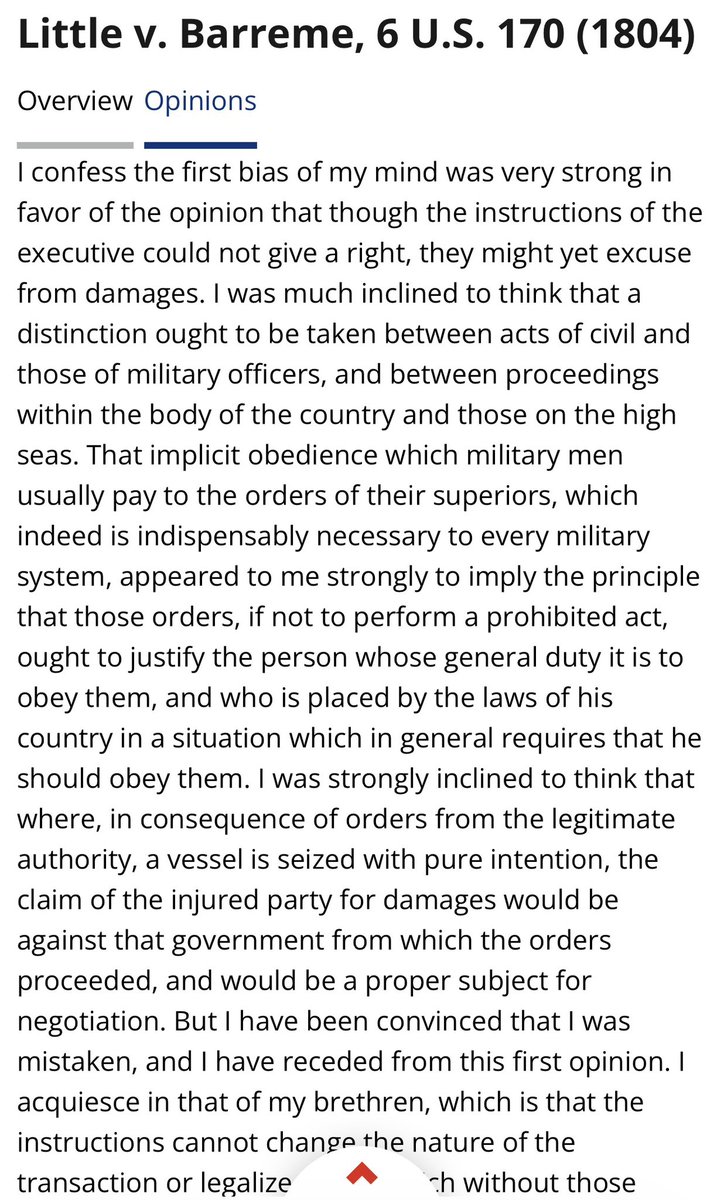
@kroosevelt93@OrinKerr I agree. I think we have to understand the senior status practice as a form of gloss/liquidation, with a limited holding that should not be extended because voluntariness was crucial to its acceptance. Page of history vs. volume of logic.
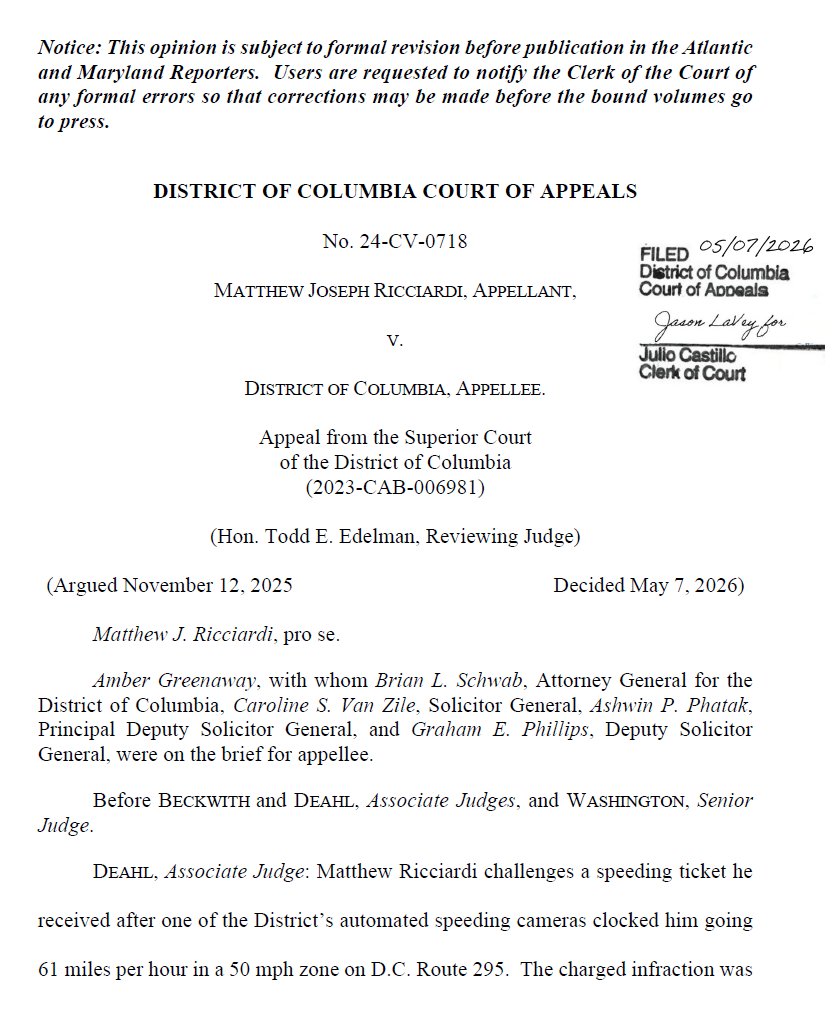
A former colleague just beat a DC speed-camera ticket at the DC Court of Appeals. DC tried to make a ±1 mph margin of error vanish by regulation. The court held a coin flip isn’t clear and convincing evidence.
Ticket dismissed; math remains undefeated.
https://t.co/7m1JLQB7WR
🚨 New Experiment: Everyone thinks AI firms will look like little companies. A manager model decomposes the task and worker models do subtasks. The manager red-teams, revises, and recombines. A seemingly simple org chart.
But when I ran the experiment, the current in-vogue org setup, manager-subagent, cost 4x more and performed worse than letting a rather simple market do the trick.
I tested 3 ways to organize multiple AI models:
1. Solo: Onefrontier model does everything itself
2. Hub-Spoke: A "manager" model splits tasks, delegates, red-teams, revises
3. Market: Models bid on tasks, winner gets the job, reputation updates
I also tested were 3 types of tasks - Coding, Reasoning and Synthesis.
- Coding required most "global state" management, which the solo model did best at. In future @a1zhang's RLM will probably do even better here
- Reasoning is the hardest to cleanly decompose, and the market worked the best here
- Synthesis too, the market beat hub-spoke as the framing could be ambiguous
The reason is, a hub isn't a "manager" as we know it. It's a model that must somehow know:
- What the subtasks are
- What good recomposition looks like
And if either fails, as it does for complex or not-easily-decomposable tasks, competent workers still produce garbage.
As we move from coding to letting multi-agent systems do work across the entire economy we'll end up with more not-easily-verifiable tasks with ambiguous settings and uncertain payoffs. In those, we won't be able to use the factory approach to get work done.
The Coasean argument is that firms will get smaller, and the smaller firms will transact more, since the organisational premium reduces with AI. But how? Through central hubs, or markets? The fact is, Coase here needs Hayek. Setting up markets is not trivial, as @AndreyFradkin and I looked in our recent paper.
Essay: https://t.co/kK3gMQfbCs
“We’ve never lived in a world where 22-year-olds couldn’t assume that the work they did they would be able to do until death or retirement, and we’re never going to have that world again,” says former Nebraska Sen. Ben Sasse.
Like @davidbessis and others, I think that Hinton is wrong. To explain why, let me tell you a brief story.
About a decade ago, in 2017, I developed an automated theorem-proving framework that was ultimately integrated into Mathematica (see: https://t.co/nGCIUk44TP) (1/15)
Baker Botts advised Helix Energy Solutions Group, an offshore energy services company, in its definitive agreement to combine with Hornbeck Offshore Services in an all-stock transaction.
Read more on the transaction and global deal team here: https://t.co/gieWUEwpHB
A major win for our client Winston Hencely today at the Supreme Court in Hencely v. Fluor Corp., 24-924! Firm counsel Frank Chang led the charge arguing the case and had critical support from Tyler Green, Taylor Meehan, Tom McCarthy, and Cody Ray Milner. Very proud of the result!