I wish I owned a VLCC right now.
OK, even just a mere Suezmax would be good.
Hell, an Aframax would do it.
(looking at eyewatering dirty freight rates)
The Group of Seven countries and the European Union are in talks to replace a price cap on Russian oil exports with a full maritime services ban in a bid to reduce the oil revenue that helps finance Russia's war in Ukraine, six sources familiar with the matter said.
Russia exports over a third of its oil in Western tankers - mostly to India and China - with the use of Western shipping services. The ban would end that trade, which is mostly done through the fleets of EU maritime countries including Greece, Cyprus and Malta.
#oott
The eight participating countries reiterated that the 1.65 million barrels per day may be returned in part or in full subject to evolving market conditions and in a gradual manner. The countries will continue to closely monitor and assess market conditions, and in their continuous efforts to support market stability, they reaffirmed the importance of adopting a cautious approach and retaining full flexibility to continue pausing or reverse the additional voluntary production adjustments, including the previously implemented voluntary adjustments of the 2.2 million barrels per day announced in November 2023.
#oott
Everybody, incl all oil specialists are bearish oil. I think the actions below are very significant and its time to go long oil related stocks.
Will be very interesting to learn if these are incidents , or new Ukrainian Mass tactics. I can't see how Russia defends against this.
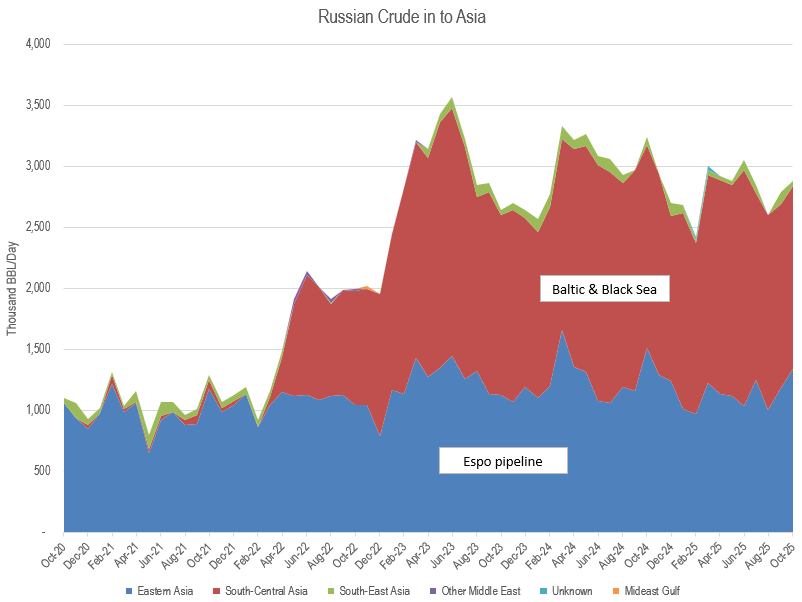
IF #China and #India reduce #Russian#Crude imports - it's likely to affect the incremental take from Feb-22, ~2mbd or about 5% of seaborne #Oil. Material to arbs and flows and... "Compliant Oil -> Compliant Ships!" #OOTT $FRO #Kpler
The news over the weekend from Asia regarding US-China relations are positive for dry bulk freight given the Soybeans purchase news. Freight futures should reflect that tomorrow.
The US plans to announce a “substantial” increase in sanctions related to Russia within the next day, U.S. Treasury Secretary Scott Bessent said Wednesday. President Trump has repeatedly threatened new punishment against Russia, but has largely held off.
INDIA-US TRADE DEAL PROGRESS
A report says India may quietly reduce Russian oil imports and allow limited GMO corn and soymeal imports — a key U.S. condition for a trade deal. The main terms of the agreement are reportedly set, with final talks possibly concluding at the APEC Summit later this month.
Trump confirmed discussions with India but gave few details. The news could boost India’s stock market and potentially trigger a breakout in the Nifty 50, signaling broader U.S. dealmaking momentum.
Incredibly frustrating sellofff in #Shipping equities last couple weeks. Rates for Tanker, Bulk and LPG ships are still very profitable.
For me personally, gold exposure is keeping my portfolio near recent highs, but it could/should have been soo much better... Frustrating
VLCC commentary by Xclusiv Shipbrokers research team: “The VLCC market shifted gears in September. On our Baltic series, the benchmark rose from about $45,155/day on 1 September to $87,532/day on 18 September — a 94% surge in barely two and a half trading weeks. The climb accelerated after 10 September: we crossed $70,000/day on the 11th and brushed $88,000/day by the 17th, with the intra-September average now roughly $65,300/day.
“Context matters: until end-August, the year’s high was just over $60,500/day, so this is not a gentle repricing; it’s a regime change. At today’s $87.5k, we are running at a little above 2.1x the 2025 year-to-date average of roughly $41,500/day and about 5.0x the five-year average (c. $17,400/day) calculated from 19 September 2020 to today. We also haven’t seen these levels in over five years; the last print north of today’s mark was on 30 April 2020, during the floating-storage super-spike, when the Baltic topped $92,500/day and briefly soared well above that through late April.
“Even the March 2023 rally stalled around $77,600/day. In other words, this September breakout is the strongest since the pandemic storage episode and the first time in 2025 that VLCCs have decisively retaken leadership from midsize crude segments. What changed? First, fundamental tonne-mile demand improved right where VLCCs live. Fixtures out of the Middle East Gulf firmed into mid-September, and trans-Atlantic to Pacific VLCC legs rebounded from their summer lows, widening voyage lengths and tightening the list. That shift shows up in the quality of the rally: charterers have been holding on-subs at elevated numbers rather than cancelling when the tape wobbles, a tell-tale sign of real S&D pressure rather than hot air. Second, geopolitics continue to push barrels and tonnage out of their old grooves. Sanctions and trade frictions are diverting Russian-related flows and lifting demand for compliant capacity, while the compliant VLCC fleet hasn’t grown meaningfully since 2021 as older units drifted into the shadow fleet or aged out. When demand nudges up against a structurally tight supply side, upside convexity appears.
“Third, there’s a seasonal and macro overlay. Q4 is historically VLCC’s strongest quarter, and OPEC+ is nudging output higher into year-end. Those volumes haven’t fully hit the water yet, but the market is already clearing the forward program at richer numbers. Add refinery maintenance and the prospect of inventory builds in Q4 and Q1, and you have the pre-conditions for contango and, if onshore tanks fill quickly, a modest return of floating storage. It doesn’t take 2020-style storage to move the needle: even small increments absorb capacity and force charterers up the curve.
“It’s also worth noting that broker assessments and pool prints have already flashed six-figure headlines this week on individual voyages, even as the Baltic sits just shy of that line. The dispersion reflects route mix, eco/scrubber premia, and timing, but the direction is unambiguous. For S&P, this kind of step-change typically pulls prompt modern tonnage into tighter negotiating ranges and narrows the bid-ask; for period, it encourages owners to keep spot exposure high in anticipation of a Q4 follow-through. Unless oil supply or risk sentiment abruptly reverse, September’s jump looks less like a spike and more like the opening phase of VLCC’s delayed upcycle.”