Need a dense multi-vector retrieval model in your language? We've got you covered with ColBERT-XM, a new modular retriever that supports 81+ languages and can easily be extended to many more. [1/4]
📑 Paper: https://t.co/9OWpjjgpFE
🤗 Model: https://t.co/LvQSsozQnf
excited for this collab between https://t.co/okchcKUOCt and https://t.co/YEfj0QIpzp! the largest online repositories of legal agent skills now officially integrated into the largest open-source legal AI platform.
For companies with modern embedding-based retrieval system, this paper has an insane density of actionable key takeaways - which btw align well with my practical experience! Awesome work @antoinelouis_
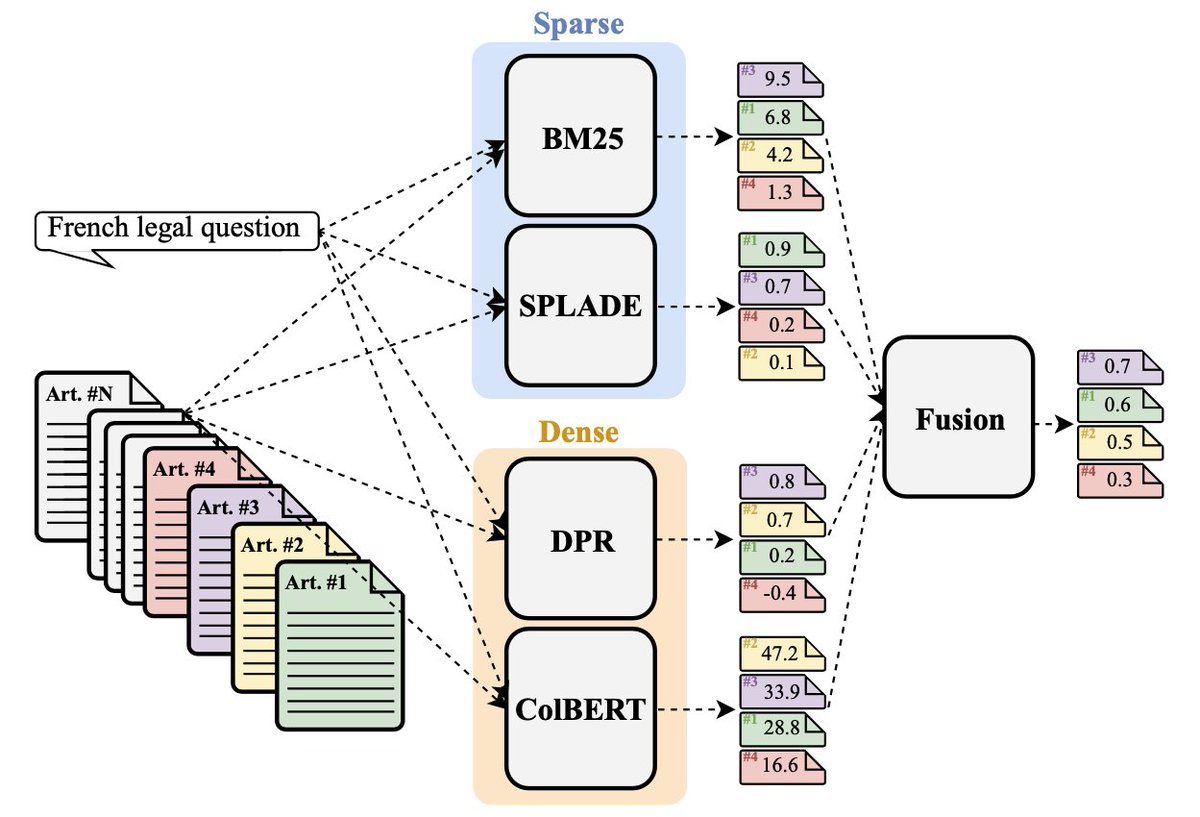
Wow, this is definitely one of my favorite papers of the last while. It details various Sparse/Dense/Multi-vector search combinations, and whether it makes sense to use them together.
Definitely give it a read, or at least read @antoinelouis_' thread below:
Overall, these insights suggest that for specialized domains, fine-tuning a dense bi-encoder model generally yields optimal results when (even limited) high-quality domain-specific data is available, whereas fusion should be preferred when such data is not accessible and domain-general retrievers are used.
But that’s not all! The paper also dives deeper into topics like:
- Language-specific retrievers trained on a budget using mMARCO, vs. larger-scale multilingual models like mE5 and BGE-M3;
- Effect of task-adaptive pre-finetuning on downstream performance;
- Efficiency of different retrieval approaches (BM25, DPR, SPLADE, ColBERT, monoBERT) in terms of index size, retrieval latency, and inference FLOPs;
- Alignement of score distributions from learned retrievers under different normalization techniques;
- Complementarity of different matching paradigms to understand the impact of fusion;
...and more.
Interested? Check it out here:
📄 Paper: https://t.co/xvdvJuaTZw
💻 Code: https://t.co/NStJPsG2kX
🤗 Domain-specific models: https://t.co/GGF6oQ5JBB
🤗 Domain-general models: https://t.co/PQIKTOB5Fo
Can hybrid search boost retrieval performance in a non-English, highly specialized domain like law?
In my final PhD paper (COLING 2025), I investigate this question by combining various retrieval techniques across two realistic scenarios:
1️⃣ zero-shot, where we assume **no** domain-specific data is available and assess the performance of fusing domain-general models;
2️⃣ in-domain, where we assume **limited** domain-specific data is available and assess the performance gains of fusing fine-tuned retrievers. (1/N 🧵)
For example, in the DPR+BM25 combination, we find that integrating BM25 offers minimal benefits once DPR is domain-tuned, with equal weighting between both systems consistently leading to worse performance. This contrasts starkly with the out-of-domain setting, where fusing the two consistently improves performance over using either one alone, regardless of the weighting.
Such an important release! BERT, modernized with years of research in language modeling.
Now I need to see this for French. A long-awaited update to the legendary CamemBERT. Maybe it’s time for a new French king: DagoBERT! 👑
It's finally out!
We at @answerdotai, @LightOnIO and friends are releasing ModernBERT 🎉
It does exactly what it says on the tin: It's BERT, but not 2018 BERT, no, it's 2024 BERT, with all the 2024 bells and whistles.
They're slot-in replacements for BERT, at both model sizes.
The popular buzz around GenAI has obscured the role of encoder-only models. These are the workhorses of practical language processing, the models that are actually being used for such workloads right now in many scientific and commercial applications.
And would you generally agree with the following suggested settings: https://t.co/0sNf0PUbrh? What is your own recommendation for a robust configuration that best prevents 'database locked' errors when doing concurrent writing (5-10 workers)? Asking as I'm still having them even in WAL mode...
@simonw@moojii@ImSh4yy Simon, would you mind sharing what it means in practice for a Django write? Does it mean placing every save, create and delete operation inside a 'with django.db.transaction.atomic():'?