688 Attack Sub: 1989 DOS vs Enhanced | Before and After (fan remake, 5 min) https://t.co/69CkpNmJpa via @YouTube
In 1989 a nuclear submarine fit in 320 by 200 pixels. Orders scrolled on the teletype, and a torpedo hit was a line of text: "A TORPEDO HAS REACHED ITS TARGET". Imagination did the rest.
Thirty-seven years later, "688 Attack Sub - Enhanced Edition", a non-commercial fan remake of John W. Ratcliff's simulator, has rebuilt it from scratch. This is the trailer of all the work so far: five and a half minutes of before and after.
THE 1989 SIDE IS THE REAL ONE
The 1989 side is the original DOS game, run in the DOSBox Staging emulator from the 1989 files and captured without retouching, manual security code included. Every comparison pairs the same feature: the 1989 sonar station with today's sonar station, chart with chart, periscope with periscope. Today's side is footage from the remake's engine, in 256-colour VGA graphics.
BEFORE / AFTER
- Missions: 10 missions and 22 scenarios from a table / the 22 originals, 19 library missions, quick missions from a code, editor
- Orders: text on the teletype / briefing room with the theatre chart, forces, layers, weather
- Radio: a security code and a message archive / VLF, HF and satellite by mast and depth, changing orders and ROE
- ESM: nine boxes and one level / WLR-8 with 26 radars in its database, identification, trend, risk
- Sonar: the chart and a twelve-bar analyser / 72-beam SDR waterfall, LOFAR, DEMON, sonar equation, ray tracing
- Chart: flat-colour seabed / NATO 1988 chart with isobaths, TMA with the MATE tool
- Periscope: a silhouette on the horizon / Type 2 and Type 18 with the eyepiece, elevation, stadimeter, real waves
- Manoeuvring: a 7-position telegraph / rudder in degrees, nine bells, thrust, planes, cavitation
- Weapons: four tubes armed in 20 seconds / torpedo room with a rack-by-rack loadout, seeker, RTE, real reload
- Status: six systems, OK or broken / twelve systems with repairs, cutaway with leaks, fire, bulkheads
- The hit: one line of text / the bubble that lifts and breaks the ship, from the damage physics
- The outcome: one message from command / debriefing with mini-postcards, report, decorations, career
- The Alfa: the same interface in mock Cyrillic / Soviet sonar, Soviet 1987 chart, readable text
WHAT 1989 DIDN'T HAVE
A mission editor, quick missions from a 13-character code, a library of 19 Cold War missions (diesels forced up by flat batteries, towed-array cables, CAPTOR minefields, submarines under tow), mines, airborne ASW, weather and sea, naval gunfire against the periscope, a Museum with 193 sourced entries, a replay showing the truth or the captain's picture, career, decorations and hall of fame, compartment damage, the emergency blow.
Where the footage comes from: the explosions on ships and the battle were filmed in the engine's test scene; airborne ASW comes from the kit's previews; weather, rain and gunfire from the periscope previews; the emergency blow is rendered with the engine's code. The original title screen with its logo is not shown.
And the classic stays, true to the original.
CHAPTERS
0:00 1989
0:24 37 years later
0:48 Before and after: missions, orders, radio
1:15 ESM, sonar, chart, periscope
1:51 Manoeuvring, weapons, status
2:18 The hit, the outcome, the Alfa
2:48 What 1989 didn't have
4:00 Listen, find, strike, survive
4:12 Battle
5:00 The classic stays
MUSIC
"Prezhde i posle" (Before and After), an original theme for male choir in Russian, written for this trailer: it is born from the square wave of a 1989 computer, the choir takes it through five verses, then a brass march and the battle; in the coda the square wave returns alone. It uses no music from the original game or from any film. Sounds: MuseScore General soundfont (MIT licence) - adaptation by S. Christian Collins (c) 2018-19; FluidR3 by Frank Wen (c) 2000-02; FluidR3Mono by Michael Cowgill (c) 2014-17; Temple Blocks by Ethan Winer (c) 2002; Drumline Cymbals by Michael Schorsch (c) 2016.
DISCLAIMER
Non-commercial fan project, not affiliated with Electronic Arts or the rights holders. "688 Attack Sub" (1989) is a trademark of its respective owners and is mentioned only as the work this remake pays tribute to. The 1989 footage is captured from the original game for comparison; the remake does not distribute the original game's files.
#688AttackSub #BeforeAndAfter #RetroGaming #SubmarineSimulator #ColdWar #DOSgames #VGA #FanRemake
688 Attack Sub Enhanced - Crazy Ivan: the turn no submarine wants to see https://t.co/KCAPEO4HkJ via @YouTube
Norwegian Sea, November 1989.
A Los Angeles trails a Soviet Victor III at 350 metres, in the baffles astern of her, where Soviet sonar hears nothing. Then the Victor does what American submariners called a "Crazy Ivan": a sudden turn to double back and listen for anyone following.
All stop. Silent running. The Victor passes at 90 metres.
NOTHING SCRIPTED
The trailer is a single game of "688 Attack Sub - Enhanced Edition", a non-commercial fan remake of the 1989 simulator. The Crazy Ivan is not hand-made: it is what the Enhanced engine has Soviet submarines do on their own, turns of 120-180 degrees, likelier after a course change, then a few minutes of listening at low speed. The 90-metre pass is the one the mission log recorded.
WHAT YOU SEE
- The sonar waterfall: the Victor's trace, steady astern, starting to drift as she turns.
- The replay's top-down view in "truth" mode: the two boats' wakes crossing.
- Ship control at all stop and silent running, the damage board, the collision warning.
- The debriefing, with the mini-postcard of the close pass.
- The sea through the periscope at dusk and at night (engine test scene).
Every image comes from the game engine, in 256-colour VGA graphics.
CHAPTERS
0:00 Norwegian Sea
0:20 In the baffles
0:47 Crazy Ivan
1:07 All stop
1:20 Ninety metres
1:47 Silence
MUSIC
"Ten'" (The Shadow), an original theme for male choir in Russian, written for this trailer in the spirit of Soviet Navy choral hymns. Three verses: the trail ("he does not hear us: we are only his shadow"), the turn ("all stop! silence on board"), the pass ("he passed by us, like a mountain in the night"). It uses no music from the original game or from any film. Sounds: MuseScore General soundfont (MIT licence) - adaptation by S. Christian Collins (c) 2018-19; FluidR3 by Frank Wen (c) 2000-02; FluidR3Mono by Michael Cowgill (c) 2014-17; Temple Blocks by Ethan Winer (c) 2002; Drumline Cymbals by Michael Schorsch (c) 2016.
DISCLAIMER
Non-commercial fan project, not affiliated with Electronic Arts or the rights holders. "688 Attack Sub" (1989) is a trademark of its respective owners and is mentioned only as the work this remake pays tribute to. The remake does not distribute the original game's files.
#688AttackSub #CrazyIvan #ColdWar #SubmarineSimulator #RetroGaming #VGA #RussianChoir #FanRemake #redoctober
688 Attack Sub Enhanced - "Ivan il Matto": la virata che nessun sottomar... https://t.co/gF5nMPO7uA via @YouTube
Mare di Norvegia, novembre 1989.
Un Los Angeles segue un Victor III sovietico a 350 metri, nel cono sordo dietro la sua poppa, dove il sonar sovietico non sente niente. Poi il Victor fa quello che gli americani chiamavano "Crazy Ivan": una virata improvvisa per tornare indietro e ascoltare chi lo seguiva.
Macchine ferme. Silenzio a bordo. Il Victor passa a 90 metri.
NIENTE DI RECITATO
Il trailer è una sola partita di "688 Attack Sub - Edizione Enhanced", remake amatoriale e non commerciale del simulatore del 1989. Il Crazy Ivan non è scritto a mano: è quello che l'Enhanced fa fare da solo ai sottomarini sovietici, virate di 120-180 gradi, più probabili dopo un'accostata, poi qualche minuto d'ascolto a pochi nodi. Il passaggio a 90 metri è quello che il registro della missione ha annotato.
COSA SI VEDE
- La cascata del sonar: la traccia del Victor, ferma a poppa, che comincia a scorrere quando vira.
- La vista dall'alto del replay, nella lettura "verità": le scie dei due battelli che si incrociano.
- La plancia con le macchine ferme e il silenzio a bordo, il quadro danni, l'avviso di collisione.
- Il debriefing, con la minicartolina del passaggio ravvicinato.
- Il mare dal periscopio, al tramonto e di notte (scena di prova del motore).
Tutte le immagini vengono dal motore del gioco, in grafica VGA a 256 colori.
CAPITOLI
0:00 Mare di Norvegia
0:20 In coda
0:47 Crazy Ivan
1:07 Macchine ferme
1:20 Novanta metri
1:47 Il silenzio
MUSICA
"Ten'" (L'ombra), tema originale per coro maschile in lingua russa, scritto per questo trailer, nello spirito degli inni corali della Marina sovietica. Tre strofe: il pedinamento ("lui non ci sente: siamo solo la sua ombra"), la virata ("macchine ferme! silenzio a bordo"), il passaggio ("ci è passato accanto, come una montagna nella notte"). Non usa musiche dell'originale né di film. Suoni: banco MuseScore General (licenza MIT) - adattamento di S. Christian Collins (c) 2018-19; FluidR3 di Frank Wen (c) 2000-02; FluidR3Mono di Michael Cowgill (c) 2014-17; Temple Blocks di Ethan Winer (c) 2002; Drumline Cymbals di Michael Schorsch (c) 2016.
AVVERTENZA
Progetto amatoriale e non commerciale, non affiliato a Electronic Arts né ai titolari dei diritti. "688 Attack Sub" (1989) è un marchio dei rispettivi proprietari ed è citato solo come opera a cui il remake rende omaggio. Il remake non distribuisce i file dell'originale.
#688AttackSub #CrazyIvan #GuerraFredda #SimulatoreDiSottomarini #Retrogaming #VGA #CoroRusso #RemakeAmatoriale #ivanilmatto #ottobrerosso
688 Attack Sub Reborn #119: The Enhanced Manual
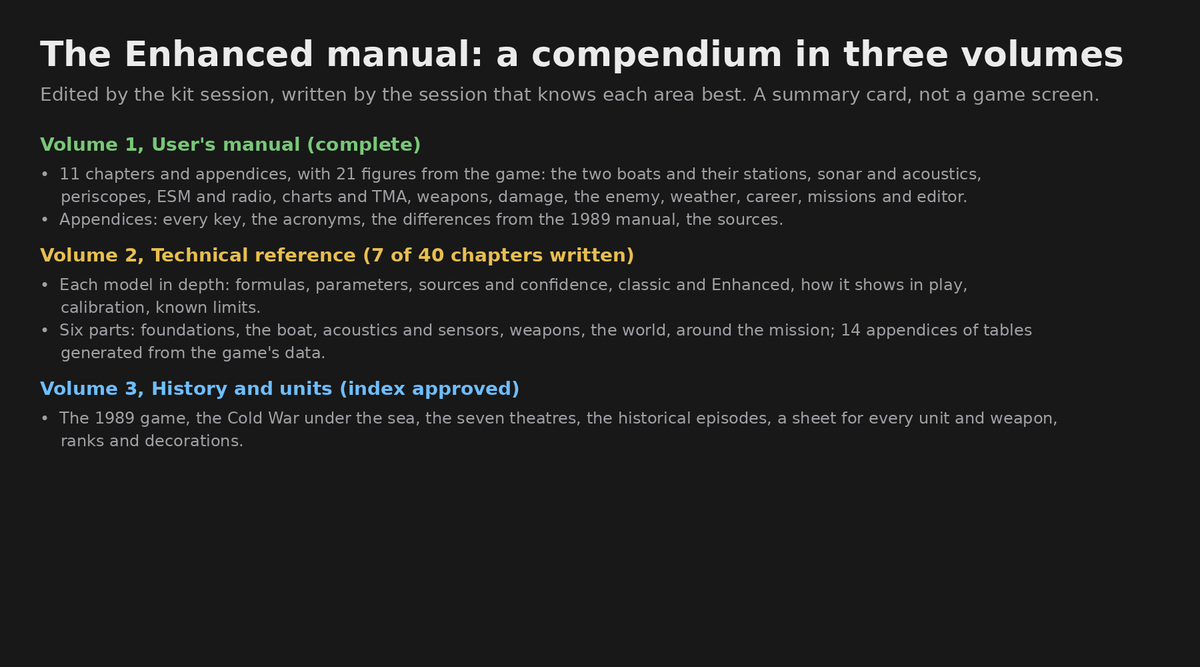
The 1989 game came with a manual, which post #10 recovered from a print scan and translated. The Enhanced level now does far more than that manual describes, so it needs its own. I asked for more than a user's guide: a real compendium and technical reference, where a player can find any detail of the simulation, with the history of the game, historical sections and statistics. The kit session edits it, and each technical chapter is written by the session that knows that area best, on a common template.
Volume 1, the user's manual
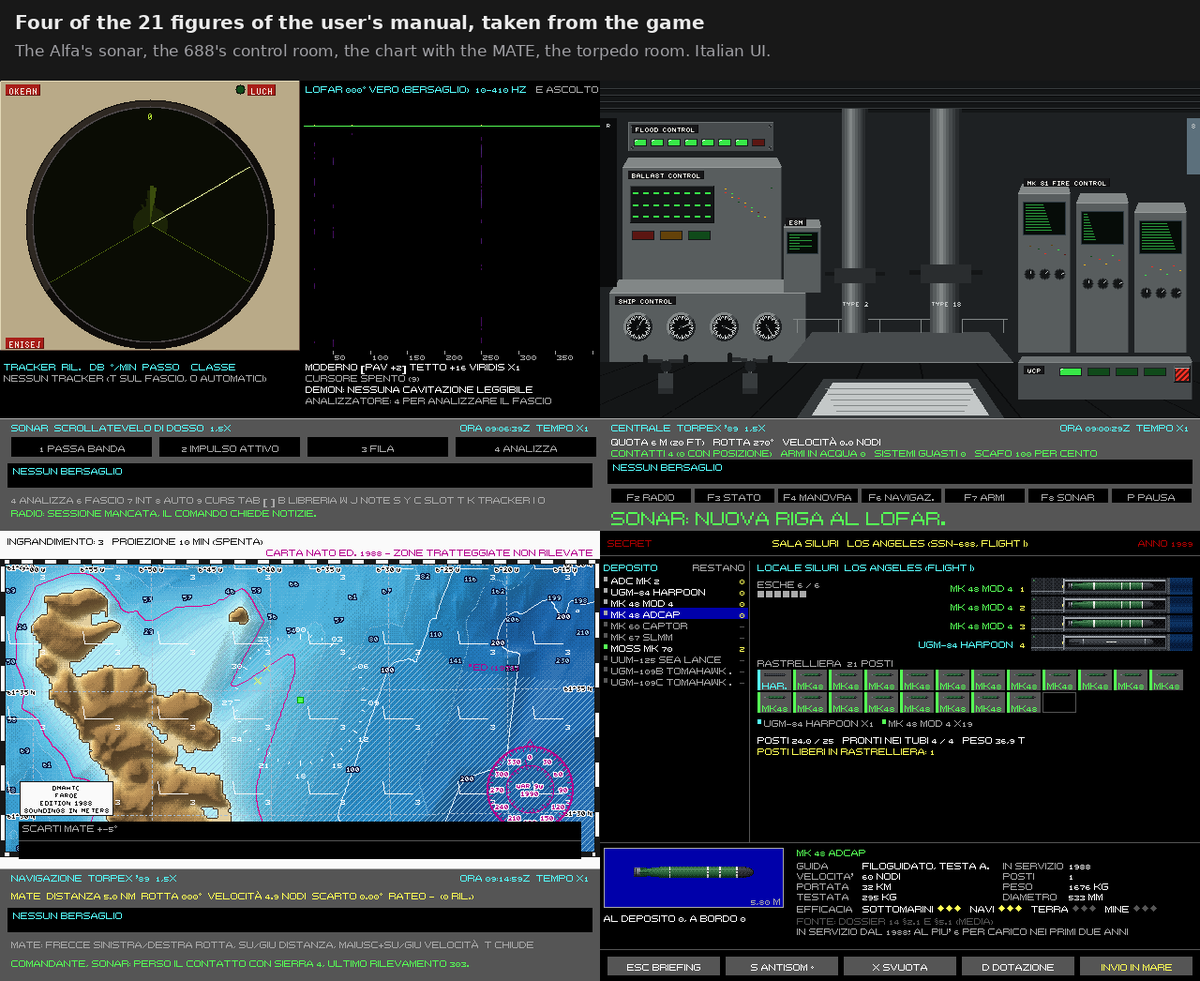
It's complete: 11 chapters and appendices, with 21 figures taken from the game.
- Chapters:
1. classic and Enhanced, the symmetry with the AI, the way from the menu to sea;
2. the two boats, the stations, ship handling, emergencies, the Alfa's own systems, the keys;
3. sonar and acoustics;
4. periscopes, ESM and the radio room;
5. period NATO and Soviet charts, plotting tools, TMA;
6. the torpedo room, tubes and reloading, torpedoes and wire guidance, missiles, decoys, mines;
7. damage, the cutaway and damage control, how ships sink;
8. the enemy: AI, ASW aircraft, gunfire, mines, collisions;
9. weather, sea state, day and night;
10. career, debriefing, replay, decorations, achievements, statistics;
11. quick missions, the editor, the library, packages to swap.
- Appendices: every key, the acronyms, the differences from the 1989 manual, the sources.
- Every function described was checked in the code; what isn't there yet is marked "coming".
Volume 2, the technical reference
- Each model explained in depth, on an eight-section template: what it's for, the model with formulas and parameters, sources and confidence, classic and Enhanced, how it shows in play, calibration and tests, known limits.
- 40 chapters in six parts: foundations, the boat, acoustics and sensors, weapons, the world, around the mission.
- 14 appendices of tables (classes, weapons, sensors, aircraft, ranks, decorations) are generated by a script straight from the game's data files, so the manual can never contradict the simulation.
- Seven chapters are written, all by the kit session: submarine damage, explosions, ship damage and sinking, collisions, navigation, day, night and sky, and graphics.
Volume 3, history and units
Its index is approved: the 1989 game, the Cold War under the sea, the seven theatres, the historical episodes, a sheet for every unit and weapon with freely licensed photos and game images, ranks and decorations, and the project's statistics.
What writing it found
Checking every page against the game turned up mistakes in the game itself, now corrected:
- the Alfa's sonar offered a button to stream a towed array the Alfa never had; it now shows "no array";
- in 1989 mode the Alfa had sonar recording slots, which are meant for modern mode only;
- the Status station could say "systems at 100%" with a damaged system: at the Enhanced level the figure now follows the real damage;
- time compression didn't stop by itself at events; now it does;
- the patrol report showed a date different from the mission's;
- the chart had its header over the frame: the margin outside the frame is now white paper, as on real charts, with the header in black;
- a few keys couldn't be pressed or did two things: the arrows at the periscope changed the magnification too, and "clear overlay" moves to Ctrl+X;
- at the Radio station key 6 now reaches the weather forecast request.
A rereading of volume 1 against the code gave 25 more notes, all applied. The classic level is identical.
Next: the game code, to replay or share any mission.
#688AttackSub #gamedev #retrogaming
688 Attack Sub Reborn #118: When the AI Meets the AI
Gunfire, ASW aircraft and collisions had all shown the same thing: a mechanism that works only against the player makes a scene that holds up only while the player is at its centre. With a friendly submarine nearby the world turns fake: the enemy ASW group ignores it, or the ally doesn't react when it's detected. So I set a principle for the Enhanced level: whatever the player can do and see, the AI must be able to do too, towards us and between its own units. The classic level stays as it is.
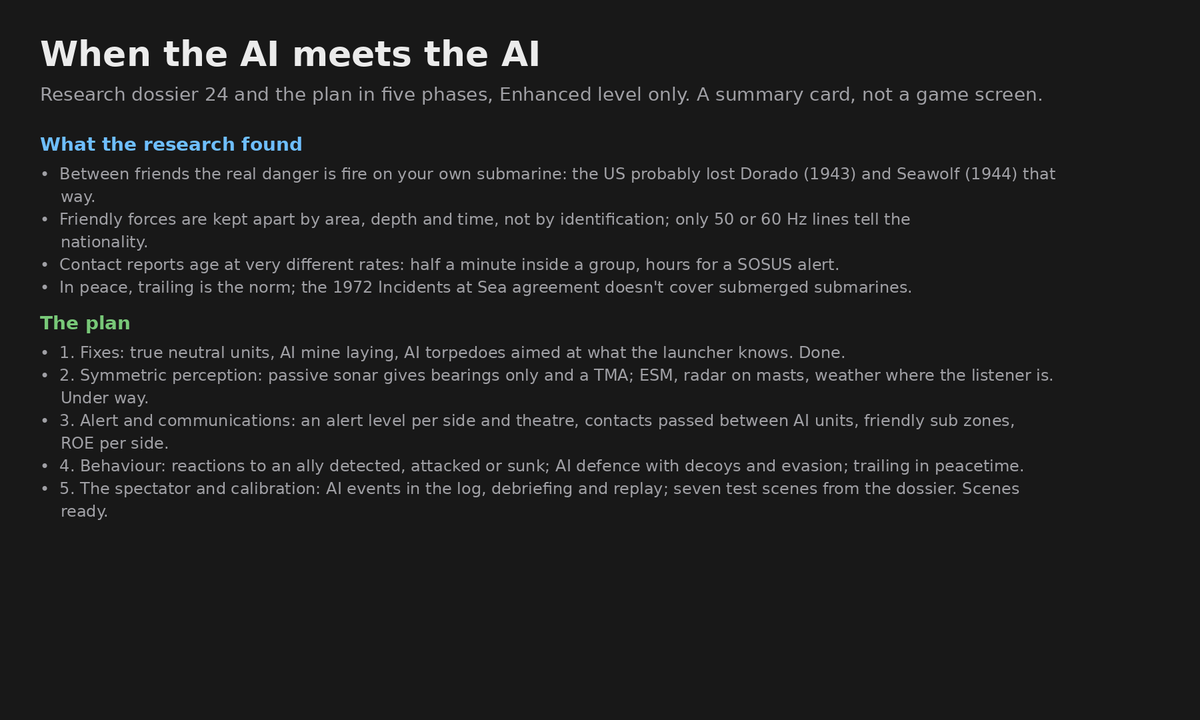
What the research found
A research agent wrote dossier 24 on how forces really behaved towards each other:
- Between friends, the real danger is fire on your own submarine, more than collision. In WWII the US probably lost the Dorado (1943) and the Seawolf (1944) this way, both inside protected zones.
- Friendly forces are kept apart by area, depth and time, not by identification: inside a friendly submarine's area only that submarine may use anti-submarine weapons. Nationality can be told only from the 50 Hz (Soviet) or 60 Hz (US) electrical lines in a boat's noise.
- The two doctrines differ: NATO separates its forces in layers, with SSNs alone in the forward areas; the Soviets coordinate mixed forces from the centre, with 1983 rules more prone to friendly fire.
- Contact reports age at very different rates, from half a minute inside a group to hours for a SOSUS alert.
- In peace, trailing is the norm. The 1972 Incidents at Sea agreement forbids simulated attacks, but doesn't cover submerged submarines.
- More alert means more detections, and many more false ones. In a 1983 exercise, out of about 300 reports only 7 were credible.
- For the game it proposes an alert level per side and theatre, contact messages between AI units with delays and errors, zones that apply to the AI as to us, reactions by peace, crisis and war, and seven minute-by-minute scenes.
Some CIA and DTIC documents couldn't be reached that day: the dossier cites them through earlier dossiers and lists the gaps.
What the code does today
At the same time the runtime session went through 16 systems to see which ones only work with the player.
- The classic level is already almost symmetric: detection and choice of target work for any pair of units. The asymmetry lies only in the scripts of the 22 original missions, which look for the player, and those stay untouched.
- At the Enhanced level, some things favour the player:
- only the player has ESM and direction finding, and sees AI periscopes;
- only the player receives contacts from aircraft and radio;
- only a launch by the player turns a crisis into war;
- the AI never defends itself from a torpedo fired by a ship or a submarine.
- Others favour the AI: from passive sonar it gets a position, where the player gets only a bearing; its torpedoes were launched at the target's true position; and the weather at the player's spot applied to every pair, however far away.
The plan, approved
1. Fixes: true neutral units (the editor wrote them as American), AI mine laying without a starting minefield, and AI torpedoes launched on what the launcher knows. Done: with an estimated position they aim at it; with a bearing only they follow it, with the head enabled at 2,000 m and the launcher's depth.
2. Symmetric perception: passive sonar gives everyone bearings only, and the position comes from a real TMA; ESM, radar against masts and sight of periscope heads for all; weather and sea computed where the listener is. Under way. The disassembler session has written its part:
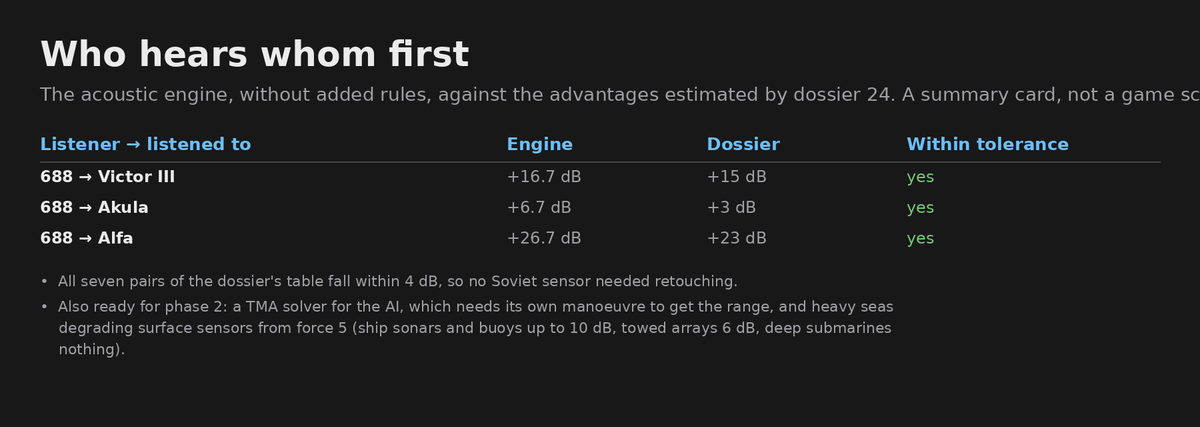
- a TMA solver that needs the boat's own manoeuvre to get the range, as for the player, finding the target within 20% of the range in tests;
- heavy seas from force 5 degrade sensors near the surface: ship sonars and buoys by up to 10 dB, towed arrays by 6, deep submarines not at all;
- a test measuring how far ahead one class hears another with the acoustic engine alone: all seven pairs of the dossier's table fall within 4 dB.
3. Alert and communications:
- an alert level per side and theatre that rises and falls with events;
- contacts passed between AI units by radio, with delays and errors;
- friendly submarine zones, with the risk of friendly fire;
- rules of engagement per side, so an AI attack can start a war too.
4. Behaviour: reactions to an ally detected, attacked or sunk; the AI defending itself with decoys, evasion and withdrawal, using weapons and wire guidance as the player does; trailing in peace and respecting the Incidents at Sea agreement.
5. The spectator and calibration:
- the spectator, already started: six new events in the mission log for launches, detections, attacks, evasions, gunfire and collisions between AI units. During the mission the crew reports launches, salvoes and collisions only when it holds a contact on whoever acts; the replay shows everything in the "truth" reading and only what was known in the player's picture;
- calibration: the editor session has turned the dossier's seven scenes into nine test missions. Today they show what's missing: AI contacts within seconds at 6–15 km, ASW aircraft that never find a submarine in two hours, escorts that sink a Victor 8–19 s after its hit on a tanker, where the dossier expects 5–15 minutes of search.
The AI will get stronger and more believable, so the Enhanced level will be calibrated again afterwards. Once the AI plays by the same rules, a "sandbox" to watch it fight on its own will follow, with settings per side, the truth or one side's picture, and statistics over many seeds.
Next: the Enhanced manual.
#688AttackSub #gamedev #submarine
688 Attack Sub Reborn #117: New Objectives, Wrecks and Practice Torpedoes
Several library missions had been built with stand-ins: a classification instead of a periscope photo, a rule instead of a zone that must stay clear, a Charlie II hovering at its maximum depth instead of a wreck. The runtime session has now built the real pieces, and the editor session has put them in the editor.
New objectives
- Photo: photograph the listed units or classes through the periscope, optionally within a maximum range.
- Inviolate zone: no ship or submarine of a given side may enter a circle. It can allow some minutes of tolerance; it fails at the first violation and is achieved at the end of the mission.
- Reach a moving unit: get within a set distance of a unit, instead of a fixed circle.
- Hit: counts hits, real or practice, even without sinking. It's what Vestfjord's "orange" Trafalgar needed.
New keys for units and missions
- Initial damage: the player's boat can start the mission already damaged, with a collision, the efficiency of single systems, and water, leaks and fires by compartment, named or by use (for example "engines"). The damage applies at the first step and shows in the Status station's report.
- A wreck: a unit with the state "wreck" rests with its keel on the bottom and hears nothing. The disassembler session gave the acoustics a "mute" source: passive sonar never hears it, but it still returns an echo to active sonar, and the MAD finds it.
- Practice weapons: declared for every weapon, for one unit's or for a single one, from the mission or from a script. A hit is recorded without damage or explosion, at both levels, with its own crew messages.
- A special sonar: a unit can carry its own active sonar, replacing its class's when it pings, optionally on a cadence, with antenna (sphere, line or hull), power, frequency and pulse.
- The scene is limited by reverberation, the echo of the sea itself, so what counts is the antenna and the pulse compression, not the power.
- With 230 dB at 3.5 kHz, a 15 m antenna and a pulse compressed to 5 ms, a Slava hears a 688's echo at 40 km, where its class sonar doesn't reach 20.
- A line array mounted on the ship does worse than the sphere: it's narrow sideways but wide vertically, so it picks up much more surface reverberation. Real systems of this kind lower it to 100–200 m.
- AI mines are now laid even when no minefield exists at the start: the bug found by the inventory of post #118.
In the editor
- Objectives: photo, inviolate zone, "reach" a unit and "hit".
- Units: initial damage, the special sonar and its antenna, the wreck state.
- Weapons: an ARMS entry for real or practice weapons, and a PRACTICE rule action that makes a unit's weapons inert or real again.
- The check reports an unknown antenna or state.
The career
The career penalty for territorial waters, announced in post #116, is in:
- each entry in peace or crisis takes 30 points off the orders score, like a breach of the rules of engagement;
- being detected inside is a diplomatic incident: 150 points off, as much as hitting a neutral ship, and a recall (a reprimand for a Soviet commander), with promotions blocked for two missions;
- detected means seen, located by radio, pinged, or warned and fired on by the ships;
- in special operations entering is the order itself, so it costs nothing and detection counts half, without a recall; in war none of this counts.
The weights are game estimates, kept in the career rules file. All tests pass and the classic level is identical (0 games out of 110).
Next: when the AI meets the AI.
#688AttackSub #gamedev #retrogaming
688 Attack Sub Reborn #116: Territorial Waters
Post #112 closed the calibration of naval gunfire with three extensions still on the list. The runtime session has now done all three, so nothing of the plan of post #87 is left open, apart from a career penalty that the disassembler session is adding.
Ships against AI submarines
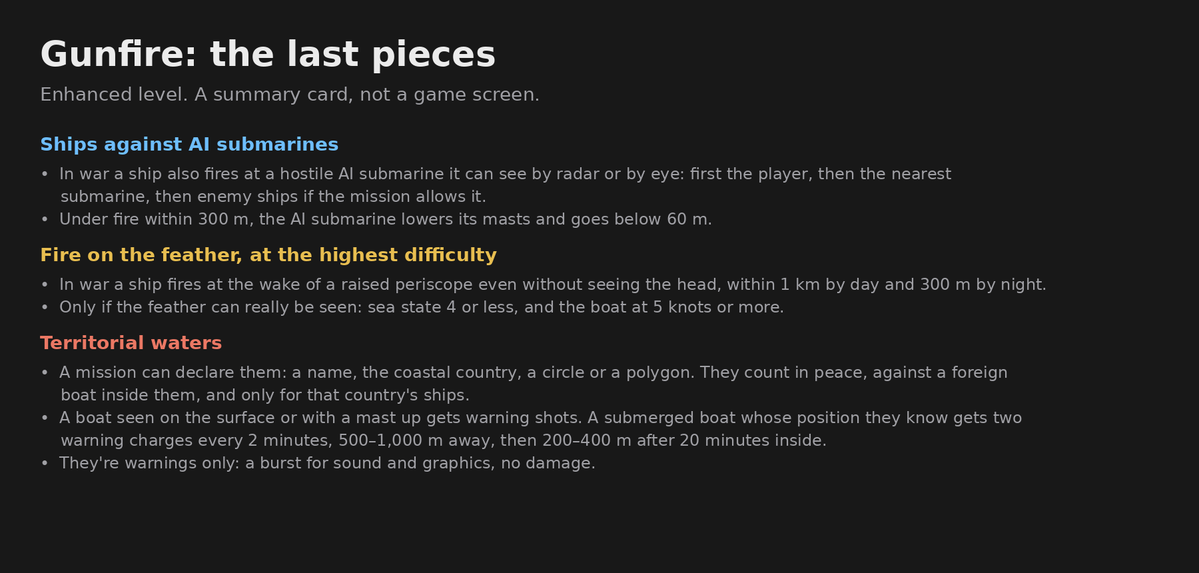
- In war a ship also fires at a hostile AI submarine it can see by radar or by eye, not only at the player.
- Its choice of target: first the player, then the nearest submarine, then enemy ships when the mission allows ships to fire at ships.
- An AI submarine under fire within 300 m lowers its masts and goes down to at least 60 m.
So when the player isn't alone, a friendly submarine caught at periscope depth near an enemy escort can now come under fire too.
Fire on the feather
- At the highest difficulty, in war, a ship fires at the wake of a raised periscope even if it hasn't seen the head itself: within 1 km by day and 300 m by night.
- Only if the feather can really be seen: sea state 4 or less, and the boat moving at 5 knots or more.
- Measuring it showed that radar usually sees the head within seconds anyway; the feather matters when radar and eyes don't.
Territorial waters
- A mission can declare territorial waters: a name, the coastal country, and a circle or a polygon.
- They apply in peace, against a foreign boat inside them, and only for the coastal country's ships.
- A boat seen on the surface or with a mast up gets warning shots.
- A submerged boat whose position they know gets two warning charges every 2 minutes, 500–1,000 m away. After 20 minutes inside, they fall at 200–400 m.
- They're warnings, not attacks: a burst for the sound and the graphics, without damage. The mission log records the intrusion, and the crew has its own messages for it.
- In the career, the disassembler session is adding a penalty for crossing into another country's waters, based on the law of the sea (UNCLOS) and on the case of the Soviet Whiskey S-363, the "U-137" aground in Sweden in 1981.
Also tuned: the BQS-15's side lobes are now at −25 dB, so outside its beam the sonar is heard at about 5.5 km, closer to the dossier's 2–4 km.
All 616 tests pass and the classic level is identical (0 games out of 110).
Next: new mission objectives.
#688AttackSub #gamedev #submarine
688 Attack Sub Reborn #115: Statistics
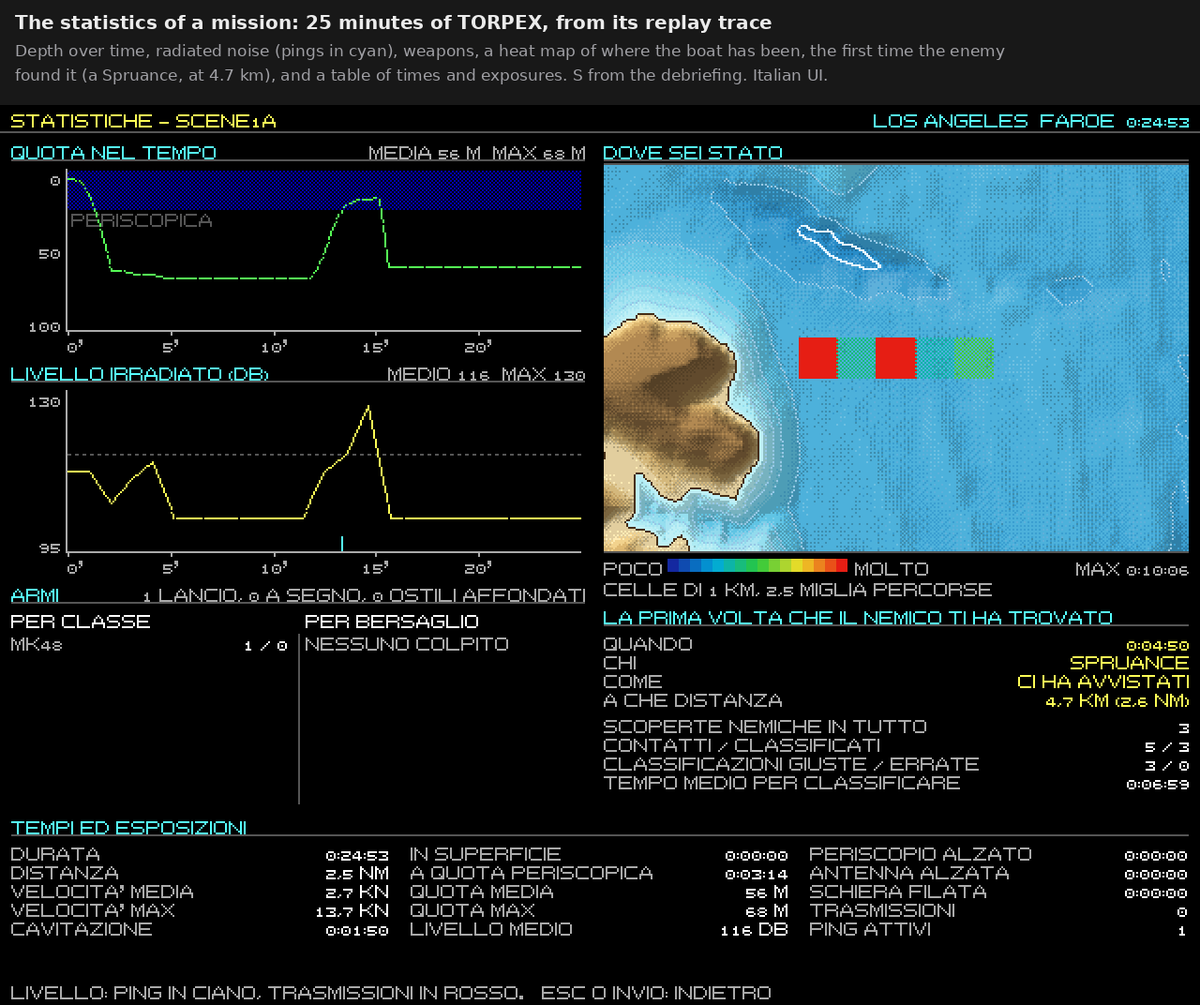
The replay trace of post #110 records the truth of every Enhanced mission. The disassembler session now reads it to build a report of how the mission was played, the editor session drew the screens, and the main session wired them into the debriefing and the roll of commanders.
The report of a mission
It's computed from the trace, so it can be rebuilt for older missions too.
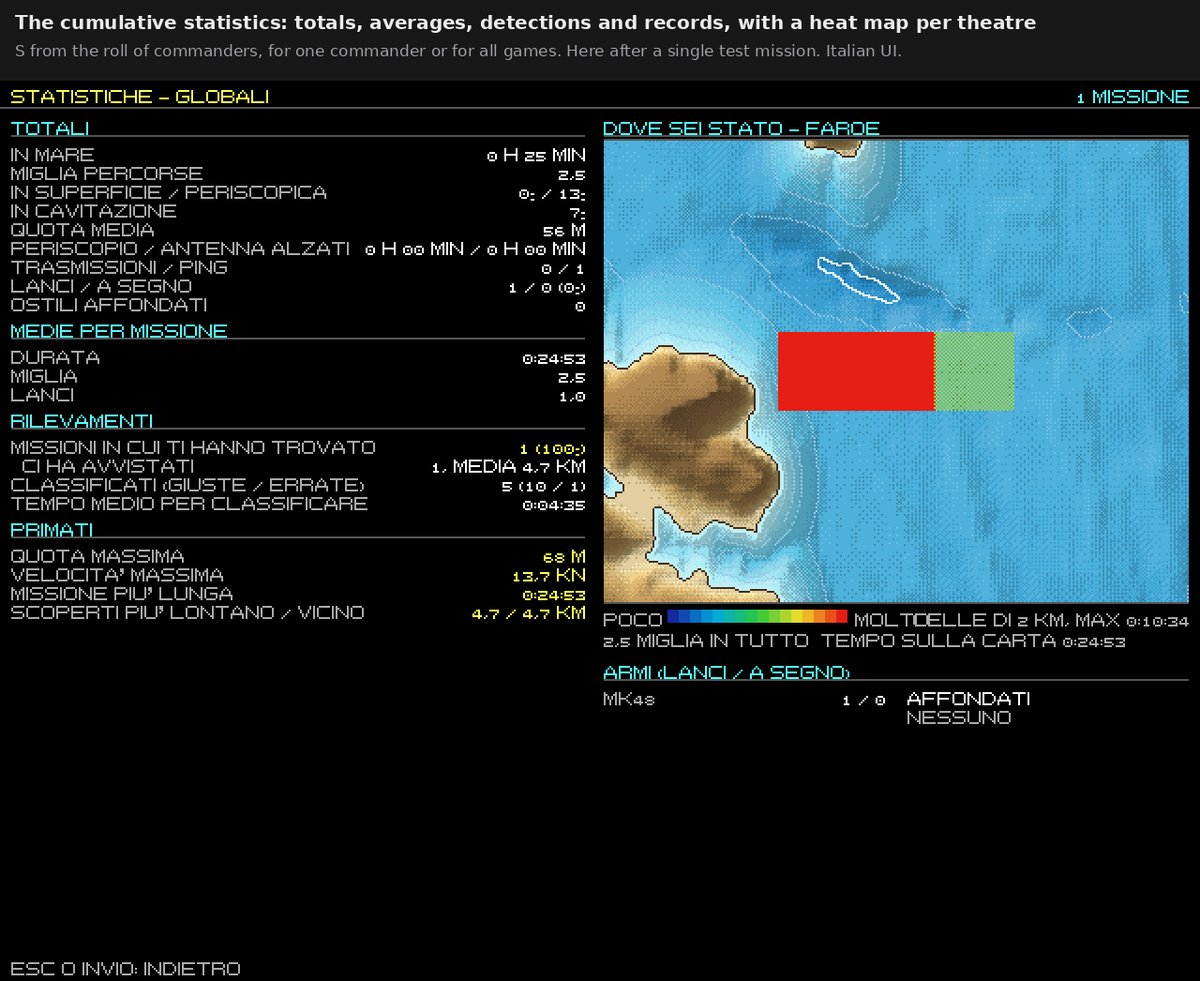
- Time: on the surface (above 2 m), at periscope depth (2–25 m) and above the cavitation speed; average and maximum depth and speed; distance run.
- Exposures: periscope, antenna, towed array, transmissions and pings.
- Weapons: launches and hits by weapon and by target.
- Detections:
- the first time the enemy found the boat: when, who, how and at what range;
- the player's own contacts, the correct and wrong classifications, and the average time to classify.
- Radiated noise: the boat's level minute by minute, worked out from its class signature at each speed and depth, with pings in cyan and transmissions in red.
- A heat map: the time spent in each square kilometre, on the theatre chart.
S from the debriefing opens it.
The cumulative statistics
- Saved at the end of each mission, for each commander and globally, with the same rules as the achievements of post #109: a resumed mission never counts, and the classic level, which records no trace, stays out.
- They hold totals, averages per mission, detections, records (deepest, fastest, longest mission, detected farthest and nearest), weapons and ships sunk, and a heat map for each theatre.
- S from the roll of commanders opens them for the chosen commander or for all games; Tab or a click on the chart changes theatre.
What the first look caught
The main session read the first report of SCENE2A and found counts that didn't add up: 5 contacts but 23 classified. Every update was counted as a classification. Now the report follows the rules of the mission outcome: the crew sonarman's classifications are kept apart, and automatic category-only ones don't count.
The game's font has no "%" sign, so the cumulative screen shows times instead of percentages. All 616 tests pass and the classic level is identical (0 games out of 110).
Next: the last pieces of gunfire, and territorial waters.
#688AttackSub #gamedev #retrogaming
688 Attack Sub Reborn #114: Nineteen Missions, and Two Old Mistakes
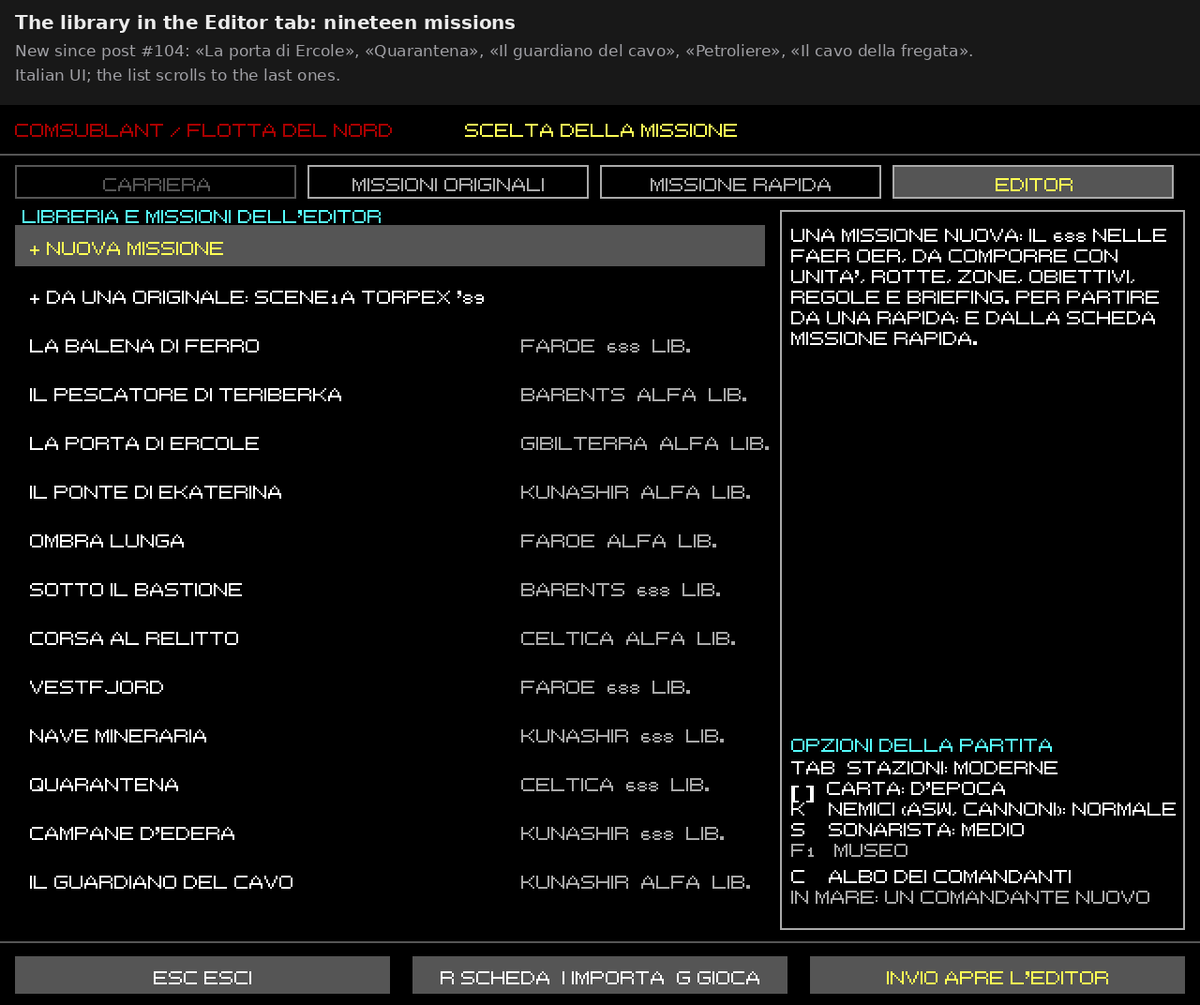
Post #104 left the library at fourteen missions. With the radio inside the mission (post #108), enemy mines, the towed array cable and tows (post #111), five more are built, and the library holds 19 of its 22.
The five new missions
- «Il guardiano del cavo» (The Cable Keeper), Alfa: an American boat rests on the bottom by the Okhotsk cable, silent to passive sonar. Only a ping within 3 km finds it; then it runs for the strait, and a FLASH orders the Alfa to force it away.
- «Quarantena» (Quarantine), 688: after four days of hunting, a Foxtrot's battery is at 6%. Ping it and hold it, and it's forced to surface; lose it for ten minutes, and it snorkels and recharges.
- «Petroliere» (Tankers), 688: an armed Mk 67 already lies on the tankers' route. When the first tanker is hit, a darkened "merchant" starts laying three more ahead of the others, and a FLASH orders the 688 to intercept it.
- «Il cavo della fregata» (The Frigate's Cable), Alfa: thirty minutes of contact astern of a Perry streaming its array, never closer than 50 m to the cable. An hour in, she turns hard.
- «La porta di Ercole» (The Gate of Hercules), Alfa: out of the Mediterranean under a container ship, past five Mk 60 CAPTOR mines in the channel; above 20 knots, a P-3C from Rota comes.
«Tenete il confine» now has a real grounding and tow, instead of a unit that stops and starts again.
Still waiting: «Acque basse, nervi tesi» for a practice torpedo, «Il disertore» for a Kilo attacking a ship of its own side, and «Lupo ferito» for a player's boat that starts damaged.
The radio in the editor
- Editor and library missions can have their own radio: the orders' header, initial rules of engagement, messages on a timer, on a condition, sent by a rule, or deceptions.
- In the editor the radio is a third view of the Briefing tab; fixed weather is on the Mission tab.
- Rules have two new actions: "radio", which sends a message, and "situation", which changes the AI's weapons.
- The 22 originals now have their messages tied to events. In SCENE4A, when the first tanker is hit, a FLASH lets the player fire on the Konis only if identified and necessary. In SCENE8A the first Soviet launch brings weapons free on Soviet submarines.
Two mistakes from 1989
The 1989 manual had two geography mistakes. They're corrected only at the Enhanced level, in the radio messages; the classic missions are untouched.
- Mission 7: a new message says the Typhoon leaves the Sea of Okhotsk bastion for the Pacific through the Ekaterina Strait, between Kunashir and Iturup.
- Mission 10: the exit messages no longer send the boat into the Øresund, but to Danish waters south of Copenhagen, in Køge Bay, and add that the Drogden (7–9 m) and Darss (18 m) sills can only be crossed on the surface. Moving the launch area to the Kattegat would need the Baltic theatre to reach that far, and a way for the Enhanced level to have its own version of a mission.
All tests pass and the classic level is identical.
Next: mission and career statistics.
#688AttackSub #gamedev #retrogaming
688 Attack Sub Reborn #113: The Alfa's Own Systems
Post #88 drew the Alfa's consoles, with controls the engine didn't have behind them. The disassembler session proposed four of them and wrote the first two, the runtime session the trim and tanks, the main session wired the panels and keys, and the kit session is drawing the last buttons. Enhanced level and Alfa only.
Boksit, course and depth
- Three modes, separately for course and for depth: manual, automatic (holding the set course and depth, as the Enhanced level already did), and program.
- In program mode the boat follows the chart's waypoints by itself, taking at each one the depth and speed set for that leg.
- Touching the rudder leaves the program.
Akkord, the combat system
- Up to three designated targets, each with its own solution; a fourth takes the place of the oldest, and lost contacts free their slot.
- The player chooses which target goes to the launch.
- If fire control drops below half efficiency, Akkord locks every weapon, as it really did: no arming, launching, settings or guidance, and armed tubes go back to just loaded. Only the mechanical reload carries on.
- It fails only from damage, never at random.
Tan, trim and tanks
- Tan, the automatic trim, brings the boat back to neutral by itself, also compensating water taken on. It switches off if the pumps drop below 50%.
- The weight changes: each weapon launched lightens the bow, 1.9 t for a torpedo, 0.3 t for a decoy, 1 t for a mine, and the hull compresses by 0.5 t every 100 m of depth below the depth where the crew trimmed it.
- SFOGA (vent) stops the blow and lets the air out of the main tanks: a full tank empties in 15 s, to stop a rise.
- COMPENSA (compensate) moves trim water in steps of ±0.5 m³, down to 15 m³ below neutral (an estimate).
- A red window lights up when air or pumps are below 50%, or a tank is torn open.
On the panels
- Boksit shows the course and depth modes and the program's leg; Akkord the three targets, the chosen one and any failure; the trim panel the Tan lamp, open vents and tank failures.
- Keys: Ctrl+B, U, T, N, G, K, J, A, 5, 6 and 7, or the buttons on the consoles.
- Every command goes through the order history, so it works in the replay and when resuming too.
Thresholds and times the sources don't give are game estimates. All tests pass and the classic level is identical.
Next: nineteen missions.
#688AttackSub #gamedev #submarine
688 Attack Sub Reborn #112: Gunfire, Calibrated
Post #106 put naval gunfire in the game with one piece left, the calibration (G7). The runtime session has now run the three test missions of the research dossier, and all three land where they should.
The three tests
- An Alfa keeps its periscope up for 30 s, 3 km from a Perry on alert. The head is hit in 58% of 200 games, and the first round arrives after 22 s (the median). Expected: about one time in two.
- A 688 surfaces 8 km from a Kara and dives as soon as the first round lands, 10 s later. It always gets under, with 0.7 direct hits on average and serious damage in 2% of the games. Expected: nearly always under before serious damage.
- A Kara and a Perry fight at 7 km, with a 688 listening submerged. The rounds are heard in 97% of the samples at 10, 20 and 40 km. Expected: a distant battle audible at the sonar.
What changed to get there
All four are estimates set by the calibration:
- Ranging fire: each gun's first three rounds carry the larger error of a first round.
- Reaction: the time to the first round varies from 0.9 to 1.7 times the gun's own.
- Battle stations: in war, a cruising ship reaches them 120 s after its first contact. Before, any contact was enough, and the Kara opened fire after 22 s.
- Battle stations at once: a mission script can now call them on a ship straight away.
Ships against ships
The third test needed ships firing at other ships. It's now a mission option, which none of the 22 originals uses.
Once the kit session applied gunfire damage to ships too, the Perry sank the Kara of that test before it could answer. The cause was one 76 mm hit setting off the magazine, which broke the ship in two after 18 seconds: shells had the same 4% chance per hit as missiles. Now the chance grows with the charge, about 0.1% for a 76 mm, 0.6% for a 5-inch and the full 4% for a 16-inch. In the kit's run the Kara takes 40 hits of 76 mm, ships about 700 t of water, fights two fires, floods a magazine to put one out, and stays afloat.
The classic level is identical (0 games out of 110).
Next: the Alfa's own systems.
#688AttackSub #gamedev #submarine
688 Attack Sub Reborn #111: Mines, Cables and Tows
The last library missions asked for things the engine didn't have: enemy mines, a mine-hunting sonar, a towed array cable to get caught in, and a boat aground to be towed away. The runtime session built them, and the main session put the controls and warnings on the stations.
Enemy mines
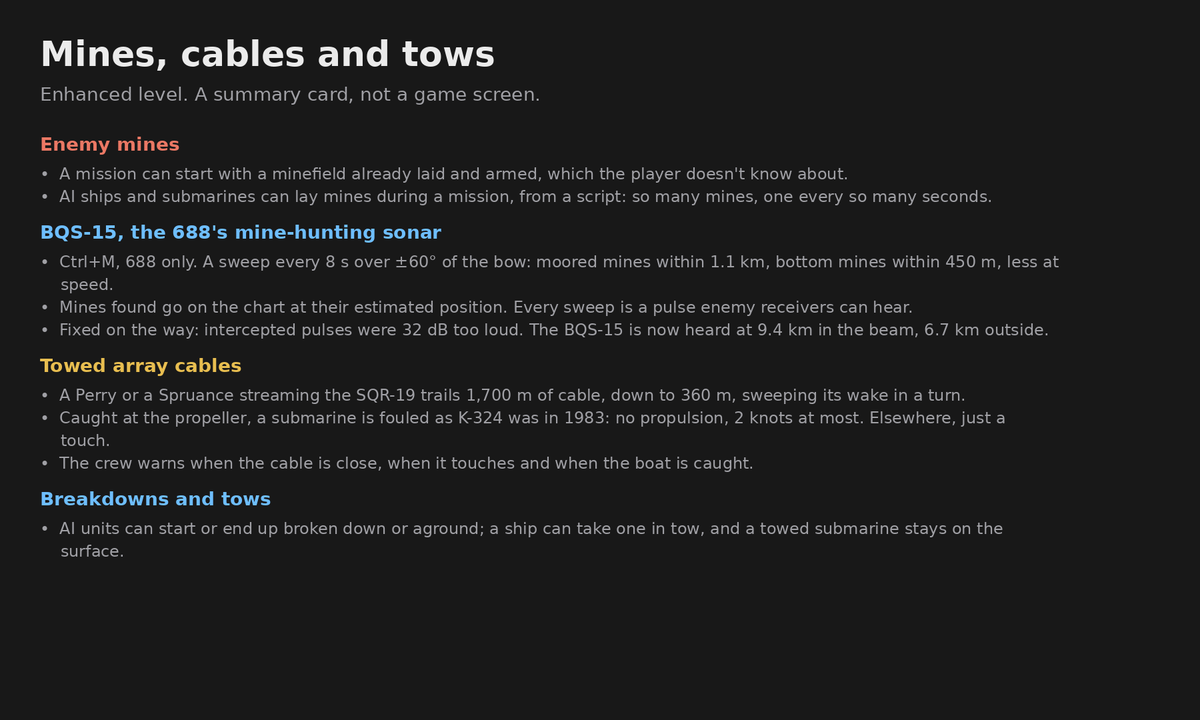
- A mission can start with a minefield already laid and armed. The player doesn't know about it, and it doesn't appear among the events.
- AI ships and submarines can lay mines during the mission, from a script: how many, and one every how many seconds. The log records them without the player knowing.
- In the test a tanker blows up on an armed Mk 67, and a hostile merchant lays three MDT mines, one every 30 seconds.
The BQS-15
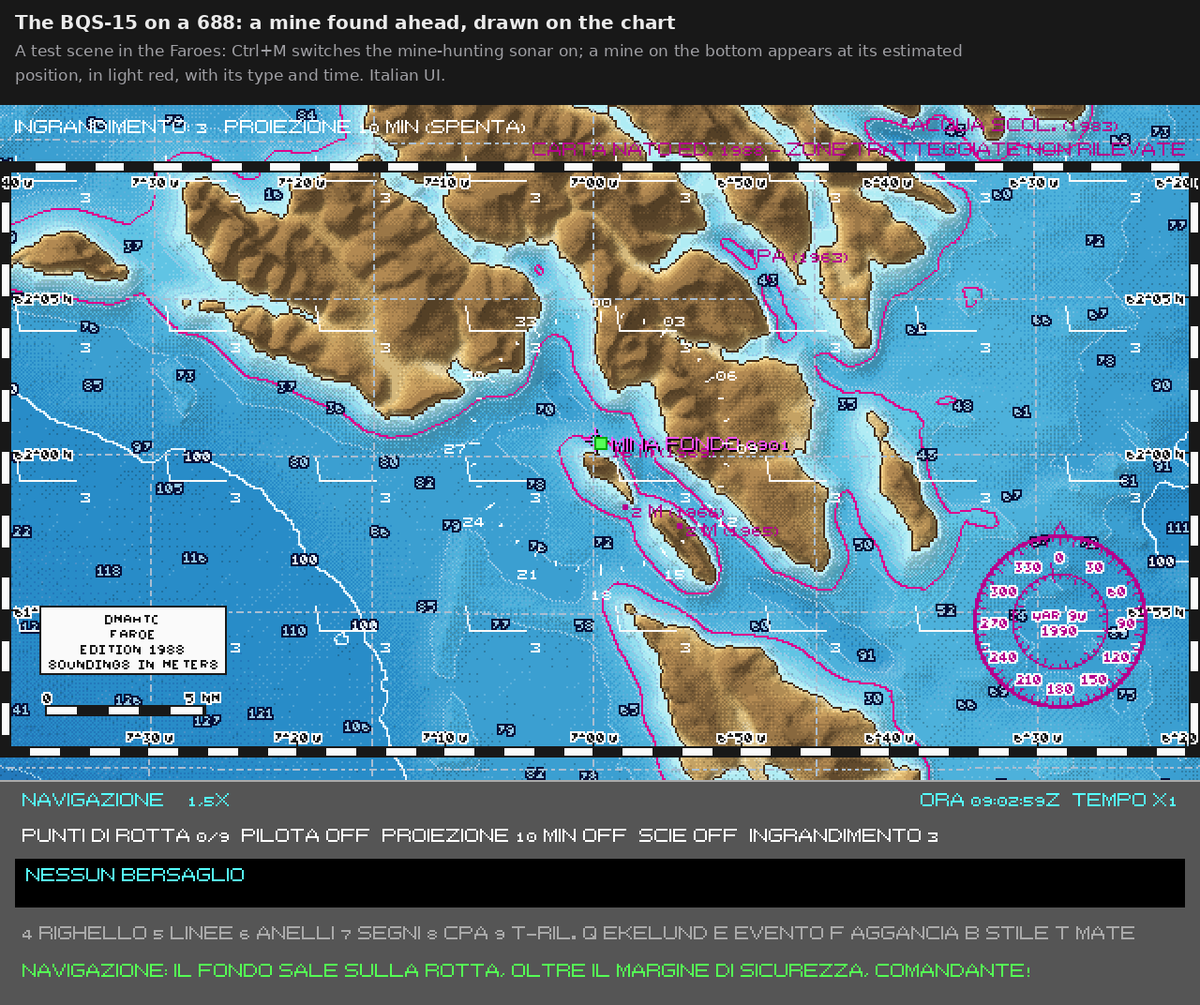
- The 688's mine-hunting sonar, on Ctrl+M, only on the 688 and only at the Enhanced level.
- Every 8 s it sweeps ±60° off the bow. It sees moored mines within 1.1 km and bottom mines within 450 m; at speed the range drops, by 30% at 15 knots and 60% above 20.
- Mines it finds go on the chart at their estimated position, so with a small error, in light red with their type and time. The crew reports "mine ahead".
- Every sweep is a pulse that enemy receivers can hear.
Measuring it turned up two errors in the acoustics, fixed by the disassembler session. A short active pulse was treated as continuous noise filling the whole band for a full second, about 32 dB too much for a 10 ms pulse at 25 kHz. And the intercept receivers, the American WLR-9 and the Soviet Enisej, had 24 dB of antenna gain, as if they were small directional arrays rather than nearly omnidirectional hydrophones. Now the BQS-15 is heard at 9.4 km in its beam and 6.7 km outside it, against the 8 and 2–4 km of the dossier, which assumes warmer water than the Faroes in winter. The fix applies to every active ping heard by a passive sensor.
Towed array cables
- A Perry or a Spruance streaming the SQR-19 trails 1,700 m of cable, down to 360 m deep. The cable follows the ship's wake, so in a turn it sweeps the water behind her.
- If it catches a submarine's stern at the propeller, the boat is fouled, as the Soviet Victor K-324 was in 1983: no propulsion and 2 knots at most. The bang is heard at the sonar, and the ship loses its array but hears the boat.
- Anywhere else on the hull it's just a touch, without damage.
- The crew warns when the cable is close, when it touches, and when the boat is caught.
Breakdowns, groundings and tows
- An AI unit can start broken down or aground, or end up so: broken down, it stops and now and then makes repair noises.
- A ship can take it in tow, with the cable taut along the wake; a towed submarine stays on the surface.
- Scripts and the editor can use all of it.
All tests pass and the classic level is identical (0 games out of 110).
Next: gunfire, calibrated.
#688AttackSub #gamedev #submarine
688 Attack Sub Reborn #110: The Full Replay
Post #86 rebuilt a game from the player's own orders to resume it from a key moment, but rebuilding takes time: 170 s for 1,600 s of mission. Now every Enhanced mission records a light trace of itself, and a replay screen scrolls through it like a video.
The trace
- A frame every 5 seconds, every 2 for aircraft and weapons in the water, and one at every mission event.
- Each frame holds:
- the truth: position, course, speed and depth of every unit, the destroyed ones, raised masts, weapons in the water with their wires;
- the player's picture: contacts, bearing lines and the TMA solution;
- the state of the sonar and the stations.
- The events are saved with their type, their text in Italian and English, how interesting they are, whether the player knew of them at the time, and the unit involved.
- Small: two hours with 45 units take 1.28 MB, and 600 s of TORPEX take 20 KB.
- Built to last: the file is read by field name, so it stays readable after engine updates, and a damaged piece is skipped without losing the rest.
- Recording doesn't change the game, and the classic level is identical.
- A career mission keeps the name of its replay in the personnel file; outside the career the last 20 are kept.
The screen
- P from the debriefing opens it.
- The theatre chart, as in the editor, with two readings on V:
- "truth": every unit in its side's colour, the last 5 minutes of tracks, weapons in the water, raised masts;
- "player's picture": contacts by letter at their estimated position, bearing lines, the proposed TMA solution, own weapons in yellow.
- On the right the latest events, and a depth profile in metres with the boat in green, the target in red and the thermoclines.
- The timeline has a mark for each event. In the player's picture only the events the player knew of at that moment appear.
- Controls:
- P plays and pauses, from 1× to 64×;
- the arrows jump 30 s;
- Tab goes to the next event, Shift+Tab to the previous one;
- a click on the line jumps there;
- Enter resumes the game from the chosen moment.
- A resumed game records during the rebuild too, so its trace covers the whole timeline, with a mark where the player takes command again.
A message log
Also at the Enhanced level, no crew message gets lost any more:
- Messages queue and each stays in the bar for a time that depends on its length; urgent warnings, the ones with "!", go first.
- Long messages wrap onto two lines instead of being cut.
- Ctrl+L opens the message log from any station, with the mission time beside each line and urgent warnings in yellow.
All tests pass and the classic level is identical.
Next: mines, cables and tows.
#688AttackSub #gamedev #retrogaming
688 Attack Sub Reborn #109: Achievements and a Hall of Fame
The career of posts #53–#68 gave the player ranks, medals and a personnel file, and post #91 a roll of commanders. What it didn't have was a record of how each mission was played. The disassembler session wrote the rules, the kit session drew the medallions, and the main session built the screens.
41 achievements
- Six categories, plus four hidden ones: tactical, stealth, technical, historical, career and editor.
- Many have three levels, bronze, silver and gold.
- Some examples:
- Ghost: a mission won without ever being located;
- Silence in the Barents: a Barents mission won without pinging or transmitting;
- One torpedo, one target: every launch a hit;
- The missions of 1989: completing the originals;
- For valour: the highest decorations of the two navies;
- Shared codes: playing quick missions from different codes.
- They come from what the game already records at the end of a mission: the events in the mission log, the outcome and the commander's file.
- Each commander has their own, and there are global ones across all games. A mission resumed with "Resume from here" (post #86) counts for neither. Global ones also count missions outside the career.
- Only what a mission really earns counts. The short career, which starts already in command, used to award "In command", "Dolphins" and "Decorated" at the first mission, from the rank and decorations it starts with. Now the rules compare the file before and after the mission.
The medallions
- One for each achievement, in relief metal like the decorations of post #59.
- The enamel follows the category: red for tactical, night blue for stealth, green for technical, light blue for historical, white for career, purple for editor, black for hidden.
- The rim shows the level: plain bronze, beaded silver, beaded gold with a small star.
- Symbols such as a torpedo, a submarine in the crosshairs, a mine, a 5.25" floppy disk, dolphins and stripes.
- Not yet earned, a medallion is dull grey; a hidden one shows a "?".
The screens
- The board opens with B from the roll of commanders: seven tabs by category, and the chosen medallion's detail with date, mission and progress ("2 of 5"). G switches between the commander and the player.
- "New achievements" appears after the outcome of a mission, with the levels gained and a note when the mission was outside the career.
The hall of fame
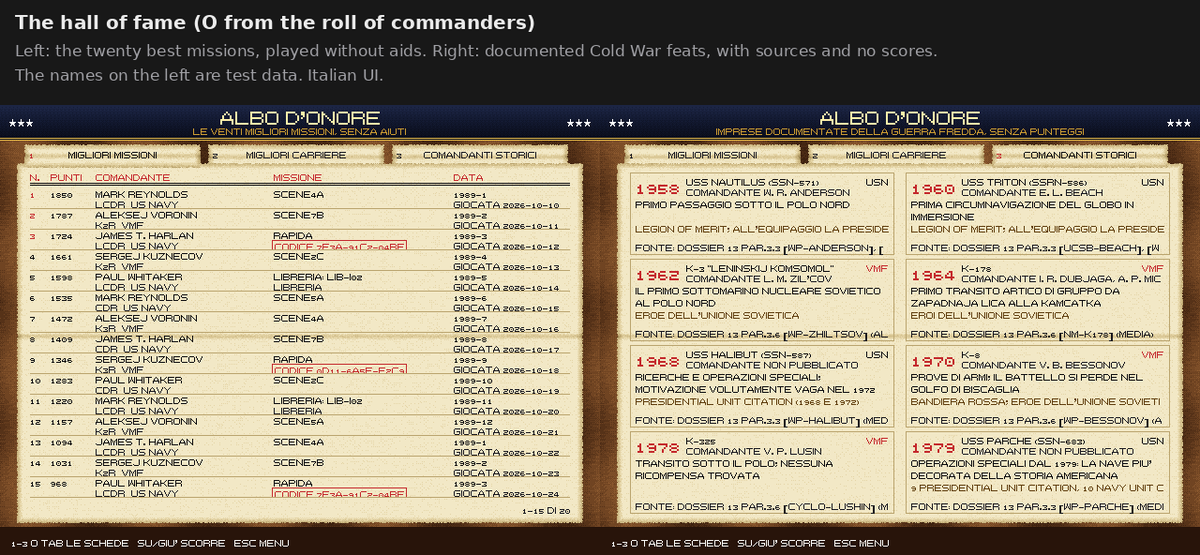
It opens with O from the roll of commanders, next to the board (B) and the personnel file (F), and has three tabs:
- the 20 best missions, only those played without aids and never resumed. Quick missions keep their code, so they can be played again;
- the 10 best closed careers, fallen commanders included, each with its highest decoration;
- eight documented feats of real submarines, with source and reliability, no scores and no words put in real people's mouths: Nautilus, Triton, Halibut, Parche, K-3, K-178, K-325 and K-8.
Achievements about the towed array, navigation and a mobile decoy fooling a torpedo are still to come: the mission log doesn't record what they need yet.
Next: the full replay.
#688AttackSub #gamedev #retrogaming
688 Attack Sub: il DOS del 1989 contro l'Enhanced | Prima e dopo (remake... https://t.co/XQKqfz0oUX via @YouTube
Nel 1989 un sottomarino nucleare stava in 320 per 200 pixel. Gli ordini scorrevano sulla telescrivente, e un siluro a segno era una riga di testo: "A TORPEDO HAS REACHED ITS TARGET". Il resto lo metteva la fantasia.
Trentasette anni dopo, "688 Attack Sub - Edizione Enhanced", remake amatoriale e non commerciale del simulatore di John W. Ratcliff, lo ha rifatto da zero. Questo è il trailer di tutto il lavoro fatto finora: cinque minuti e mezzo di prima e dopo.
IL 1989 È QUELLO VERO
Il lato del 1989 è il gioco DOS originale, girato nell'emulatore DOSBox Staging dai file del 1989 e catturato senza ritocchi, codice di sicurezza del manuale compreso. Ogni confronto accosta la stessa funzione: la stazione sonar del 1989 alla stazione sonar di oggi, la carta alla carta, il periscopio al periscopio. Il lato di oggi sono immagini del motore del remake, in grafica VGA a 256 colori.
PRIMA / DOPO
- Missioni: 10 missioni e 22 scenari da una tabella / le 22 originali, 19 missioni della libreria, missioni rapide da un codice, editor
- Ordini: testo sulla telescrivente / sala briefing con la carta del teatro, forze, livelli, meteo
- Radio: il codice di sicurezza e l'archivio dei messaggi / VLF, HF e satellite secondo antenna e quota, ordini e ROE che cambiano
- ESM: nove riquadri e un livello / WLR-8 con 26 radar in banca dati, identificazione, tendenza, rischio
- Sonar: la carta e un analizzatore a dodici barre / cascata SDR a 72 fasci, LOFAR, DEMON, equazione del sonar, raggi tracciati
- Carta: fondale a colori piatti / carta NATO 1988 con le isobate, TMA con lo strumento MATE
- Periscopio: una sagoma sull'orizzonte / Type 2 e Type 18 con l'oculare, elevazione, stadimetro, onde vere
- Plancia: telegrafo a 7 posizioni / barra in gradi, nove campane, spinta, idroplani, cavitazione
- Armi: quattro tubi armati in 20 secondi / sala siluri col carico posto per posto, testa, RTE, ricarica vera
- Stato: sei sistemi, OK o guasto / dodici sistemi con le riparazioni, spaccato con falle, fuoco, paratie
- Il colpo: una riga di testo / la bolla che solleva e spezza la nave, dalla fisica dei danni
- L'esito: un messaggio del comando / debriefing con le minicartoline, rapporto, decorazioni, carriera
- L'Alfa: la stessa interfaccia in finto cirillico / sonar sovietico, carta sovietica 1987, testi leggibili
QUELLO CHE NEL 1989 NON C'ERA
Editor di missione, missioni rapide da un codice di 13 caratteri, una libreria di 19 missioni ispirate alla Guerra Fredda (diesel che emergono a batteria scarica, cavi delle schiere, campi di mine CAPTOR, sottomarini rimorchiati), mine, ASW aereo, meteo e mare, artiglieria contro il periscopio, il Museo con 193 voci e le fonti, il replay con la verità o il quadro del comandante, carriera, decorazioni e albo d'onore, danni per compartimento, l'emersione d'emergenza.
Da dove vengono le immagini: le esplosioni sulle navi e la battaglia sono girate nella scena di prova del motore; l'ASW aereo viene dalle anteprime del kit; meteo, pioggia e artiglieria dalle anteprime del periscopio; l'emersione d'emergenza è resa con il codice del motore. Il titolo originale col logo non compare.
E il classico resta, identico all'originale.
CAPITOLI
0:00 1989
0:24 37 anni dopo
0:48 Prima e dopo: missioni, ordini, radio
1:15 ESM, sonar, carta, periscopio
1:51 Plancia, armi, stato
2:18 Il colpo, l'esito, l'Alfa
2:48 Quello che nel 1989 non c'era
4:00 Ascolta, trova, colpisci, sopravvivi
4:12 Battaglia
5:00 Il classico resta
MUSICA
"Prezhde i posle" (Prima e dopo), tema originale per coro maschile in lingua russa, scritto per questo trailer: nasce dall'onda quadra di un computer del 1989, il coro lo prende e lo porta per cinque strofe, poi una marcia d'ottoni e la battaglia; nella coda l'onda quadra torna da sola. Non usa musiche dell'originale né di film. Suoni: banco MuseScore General (licenza MIT) - adattamento di S. Christian Collins (c) 2018-19; FluidR3 di Frank Wen (c) 2000-02; FluidR3Mono di Michael Cowgill (c) 2014-17; Temple Blocks di Ethan Winer (c) 2002; Drumline Cymbals di Michael Schorsch (c) 2016.
AVVERTENZA
Progetto amatoriale e non commerciale, non affiliato a Electronic Arts né ai titolari dei diritti. "688 Attack Sub" (1989) è un marchio dei rispettivi proprietari ed è citato solo come opera a cui il remake rende omaggio. Le immagini del 1989 sono riprese del gioco originale a scopo di confronto; il remake non distribuisce i file dell'originale.
#688AttackSub #PrimaEDopo #Retrogaming #SimulatoreDiSottomarini #GuerraFredda #GiochiDOS #VGA #RemakeAmatoriale
Thanks to @whyamas for accepting my project "688: Attack Sub Enhanced" onto his fascinating website - a collection of projects that have been reverse-engineered with the help of AI models. Truly compelling stuff!
688 Attack Sub Reborn: 22 new missions
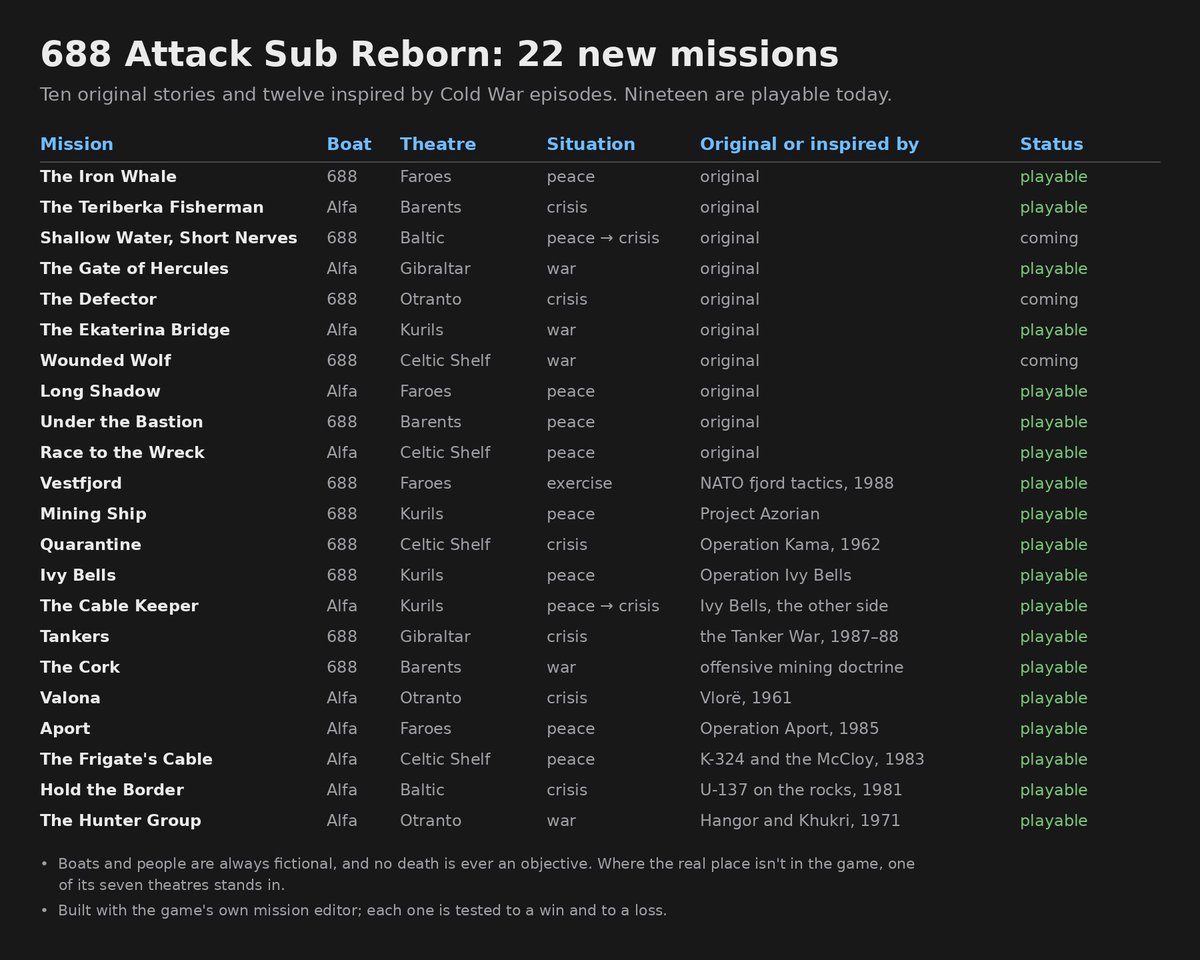
The remake of EA's 1989 sub sim is getting a library of ready-made missions, built with the game's own mission editor: half for the 688, half for the Soviet Alfa. Ten are original stories, twelve are inspired by real Cold War episodes. Boats and crews are always fictional, no death is ever an objective, and where the real place isn't in the game, one of its seven theatres stands in.
15 are playable today. The other 7 arrive as the engine gains the pieces they need.
ORIGINAL STORIES
The Iron Whale (688 · Iceland–Faroes ridge · peace · playable)
SOSUS has a quiet seven-bladed screw that matches nothing in the archive. Find it, record 40 minutes of its signature, stay unseen. Then it does a Crazy Ivan, and you learn there were two boats all along: the noisy one was bait, and now you're the one being followed.
The Teriberka Fisherman (Alfa · Barents, polar night · crisis · playable)
A Typhoon comes home after 90 days under the ice, and a "Norwegian" trawler keeps fishing right on its route into the bastion. Escort the Typhoon in, find the American sub hiding nearby, and check every order you receive: one of them is fake.
Shallow Water, Short Nerves (688 · Baltic · peace, then crisis · coming)
Shadow a Soviet and East German exercise in 25 m of water, in a boat whose sail alone is 9 m tall. An hour in, a Kilo's practice torpedo loses its target and locks onto you. Dodge it like a real one and you give yourself away. Or trust that it's inert.
The Gate of Hercules (Alfa · Strait of Gibraltar · war · coming)
The war is 36 hours old and the Mediterranean is a trap. The fastest sub afloat has to slip into the Atlantic slowly, hiding under the screws of a 100,000-ton container ship. Halfway through the strait, the sonarman hears the hydrophones of a NATO minefield.
The Defector (688 · Strait of Otranto · crisis · coming)
A Soviet survey ship asks for asylum on the open radio and runs for Brindisi, a Krivak behind her. Get her into Italian waters without starting a war. The Krivak isn't the real threat: a Kilo waits on her route, with orders to make it look like an accident.
The Ekaterina Bridge (Alfa · Kurils · war · playable)
Two Los Angeles boats try to force the strait into the Sea of Okhotsk, the Soviet Pacific bastion. Hold the door, knowing that whoever holds a door can't chase whoever runs. Then a US carrier group appears to the south-east.
Wounded Wolf (688 · Celtic Shelf · war · coming)
You sank a Victor III, but its last torpedo flooded your engine room. Twelve knots at most, 240 miles to Brest, a Krivak barrier in between and an autumn gale overhead. Then an Oscar opens its missile doors, aimed at a convoy. You have two torpedoes left.
Long Shadow (Alfa · north of the Faroes · peace · playable)
The longest day of the year, a flat calm, and a NATO carrier group on exercise. Slip inside the screen, record the Nimitz's screws from under five miles, photograph her and get home unseen. In a sea like this a periscope shows from ten miles away.
Under the Bastion (688 · Barents, polar night · peace · playable)
A satellite has spotted a new ship at Zapadnaya Litsa with a bow dome no analyst can read. Go where no American sub should be, identify her on her sea trials and get out unseen. Her new sonar may hear you from thirty miles.
Race to the Wreck (Alfa · Celtic Shelf · peace · playable)
A Soviet sub lies sunk on the edge of the Celtic Shelf, codes aboard. Guard it until the rescue ship comes, against an American sub and a "research" ship. No weapons: only active sonar, speed and the nerve to pass under someone's keel.
INSPIRED BY REAL COLD WAR EPISODES
Vestfjord (688 · a Faroese fjord · exercise · playable)
NATO wants to hide a carrier in a fjord, and someone has to clear it first. A Trafalgar plays the Soviet sub, waiting at the mouth. Steep walls, a rising bottom, and the carrier arrives early. The easiest mission of the library. Inspired by NATO's fjord tactics of the 1980s.
Mining Ship (688 · Kurils · peace · playable)
A ship has been "mining manganese nodules" over the deepest basin for nine days. Guard her without being told from what, while a Soviet tug parks two hundred yards away. You win by staying silent. Inspired by Project Azorian.
Quarantine (688 · Celtic Shelf · crisis · coming)
A blockade, and Soviet diesel boats heading south. Washington doesn't want them sunk: it wants them on the surface, flag and all. Hold contact until the battery runs out, without firing a shot. Inspired by the Foxtrots of 1962.
Ivy Bells (688 · Kurils and the Sea of Okhotsk · peace · playable)
Slip through the Kurils into the Sea of Okhotsk, settle over a Soviet cable on the bottom and stay still for two hours while the divers swap the tapes. Then a Soviet ship stops right overhead. One of the four hardest in the library. Inspired by Operation Ivy Bells.
The Cable Keeper (Alfa · Sea of Okhotsk · peace, then crisis · playable)
Ivy Bells from the other side: something is on the Okhotsk cable. Escort the rescue ship and find the intruder, an American boat resting on the bottom, silent to any passive sonar. Only a ping finds it, and then the radio changes your orders.
Tankers (688 · Strait of Gibraltar · crisis · coming)
Escort three reflagged tankers through a strait at night, from below. A darkened "merchant" crosses the convoy, stops, starts, stops again. Nobody admits to laying mines. Then the first tanker hits one. Inspired by the Tanker War of 1987–88.
The Cork (688 · Barents · war · playable)
The war starts at dawn. Lay ten Mk 67 mines along the exit channel of the Kola Gulf and leave before they arm and the Northern Fleet wakes up. While your tubes reload, an Akula comes out of the channel. Let it pass, or wake the Krivaks?
Valona (Alfa · Vlorë Bay · crisis · playable)
The host country has broken with Moscow. Lead a support ship and four Foxtrots out of the bay, while four more are "detained" at the piers and NATO watches from outside. Nobody wants to shoot. Inspired by the Soviet withdrawal from Vlorë in 1961.
Aport (Alfa · Iceland–Faroes gap · peace · playable)
Cross the gap under SOSUS. Every sprint over twenty knots is a report to Keflavík and an Orion overhead an hour later. Sprint, drift under the layer and let the datum go stale. Inspired by Operation Aport, 1985.
The Frigate's Cable (Alfa · Celtic Shelf · peace · coming)
Tuck into the deaf cone astern of a Perry towing a new sonar array and record it for thirty minutes. Not too close: a kilometre of steel cable trails behind her. Then she turns hard. Inspired by K-324 and USS McCloy, 1983.
Hold the Border (Alfa · Baltic · crisis · playable)
A Soviet diesel sub has run aground inside a neutral country's waters. Wait just outside the 12-mile line, unseen, and cover her home once she's towed out. One step over the line and the crisis becomes something else. Inspired by U-137, 1981.
The Hunter Group (Alfa · Strait of Otranto · war · playable)
Two frigates and a helicopter have hunted you for six hours. Then one slows to twelve knots to test her new sonar, and for a few minutes she's the prey. Opportunity or bait? Inspired, as doctrine only, by the 1971 Hangor and Khukri.
Every mission is tested to a win and to a loss, and each can be opened in the editor to see how it's made.
What do you think? Which of these could be your favourite/most interesting one? @ARRGETSTUFFED@ChrisSPITZER7@Mountain_Navy@RewindStephan@ringohrani@jwestonharvey@oldyzach
#688AttackSub #gamedev #retrogaming
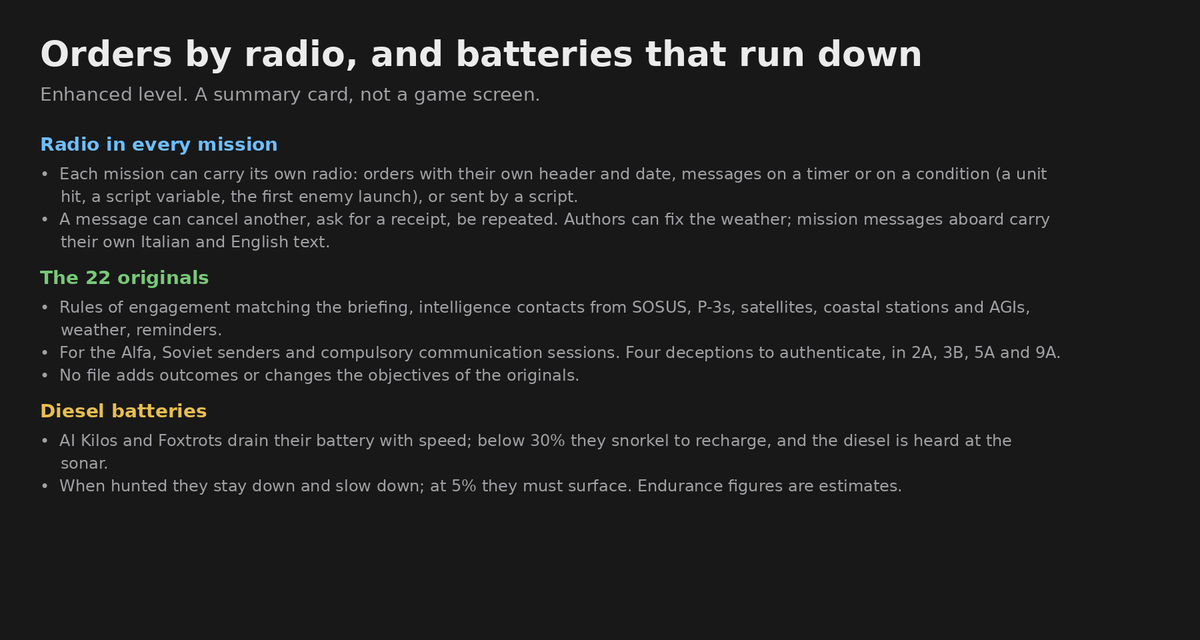
688 Attack Sub Reborn #108: Orders by Radio, and Batteries That Run Down
The radio room of post #39 had the broadcast, the schedule and the risks of transmitting, but few messages written for each mission. Several library missions also waited for radio orders that change the situation. The runtime session has now built the radio inside the mission, and the editor session has written the traffic for the 22 original missions.
The radio of a mission
- Each mission can carry its own radio: the mission orders with their own header and date-time group, and messages on a timer.
- Messages on a condition go on the air the first time it's true: a unit hit or out of the game, a script variable, a transmission, an event in the mission log such as the first enemy launch.
- Scripts can send a message with https://t.co/UjvKEEmJVL(u, "ID").
- A message can cancel another, ask for a receipt (missed receipts show in the radio debriefing) and be repeated.
- The author can fix the weather, and it holds even with simplified weather in the options.
- Messages aboard written for the mission have codes from 1000 up, with Italian and English text in the file itself. They don't touch the game's shared table and never end the mission.
The 22 originals
- Every file has rules of engagement matching the briefing, with neutral units named, and intelligence contacts on the real units: SOSUS, P-3s, LAMPS and satellites for the 688; coastal stations, AGIs, Il-38s and Tu-95s for the Alfa.
- Also the theatre's weather, a few reminders about the rules of engagement and, for the Alfa, Soviet senders and compulsory communication sessions every 5 or 10 minutes, which count in the debriefing.
- Four deceptions to authenticate, in 2A, 3B, 5A and 9A. They do nothing by themselves: whoever believes one harms only themselves. In SHAKE 'EM a false FLASH says the Alfa has broken off the trail and orders a flank-speed transit: whoever doesn't check the authentication runs, and gets heard.
- No file adds outcomes or changes the objectives of the originals.
- In TORPEX an IMMEDIATE from CINCLANTFLT warns of a possible Soviet submarine near the range: not an exercise target, do not engage.
- More messages tied to events are being added now that the loader reads conditions, such as the Konis attacking after the first shot in 4A, or weapons free at the first Soviet launch.
Diesel batteries
- The AI's Kilos and Foxtrots now drain their battery according to speed.
- Below 30% they come up to periscope depth to recharge with the diesel, and the diesel can be heard at the sonar.
- When hunted they stay down and slow down to save power; at 5% they are forced to surface, and the mission log records it.
- The endurance figures are estimates, and a mission can set each boat's initial charge.
This opens the library's historical «Quarantena»: holding contact with a Foxtrot until its battery forces it up.
All 571 tests pass and the classic level is identical (0 games out of 110).
Next: achievements and a hall of fame.
#688AttackSub #gamedev #submarine
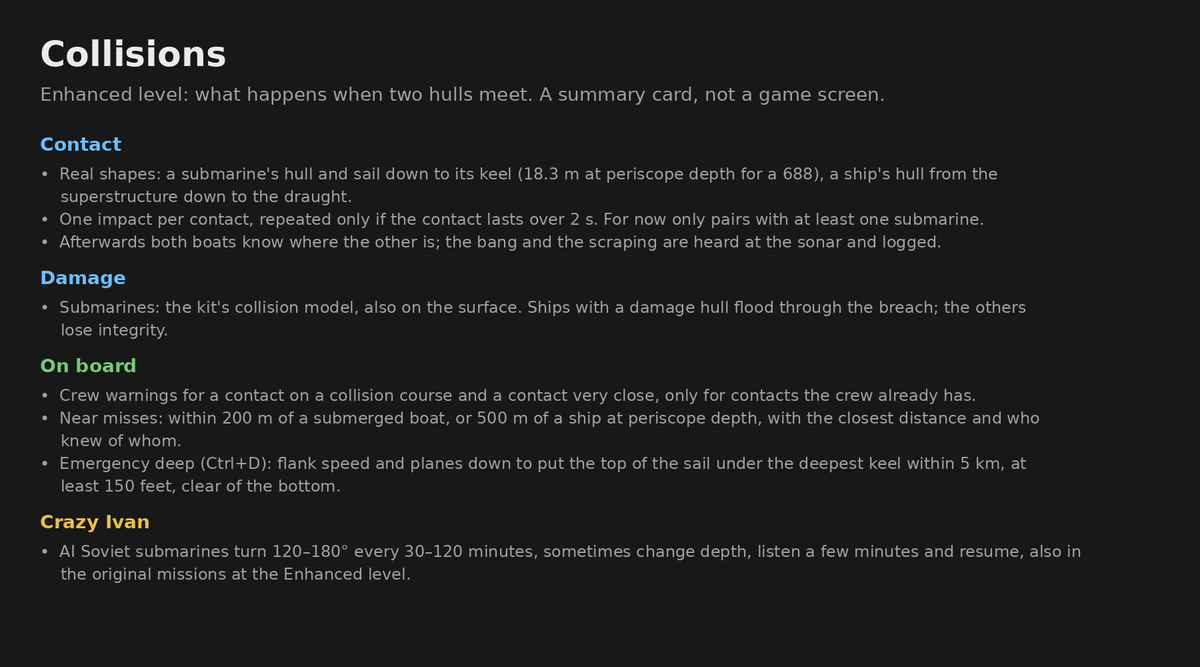
688 Attack Sub Reborn #107: Collisions
The kit session had already written the damage of a collision, tested on twelve historical cases, and the disassembler session its sounds. Now the runtime session has wired it all into the mission, and the main session into the player's stations. Enhanced level only; the classic level is identical.
The impact
- The mission detects the contact with the classes' real shapes:
- for submarines the hull and the sail, down to the real keel (at periscope depth, 18.3 m for a 688);
- for ships the hull, from the superstructure down to the draught.
- One impact per contact, repeated only if the contact lasts more than 2 s, and judged with the kit's damage model.
- After the impact both boats know where the other is. The bang and the scraping are heard at the sonar, and the mission log records the collision.
- For now only pairs with at least one submarine count: ships don't collide with each other yet.
The damage
- Submarines take the kit's collision damage, also on the surface. A surfaced, damaged boat floods through its breach like a ship.
- Ships with a damage hull take the impact in their compartments; the others lose integrity in proportion and are destroyed if it reaches zero.
Near misses
The player's near misses are recorded: passing within 200 m of another submerged boat, or within 500 m of a ship at periscope depth. For the debriefing the log keeps the closest distance and whether each of the two knew of the other.
On board
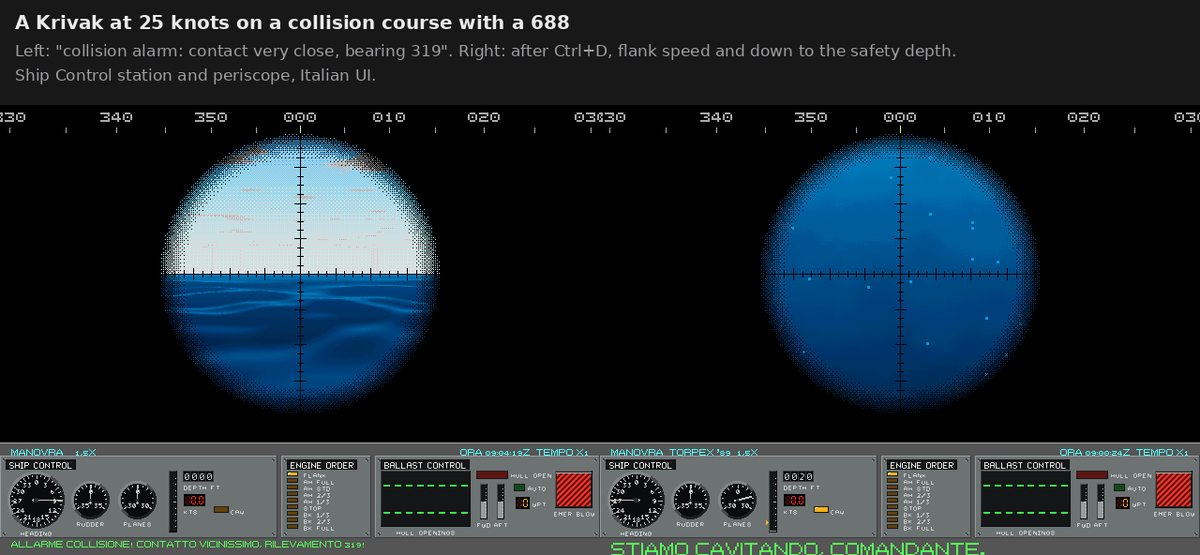
- Crew warnings: a contact on a collision course, and a contact very close, only for contacts the crew already holds. Then the near misses, telling apart those with a unit nobody had heard.
- Emergency deep, Ctrl+D: flank speed and planes down to a safety depth that puts the top of the sail under the keel of the deepest ship within 5 km, at least 150 feet, without going too close to the bottom. The depth shows on the Ship Control panel. It's an order like the others, so it goes in the history and in the replay, and it works in the original missions and in those without the dynamic model.
Crazy Ivan
The AI's Soviet submarines now clear their baffles: every 30–120 minutes, more often after a turn, they swing 120–180°, sometimes change depth, listen for a few minutes and resume their course. This changes how they behave in the original missions too, when played at the Enhanced level.
All tests pass. Still open: the AI avoiding collisions with what it knows; the outcome of the mission, the career and a political incident after a collision; and torpedoes, trawl nets and towed array cables as things to run into.
Next: radio traffic for every mission.
#688AttackSub #gamedev #submarine