Me on Bloomberg today ....
Centralized ownership of a decentralized asset is a potential problem. Big owners (whales) get enormous power and will exercise this power.
Have we seen this before?
When firms like Blackrock centralized ownership of passive Tradfi investments via ETFs (index funds), the ETF shareholders ignore voting proxies giving the ETF provider all the power. They used this power to create ESG or promote morality upon companies and investors. In effect, they got to play God (Do what we say/want. Otherwise, we'll vote our proxy a different way, or you could find yourself outside our investment criteria).
Why won't they repeat this playbook if they get enough centralized ownership in BTC? And could it happen quickly?
BTC has a $1 trillion market value, but 80% of the coins have not moved from their wallet in a year. That leaves the "tradeable float" at about $200 billion. These ETFs have acquired about ~3% of this float in a month, and I see many on crypto twitter saying this is "just the beginning." If correct, and their ownership does skyrocket, do not expect the Tradfi ETF owners to care about these voting proxies either, giving the ETF providers all the power again to play God in this space under the approval of their regulator.
Yes, the network is decentralized, but this is not the issue. Will the ETF providers use this influence to "suggest" rules or procedures forced on them by their regulators or in their narrow interest? (Hey miners, pass this improvement proposal; otherwise, it would be awful if your tokens lost our flows and declined 40% to 50%).
Saylor, the Winklevoss, or centralized crypto exchanges could do the same, and that has always been a risk. However, their interests are aligned with a decentralized world. Can we say the same about ETF providers under the watchful eye of Gary Gensler?
https://t.co/JSrpTfyDP1
"American Girl in Italy" (1951) is one of the most iconic photos of all time.
It tells a powerful story and raises big questions: is it a staged scene? were these men harassing the girl?
I'm going to tell you the true story behind this photo 🧵👇
Look at the Fed’s latest H.4.1 statement. They are paying 4.9% on $3.4 trillion on bank reserves; they are paying 4.8% on $2.6 trillion in money market mutual funds parked overnight through reverse repurchase agreements. Just think: The Fed is shelling out an annualized $291 billion on $6 trillion in cash to keep it from going into the real economy. It’s more than the Fed earns on its own portfolio so Treasury is advancing funds. How much of that interest being paid by the Fed is going to foreign-owned financial institutions?
We have crystals that can produce electricity, plants that can cure cancer, mushrooms that can fix depression, bee products that can help with dementia.
It has always been here.
We have always lived in heaven.
Bloomberg reports that JP Morgan advises $FRC convert the $30 Bn bank deposits received last week into equity.
1. Today, the top banks are depositors.
The big banks are last in line for losses. As equity holders they are first in line for losses.
That’s a major change.
2. Regulatory capital rules require banks to hold capital dollar-for-dollar against any equity risk.
So the total capital set aside requirement is $60 Bn (vs the $30 Bn term deposit). And equity capital is illiquid, unlike the $30 bn term deposits.
3. If the banks execute this plan, FRC will be saved by a consortium of competitors - a historical first - at the cost of significant shareholder dilution.
4. The drawback to this method is the big banks have less firepower to save another bank using the same playbook (because of the 100% equity set aside requirement).
The banks get a lot more capital efficiency by liquefying First Republic’s jumbo mortgage book via credit facilities.
Credit facilities do not tie up much capital, are profitable for facility providers such as JPM and the Federal Reserve, and can be paid back by $FRC when the crisis subsides.
5. Lastly, if the big banks and the regulators are seriously considering converting last-in-line for losses bank deposits into first-in-line equity capital risk — then it means the regulators (i) do not expect further contagion or (ii) do not expect to use this tactic in the future or (iii) see First Republic as a type of ‘firewall’ to defend against further contagion.
FRC may be tripping its ‘well capitalized’ Tier 1 capital requirement (unclear). That would explain why the banks/regulators are looking beyond credit facilities.
What’s missing in the picture?
A big private equity firm. PE firms and other ‘non-banks’ (VC and tech, etc) are prohibited from owning controlling interests in banks (eg, board seats and ownership greater than 24.99%) due to antiquated laws.
US 2-year yield vs. fed funds. The market tells the Fed when to cut.
1-4: you see 2's peak way before Fed funds.
a-d: shows the Fed will sometimes ignore the market's suggestion to hike.
Fed asymmetry in action there. They happy to be loose but terrified of staying tight. Will this cycle be different due to high inflation? I doubt it. Oil and copper disinflating like 2-year yield.
Ram Ahluwalia @ramahluwalia of @lumidawealth believes that regional banks will face more pressure should the #Fed continue raising rates. What does the path ahead hold for smaller financial institutions? @TanvirGill2@WillKoulouris $SIVB $SBNY $SI
So in the last 7 years I’ve have, without exaggeration, consumed approximately 8,000 lbs of red meat! If red meat is bad for us, then why do I have perfectly clean coronary arteries (per CAC scan), why am I stronger now at 56 then I was at 46, with same training effort, why am I ranked number 1 in the world in rowing? Why am I lean and not fat? What gives? Perhaps we’ve been lied to?
1/ The Celsius bankruptcy examiner report is out.
My opinion is that @Mashinsky and other executives will go to jail for a long time.
Celsius propped $CEL token while Mashinsky dumped on retail.
Evidence show willful deception to keep the 'flywheel' going
Highlights🧵
Ethereum is like a blackhole.
Art, banking, politics, payments, gaming, communities, entrepreneurs, creators, devs & even real world assets.
The bear market likes to hide this fact, but it’s important to take a look behind the curtains…
1/ Is there a way to invest that beats the S&P 500 85%+ of the time over decades?
Think hard about this and then look at the answer.
If you have a passion for markets and investing like we do at https://t.co/rlKxIqyfTM, you will appreciate this nugget.
Big if true.
“US government scientists have made a breakthrough in the pursuit of limitless, zero-carbon power by achieving a net energy gain in a fusion reaction for the first time, according to three people with knowledge of preliminary results from a recent experiment.”
Today is a very special day for me and Bridgewater Associates because I transitioned my control of Bridgewater to the next generation and I feel great about the people and "machine" now in control. This transition moment is the culmination of a 47-year journey (1/11)
Is the European banking sector on the brink of a systemic crisis?
I have worked for a large European bank for 8 years - pockets of weakness and structural problems are undeniable.
But let's look into some data to make a non-emotional assessment.
A thread.
1/
An experiment led by the Oxford condensed matter physicist J. C. Séamus Davis all but settles the origin of high-temperature superconductivity. “I’ve worked on this problem for 25 years, and I hope I have solved it. I’m absolutely thrilled.” https://t.co/lq4kof72aT
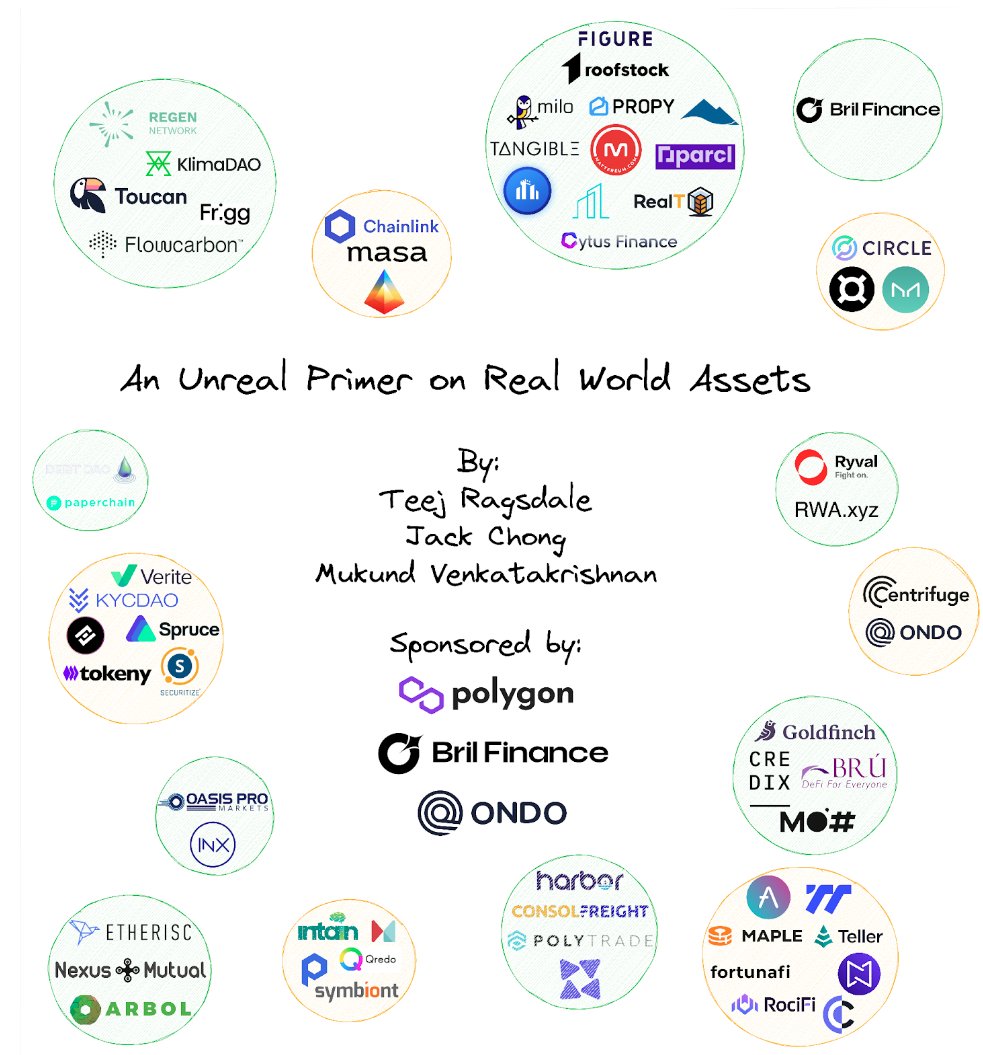
DeFi will eat TradFi. The key is via Real World Assets (RWA).
But the industry lacks a rigorous case....
So we wrote a 70-page primer to walk through our idea maze 🔍
Here's a sketch of the report so that you can skip to the section you like 🧵