¡Hoy la revista Science publica el principal resultado de mi tesis doctoral!
Más allá de la ilusión del descubrimiento en sí, lo más bonito ha sido el camino por el que llegamos a él.
¡Se me ponen los pelos de punta al pensarlo!
¡Os cuento!:
https://t.co/IxTRgxuaUn
🎓👏 Big congratulations to Dr. @aodena98 on a brilliant thesis defense ‼️ “Exploring the therapeutic potential of a novel HER3-targeted antibody drug conjugate in breast cancer patient-derived xenograft models”
An important milestone! 🔬
#SOMMVHIO#ThesisDefense
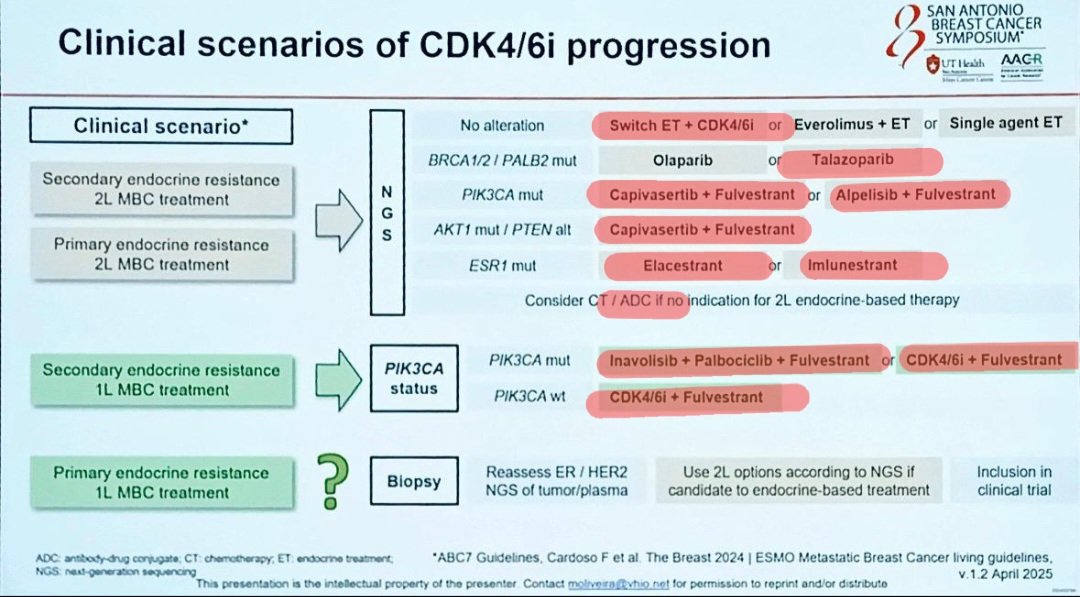
This slide perfectly illustrates the paradox of modern HR+ metastatic breast cancer management.
On paper, the post–CDK4/6 landscape is elegant and biologically rational: NGS-guided decisions, ESR1-targeted oral SERDs, PI3K/AKT pathway inhibitors, PARP inhibitors, and even CDK4/6 continuation strategies. Almost every resistance mechanism has a proposed solution.
In real life, however—in many countries, including my own—most of these red-highlighted options are simply not accessible. The algorithm exists, the evidence exists, the biomarkers exist… but the treatments do not.
So the question is unavoidable: who is this progress really for?
If we cannot deliver these drugs to patients, daily discussions about ever-expanding therapeutic menus risk becoming purely theoretical exercises.
Theoretical knowledge alone is not enough; translating it into practice is essential, but this is unfortunately not in the hands of physicians. It is a global problem.
So, where were we? What were we supposed to give patients with ESR1 mutations, those with PIK3CA alterations, and those with co-mutations? And then the questions keep coming: what if the DFI is less than 12 months? If ctDNA turns positive before radiologic progression—was that SERENA-6 or PADA-1?
After every conference, I find myself trapped in this paradox. Hopefully, one day everyone will have fair access to the treatments they deserve. Wishing you a nice weekend—it was a good conference. #SABCS25
During this #SABCS25, we presented the interim results of the ACROSS-TROP2 (SOLTI-1903) study, a SOLTI-led phase II trial investigating biomarkers of response and resistance to Sacituzumab Govitecan (SG) in advanced HR+/HER2- breast cancer, led by @evaciruelos and @MOliveira_MD.
🧬 Why is this relevant?
Although SG has shown significant clinical benefit in trials such as ASCENT and TROPiCS-02, we still lack validated biomarkers that can predict which patients are most likely to benefit from treatment.
🔍 What does ACROSS-TROP2 add?
After one cycle of treatment, the interim analysis shows:
-An increase in the CelTIL score, with greater rises in patients who achieved radiologic response.
-A safety profile consistent with previously known data for the drug.
-Key insights from sequential biopsies taken before, during, and after treatment, which will help characterize primary and acquired resistance mechanisms.
-A solid foundation for defining future predictive biomarkers that may optimize patient selection for SG.
These early results are just the beginning: the final analysis will include the full cohort of 100 patients and an in-depth translational study that will help advance toward more personalized care in HR+/HER2- breast cancer.
We are also proud of this work being selected by @GRASPtweets Patient Advocay Group to be presented within their forum. Bridging the gap between clinicians and patients 👭
#beSOLTI #SABCS25
@Hospital12deOct@VHIO
🧪Our HER3-DXd biomarker study in BC PDXs is out in @Nature_NPJ!
Key findings🔎
Long-term response associated to:
🧫Basal-like subtype
💊low chemo exposure
🎯high TOP1i sensitivity
🔗https://t.co/ao8My1cpCN
Led by @vserra_elizalde@MOliveira_MD (@VHIO) & @prat_aleix (@idibaps)
🛑En España, cada año se diagnostican más de 30.000 nuevos casos de cáncer de mama.
👉Hoy, más que nunca, reivindicamos la necesidad de seguir investigando para mejorar los tratamientos y la calidad de vida de las pacientes🔬🧬🧪
#ASEICACancer#ASEICAInvestiga
Important data from monarchE and NATALEE adjuvant CDK46 inhibitor @myESMO
With @tess_omeara, here's our take on who needs, and who does not need, adjuvant abema/ribo, co-published in @Annals_Oncology
https://t.co/ofrZzrsTqF
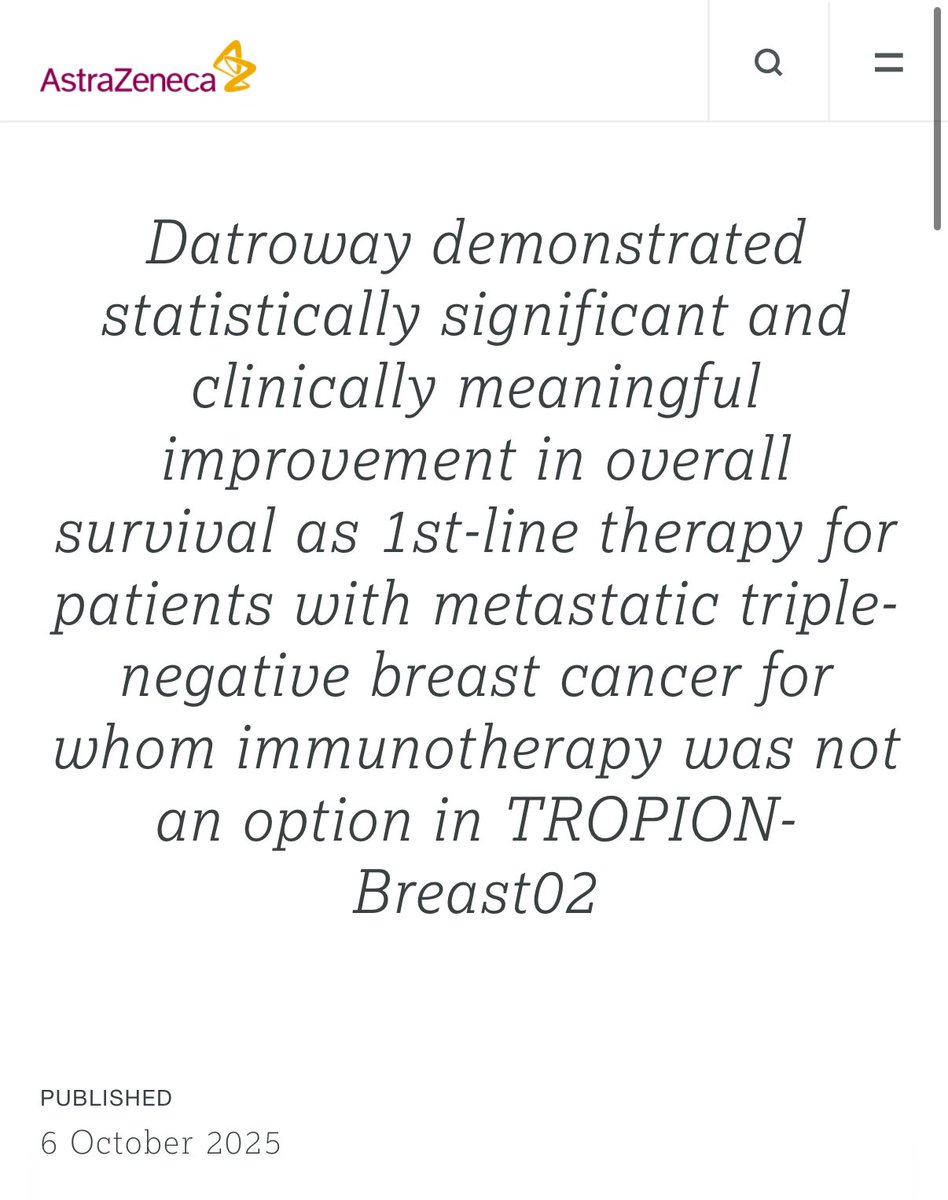
No better news to start the week. In TROPION-Breast02, 1L datopotamab deruxtecan improved PFS & OS over chemo for IO-ineligible pts with metastatic TNBC. ADCs keep delivering & are rapidly climbing to earlier lines. Hope to see the full results at #ESMO25. https://t.co/Hh0vJ8lhF4
ICARUS-B01, by @BarbaraPistill2 et al., is now published in @NatureMedicine. Among 99 pts with chemo-refractory HR+/HER2- MBC, HER3-DXd yielded an activity comparable to T-DXd (ORR 53%, PFS 9.2 months). Confirmatory phase 3 HERTHENA-Breast04 trial ongoing. https://t.co/LrkWTYzn9w
ADCs are poised to reshape standards of care across several diseases. At #ASCO25, we’ll see results from highly awaited trials in breast, gastric, lung, GU oncology and beyond. Here’s a list of 10 ADC presentations not to miss at the conference, curated by @raffcolo and myself.
AI provides a universal framework that leverages data and compute at scale to uncover higher-order patterns
Today, @arcinstitute in collaboration with @nvidia releases Evo 2—a fully open source biological foundation model trained on genomes spanning the entire tree of life 🧵