Small Cell Lung Cancer: Basic Mechanisms to Translational Advances—
Trudy G. Oliver, Matthew G. Oser, and Julien Sage will address this topic in a plenary at the AACR Conference on Lung Cancer (Jan 14-17; San Diego).
https://t.co/cE64QKPyh3
#AACRlung27@Oser_Lab@SageJulien
EED helps small cell lung cancer keep its neuroendocrine state by repressing lung adenocarcinoma genes: https://t.co/DmaHA0nTyP
Matthew G. Oser @oser_lab & team @danafarber & @BrighamWomens report the polycomb scaffolding subunit EED as a key supporter of small-cell lung cancer neuroendocrine identity and EGFR-mutant lung adenocarcinoma-to-small-cell lung cancer transformation. Notably, inactivation of EED in mice impaired small cell lung cancer tumorigenesis.
The figure: EED inactivation promotes a shift from SCLC toward LUAD histology in an RPR2 GEMM in vivo.
@the_asci
#LungCancer #SCLC
Beyond ASCL1, this study provides a generalizable framework for using complementary CRISPR-based screening approaches to dissect the regulation and function of lineage TFs in their endogenous cellular context. Congratulations to Keita, Kevin, and everyone involved in this work!
Excited to share another new study from our lab, co-led by Keita Masuzawa and Kevin Dong: “A HUWE1 Regulatory Helix Gates ASCL1 Degradation Through Its C-Terminal Phospho-Degron in Small Cell Lung Cancer.”
https://t.co/SLhbNOAek3
In this work, we combine genome-wide CRISPR knockout screening with base editor screening to identify regulators of ASCL1 protein abundance in SCLC and uncover a mechanism by which HUWE1 controls ASCL1 degradation through its C-terminal phospho-degron.
Excited to share new work from our lab: “Polycomb Scaffolding Subunit EED Supports the SCLC Neuroendocrine Identity and EGFR-Mutant LUAD to SCLC Transformation.”
https://t.co/gHFOST5Zq3
This study was led by our fabulous postdoctoral fellow Yixiang Li, who drove the mouse modeling, wet-lab experiments, and bioinformatic analyses-a true tour de force! Yixiang is a K99 awardee and is currently on the faculty job market. He is an exceptionally talented!
@KarunaMDPhD@Nature Beautiful study Karuna! Congrats!!Interesting to think about the potential parallels of this family in regulating plasticity across different cancer lineages.
🚨We're growing! Our lab at @TischCancer is #recruiting postdocs for 3 fully funded NIH projects. If you want to explore the biology of tumor dormancy, join us!!! Projects focus on:🧠Cancer neuroscience, ECM-driven dormancy, HER2 biology.
📩 email for more info or send your CV👇
Dear Colleagues,
In two weeks, I’ll ride the Pan-Mass Challenge (162 miles) for the second year in honor of my parents and everyone affected by cancer.100% of every donation supports cancer research at DFCI. Please consider donating. Thank you in advance!
https://t.co/cRKGBnsF33
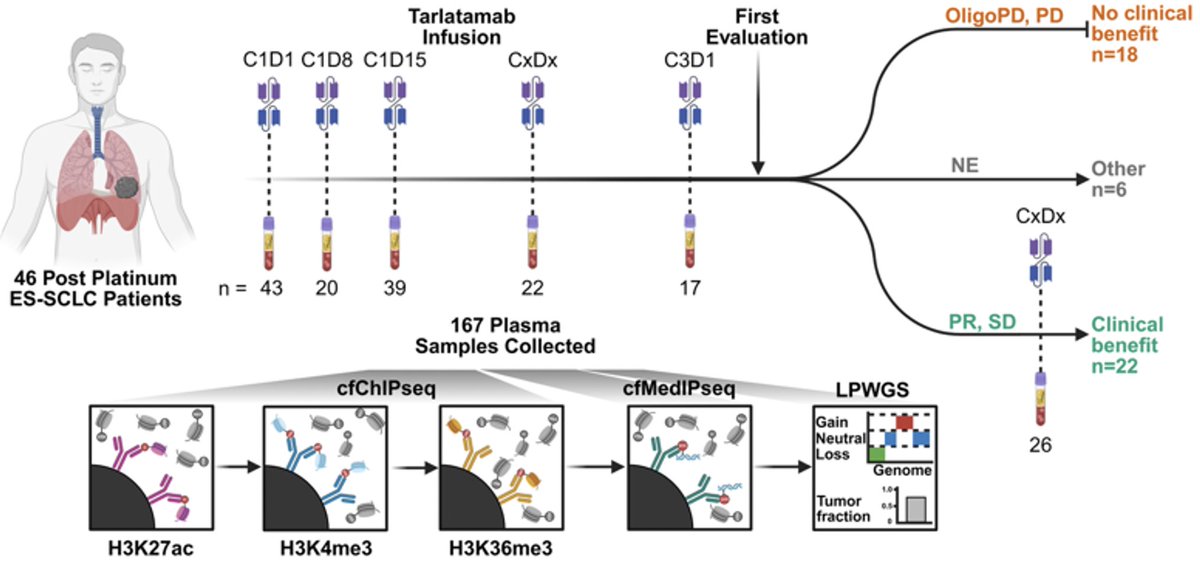
Excited to share our latest preprint, a wonderful collaboration w/ Matt Freedman and Sylvan Baca’s labs. Leveraging cfChIP-seq from patient plasma + functional mouse modeling, we uncover how TF subtype shapes response and resistance to tarlatamab in SCLC.
https://t.co/4nKW8PKe4D
Our latest collaboration with #MattFreedman and @Oser_Lab on resistance to tarlatamab: https://t.co/3Ei2gYY3Gm. An exciting framework for studying cancer resistance: observations from patients using epigenomic #LiquidBiopsy -> functional validation in mouse models.
It was wonderful visiting the Northwestern BMG Department today and learning about all the outstanding science going on here. Thank you @LuWangLab for the invitation!
Excited to share our new work in Dev Cell (https://t.co/BjVkuDiBXi), led by my highly talented postdoc Deli Hong! We find that loss of NOTCH2 creates a dependency on TRIM28, highlighting TRIM28 as a potential therapeutic target in NOTCH2-deficient or low-NOTCH2 SCLC.
This study was led by my highly talented postdoctoral fellow Shilpa Singh and was an outstanding collaboration with Circle Pharma and Deepak Nijhawan's lab at UTSW. @DanaFarberNews@DFarberThoracic.
Thrilled to share our new work published in Nature (https://t.co/6KIgZiDhMN). We report an exciting new potential therapeutic strategy with a fascinating mechanism of action for cancers with a compromised G1–S cell cycle checkpoint, including SCLC.
https://t.co/8UyaKWbecQ