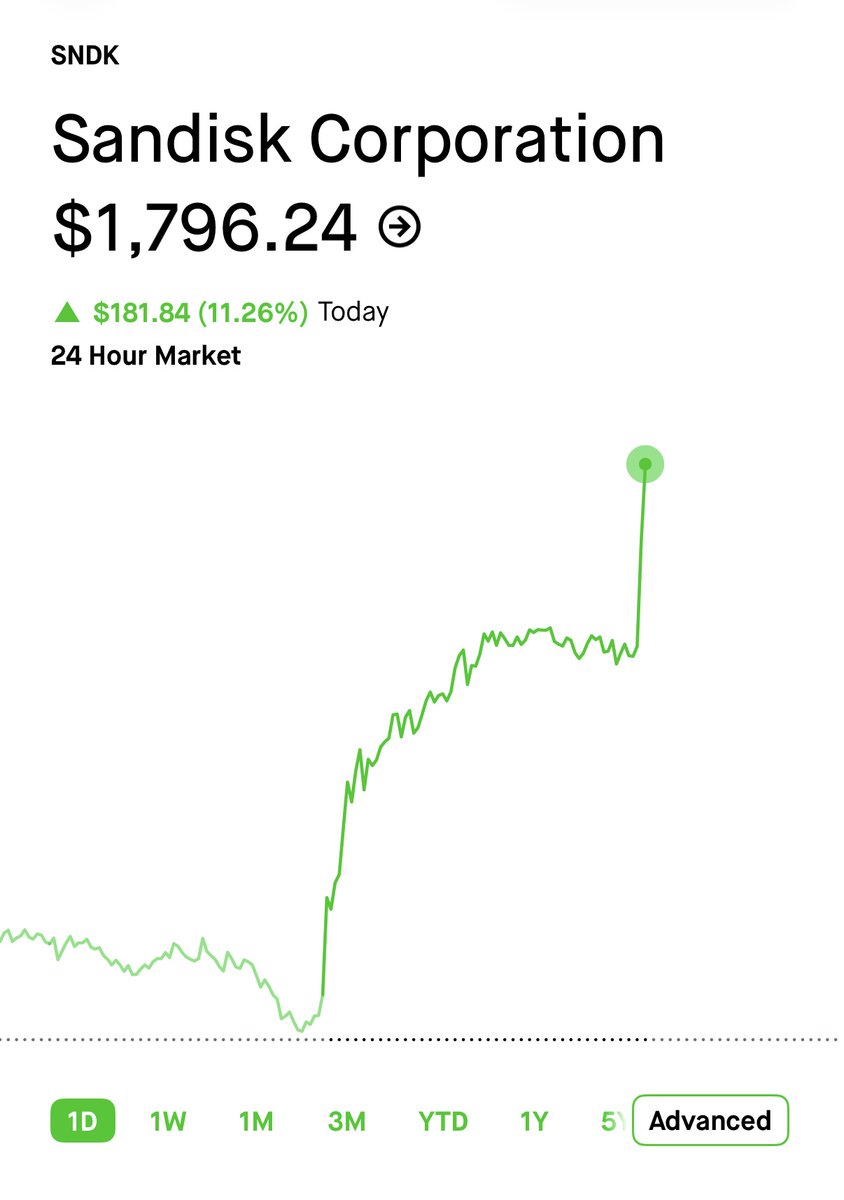
Something I heard from memory industry insiders today:
The demand gap is not 2x or 3x. They say it is more than 10x.
“There is absolutely no way we see a memory downcycle in 2028.”
Is that really true?
@evrgn11112231 It’s funny to read you calling other people extremely arrogant when a majority of your posts are talking about how everyone is so dumb and you’re so smart. Seems like you’re massively insecurw
@evrgn11112231 Losing it all?? If you actually did real work, you’d realize that people continuing to own semis even in late June to mid July had a cost basis a fraction of where the current stock prices were and probably have a different time horizon than you….
$CRDO on optics @ GS communicopia
GS : “how do you encourage investors to think about the growth rate specifically for optics as we progress through fiscal ‘27 and into ‘28?”
Credo : CEO “ so my expectation that I would like investors to have is that it’s going to be a very fast growth rate…”
“We will increase that production rate to double and then even triple by the end of fiscal year ‘28. So the ramp is going to be quite fast, it’s going to be quite significant, and we expect to even go beyond that in fiscal ‘29”
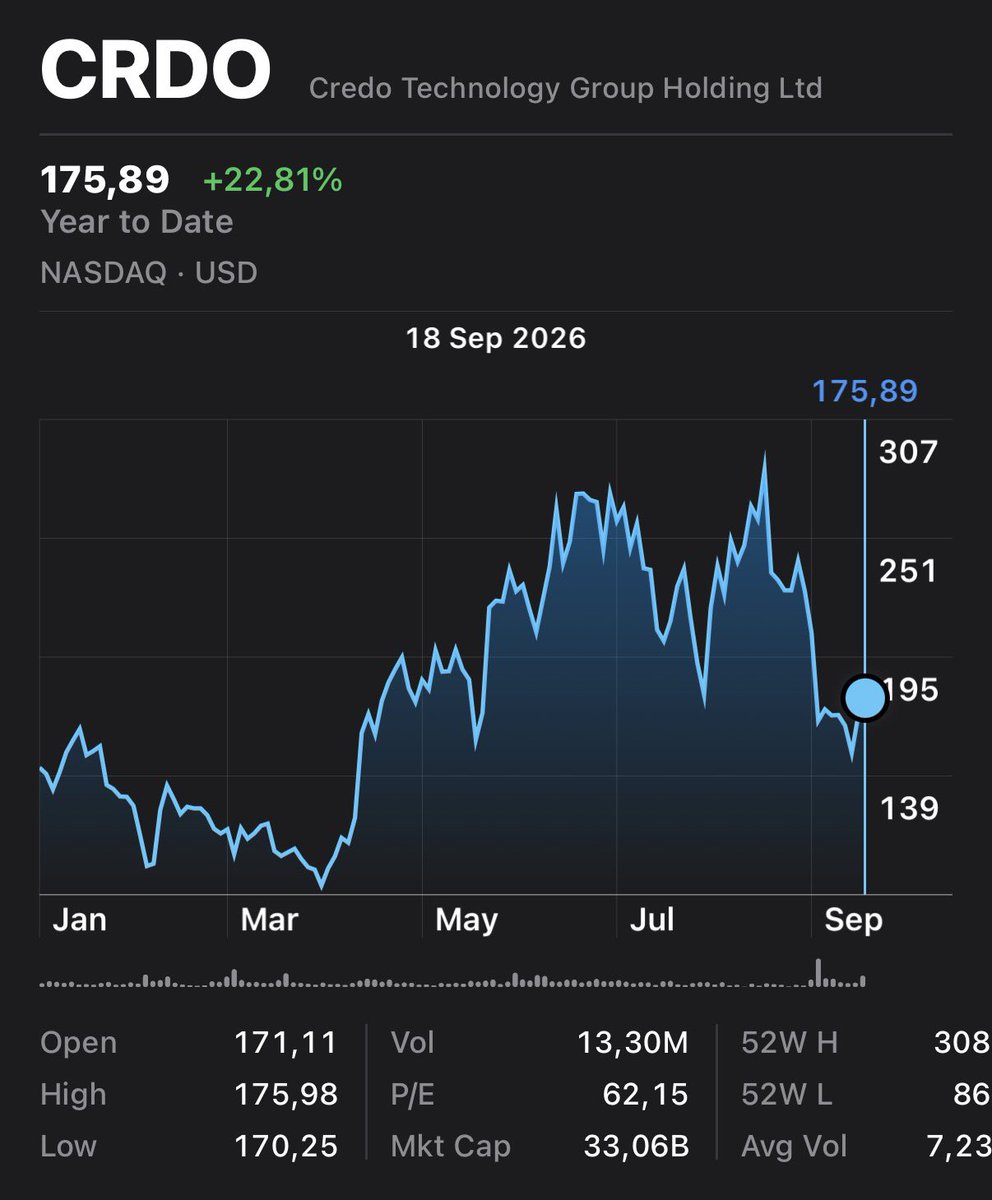
My prediction — $CRDO
2031 market cap: $200B.
From $33B today.
Why: AECs already print 68% Gross Margin and 48% Op. Margin. Optical DSP + ZeroFlap + silicon photonics is the second act. CPO/NPO hits FY28.
Every extra GPU rack is more SerDes, more copper, then more light. This is the interconnect tax on the entire AI cluster.
If they do $10B+ revenue at software-like margins, $200B is not a moonshot.
I’m positioned. NFA.
$CRDO will showcase its latest optical connectivity technologies and silicon photonics innovations at ECOC 2026, taking place September 21-23 at FYCMA in Málaga, Spain.
Credo Booth Demonstration Highlights (Booth #2056)
•1.6T 2xDR4 Fully Retimed Module Powered by Credo's Cardinal 802 1.6T DSP and Kfir 200G silicon photonics PIC, the solution delivers advanced optical connectivity to support the growing bandwidth demands of AI and cloud infrastructure.
•800G & 1.6T ZeroFlap Optics + PILOT High-performance optical interconnect solutions featuring real-time link health monitoring and root-cause diagnostics through the Credo PILOT observability platform, enabling greater visibility and reliability at AI scale.
Big Tech is not burning its cash on AI but rather transferring trillions of dollars directly into the infrastructure companies powering it (Save this).
The chart shows that hyperscaler capital spending is expected to increase from $422 billion in 2025 to $788 billion in 2026 and $1.086 trillion in 2027.
At the same time, aggregate semiconductor free cash flow is projected to rise from $279 billion in 2025 to $772 billion in 2026 and $1.303 trillion in 2027.
In simple terms, the hyperscalers are taking cash generated by advertising, cloud computing, software, and e-commerce and reinvesting it into GPUs, custom chips, memory, networking, and semiconductor manufacturing equipment.
That spending becomes revenue for the AI supply chain and a growing portion of that revenue could eventually become free cash flow for semiconductor companies.
The most striking part is the cumulative calculation because hyperscalers are projected to spend approximately $2.295 trillion from 2025 through 2027, while the semiconductor companies included in the chart are expected to produce approximately $2.354 trillion of free cash flow.
The semiconductor companies are not merely benefiting from a temporary increase in chip orders but rather the AI buildout could transform them into some of the largest cash generating businesses in the world.
NVIDIA, AMD, Broadcom, and Marvell benefit from demand for GPUs, custom accelerators, networking chips, and connectivity products.
Micron and other memory producers benefit because every new AI accelerator requires large amounts of high-bandwidth memory.
TSMC benefits by manufacturing many of the advanced processors designed by NVIDIA, AMD, Broadcom, and the hyperscalers themselves.
ASML, Applied Materials, Lam Research, KLA, and Tokyo Electron benefit because semiconductor manufacturers need more advanced equipment to expand production.
The second bullish signal is that semiconductor free cash flow is expected to grow faster than hyperscaler capital expenditure while hyperscaler spending is projected to increase by roughly 157% between 2025 and 2027, while semiconductor free cash flow is projected to rise by approximately 367%.
This suggests that operating leverage could begin appearing across the semiconductor industry because once factories, intellectual property, and supply chains are established, additional AI demand can produce significantly more revenue and cash flow without costs rising at exactly the same rate.
The hyperscalers are effectively funding one of the biggest semiconductor cash flow booms we’ve ever seen.
That’s exactly what I’m positioning around at Milk Road and if you want full transparency into the names I own and the trades I’m making, you can follow my portfolio below.
https://t.co/Hkywss4Ugh
*OPENAI PROJECTS NEGATIVE FREE CASH FLOW OF $278B FROM 2026 THROUGH 2030: FT
*OPENAI FORECASTS SPENDING $856B ON COMPUTE, INFRASTRUCTURE THROUGH 2030
*OPENAI EXPECTS MARCH $122B CASH CUSHION TO RUN OUT IN 2028
*OPENAI SEES REVENUE GROWING TO $350B IN 2030 FROM $36B THIS YEAR