Ha muerto Margaret Hamilton, responsable del equipo que desarrolló el software de los ordenadores del programa Apolo, y madre de la ingeniería del software
Margaret Hamilton , pionera y madre de la ingeniería del software , ha fallecido a los 90 años
https://t.co/sj0eKn5TkG
Vengo con una noticia muy buena 🥳
El post del límite de la IA llegó hasta gente de @AnthropicAI , que me escribió rapidísimo. Eso lo habéis conseguido con la difusión. Gracias de corazón 🙏🫶
Yo había enviado la solicitud a su programa AI for Science. Esta madrugada me ha llegado la aceptación del proyecto, y los créditos de uso de Claude ya están en mi cuenta 🎉
Sigo construyendo y os voy contando lo que salga 💜💜💜 GRACIAS
Clear intent with your AI-generated code is crucial. And confidence in your results takes more than just passing a test.
Our free ebook, Spec-Driven AI Development, covers specs, risk-based testing, and evaluating agent-produced code.
La crisis de vivienda en España: lo que creo que puede funcionar para solucionarla... y lo que probablemente no sirva o sea directamente contraproducente. En siete minutos y medio.
Dentro video 👇
Meet Mistral Large 4, aka Le Chonk.
• 1T parameters, natively multimodal. 49B active.
It is the best open weights model from US or Europe on aggregated benchmarks.
• State-of-the-art on critical workloads, including cyber defense, manufacturing and finance and it surpasses closed frontier models on visual grounding.
• Forged in Europe end-to-end and is deployable from Europe via our own Mistral Cloud infrastructure.
• Available to all via API today. Working with cybersecurity partners privately.
Open weights release end of October.
Increíble de ver a los “expertos” en solventar la emergencia de vivienda que vive España! En cada televisión! @telediario_tve@A3Noticias@tele5_noticias@noticias_cuatro La realidad es que tenemos a políticos que intentan crear decretos y soluciones cuando no tienen la preparación ni el conocimiento para idear una solución real al problema que vivimos.
España no tiene un problema de falta de decretos. Tiene un problema de falta de viviendas.
Y mientras el Gobierno siga confundiendo anunciar medidas con resolver problemas, seguiremos pagando las consecuencias de su inacción.
Subvencionar la demanda sin aumentar la oferta presiona los precios. Regular cada vez más un mercado sin construir vivienda nueva no elimina la escasez: la administra. Castigar fiscalmente una modalidad de alquiler puede cambiar incentivos, pero tampoco pone un solo ladrillo.
El Gobierno puede aprobar todas las medidas que quiera y venderlas como grandes soluciones. Puede encadenar decretos, anuncios y campañas de propaganda. Pero hay una pregunta que desmonta cualquier discurso:
¿Cuántas viviendas nuevas crea todo esto?
Porque la vivienda no se abarata repartiendo la escasez. Se abarata acabando con ella.
España necesita construir. Mucho.
Más suelo disponible. Licencias en meses, no en años. Más densidad donde sea posible. Seguridad jurídica. Muchísima más vivienda pública y también privada.
Pero el Gobierno no está haciendo lo necesario. Prefiere intervenir sobre las pocas viviendas que existen antes que crear las condiciones para que haya muchas más. Prefiere presentar parches como soluciones y cargar sobre propietarios, promotores y ciudadanos el coste de su fracaso.
Lo demás puede servir para redistribuir, proteger a determinados colectivos o cambiar incentivos. Pero no confundamos eso con solucionar el problema de fondo.
No se arregla una falta de vivienda repartiendo mejor las pocas casas que existen. Se arregla haciendo que existan muchas más.
Menos propaganda. Menos parches. Menos obsesión por intervenir sobre el mismo piso.
Más oferta. Más construcción. Más casas.
You're going to have to deal with the fact that nobody knows exactly what the future role of programming languages and frameworks are. Maybe it all does go away and it's a straight shot from prompt to microcode! But best you can do today is get the most out of what's here now.
Netflix replaced their 15 years old recommendation algorithm with an LLM.
It’s called "GenRec" and it completely changes how recommendation algorithms are built.
For over a decade, the Netflix recommendation engine was a masterclass in feature engineering. Data scientists built thousands of complex, handcrafted features to figure out what you wanted to watch next.
It required bespoke architectures. Massive infrastructure. Constant manual tuning.
Netflix threw all of it away.
They built GenRec, an LLM-backed ranker.
Instead of translating your behavior into complex math, they just turn your watch history and metadata into a natural language sentence.
They feed that raw text into a foundation LLM.
The AI simply reads your behavior like a story, understands your evolving tastes, and scores the entire catalog in a single forward pass.
No manual feature engineering. No complex bespoke architectures.
Here is the part that should terrify traditional data scientists.
This text-based LLM didn't just match the highly tuned production system Netflix spent years perfecting.
It beat it.
And it achieved those statistically significant gains using roughly 40x fewer labeled training examples.
We are watching a massive paradigm shift in real time.
The most complex predictive algorithms in the world are being replaced by models that just know how to read.
If Netflix can replace their core product engine with an LLM, what complex system in your business is about to become obsolete?
In the 90s, I programmed COBOL on the IBM mainframe. Later came client/server.
Back then, I had all the roles. I talked to the customers, did the architecture and design, wrote the code, and made sure the application ran in production.
Then we specialized. Business analyst, architect, developer, tester, operations. Every handover lost knowledge.
With AI coding agents, we are back. One person has time for the whole thing again.
But two things are different:
1. The specification is now input for the AI, not just documentation. Good spec, good code. Bad spec, a lot of bad code, fast.
2. Systems are much more complex. The most important skill is judging if the AI result is correct.
The new role? An architect who gets their hands dirty again.
The tools are new. The principle is old. Keep IT simple.
Read the full post:
https://t.co/4j0NTLpPlU
#SpecDrivenDevelopment #AIUnifiedProcess #SoftwareArchitecture #AI
1👻-"¿Sabéis esos certificados TLS que renováis cada año con sudores fríos? Pues preparaos: van a durar 47 DÍAS"
🤬-"¡¿CÓMO?!"
No es rumor: está aprobado y el calendario corre.
Hoy: qué viene y por qué (aunque duela) tiene sentido. Abro 🧵
In amongst all the AI madness, people seem to have forgotten that the point of working in very small increments with very frequent releases is to get feedback sooner so that we can adjust what we're building to best meet our customers' needs. Small changes are easier to assess and easier to tweak. The point was to build the best product—the one that was most valuable to our customers. Any technical advantage (e.g., it's way easier to find and fix bugs when you've changed less code) is secondary to building a better product.
When you work in large batches, reviewers quickly become overwhelmed and don't really look at what you've done. The program tends to end up bloated with hard-to-use features nobody wants (or wants to buy).
Mix AI into the scene, and the volume of code produced before a customer sees it gets vastly larger, so the feedback-and-adjust process goes by the wayside. The result is worse products, loaded with useless, hard-to-use features. These too-large systems are also expensive to work on, especially when an AI has to load all that cruft into its context to do minor things. Don't do that.
Por si alguien no me lo ha leído alguna vez, aunque lo he repetido decenas de veces:
La comprensión lectora será la habilidad más demandada en el siglo XXI.
Meet a developer who can't use AI because his company doesn't let him.
He knows this is probably the last developer job he will ever have. If he gets laid off, he will be years behind everyone else.
Scary place to be.
I told him to find a new job.
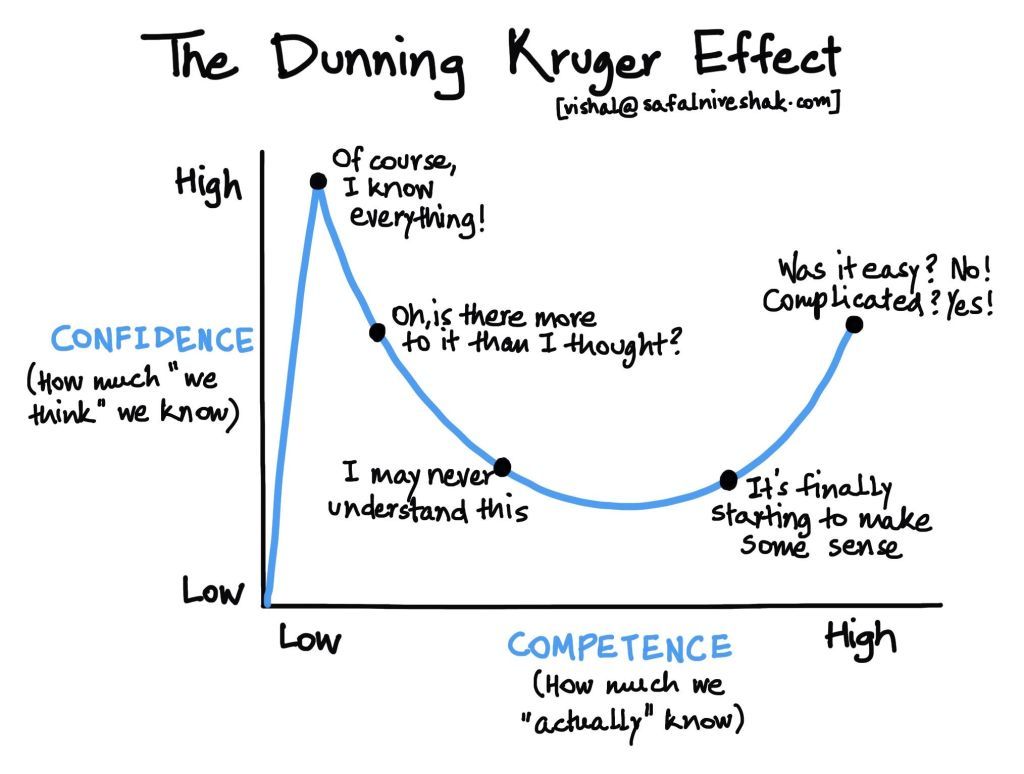
Many people have heard about the Dunning-Kruger effect: people don't know what they don't know, so they inaccurately assess their own competence. Everybody puts themselves in the 99th percentile of good drivers, great programmers, or AI users, even though that's statistically impossible. Paradoxically, the truly competent rate themselves much lower. The graph👇 demonstrates the problem. (I just pulled that image off the web—if you know the author, please tell me so that I can credit them.)
Dunning-Kruger is driven by social connection. You determine "correct" by talking to the people around you, which, more and more, includes social media. AI amplifies the problem because it doesn't actually know anything, but is trained off the web, so it reports the prevailing (on the internet) belief as correct, whether or not it's actually correct. It's an echo-chamber problem: "If my thinking aligns with the people around me, I must be correct!"
I see this problem with terms like TDD, Agile, and MVP, among others. Many (most?) of the people with strong opinions about what those terms mean have never read the work of the people who coined the terms and did the original thinking: Kent Beck's "Test Driven Development: By Example" or his "Extreme Programming Explained" or Ries' "Lean Startup," for example. Mentions of those names are often met with blank stares. (Ironically, that applies to Dunning-Kruger as well—almost nobody's read David Dunning and Justin Kruger's original paper.) Their notion of "right" is defined entirely by their social circle.
This is tribal thinking, and attempts to push back on it are almost always met with hostility directed at the outsider. People jump on "the popular belief is what defines the term" bandwagon rather than thinking "hmm, maybe I need to do some research." The tragedy is that the original thinking is lost, and we, as a profession, take a giant step backward as we move blindly towards easily preventable disaster. "Doomed to repeat it," indeed.
Many people have no idea what's happening.
They can't conceive that developers out there are deploying AI-generated code, because in their bubble, everyone is still writing Java code and running Scrum retrospectives.
One sunny afternoon, their CTO will meet a modern developer at church; they will talk about the possibilities and how AI can change their business. A month later, these dinosaurs will face a tough decision: either get up with the times, or find another job.
Multiple Deepmind employees are claiming the TOS is out of date and Google doesn't enforce this anymore. Separately, I found a semi-official ACP server for AGY.
Gonna try to get this out by end of week. If you get banned, tell @_mohansolo and it should be fixed quickly :)
Antigravity's terms of services make it crystal clear that if they determine you use Antigravity in a way they suspect is eg third-party usage (eg use OpenClaw), they can suspend your Google account.
One reason to NOT use Antigravity.
I'm not taking this risk, sorry.
No se acaban las desgracias 😣😣
Necesito casa de acogida para 8.
No hace falta que sea 1 para 8 pueden ser 2 para 4 o 4 para dos. URGENTISIMO. SI NO LES ENCONTRAMOS NADA SE LOS LLEVAN EL SÁBADO "AL CAMPO"