Μαρία Μοντεσόρι 31 Αυγούστου 1870 - 6 Μαΐου 1952
1.Τα παιδιά μαθαίνουν από το περιβάλλον τους.
2.Όταν ένα παιδί δέχεται συχνά κριτική, μαθαίνει να κατακρίνει τους άλλους.
3.Όταν ένα παιδί επαινείται συχνά, μαθαίνει να εκτιμά τους άλλους.
4.Όταν ένα παιδί αντιμετωπίζεται εχθρικά,
In 1898, an Austrian physicist published a radical mathematical theory that claimed the entire universe was slowly, irreversibly ticking toward its own death.
The elite scientific establishment mocked him so relentlessly that he slipped into a deep depression and eventually took his own life.
Only a few years later, the world realized he was entirely right.
His name was Ludwig Boltzmann.
Today, his breakthrough formula is carved onto his tombstone in Vienna.
Yet outside of the physics community, almost no one understands the brutal, mind-bending philosophical truth he discovered about how our lives actually work.
In the late 19th century, physics was neat, orderly, and beautiful. Scientists believed that if you knew the exact position and velocity of every particle in the universe, you could predict the future perfectly.
The universe was a flawless clock.
Boltzmann looked at the world and realized that was an illusion.
He wanted to solve a deceptively simple riddle: Why does time only move forward? Why does a dropped coffee mug shatter into a hundred pieces, but a hundred scattered pieces never spontaneously jump back together to form a mug?
The laws of standard physics said it could happen. The math didn't forbid it.
So why didn't it?
Boltzmann realized the establishment was looking at the problem completely wrong. They were trying to track every single particle individually. It was an impossible formula.
Instead, Boltzmann decided to use probability and statistics. He stopped looking at individual atoms and started looking at the chaos of the crowd.
He invented a concept called Entropy, the mathematical measure of disorder.
His breakthrough was simple but devastating:
There is only one specific way for the atoms in your coffee mug to be perfectly arranged. But there are trillions of disordered ways for those same atoms to be scattered across the floor.
Things don’t break because the universe is malicious. They break because chaos is statistically overwhelming. Order is rare; disorder is infinite.
Boltzmann proved that the universe is constantly, inevitably moving from a state of low entropy (perfect order) to high entropy (maximum chaos). This cosmic slide toward disorder is the very reason time exists. The "arrow of time" is just the universe getting messier.
The professors of his day were furious. They hated his math because it relied on probability instead of certainty. They refused to believe that the fundamental laws of reality were governed by statistics.
But Boltzmann’s math laid the groundwork for quantum mechanics and explained the fate of the cosmos.
The philosophical lesson Boltzmann left behind is a cold, liberating truth for everyday life:
Order requires deliberate energy. Chaos is free.
Most people treat problems in their lives, a collapsing relationship, a chaotic career, a messy mind, as a sign of personal failure. They think they did something uniquely wrong.
But Boltzmann’s math proves that if you leave any system alone, it will naturally decay into chaos all by itself. Your room doesn't get messy because you are a bad person; it gets messy because the laws of physics dictate that there are infinitely more ways for your clothes to be on the floor than in the closet.
If you want to maintain order, sanity, or success in any area of your life, you cannot rely on things "just working out." The universe is actively trying to scramble your plans.
What is an area of your life right now that is sliding into chaos? Stop waiting for it to fix itself. Chaos is the default setting of the universe. What is the precise, deliberate energy you need to inject into that system today to fight back against the entropy?
This is really stupid, and it’s not getting enough attention.
The Trump administration is pulling a working $368 million ocean monitoring system out of the water, equipment taxpayers already bought, built, and sank into the deep ocean.
And they are doing it right when the oceans are behaving in ways that alarm the scientists who study them.
Record-breaking temperatures.
A system of Atlantic currents that may be lurching toward collapse.
The response?
Yank out the instruments and walk away.
That is not budgeting. That is smashing the gauges while the engine is on fire and calling it efficiency.
For what? The Trump administration dressed it up as a “nimbler approach” and “smart lifecycle management,” which is fancy nonsense for “we shut it off and hoped nobody would ask why.” There is no return-on-investment analysis. They cannot show taxpayers save a dime, because the gear is already paid for and the science it produces protects real money and real lives.
The kicker: the same people killing the monitors want to mine the deep sea for minerals. So they are destroying the only tools that could measure what that mining does. That is not an accident.
That is the point. You cannot see the damage if you break the instruments first.
https://t.co/MzE4AW1QBv
Every Honeycrisp apple is a clone of a single tree planted at the University of Minnesota in 1962. Every one. Apple seeds are random. Plant a Honeycrisp seed and the new tree produces a small, sour apple that’s usually inedible.
So apple growers do something old and clever. They cut a small branch off the original Honeycrisp tree, slot it into a slit in a young apple sapling, wrap the joint, and wait. The branch fuses to its new host and starts producing Honeycrisps. About 20 million Honeycrisp trees exist worldwide, every one a piece of that 1962 tree on different roots.
Same goes for Gala, Fuji, Pink Lady, Granny Smith. Every Granny Smith on Earth traces back to a seedling found in 1868 by a woman named Maria Ann Smith in Australia. She’d thrown French crab apple cores onto her compost heap, one of them sprouted, and the apples it bore were unusually tart and good for cooking. That one tree is the ancestor of every Granny Smith in every grocery store on the planet.
Wine has the bigger story. In the 1860s, a tiny aphid called phylloxera caught a boat from America to France, hidden in some grapevine cuttings. It eats grape roots. French vines had no defense and started dying everywhere. Within 15 years, French wine production crashed from about 11 billion bottles a year to 3 billion. The blight then tore through Italy, Spain, and Germany, and European wine was on the edge of collapse.
The rescue came from Missouri and Texas. American grapevines had grown up with phylloxera and were immune to it. So growers chopped French grape varieties off at the trunk and joined them to American roots. Above the soil: still French grapes. Below the soil: aphid-proof American root. It worked. Today, almost every bottle of French, Italian, Spanish, Australian, and Californian wine you’ve ever drunk sits on top of an American root.
The technique is ancient. Chinese farmers were grafting trees by 1000 BCE. A Greek medical text from 424 BCE describes it casually, like it was already old news. It works because plants don’t have a rejection system the way animals do. Cut two branches. Match the green layers just under the bark. Wrap them tight. In a few weeks the plumbing has fused into a single plant.
A Syracuse University art professor named Sam Van Aken has spent 18 years building a single tree that grows 40 different fruits: peaches, plums, apricots, cherries, nectarines, almonds. In spring it blossoms in pink, white, and crimson all at once. He’s made more than a dozen. They sell for up to $30,000 each.
Without grafting, there would be no commercial apple industry, no global wine industry, and most of the heirloom fruits humans have bred over the centuries would have gone extinct. One clean cut, and you’ve kept entire species alive.
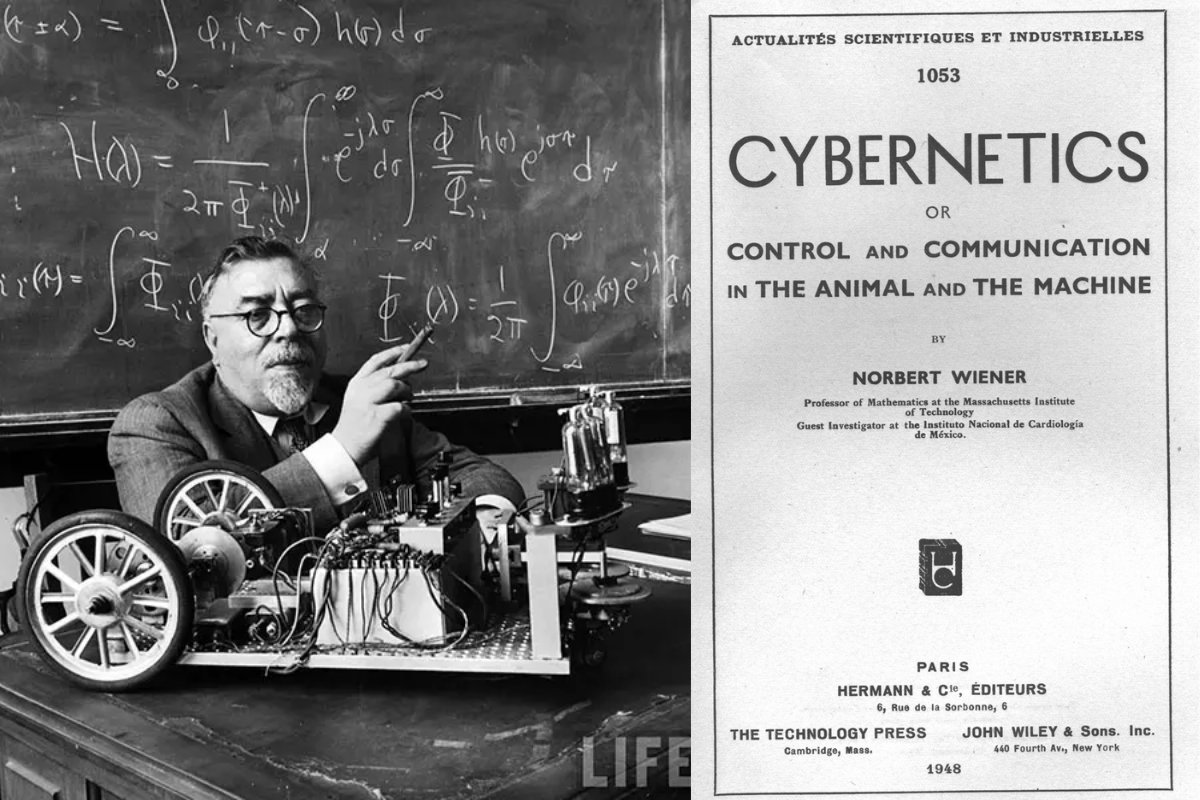
A child prodigy who finished his Harvard degree at 14 and his PhD at 17 sat down in 1948 and wrote a single book that invented the entire conceptual vocabulary we still use to talk about AI, robotics, self-driving cars, and reinforcement learning.
He never got the credit. Most people have never heard his name.
His name was Norbert Wiener. The book was called Cybernetics.
Every feedback loop running inside every system you interact with today traces back to one problem he was handed during World War II.
The problem was this: how do you aim a gun at a fast-moving airplane?
By the time your shell arrives, the plane is somewhere else. You cannot aim at where the plane is. You have to aim at where the plane will be. And the plane's pilot, knowing this, is constantly changing course to make that prediction wrong.
Wiener spent years on this. What he built to solve it was not a better gun. It was a new science.
He noticed something that nobody had formally described before. The gun system and the human nervous system were solving the same problem using the same method. You observe where the target is. You compare it to where you want to hit. You calculate the gap. You correct. You observe again.
He called that loop feedback.
Not in the casual sense people use it today. In the precise mathematical sense. A signal goes out. The result comes back. The system compares the result to the goal. The gap between them drives the next action. The loop closes.
That mechanism, exactly as Wiener described it in 1948, is what runs inside every thermostat, every autopilot, every cruise control system, and every AI training loop on the planet right now.
When GPT-4 learned to answer questions better, it was doing feedback. When AlphaGo learned to play Go, it was doing feedback. When a self-driving car adjusts its steering because it drifted two inches toward the curb, it is doing feedback.
The word they all use, the concept underneath the word, the mathematics formalizing the concept, all of it came from one book written by a child prodigy in 1948 who was trying to figure out how to shoot down a plane.
The deeper insight was what he proved about living systems and machines.
Before Wiener, biology and engineering were treated as completely separate domains. Organisms adapted. Machines calculated. The idea that you could describe both using the same mathematical framework was not just unusual. It was considered a category error.
Wiener proved it anyway.
He showed that a brain correcting a reaching movement and a missile correcting its trajectory were running mathematically identical control loops. The hardware was different. The math was the same. Living systems and engineered systems obeyed the same laws once you understood what those laws actually were.
He named the field after the Greek word for steersman. Kubernetes. Cybernetics. The person who holds the rudder, reads the water, and adjusts constantly to hold a course through a current that is always pushing the ship somewhere else.
That is the mental image he wanted. Not a machine that executes instructions. A system that responds to its own results.
The third thing he did is the part almost nobody connects to modern AI.
In 1948, Wiener spent an entire chapter of Cybernetics warning about what would happen when machines that learn from feedback were given control over consequential decisions.
He described the displacement of workers not as a distant possibility but as a near-term certainty. He wrote about the ethical risks of building systems that optimize for measurable proxies of human values rather than actual human values.
He described in plain language what alignment researchers today call Goodhart's Law without using that name, 25 years before Charles Goodhart published anything.
He was a mathematician in 1948 writing about problems that AI safety researchers are still trying to solve in 2026.
The book is dense in places. The equations are real and the sections on statistical mechanics require actual attention. But Wiener knew this, which is why in 1950 he published The Human Use of Human Beings, which is the same book with all the math removed. Same ideas. Same warnings. Written for anyone who reads English.
That second book has been in print for 75 years and almost nobody in tech has read it.
Wiener died in 1964 at a conference in Stockholm. He collapsed mid-conversation between sessions. He was 69.
He did not live to see a personal computer. He did not live to see the internet. He never saw reinforcement learning, neural networks, or the AI systems that run almost entirely on the mathematical architecture he designed while trying to solve a World War II gunnery problem.
Every AI lab in the world today is building systems that run on his framework. Almost none of the people building those systems know his name.
The field he founded, cybernetics, mostly disappeared as a word. The ideas did not disappear. They dissolved into every other field. Control theory. Cognitive science. Computer science. Neuroscience. AI. They each took a piece of what he built and called it their own terminology.
The word that survived is the one that proves he invented it.
Feedback.
You use it every day. You use it in code reviews, in meetings, in conversations about AI performance. Every time you use it in the technical sense, meaning a signal that closes a loop between output and goal, you are using the exact definition Wiener wrote down in 1948.
He gave the word its meaning. Most people using it have never heard of him.
The Human Use of Human Beings is free on archive. Cybernetics is in print and available anywhere books are sold. His major essays are in academic archives at no cost.
The man who built the foundation of modern AI was writing about its dangers before the first commercial computer existed.
Most people building AI today have never read a word he wrote.
In Japan, children clean their own schools.
Every day. After lunch.
About twenty minutes.
Classrooms.
Hallways.
Toilets.
Not because the schools are too poor
to hire someone.
Because in 1947, this country decided
that cleaning your own space
is part of becoming a person.
The cleaning rag
is on the school supply list.
Right next to the pencils.
Egypt teaches it now.
So does Indonesia.
So does Mongolia.
Think about the last time
you watched a seven-year-old
mop a floor without complaining.
Japan does that
in every elementary school
in the country.
Not as punishment.
As education.
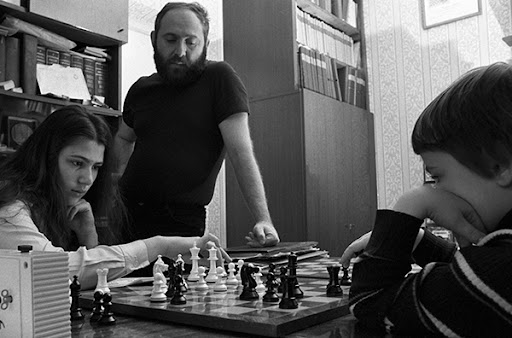
A Hungarian psychologist raised three daughters to prove that any child could become a chess grandmaster through early specialization. He succeeded. Two of them became grandmasters. One became the greatest female chess player who ever lived.
Then a sports scientist looked at the data and found something nobody wanted to hear.
His name is David Epstein. The book is called "Range."
The Polgar experiment is one of the most famous case studies in the history of deliberate practice. Laszlo Polgar wrote a book before his daughters were even born arguing that geniuses are made, not born. He homeschooled all three girls in chess from age four. By their teens, Susan, Sofia, and Judit were dominating tournaments against grown men. Judit became the youngest grandmaster in history at the time, breaking Bobby Fischer's record. The story became the gospel of early specialization. Pick a domain young, drill it hard, and you can manufacture excellence.
Epstein opens his book by telling that story honestly and then quietly demolishing the conclusion most people drew from it.
Chess works that way. Most things do not.
Here is the distinction that took him four years of research to articulate, and that almost nobody who quotes the 10,000 hour rule has ever read.
There are two kinds of environments in which humans develop expertise. Psychologists call them kind and wicked. A kind environment has clear rules, immediate feedback, and patterns that repeat reliably. Chess is the cleanest example. Every game ends with a winner and a loser. Every move is recorded. The board never changes shape. The pieces never invent new ways to move. A child who plays ten thousand games will see most of the patterns that exist in the game, and pattern recognition is exactly what chess mastery is built on.
A wicked environment is the opposite. Feedback is delayed or misleading. Rules shift. The patterns that worked yesterday may be exactly the wrong patterns to apply tomorrow. Most of the real world looks like this. Medicine is wicked. Investing is wicked. Building a company is wicked. Scientific research is wicked. Almost every job that involves a complex changing system with humans in it is wicked.
The Polgar sisters trained in the kindest environment any human can train in. Their success was real and the method was correct. The mistake was generalizing the method to fields where the underlying structure of the environment is completely different.
Epstein's research is what made the implication impossible to ignore.
He looked at the careers of elite athletes outside of chess and golf and found that the pattern was almost the inverse of what people assumed. The athletes who reached the very top of their sports were overwhelmingly people who had played multiple sports as children, specialized late, and often switched disciplines well into their teens. Roger Federer played squash, badminton, basketball, handball, tennis, table tennis, and soccer before tennis became his focus. The kids who specialized in tennis at age six and trained year-round for a decade mostly burned out, got injured, or topped out at lower levels of the sport.
The same pattern showed up everywhere he looked outside of kind environments. Inventors with the most patents had worked in multiple unrelated fields before their breakthrough work. Comic book creators with the longest careers had drawn for the most different genres before settling. Scientists who won Nobel Prizes were dramatically more likely than their peers to be serious amateur musicians, painters, sculptors, or writers.
The skill that mattered in wicked environments was not depth in one pattern. It was the ability to recognize when a pattern from one domain applied unexpectedly in another. That kind of thinking cannot be built by drilling a single subject. It can only be built by accumulating mental models from many subjects and learning to move between them.
The deeper finding is the one that should change how you think about your own career.
Specialists in wicked environments often get worse with experience, not better. Epstein cites studies of doctors, financial analysts, intelligence officers, and forecasters showing that years of experience in a narrow domain frequently produce more confident judgments without producing more accurate ones. The expert builds elaborate mental models that feel comprehensive and turn out to be increasingly disconnected from the actual structure of the problem. They stop noticing what does not fit their framework. They mistake fluency for understanding.
Generalists do better in wicked domains for a reason that sounds almost mystical until you understand the mechanism. They have less invested in any single mental model, so they abandon broken models faster. They are used to being a beginner, so they are not threatened by the discomfort of not knowing. They have seen enough different domains that they can usually find an analogy from one field that unlocks a problem in another. The technical name for this is analogical thinking, and the research on it is one of the most underrated bodies of work in cognitive science.
The single most useful sentence in the entire book is the one Epstein puts almost as a throwaway.
Match quality matters more than head start.
A person who tries six different fields in their twenties and finds the one that genuinely fits them will outperform a person who picked one field at fourteen and stuck to it on willpower alone. The lost years were not lost. They were the search process that produced the match. Every field they walked away from taught them something they later imported into the field they finally chose.
The reason this is so hard to accept is cultural, not empirical. We tell children to pick a path early. We reward the prodigy who knew at six. We treat the late bloomer as someone who failed to launch on time, when the data suggests they were running an entirely different and often more effective optimization process underneath.
The Polgar sisters were not wrong. The conclusion the world drew from them was.
If your environment is genuinely kind, specialize early and drill hard. If it is wicked, and almost every interesting human problem is, then the people who win are the ones who refused to specialize until they had seen enough to know what was actually worth specializing in.
You are not behind. You were running the right experiment all along.
A 21-year-old MIT student wrote a master's thesis in 1937 that Harvard's most famous professor of cognitive science later called "possibly the most important master's thesis of the century."
I read it at 2am and could not believe one paper had quietly built the entire foundation of every computer that exists today.
His name was Claude Shannon. The thesis is called "A Symbolic Analysis of Relay and Switching Circuits."
Every smartphone in your pocket. Every server farm running ChatGPT. Every chip Nvidia ships. Every line of code an engineer has ever written. All of it traces back to a single insight one graduate student had at 21 years old, working on a side project at MIT.
Here is the story almost nobody tells you.
Claude Shannon was born in 1916 in a small town in Michigan. He grew up tinkering. Built a telegraph between his house and a friend's house using barbed wire from a nearby fence. Repaired radios for the local department store. He studied both mathematics and electrical engineering at the University of Michigan because he could not decide which one he loved more. That refusal to choose is what eventually made him.
When he got to MIT for graduate school in 1936, he was assigned to operate a strange machine called the differential analyzer. It was room-sized. Mechanical. Built by Vannevar Bush. It used a tangle of gears, shafts, and electrical relays to solve calculus problems. Most students just operated it.
Shannon did something else. He stared at the relay circuits inside it. The way they clicked open and closed. The way they routed signals through the machine.
He noticed something nobody had noticed before.
The relays inside the machine had two states. Open or closed. On or off. One or zero. And the way the relays were wired together to make decisions looked exactly like a 90-year-old branch of mathematics that almost everyone had forgotten about. Boolean algebra. Invented by a British mathematician named George Boole in the 1850s. Boole had built a system of logic where statements could be true or false, and you could combine them with operators like AND, OR, and NOT to derive new statements.
For 90 years, Boolean algebra had been a curiosity. A philosophical tool. Nobody saw a practical use for it.
Shannon saw it.
He realized that an electrical circuit was not just an electrical circuit. It was a physical implementation of a logical statement. A switch that closed when both A and B were true was an AND gate. A switch that closed when either A or B was true was an OR gate. The entire branch of pure mathematics that Boole had invented as a thought experiment could be built out of wires and relays. And once you could build logic out of wires, you could build anything that could be expressed in logic out of wires too.
This was the insight that quietly created the modern world.
Before Shannon's thesis, electrical engineers designed circuits the way artisans built watches. By feel. By experience. By trial and error. Every new circuit was a craft project. There was no theory underneath it.
After Shannon's thesis, circuit design became a branch of mathematics. You could specify the logic you wanted on paper, and translate it directly into a wiring diagram. You could prove a circuit was correct before you built it. You could simplify a circuit by simplifying the underlying logical expression.
The MIT historian who reviewed his thesis described the shift in one sentence. It transformed circuit design from an art into a science.
Shannon was 21 years old when he wrote it.
That alone would have earned him a place in every computer science textbook on Earth.
But Shannon was not done. He spent the next 11 years working on a problem nobody had even framed properly. He wanted to know what information actually was. Not what messages were. Not what signals were. What information was. Mathematically. Quantitatively. As a measurable thing.
In 1948, while working at Bell Labs, he published a 79-page paper called "A Mathematical Theory of Communication." The paper invented the entire field of information theory in a single shot.
He proved that all information, regardless of whether it was a voice on a phone, a photograph in a magazine, or a chess move on a board, could be measured in a single unit. He named that unit the bit. Short for binary digit. It was the first time anyone had given information a unit of measurement.
The paper proved something that sounded impossible. He showed that you could send a message reliably through a noisy channel, with arbitrarily low error, as long as you encoded it correctly and stayed below a specific limit he called the channel capacity. Every Wi-Fi connection, every satellite signal, every cell phone call, every fiber optic transmission across the floor of the Pacific Ocean operates inside the mathematical bounds that Shannon proved in this single paper.
He did all of this in his spare time while officially working on cryptography for the war effort.
The strangest part of the man is what he did when he was not inventing the future.
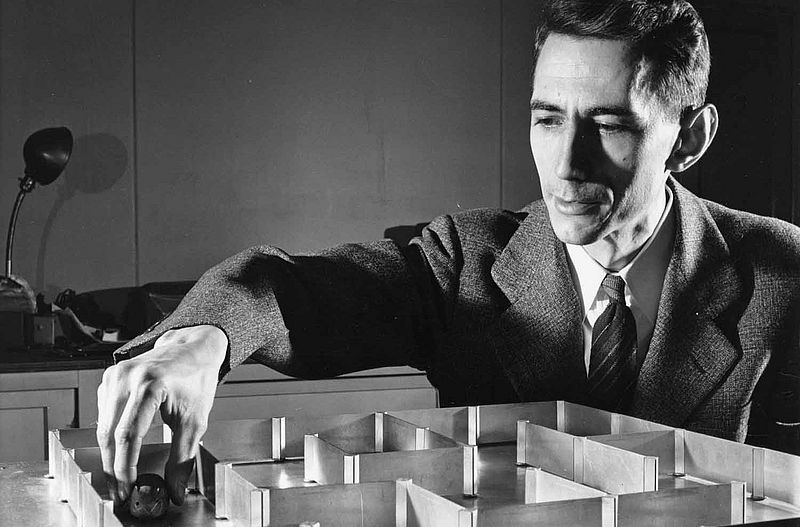
He rode a unicycle through the hallways of Bell Labs at night while juggling. He built a chess-playing machine in 1950 that played a primitive form of chess decades before computers were supposed to be capable of it. He built an electronic mouse named "Theseus" that could solve a maze and remember the solution. It was one of the first machines on Earth that learned. He built a flame-throwing trumpet for fun. He had a closet full of unicycles in different sizes. He installed a chairlift across his backyard so his kids could get to the lake faster.
Marvin Minsky, one of the founders of artificial intelligence, said Shannon was the most genuinely playful great scientist he had ever met. Other people approached research with seriousness. Shannon approached it like a kid who had snuck into the toy store after closing time.
Stevens Institute of Technology called him the least known genius of the 20th century.
That title is exactly correct. Most people have heard of Einstein, Turing, von Neumann. Shannon's name barely registers outside engineering departments. Yet without his master's thesis, there is no digital circuit. Without his 1948 paper, there is no internet. Without his framework, there is no measurement of information at all, which means no compression, no error correction, no cryptography, no machine learning.
He died in 2001 at age 84, after years of Alzheimer's disease that took away his ability to recognize the world he had built. Most newspapers ran a small obituary. The world he had given us did not pause.
His thesis is on the MIT archive. His 1948 paper is on the Bell Labs site. Both are free. Both are short. Both are still readable today by anyone willing to spend an evening with them.
The least known genius of the 20th century is one click away from you.
Most people will never open the file.
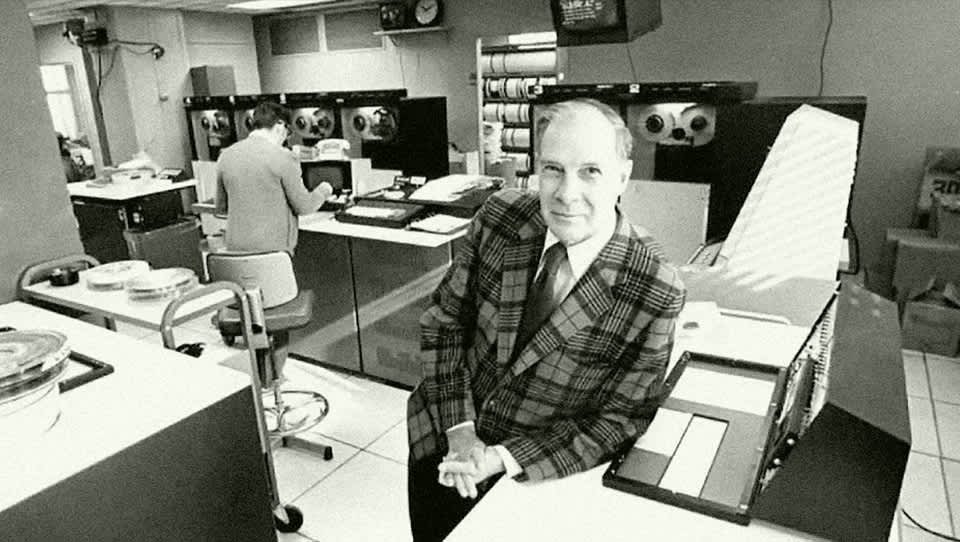
A mathematician who shared an office with Claude Shannon at Bell Labs gave one lecture in 1986 that explains why some people win Nobel Prizes and other equally smart people spend their whole lives doing forgettable work.
His name was Richard Hamming. He won the Turing Award. He invented error-correcting codes that made modern computing possible. And he spent 30 years at Bell Labs sitting in a cafeteria at lunch watching which scientists became legendary and which ones faded into nothing.
In March 1986, he walked into a Bellcore auditorium in front of 200 researchers and told them exactly what he had seen.
Here's the framework that has been quoted by every serious scientist for the last 40 years.
His opening line landed like a punch. He said most scientists he worked with at Bell Labs were just as smart as the Nobel Prize winners. Just as hardworking. Just as credentialed. And yet at the end of a 40-year career, one group had changed entire fields and the other group was forgotten by the time they retired.
He wanted to know what the difference actually was. And he said it wasn't luck. It wasn't IQ. It was a specific set of habits that almost nobody is willing to follow.
The first habit was the one that hurts the most to hear. He said most scientists deliberately avoid the most important problem in their field because the odds of failure are too high. They pick a safe adjacent problem, solve it cleanly, publish it, and move on. And because they never swing at the hard problem, they never hit it. He said if you do not work on an important problem, it is unlikely you will do important work. That is not a motivational line. That is a logical one.
The second habit was about doors. Literal doors. He noticed that the scientists at Bell Labs who kept their office doors closed got more done in the short term because they had no interruptions. But the scientists who kept their doors open got more done over a career. The open-door scientists were interrupted constantly. They also absorbed every new idea passing through the hallway. Ten years in, they were working on problems the closed-door scientists did not even know existed.
The third habit was inversion. When Bell Labs refused to give him the team of programmers he wanted, Hamming sat with the rejection for weeks. Then he flipped the question. Instead of asking for programmers to write the programs, he asked why machines could not write the programs themselves. That single inversion pushed him into the frontier of computer science. He said the pattern repeats everywhere. What looks like a defect, if you flip it correctly, becomes the exact thing that pushes you ahead of everyone else.
The fourth habit was the one that hit me the hardest. He said knowledge and productivity compound like interest. Someone who works 10 percent harder than you does not produce 10 percent more over a career. They produce twice as much. The gap doesn't add. It multiplies. And it compounds silently for years before anyone notices.
He finished the lecture with a line I have never been able to shake.
He said Pasteur's famous quote is right. Luck favors the prepared mind. But he meant it literally. You don't hope for luck. You engineer the conditions where luck can land on you. Open doors. Important problems. Inverted questions. Compounded hours. Those are not traits. Those are choices you make every single day.
The transcript has been sitting on the University of Virginia's computer science website for almost 30 years. The video is free on YouTube. Stripe Press reprinted the full lectures as a book in 2020 and Bret Victor wrote the foreword.
Hamming died in 1998. He gave his final lecture a few weeks before. He was 82.
The lecture that explains why some careers become legendary and others disappear is still free. Most people who could benefit from it will never open it.
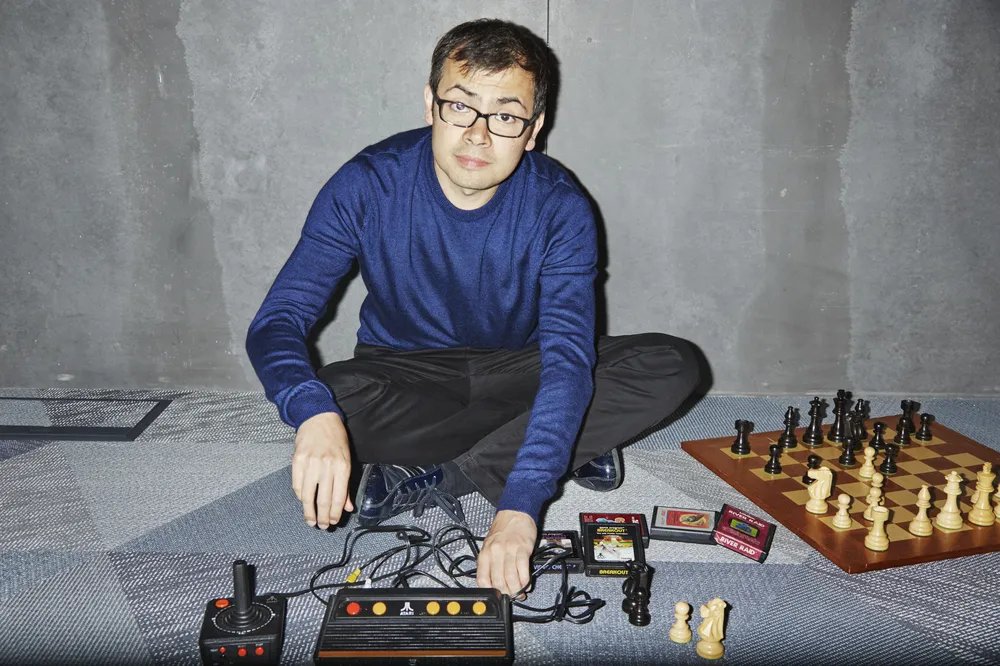
A British kid became a chess master at 13, then a bestselling video game designer at 17, then a PhD neuroscientist at 33, then the CEO of the AI lab that won the 2024 Nobel Prize in Chemistry.
People called him unfocused for twenty years. He was running the most deliberate career plan in modern science.
His name is Demis Hassabis, and the thing almost nobody understood while he was doing it was that every single step was feeding the same underlying obsession.
Here is the thread that connects the whole career, and why it matters for how anyone should think about building toward a hard goal.
The chess came first. He was born in London in 1976 and started playing at age four. By eight, he was the London champion for his age group. By thirteen, he had an international master rating that put him in the top fifty players in the world under his age bracket. He was on a track that would have made him a professional player for the rest of his life.
He walked away.
The reason he gave later, in interview after interview, is the part most people miss. He said chess forced him to think constantly about thinking itself. Every move required him to simulate what his opponent was simulating about him. He became fascinated not with winning the game, but with the process the human brain was running in order to play it. He decided chess was too small a container for the real question he wanted to answer, which was how intelligence actually works.
The video games came next. He used the money he won from chess tournaments to buy a ZX Spectrum. He taught himself to code. By seventeen, he was a lead programmer on a game called Theme Park that sold millions of copies. He could have stayed in that industry and built a career as one of the top game designers in Britain.
He walked away from that too.
He went to Cambridge, did a double first in computer science, and then made the move that looked like the strangest pivot of his life. He enrolled in a PhD in cognitive neuroscience at University College London. He was thirty. His peers from Cambridge were already running companies. He went back to graduate school to study how the human hippocampus builds memories and imagines future scenarios.
His 2007 paper on the link between memory and imagination was named one of the top ten scientific breakthroughs of the year by Science magazine. But the paper was never the point. The point was that he had spent three decades quietly building the exact combination of skills nobody else in the world had put together.
Deep intuition for how intelligent agents behave in complex systems, from a lifetime of chess. Hands-on engineering fluency, from years of shipping commercial software. And a rigorous scientific understanding of how biological brains actually produce cognition, from a PhD in neuroscience.
In 2010, he used that combination to co-found DeepMind with Shane Legg and Mustafa Suleyman. The mission statement he wrote was two sentences long and sounded absurd to most people who heard it. Solve intelligence. Then use it to solve everything else.
For the first six years, DeepMind worked almost entirely on games. Atari. StarCraft. Go. People outside the field could not understand why a lab that claimed to be building artificial general intelligence was spending hundreds of millions of dollars teaching computers to play Pong.
Hassabis kept explaining the reason in interviews and almost nobody was listening. Games were not the goal. Games were a controlled environment where you could iterate on general-purpose learning algorithms fast, measure their progress precisely, and prove to yourself that you had built something that could transfer between domains.
In 2016, AlphaGo beat Lee Sedol, the world champion at Go, in a match that had been considered decades away. And the day after that match ended, Hassabis sat down with his team lead David Silver and asked what they should do next.
The answer was the thing he had been working toward his entire life.
They turned the same deep reinforcement learning approach at a problem biology had been stuck on for fifty years. Protein folding. Given an amino acid sequence, predict the three-dimensional shape the protein would fold into. Every drug discovery effort in the world depended on it. The best computational methods could only solve a small fraction of proteins. Experimental methods took years per structure and millions of dollars per protein.
AlphaFold2 was released in 2020. Within a year, it had predicted the structure of almost every protein known to science. Two hundred million structures. Made freely available to the entire research community. More than two million researchers from a hundred and ninety countries have used it since.
In October 2024, Demis Hassabis and John Jumper were awarded the Nobel Prize in Chemistry for that work.
The line almost nobody quotes from his speeches is the one that explains the whole career. He has said, many times, that he did not build AlphaFold to solve protein folding. He built AlphaFold to prove that the approach he had been developing for thirty years could actually work on a real scientific problem. Protein folding was the demonstration. AGI was always the goal.
The chess taught him how to think about adversarial systems. The games taught him how to ship software. The neuroscience taught him how the only existing example of general intelligence actually worked. DeepMind used all three to build a method that could transfer between domains the way the human brain does. And the moment the method was ready, he pointed it at the single most important unsolved problem he could find in a domain where a breakthrough would save millions of lives.
Most people looking at his career from the outside, at any point before 2016, would have called it scattered. A chess prodigy who gave up chess. A video game designer who walked away from a gaming career. A computer scientist who detoured through neuroscience. A startup founder who burned six years on board games.
From the inside, it was the most focused career in modern science. Every step was quietly answering the same question. How does intelligence actually work, and what would it take to build one that could solve problems humans have not been able to solve alone.
The people who change a field are almost never the ones who looked focused along the way.
They are the ones who were obsessed with a single question so deep and so long that the path they took to answer it looked like chaos from the outside and like a straight line from the inside.
And they almost never get credit for the plan until decades later, when the Nobel Committee calls.
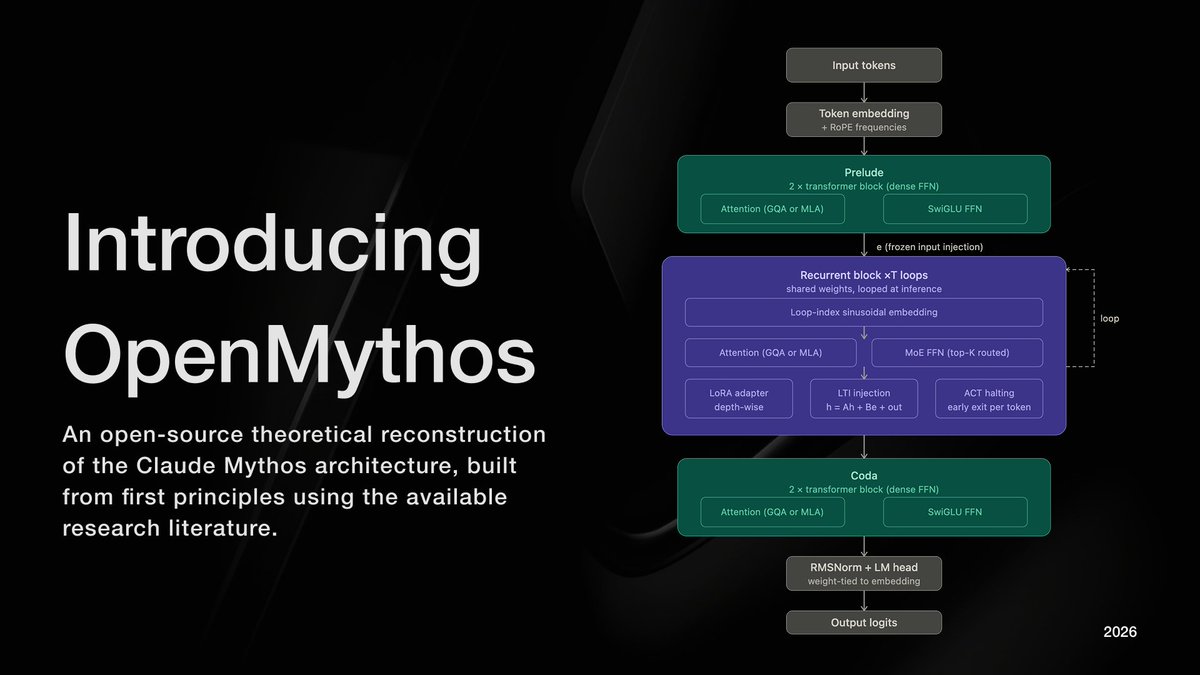
Introducing OpenMythos
An open-source, first-principles theoretical reconstruction of Claude Mythos, implemented in PyTorch.
The architecture instantiates a looped transformer with a Mixture-of-Experts (MoE) routing mechanism, enabling iterative depth via weight sharing and conditional computation across experts.
My implementation explores the hypothesis that recursive application of a fixed parameterized block, coupled with sparse expert activation, can yield improved efficiency–performance tradeoffs and emergent multi-step reasoning.
Learn more ⬇️🧵
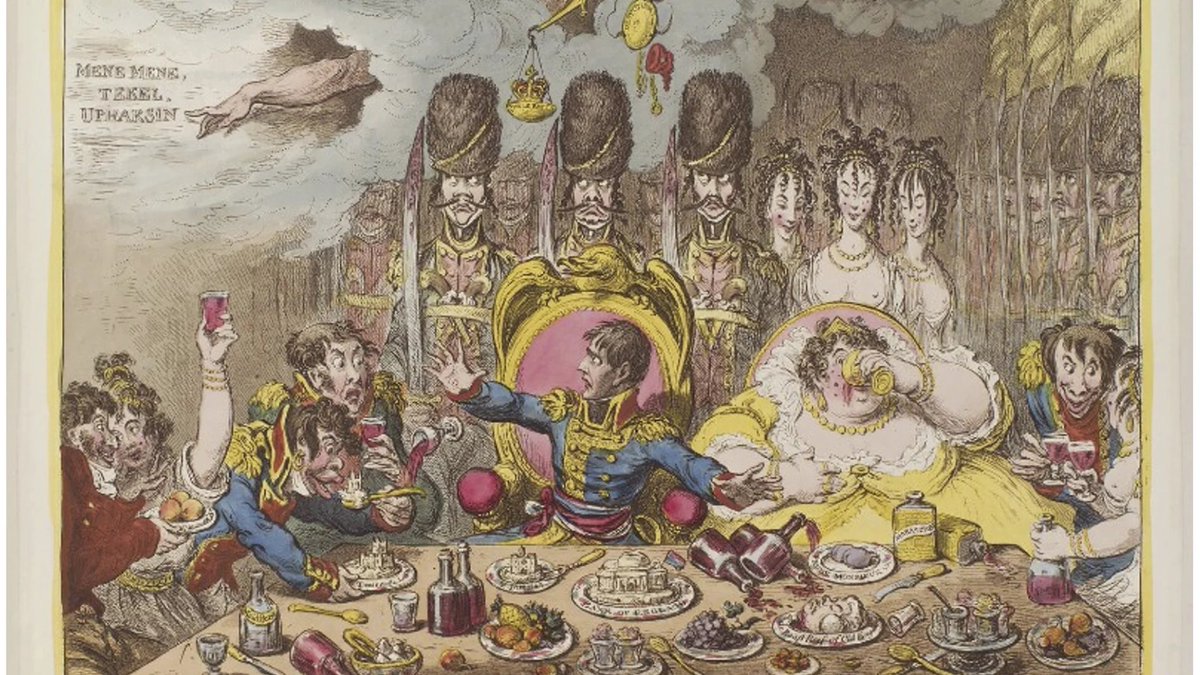
Napoleon understood something modern politicians pretend to ignore: wars cost money, and central banks exist to finance them without the messy business of asking taxpayers directly.
The Banque de France, established in 1800, gave Bonaparte exactly what he needed: a printing press disguised as monetary policy. Within four years, Napoleon granted the bank exclusive note-issuing privileges for Paris, and by 1848, it monopolized currency creation across France.
The pattern never changes: create a central bank, grant it money creation powers, then fund endless military adventures while citizens watch their purchasing power evaporate.
Bonaparte's wars consumed roughly 2.5 billion francs between 1803-1815. Direct taxation would have sparked revolution (again). So the Banque de France simply created money, bought government bonds, and voilà—invisible taxation through inflation. French citizens paid for Austerlitz, Jena, and Waterloo through debased currency, not knowing they funded each cannonball and cavalry charge through their shrinking wages and savings.
The genius of central banking lies in this deception. You can't see inflation the way you see income taxes. When bread costs more, people blame bakers, not bankers. When wages stagnate, they blame employers, not money printers. Napoleon's wars would have ended quickly if he had to knock on doors asking French families to fund another campaign against Austria.
Every central bank since has followed Napoleon's playbook. The Federal Reserve financing Wilson's war, Nixon's Vietnam spending spree, Bush's Iraq adventure.
The technology changes, but the scam remains identical: steal purchasing power gradually, fund government expansion continuously, and convince the public that monetary policy serves their interests rather than the state's appetite for power.
Hi! I'm here with *another launch*, it just happens to be extremely niche, nerdy, and probably only for a handful of people.
In the desktop app, Claude Cowork and Code now have a little Bluetooth API for makers & developers, allowing you to build hardware devices that interact with Claude.
I, for instance, built a little desk pet that alerts me whenever Claude is waiting for permission.
In 1955, a British civil servant noticed a mathematical impossibility inside the Royal Navy.
Between 1914 and 1928, the number of active Navy ships dropped by 67 percent. The number of sailors dropped by 31 percent.
But the number of desk officials managing them? It increased by 78 percent.
He spent years studying this absurdity. What he found is now the silent trap destroying tech careers in the age of AI.
His name was Cyril Northcote Parkinson. He realized that the amount of actual work being done had zero correlation with the number of people doing it. He proved that bureaucracy creates its own internal work just to keep itself busy.
He published a single sentence that changed organizational psychology forever.
"Work expands so as to fill the time available for its completion."
If you have two hours to write a report, it takes two hours. If you have two weeks for the exact same report, it takes two weeks. The brain creates artificial complexity, requests unnecessary meetings, and invents new subtasks to justify the allocated time.
This is not a flaw in human motivation. It is a feature of survival in a corporate structure. Looking busy is historically how you keep your job.
In the modern world, this is the most dangerous vulnerability for anyone working in tech.
AI did not just speed up work. It collapsed the timeline entirely. Tasks that took four days now take four minutes.
Most people handle this completely wrong. They fall straight into the Automation Trap.
You use an AI agent to automate your workflow. You finish a 40 hour sprint in 10 hours. You proudly show your manager exactly how efficient you are. You assume this massive increase in productivity will guarantee a promotion.
Leadership does not see a genius. They see a specific role they can easily eliminate to save budget.
Or worse, Parkinson's Law kicks in. They do not give you a raise. They give you three more projects of equal low-level value to fill your remaining 30 hours. You did not gain leverage. You just increased your output for the exact same pay. You automated your own workflow, and six months later, they realize they do not need you.
Here is how you actually survive the shift.
Stop broadcasting your AI efficiency. If you automate your job, keep the timeline the same. Deliver the work on the original deadline. You protect your baseline income and job security.
Take the hours you just saved and upskill aggressively. Do not use that time to scroll online. Study system architecture. Build new data models. Solve the higher-level business problems that management actually cares about.
Stop attaching your worth to manual execution. Syntax and repetitive tasks are commodities now. Detach your professional identity from the labor that can be automated. Attach it firmly to business results.
Parkinson published his law in 1955. The paper sat in academic literature for decades.
The Navy bureaucracy he studied is long gone.
But the mechanism he discovered is the exact reason why working harder is now a losing strategy.
Every time you optimize a manual task.
Every time you brag about saving your boss three hours.
Every time you ask for more busywork to fill your Friday.
It is the same exact trap.
The secret to tech survival? Stop competing with the machine. Become the director of the system.
🚨In 1990s, Stanford researcher Dr. Robert Sapolsky discovered something that should have broken the internet by now.
He was studying dopamine pathways in primates and found that the brain doesn't just adapt to repeated stimulation. It actively fights back.
When you flood dopamine receptors consistently, the brain deploys what neuroscientists call "opponent processes." For every artificial high you create, your nervous system generates an equal and opposite neurochemical low. Not eventually. Immediately. The system is designed to maintain balance, so it starts producing compounds that directly counteract dopamine while you're still experiencing the dopamine hit.
This means every notification, every scroll, every digital reward doesn't just give you a high followed by a return to baseline. It gives you a high followed by a crash below baseline. You end up in neurochemical debt.
Tech companies never publicized this research. They probably never read it. They were too busy discovering that variable ratio reinforcement schedules could keep users engaged for hours. They built addictive systems by accident, then refined them into addiction machines once they realized what they'd stumbled onto.
Your phone delivers an average of 80 dopamine hits per day. Your ancestors got maybe 5. Each hit triggers opponent processes that create a corresponding low. By the end of a typical day of normal phone usage, your baseline dopamine is running in negative territory. You feel flat, restless, vaguely unsatisfied, and hungry for stimulation because your brain chemistry is literally below zero.
You think you're bored. You're chemically depressed by artificial highs.
The opponent process theory explains why nothing feels interesting anymore. Your brain isn't broken. It's precisely calibrated to maintain neurochemical balance, and you keep throwing that balance off with artificial intensity. Every Instagram hit requires an equal Instagram crash. Every TikTok high gets paid for with a TikTok low. Every notification rush gets balanced with notification emptiness.
Your reward system is running a neurochemical deficit that grows larger every day.
Sapolsky's research revealed something even more disturbing: opponent processes don't just create temporary lows. They become permanent changes to your baseline dopamine production. Chronic overstimulation doesn't just make you tolerant to digital rewards. It makes you insensitive to natural rewards.
The sunset that would have captivated your great-grandfather becomes invisible to you not because sunsets got worse, but because your dopamine system needs intensity levels that sunsets can't provide. A good conversation becomes boring not because conversations got less interesting, but because your brain requires the rapid-fire stimulation of social media to register engagement.
You've accidentally trained your reward system to ignore everything that isn't artificially amplified.
This connects to research from Dr. Anna Lembke at Stanford, who found that people who undergo complete digital fasting for just 30 days show measurable increases in dopamine receptor density. Their brains literally regrow sensitivity to natural rewards. Food tastes better. Music sounds more complex. Social interactions become genuinely engaging again.
But there's a catch that nobody talks about: the first two weeks of dopamine detox feel like clinical depression. Your brain has been chemically dependent on artificial stimulation for years. Removing that stimulation creates actual withdrawal symptoms. Restlessness, anxiety, inability to focus, emotional flatness, and desperate cravings for digital input.
Most people interpret these symptoms as evidence that they need their phones. Actually, they're evidence that they've been neurochemically dependent on their phones without realizing it.
The withdrawal period isn't a bug. It's proof the reset is working.
What happens after week three is remarkable. Colors become more vivid. Conversations become genuinely absorbing. Simple pleasures like hot coffee or cool air become satisfying in ways you forgot were possible. Your brain rediscovers that reality contains enough complexity and beauty to hold your attention without artificial amplification.
You don't need more interesting content. You need more sensitive reward systems.
The solution isn't better apps or more engaging entertainment. The solution is restoring your brain's factory settings for what constitutes a worthwhile experience.
Sapolsky's opponent process research suggests this can happen faster than anyone expected. Every day you don't artificially spike your dopamine, your baseline moves a little higher. Every natural reward you pay attention to rebuilds receptor density. Every moment of boredom you endure without reaching for stimulation strengthens your capacity for sustained focus.
Ancient humans lived in a world that provided exactly the right amount of stimulation to keep their reward systems healthy. Enough challenge to stay engaged, enough calm to stay balanced, enough novelty to stay curious, enough routine to stay stable.
We built a world that provides 10 times too much stimulation and wonder why nothing feels rewarding anymore.
Your brain is not the problem. Your environment is the problem.
Change the environment, and the brain heals itself automatically.
The US government is simultaneously blacklisting Anthropic as a national security threat and summoning Wall Street CEOs to warn them about how powerful Anthropic's technology is. Read that again.
Tuesday: Bessent and Powell pull bank CEOs into Treasury HQ for an emergency meeting. The message: Anthropic built a model called Mythos that found zero-day vulnerabilities in every major operating system and every major web browser. Thousands of them. Including a 27-year-old bug in OpenBSD, a system famous for being unhackable. The model chains multiple exploits together autonomously. It doesn't just find the lock. It picks it, opens the door, and walks through.
Anthropic decided the model was too dangerous to release publicly. First time in seven years an AI company has withheld a model over safety concerns. Instead they gave it to Apple, Microsoft, Google, AWS, JPMorgan, and eight other companies through something called Project Glasswing. $100 million in credits. The goal: patch the bugs before someone else builds something similar and doesn't bother telling anyone.
Here's where it gets surreal. Two days before this meeting, a federal appeals court upheld the Pentagon's designation of Anthropic as a supply chain risk to national security. The same company Treasury is now begging banks to listen to. Pete Hegseth wants Anthropic banned from military work because the company refused to let Claude be used for autonomous weapons. The White House said it "fired Anthropic like dogs."
So the Pentagon says Anthropic is too dangerous to work with. Treasury says Anthropic built something so dangerous that every bank CEO needs to hear about it in person. Both statements are about the same company in the same week.
The model that the government is warning Wall Street about is the model the government won't let the military use. The company being treated as a foreign adversary is the one being asked to secure American financial infrastructure. This is what happens when AI capabilities outrun the government's ability to form a coherent position on who builds them.
This is Algebrica. A mathematical knowledge base I’ve been building for 2.5 years.
215+ entries, carefully written and structured.
400k+ views over this time. Not much in absolute terms, but meaningful to me.
No ads.
No courses to sell.
No gamification.
No distractions.
Just essential pages, aiming to explain mathematics as clearly as possible, for a university-level audience.
Built simply for the pleasure of sharing knowledge.
Content licensed under Creative Commons (BY-NC).
Best experienced on desktop.
If it helps even a few people understand something better, it’s worth it.
Memory bandwidth for local AI hardware matters a lot more than most people think
People keep comparing boxes like this:
model size
vs
memory capacity
That is only half the story
The better mental model is:
> capacity = what fits
> bandwidth = how hard it can breathe
> software stack = how much of that you actually cash out
You are buying a memory subsystem
and then negotiating with physics
Here is the current local AI hardware ladder:
> RTX PRO 6000 Blackwell
> 96GB
> 1792 GB/s
> RTX 5090
> 32GB
> 1792 GB/s
> RTX 4090
> 24GB
> 1008 GB/s
Raw single-card bandwidth king stuff
Now Apple
> Mac Studio M3 Ultra
> up to 512GB unified memory
> 819 GB/s
> Mac Studio M4 Max
> up to 128GB
> 546 GB/s
> MacBook Pro M5 Max
> up to 128GB
> 460 to 614 GB/s
> MacBook Pro M5 Pro
> up to 64GB
> 307 GB/s
> Mac mini M4 Pro
> up to 64GB
> 273 GB/s
> MacBook Air M5
> up to 32GB
> 153 GB/s
Apple is not winning raw bandwidth vs top NVIDIA
Apple is winning the:
> “I want one quiet box with a stupid amount of usable memory”
argument
And that is still a very real argument
Now another interesting new category
> DGX Spark
> 128GB unified memory
> 273 GB/s
> GB10 class boxes like ASUS Ascent GX10
> 128GB unified memory
> 273 GB/s
These are not bandwidth monsters
They are coherent-memory NVIDIA CUDA appliances
That matters
Because 128GB in one box changes what fits locally, even if it does not magically outrun a 5090 once the same model fits on both + CUDA
Then there is the one category that actually made x86 interesting again for local AI:
> Ryzen AI Max / Strix Halo
> up to 128GB unified memory
> 256 GB/s
> up to 96GB assignable to GPU on Windows
This is also where the Framework Desktop matters
Not “just another mini PC”
This is one of the first mainstream x86 boxes where local AI starts feeling like a serious hardware class instead of a laptop pretending very hard
Then the trap people keep falling into:
Most “AI PCs” are not in this tier
They are down here:
> Snapdragon X Elite
> 135 GB/s
> Intel Lunar Lake
> 136 GB/s
> Snapdragon X2 Elite
> 152 to 228 GB/s depending on SKU
> regular Ryzen AI 300 class
way closer to thin-and-light territory than Strix Halo
These are fine machines
But the AI sticker does not create memory bandwidth
Physics is still in charge
which is rude
but consistent
AMD discrete cards
> RX 7900 XTX
> 24GB
> 960 GB/s
> Radeon PRO W7900
> 48GB
> 864 GB/s
> Radeon AI PRO R9700
> 32GB
> 640 GB/s
Not the CUDA default answer
but definitely not irrelevant
Intel is interesting now too
> Arc Pro B65
> 32GB
> 608 GB/s
> Arc Pro B60
> 24GB
> 456 GB/s
And then there is Tenstorrent
> Tenstorrent Wormhole n300
> 24GB
> 576 GB/s
> Tenstorrent Blackhole p150
> 32GB
> 512 GB/s
Not mainstream but absolutely relevant if you care about alternative and opensource local AI stacks
So what does all of this actually mean?
It means the local AI market is really five different markets wearing the same buzzword
> fastest raw speed when it fits
discrete NVIDIA
> biggest one-box memory story
Apple Ultra
> coherent NVIDIA appliance
DGX Spark / GB10
> first x86 unified-memory contender
Strix Halo / Ryzen AI Max
> oss stack
Tenstorrent
That is why people keep talking past each other
A 5090 can absolutely embarrass a lot of unified-memory boxes
if the model fits
A Mac Studio M3 Ultra can fit things a 5090 cannot dream of fitting in one card
A DGX Spark is interesting because it is compact coherent NVIDIA with 128GB & 273 GB/s + CUDA
A Strix Halo box is interesting because it finally gives x86 a real answer to
“what if I want big local models in one machine without going full workstation GPU?”
Now
Stop asking:
> which box is best?
Start asking:
> what must fit?
> what bandwidth tier do I need?
> what software stack do I trust?
> which bottleneck am I buying?
That is how you stop guessing
That is how you actually design a local AI system
And yes
most people still need to Buy a GPU
@NirDiamantAI Peter Steinberger told me that he wants PR to be "prompt request". His agents are perfectly capable of implementing most ideas, so there is no need to take your idea, expand it into a vibe coded mess using free tier ChatGPT and send that as a PR, which is now most PRs.