RTs not endorsements. Followed by @colonelprasad @piyushgoyaloffc Proud Hindu & Bhakt Foul lang blocked Congies/Commies/AAPtards stay away. No DM tweets in ♥
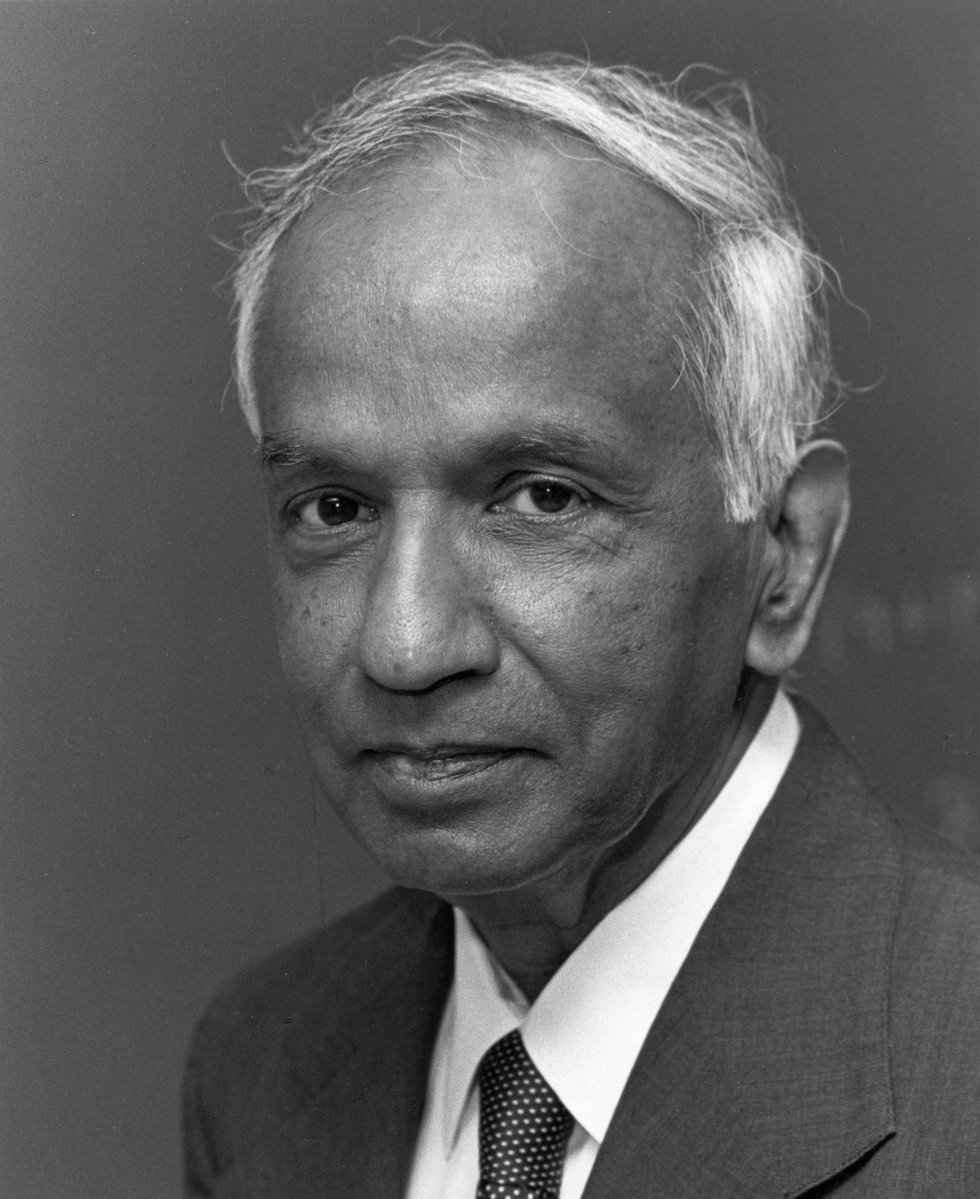
His name was Subrahmanyan Chandrasekhar.
In 1930, he was 19 years old. A boy from Madras is boarding a ship to England on a scholarship to Cambridge.
During that sea voyage, he opened his notebook and started calculating.
By the time the ship docked in Southampton, he had worked out something no one in the history of science had understood before.
Stars do not simply fade and die. Stars above a certain mass collapse into themselves with such force that nothing can stop them. Not light. Not time. Not physics as anyone understood it.
What he had discovered on that ship would eventually be called black holes.
He arrived at Cambridge. He spent four years refining his calculations. He showed them to Arthur Eddington. The most famous astronomer in the world at that time. The man who had proven Einstein right.
Eddington watched his progress. Encouraged him. Asked him to present his findings at the Royal Astronomical Society in January 1935.
Then Eddington gave his own presentation immediately after.
He publicly ridiculed Chandrasekhar in front of the entire scientific establishment. He said the theory had no physical meaning. He called it absurd. He used his enormous reputation to crush a 24-year-old Indian student in front of everyone who mattered.
Chandrasekhar left that conference devastated.
He appealed to the president of the International Astronomical Union. He was told not to respond to Eddington publicly.
He left England.
He went to America. To the University of Chicago. He drove 150 miles every week to teach a class of just two students. Those two students were Tsung-Dao Lee and Chen-Ning Yang.
Both of them won the Nobel Prize before he did.
He spent 50 years working quietly. He never stopped.
In 1983, the Nobel Committee called.
53 years after he worked out the existence of black holes on a ship as a teenager, the Nobel Prize in Physics was his.
NASA later named its most powerful X-ray telescope after him.
The Chandra X-Ray Observatory.
The universe he described is real. Eddington was wrong. The boy on the boat was right.
Most Indians have never heard his name.
They should say it every day.
Follow for real stories about Indians who changed the world.
What a cruel irony — 𝐂𝐨𝐧𝐠𝐫𝐞𝐬𝐬 𝐞𝐫𝐚𝐬𝐞𝐝 𝐒𝐚𝐭𝐲𝐚𝐦 𝐒𝐡𝐢𝐯𝐚𝐦 𝐒𝐮𝐧𝐝𝐚𝐫𝐚𝐦 𝐟𝐫𝐨𝐦 𝐧𝐚𝐭𝐢𝐨𝐧𝐚𝐥 𝐭𝐞𝐥𝐞𝐯𝐢𝐬𝐢𝐨𝐧, and now Rahul Gandhi is desperately invoking the same slogan, not out of belief, but to salvage his sinking political career.
First — The very people who shamelessly removed “Satyam Shivam Sundaram” from Doordarshan during the UPA regime in 2013 are today pretending to be its biggest admirers. Pure hypocrisy.
Second — Let it be said loud and clear: Sanatan Dharma belongs to Hindus alone. It is not a costume to be worn for political convenience.
Third — Can anyone honestly explain what Rahul Gandhi’s real faith or conviction is? Or does it change with elections and public optics?
Shashi Tharoor recently called dynastic politics a threat to Indian democracy, a critique that stings Congress amid its reliance on family legacies like the Gandhis. With Bihar's Phase 2 elections looming, where the INDIA bloc backs dynast Tejashwi Yadav as CM face, his remarks appear to undermine party unity. This mirrors Digvijaya Singh's past habit of independent statements that critics say weakened Congress at key moments.
आज कांग्रेसी चमचे चिल्ला रहे हैं कि अफगानिस्तान के विदेश मंत्री के प्रेस कॉन्फ्रेंस में महिला पत्रकारों को क्यों बाहर जाने को कहा गया
इन कांग्रेसी कुत्तों से पूछो कि 2013 में जब तालिबान को कोई मान्यता नहीं मिली थी जबकि यूनाइटेड नेशन और खुद भारत सरकार जब तालिबान को आतंकवादी संगठन घोषित किया था
जब केंद्र में यूपीएस सत्ता में थी तब गोवा में एक सेमिनार में भारत सरकार ने तालिबान के कमांडर सईद जईफ जो मुल्ला उमर का निजी सचिव भी था उसे बुलाया गया था
मजे की बात यह है कि इस समिति में उसी दिन भारत के गृह मंत्री पी चिदंबरम ने भी संबोधित किया
और जब तालिबान कमांडर सईद जईफ संबोधित करने गया था तब संबोधन हाल में बैठी सभी महिलाओं को बाहर निकाल दिया गया था
और संबोधन के पहले जो रेस्ट रूम था उसे रेस्ट रूम में गृह मंत्री चिदंबरम के पीछे तालिबान कमांडर सईद जईफ बैठा था
जबकि 2013 में सईद जईफ इंटरपोल के द्वारा वांटेड आतंकवादी था
यह कांग्रेसी चमचे अपना कुकर्म क्यों भूल जाते हैं भाई ??
Remembering today on his birth anniversary GN Ramachandran, the genius who should have got not one or two but three Nobel prizes - for Collagen; ΦΨ plot; and Tomography. Forget Nobel or Bharatratna, he wasn't even awarded a Padma - any Padma.
A Forgotten Hero of Indian Science.
Corporate Socialism: The Global Blueprint for Monopoly and Privilege
Corporate Socialism describes an economic system where profits are privatized for the elite, while losses and risks are socialized onto taxpayers and ordinary citizens.
Far from the idealized free market, this model, deeply entrenched in the United States and globally, combines monopoly power, cronyism, and state protection to enrich a few at the expense of the many.
It has hollowed out the middle class, stifled innovation, and eroded democracy, creating a global economic order marked by inequality and privilege.
Corporate Socialism did not arise overnight, nor is it a feature unique to the modern financial system. Its intellectual origins can be traced to the early 20th century, with thinkers like King Camp Gillette, who in his 1910 treatise World Corporation proposed a utopian vision of a single global corporation managing all production for the common good.
In Gillette’s world, the elimination of competitive interests would usher in an era of harmony under a “Universal Intelligence” a benevolent technocracy that would meet humanity’s needs efficiently and fairly.
If Gillette dreamed of Corporate Socialism as utopia, it was John D. Rockefeller, J.P. Morgan, and their 19th-century peers who implemented it as ruthless strategy.
Historically, Corporate Socialism’s roots trace to the Gilded Age, when figures like John D. Rockefeller and J.P. Morgan built monopolies through predatory pricing, political influence, and regulatory capture.
Rockefeller’s Standard Oil controlled 90% of U.S. oil refining by 1880, not just through efficiency but by securing secret railroad rebates and weak antitrust enforcement.
Similarly, Morgan’s creation of U.S. Steel in 1901 consolidated market control, shielded by tariffs that raised consumer prices. These monopolists understood that true wealth required eliminating competition and co-opting government, a strategy that became a blueprint for modern Corporate Socialism.
Rockefeller understood a basic truth: true wealth could not be accumulated under the impartial rules of a competitive, laissez-faire system.
As Rockefeller saw it, “The only sure road to the acquisition of massive wealth was monopoly: drive out your competitors, reduce competition, eliminate laissez-faire, and above all get state protection for your industry through compliant politicians and government regulation.”
The most candid admission of how this system worked came from Frederic Clemson Howe, a lawyer, politician, and insider of the era. In his 1906 pamphlet Confessions of a Monopolist, Howe laid bare the mechanics of Corporate Socialism:
“This is the story of something for nothing of making the other fellow pay. This making the other fellow pay, of getting something for nothing, explains the lust for franchises, mining rights, tariff privileges, railway control, tax evasions. All these things mean monopoly, and all monopoly is bottomed on legislation. And monopoly laws are born in corruption.”
In other words, monopoly was not a market outcome it was a political one. Privilege was bought, laws were shaped to secure it, and the public bore the cost.
The 2008 financial crisis epitomized this system. Wall Street’s reckless speculation led to massive bailouts trillions in public funds while ordinary Americans lost homes and jobs. The architects of the crisis faced no consequences, their wealth preserved, illustrating how losses are socialized while profits remain private.
This pattern extends beyond finance to Big Tech, healthcare, defense, and media, where monopolistic firms leverage political influence to secure subsidies, tax breaks, and regulatory leniency, all while costs are borne by the public.
The Trump administration’s so-called Trade Reset is framed as a bold attempt to restore fairness and strength to the American economy, but in reality, it further entrenched the logic of Corporate Socialism.
Central to this reset is the “Big Beautiful Bill” which gives a package of sweeping corporate tax cuts which primarily benefit high-income earners, such as expanded estate tax exemptions and deductions for pass-through businesses, disproportionately favouring the wealthy.
For the middle class, provisions like the increased standard deduction and enhanced child tax credit are temporary, set to expire in 2028, while tax relief for low- and middle-income households, such as no taxes on tips and overtime, is also not permanent.
This structure ensures long-term benefits for the rich, while middle-class tax cuts face expiration, potentially leading to higher taxes for these households after 2028.
The One Big Beautiful Bill Act’s Medicaid cuts, estimated at $793 billion to $1 trillion over 10 years, will likely reduce federal funding by 12-16%, leading to 7.8-11.8 million people losing coverage.
While sold as a pro-growth measure, the Congressional Budget Office (CBO) estimated that the Big Beautiful Bill would add nearly $3.3 trillion to the federal debt deepening the USA’s fiscal vulnerabilities.
To mask the structural weaknesses this created, the strategy evolved into inflating its way through debt: allowing rising prices and asset bubbles to erode the real burden of debt as a share of GDP. Yet this gamble will entail at a steep cost to the American middle class.
While inflation might shrink debt ratios on paper, it also erodes the purchasing power of ordinary families, making necessities like food, housing, and healthcare more expensive.
Meanwhile, asset bubbles driven by cheap money and financial engineering primarily benefit the wealthy, who can shift their wealth into global safe havens when the bust inevitably comes.
In this way, Trump’s Trade Reset and tax cuts might unleash yet another chapter in the long history of Corporate Socialism: profits privatized, losses socialized, and the middle class left holding the bag.
The corrosive effects of Corporate Socialism extend beyond economics. As Frederic Howe warned, “Privilege gives birth to corruption, just as the poisonous sewer breeds disease.”
When wealth is concentrated, political power follows. Laws are written to serve monopoly, not the people. The press, education, and even philanthropy become instruments for protecting privilege. Democracy itself is hollowed out, replaced by a system in which government serves monopoly, not citizenry.
Globally, Corporate Socialism manifests similarly. In Russia, oligarchs amassed wealth through state-backed privatizations, protected during crises like 1998. In China, billionaires thrive under Communist Party oversight, with the state absorbing risks for key firms.
In Europe, bailouts during the Eurozone crisis prioritized banks over public welfare. Across these systems, the state shields private power, creating a global template where monopoly and privilege dominate.
The truth is that Corporate Socialism has become the hidden operating system of the global economy, regardless of whether a nation claims to be capitalist, socialist, or mixed-economy.
It is a model where the state serves to protect entrenched private power, shifting costs and risks onto society, and concentrating wealth and influence in the hands of the few a global order where monopoly and privilege, not competition and fairness, define economic outcomes.
In a good work from Indian Intel, they have publicly exposed that US based think tank of IRI is the major source of coordinating with domestic state consultants in instigating youths for a revolution and regime change operations. A complete report is there on Bangladesh and Nepal
The Coming Energy Crunch: AI & Data Centers Insatiable Power Demand
Artificial Intelligence is reshaping not only industries but the global energy landscape itself. As algorithms get smarter, the machines powering them get hungrier. Data centers the digital factories of the AI age are rapidly becoming one of the world’s largest electricity consumers. Once niche infrastructure, these high-density computational hubs now rival heavy industry in energy intensity.
In the United States alone, data centers currently consume about 3.5% of total electricity, but that share is projected to soar to 8.6% by 2035, outpacing electric vehicles, hydrogen, and other emerging technologies combined.
Globally, AI-driven data centers are set to consume 1,600 terawatt-hours (TWh) annually by 2035 roughly 4.4% of total global electricity, nearly four times today’s level. If counted as a nation, the AI sector would rank fourth in the world for electricity use, just behind China, the U.S., and India.
This new generation of AI data centers differs sharply from traditional ones. They require massive computing clusters, dense cooling systems, and uninterrupted high-voltage supply lines. Each hyperscale facility can demand as much power as a mid-sized city.
The concentration of ownership among tech giants like Microsoft, Google, Amazon, and Nvidia amplifies both their market power and their strain on local grids. Across major U.S. regions from Virginia’s “Data Center Alley” to Texas and Arizona utilities are struggling to meet rising power requests.
In several markets, data center demand is growing five times faster than that of electric vehicles, underscoring how AI not transportation is now the main driver of the next global energy expansion.
Yet, this digital surge collides with the physical limits of power infrastructure. AI growth will soon be constrained not by computing chips, but by electrons. Energy has become the new bottleneck in the AI race.
The global map of this transformation is uneven. China, India, and the European Union will all need vast power upgrades to support their AI ambitions. China’s AI and cloud data centers are expected to require more than 400 TWh of electricity annually by 2035 equivalent to the total consumption of the United Kingdom.
India, meanwhile, with its booming digital economy and low-cost solar expansion, could see its AI data center demand reach 120 TWh, making it one of the fastest-growing markets. India will need massive push towards Green energy to free up grids to power Data Centers & AI Modules on enterprise scale.
The European Union may add another 250 TWh, but its energy security remains fragile due to the prolonged Ukraine conflict and the sharp decline in Russian gas supplies.
China and India are better positioned to handle this surge. Both nations are leading the world in renewables deployment China now installs over 200 gigawatts of solar and wind capacity per year, while India is adding 15–20 GW annually, with plans to reach 500 GW of renewable capacity by 2030.
These clean energy expansions give them a structural edge in powering AI infrastructure sustainably. By contrast, the U.S. remains heavily reliant on natural gas, oil & now under Trump Administration is looking back to 19th Century ideas of Coal powered Data Centers. While Europe faces chronic power shortages and volatile prices.
In essence, the AI revolution is not only a race for algorithms but a contest for energy sovereignty. The countries that secure abundant, affordable, and clean electricity will dominate the next decade of technological supremacy
You know India-US relations are in the dumps, and cannot be salvaged by diplomats, industrialists, or bureaucrats, when Bengalis start making effigies of the incumbent POTUS as demon in their Durga pandals.
@DanielBordmanOG You are definitely ignorant. I had expected you to have a lot more understanding of what deep state did from Arab spring to orange revolution in Ukraine to CAA, farmers agitation, Khalistan agitation, intolerance movement and many more in India. Which world you’re living in 🙄
Thanks to Times Now for having me on to discuss Trump’s tariffs war on India and the extreme laziness, incompetence and stupidity of Peter Navarro’s comments.
Can Marco Rubio put Humpty Dumpty back together again?