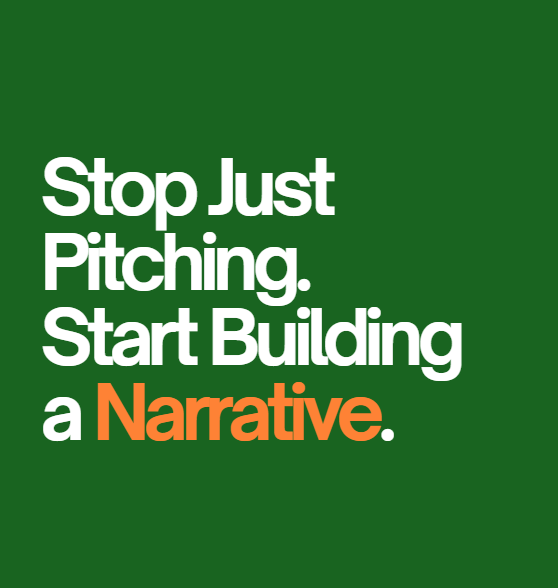
The first time I heard "narrative" in the context of pitching, I thought: Is this not just… another word for pitch? Something a consultant invented to charge more.
Turns out there's a real difference. And most founders never figure it out. 🧵
Our founders love working with us, and if introductions were the only measure of value, we’ve delivered hundreds of them.
But over time, I’ve realized there’s a difference between doing things for founders and teaching founders how to do them themselves.
Some of our proudest moments haven’t been making in just making the intro. They’ve been sitting alongside founders to craft outreach, identify customers, refine messaging, build fundraising strategy, and develop the skills that continue paying dividends long after a single introduction.
We’ve invested in nearly 100 companies, and more than 75% have gone on to raise follow-on rounds from top-tier VCs. Our goal isn’t just to help founders get a meeting it’s to help them become exceptional at fundraising, sales, & company building.
If you’re raising your first round and want a true partner in the trenches, we’d love to help. We just invested in one of our repeat founders again. Real testimony of our value add. DM us if you are raising your first capital!
Stop thinking of your pitch deck as a document.
It's something that should make a reader want to act...and that only comes from a strong narrative.
If this resonated, drop a reply or DM me. Happy to help you sharpen your narrative
The first time I heard "narrative" in the context of pitching, I thought: Is this not just… another word for pitch? Something a consultant invented to charge more.
Turns out there's a real difference. And most founders never figure it out. 🧵
A narrative outlasts the meeting.
A pitch gets forgotten when the meeting ends.
A narrative is what the investor retells to their partners. What the employee repeats when explaining why they joined. What the consumer says when someone asks why they buy from you.
@janwhyy Curious to know what you said next. Did you take a market by usage or e-commerce shopping behaviour?
Always a challenge to prove market at early stage
@janwhyy As an ex founder I can say with experience that this will flip once you hit PMF. Things will move fast and you will have to slow things down atleast mentally to make sure your achieving big picture. Startups are great that way because they keep making you go against the grain
I think that many startups still do not understand the acquisition or conversion layer to social media, and it's still just posting for a lot of people.
There's no place that organizes people into one central place right now as social media does. The people you're trying to reach are already there, scrolling, looking for content.
Your job is to figure out: how do I create content that grabs their attention and then plug in my solution?
This is where experimenting with content formats comes into play.
I've seen startups try very interesting, innovative ways.
Cluley does Office-style skits. Very humorous, very comic. People laugh, and it gets millions of views on Instagram Reels. That's one example.
But you don’t have to copy their format.
It's about understanding - what kind of content do people actually want to see? How do we present our ideas in a way that's engaging, relevant, interesting, but also shows our solution?
In practice, that can mean educational content that naturally leads to your product.
If you're building a project management tool, you can create content about "3 ways teams lose track of deadlines" - and at the end, show how your tool prevents that.
The content is valuable on its own, but it also shows your solution.
2. Behind-the-scenes content that builds trust;
Show how you're building. Show your team. Show your process. Notion does this really well. They show how their team uses Notion, they share templates, and they make you feel part of the journey. By the time you need a productivity tool, you already trust it.
3. User content and case studies:
Get your users to show how they're using your product. Repost and amplify it. Use it to build social proof at scale. When people see others like them getting results, conversion becomes a bit easier.
4. Experiment with content formats that entertain while they educate so people actually watch and share.
The key thing with a social-led acquisition strategy is that every piece of content should have a purpose.
It's not "let's post something today," but "What are we trying to achieve with this post?"
Are we building awareness? Are we educating? Are we converting? Are we building trust?
And your content strategy should map to where people are in their journey.
You need a social strategy that understands that social media is not just a place to post. It's a place to acquire and convert users if you use it right. Enough of the 'happy new week' graphic design posts.
#startupmumbai Founders highly recommend you reach out to Shruti even if you are thinking of starting something. One of the most practical investors I’ve worked with.
In Bangalore/Mumbai, starting a new company that we should invest in? We invest $250k-$2m at inception. We value your time & decide within days. Looking for - vertical AI, security, energy, health & everything in between!
Last investment was in AI security last week! DM us!
Claude Cowork just KILLED manual outreach.
I used to grind for hours on LinkedIn.
Now? My AI stack does it better.
- No "Hey {{first_name}}" spam
- Natural, multi-step conversations
- 12+ hours saved this week
The result: 500+ conversations with human-level reply rates.
I packaged the entire system (prompts + workflow) into a FREE doc.
Want it?
Repost (so others see it)
Comment "CLAUDE" & I'll DM you.